Le café du Vietnam affirme sa position sur le marché mondial

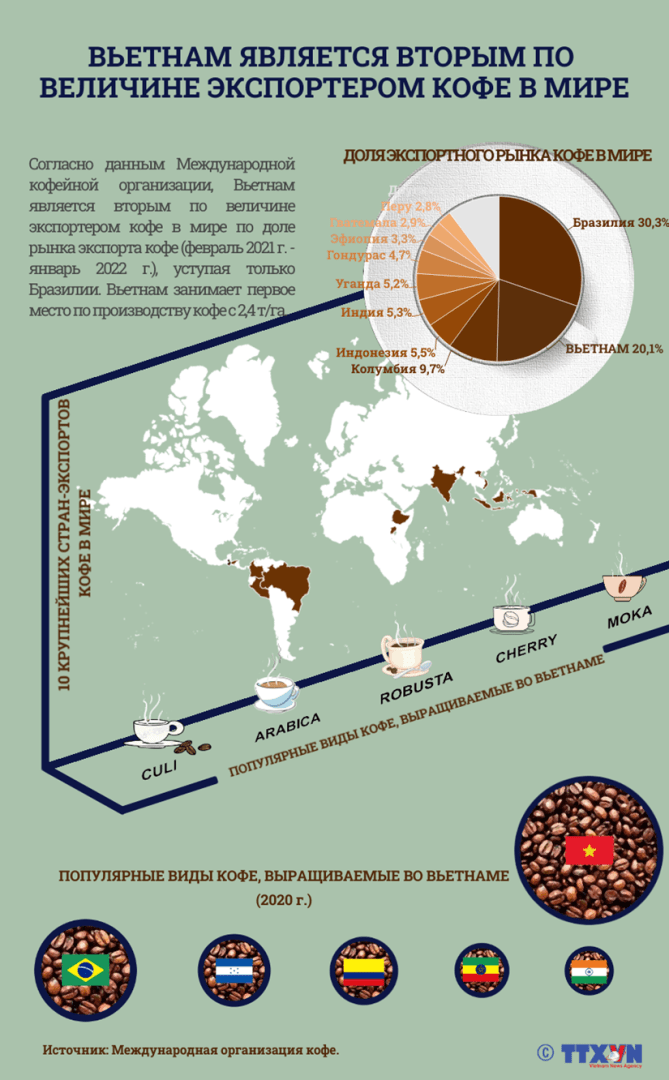
Introduit au Vietnam au milieu du XIXe siècle, jusqu’à présent, le caféier est devenu une principale culture industrielle du Vietnam. Les grains de café apportent une valeur économique élevée et constituent l’une des principaux produits d’exportation du pays. En particulier, le Vietnam est le plus grand producteur mondial de Robusta et le deuxième plus grand exportateur de café. En 2022, les exportations nationales de café ont atteint un record d’environ de quatre milliards de dollars, en hausse de 32% en glissement annuel.

  • Le processus de culture du café du Vietnam

En 1857, les Français introduisirent le café au Vietnam lors de sa conquête coloniale. Cependant, ce n’était en 1914 que les Français choisirent Buon Ma Thuot comme lieu pour se spécialiser dans la culture du caféier Robusta sur la base des recherches pédoclimatiques…En 1922, la terre de basalte rouge de Dak Lak a été recouverte d’une couleur verte des caféières gérées par les Français. A cette époque, le café récolté a été amené essentiellement en France de sorte que la culture du café au Vietnam n’a été pas encore façonnée.

Le Vietnam est actuellement le plus grand producteur mondial du Robusta et le deuxième exportateur de café au monde.

Après la réussite de la longue lutte du peuple vietnamien contre la colonisation française en 1954, la culture du café au Vietnam s’est progressivement formée. Les cafetiers sont devenus des lieux où les gens se rencontrent et même discutent des affaires commerciales. Après 1975, le café a été transporté au Nord, devenant un élément essentiel de la vie quotidienne, apportant de la fraîcheur dans des villes de plus en plus animées.

Dès 1986, le pays est entré dans la phase d’ouverture, participant à la mondialisation pour favoriser le développement socio-économique du pays. Le gouvernement a concentré les ressources dans le développement les caféières dans les Hauts Plateaux du Centre, le littoral du Centre et le Sud-Est pour faire du café une industrie clé. De nouvelles politiques favorables et l’augmentation du prix mondial du café ont permis à cette industrie de se développer fortement tant en termes de superficie qu’en termes de production et de valeur des exportations. De grandes zones spécialisées dans la culture de café, ont été établies dans la ville de Buon Ma Thuot et des districts de Cu M’gar, Krong Pak, Krong Nang de la province de Dak Lak.

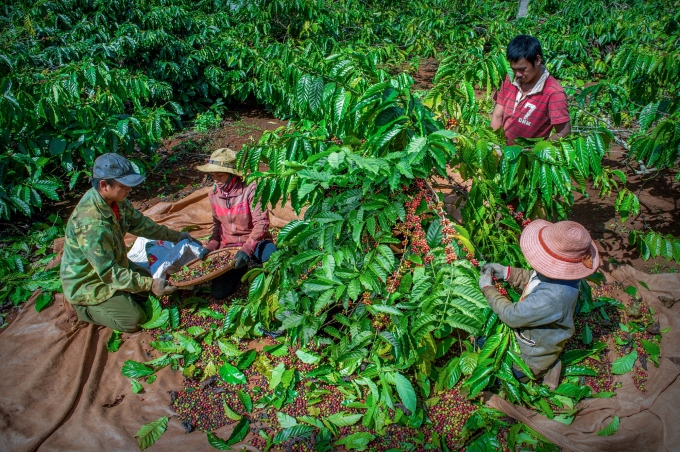
À la fin du XXe siècle, le Vietnam est devenu le premier producteur de café d’Asie du Sud-Est et le deuxième producteur mondial, derrière le Brésil. Le principal produit est le Robusta. La superficie de culture du Robusta représente plus de 90% de la superficie totale du caféier du pays. Dans le processus de rénovation, l’industrie du café s’est fortement développée dans les provinces des Hauts Plateaux du Centre.

Des entreprises privées ont participé à la production et au commerce du café. La coopération entre les agriculteurs, entreprises et État a créé des marques renommées tels que Trung Nguyen (1996) et Highlands Coffee (1998).

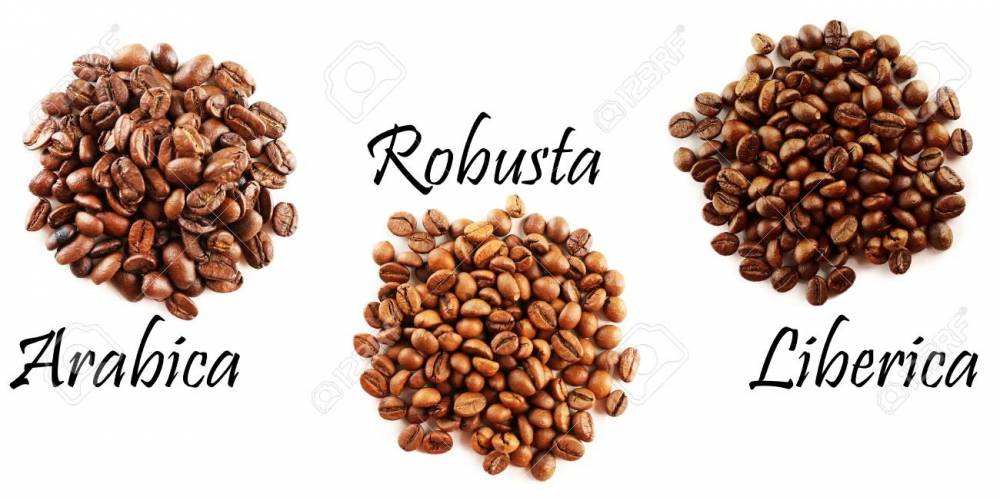
Actuellement, le Vietnam cultive trois principaux types de café : Robusta, Arabica et Libéria. Le Robusta représente 90% de la superficie de caféier du pays, l’Arabica, environ 10% et le Libéria avec un très faible pourcentage.

  • Réaffirmer la position du café du Vietnam

Selon Thai Nhu Hiep, vice-président de l’Association vietnamienne du café et du cacao, le Vietnam est actuellement le plus grand producteur mondial du Robusta et le deuxième exportateur de café au monde, derrière le Brésil.

Actuellement, la superficie totale de caféier du pays est d’environ 710.000 ha dont 650.00 ha de la superficie déjà exploitée qui se concentrées essentiellement dans les cinq provinces des Hauts Plateaux du Centre. A Dak Lak, depuis des décennies, le café s’est imposé comme une culture clé, jouant un rôle important dans le développement socio-économique de la province.

La ville de Buon Ma Thuot dans la province de Dak Lak est connue comme la “capitale du café du Vietnam” avec une superficie de culture d’environ 210.000 hectares avec la production annuelle de plus de 520.000 tonnes, soit plus de 30% de la production nationale.

Le café est également une culture clé de Lam Dong et représente un grand part de la valeur totale de la production agricole et des exportations provinciales. A ce jour, la province compte plus de 175.000 hectares de caféier avec le rendement annuel d’environ 3,3 tonnes par ha. La zone caféière de Dak Nong représente également 23% de la superficie agricole provinciale et plus de 18% de la superficie agricole nationale, figurant au 3e rang national et dans les Hauts Plateaux du Centre, derrière les provinces de Dak Lak et Lam Dong. Selon des statistiques préliminaires à fin 2022, cette zone est estimée à 140.000 hectares avec un rendement moyen de 2,8 tonnes par ha et la production annuelle de plus de 356.000 tonnes.

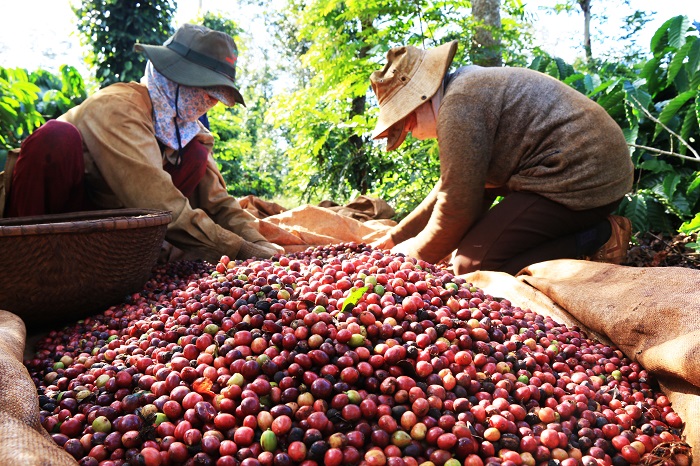
Parallèlement à l’augmentation de la superficie et de la production, le processus d’innovation et d’intégration internationale de l’industrie du café se poursuit, offrant de nombreuses opportunités à de nombreux producteurs nationaux et faire connaître du label de café du Vietnam sur le marché mondial.

En 2022, les exportations nationales de café ont atteint environ 1,72 million de tonnes pour quatre milliards de dollars. Le café du Vietnam présent actuellement dans plus de 80 pays et territoires.

En particulier, la qualité du café Robusta du Vietnam a été reconnue par les principales puissances consommatrices de café. Parmi plus de 80 pays et territoires importateurs de café du Vietnam, une forte croissance a été enregistrée dans des pays qui sont déjà des puissances mondiales du café dont l’Allemagne, la France, le Canada… Récemment, l’Italie – le pays du café avec les plus hautes exigences de qualité – a également augmenté ses importations de café du Vietnam.
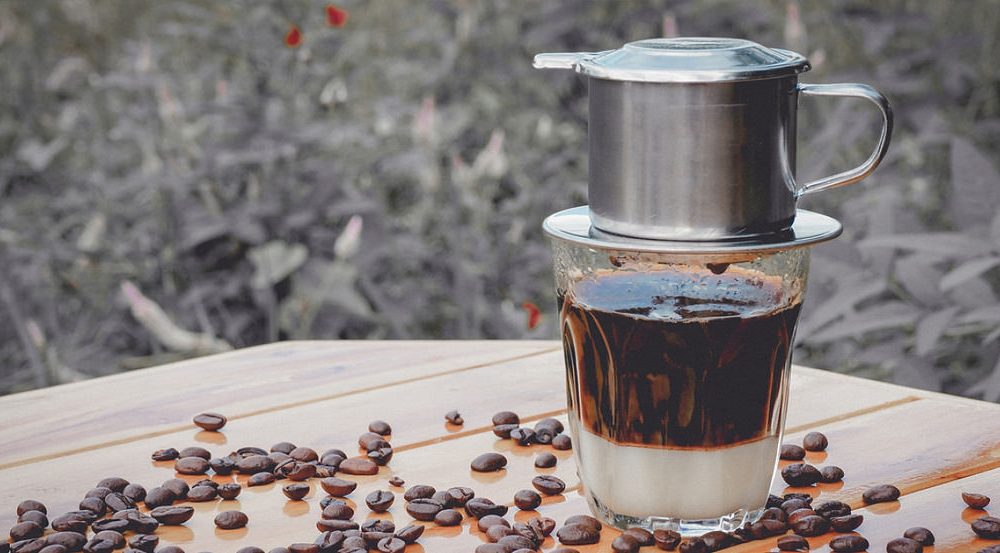
Selon les médias mondiaux, le café du Vietnam devient de plus en plus populaire. Il est continuellement loué par de nombreux journaux et magazines prestigieux. Notamment, le café filtré et le café au lait concentré sont bien appréciés par des politiciens, chefs d’État et célébrités étrangers.

Outre des valeurs économiques, le café du Vietnam revêt également une signification culturelle. Le projet « Ville du café », d’une superficie de 45,45 hectares et lancé à partir de janvier 2017, s’est progressivement manifesté conformément à la vision de devenir une zone urbaine au cœur des Hauts Plateaux du Centre, contribuant à faire de Buon Ma Thuot une ville de café du monde.

De plus, Le Musée mondial du café (The World Coffee Museum) – une œuvre symbolique de l’industrie du café au Vietnam et de ses contributions à l’industrie mondiale du café – est devenu un centre culturel et communautaire de Dak Lak.  C’est aussi le plus grand, le plus vivant et unique de ce genre, selon l’agence de presse américaine AP, préservant plus de 11.000 objets de trois civilisations typiques du café, datant de plusieurs siècles. Jusqu’à présent, le Musée mondial du café a accueilli environ quatre millions de visiteurs d’une vingtaine de pays, contribuant à l’augmentation des revenus de l’industrie du tourisme dans la province de Dak Lak… ./.
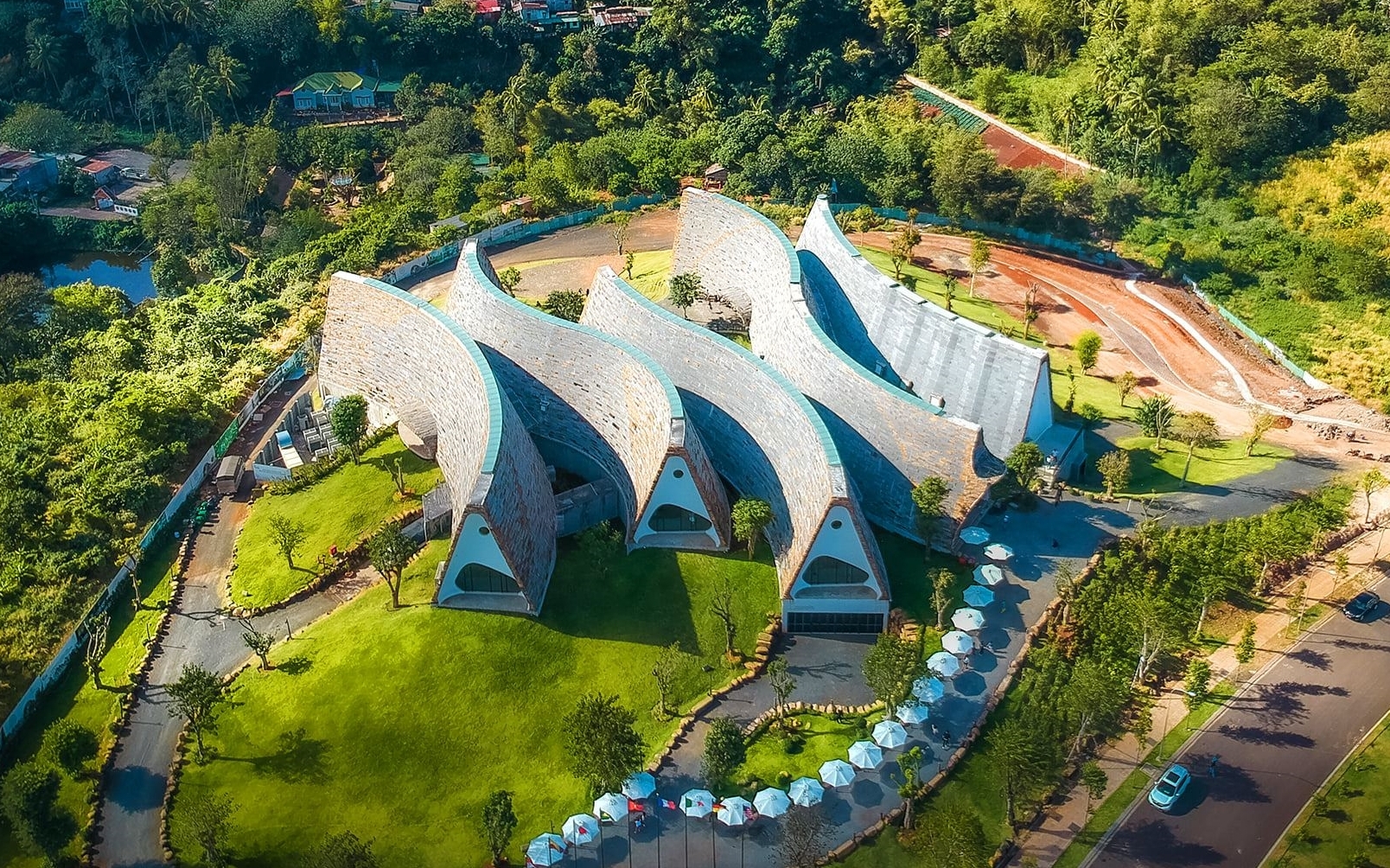
Le Musée mondial du café – une œuvre symbolique de l’industrie du café au Vietnam et de ses contributions à l’industrie mondiale du café – est devenu un centre culturel et communautaire de Dak Lak.

Вьетнамский кофе подтверждает свою позицию на кофейной карте мира

Завезенный во Вьетнам в середине XIX века, по сей день кофе уже стал основной промышленной культурой Вьетнама. Кофейные зерна приносят высокую экономическую ценность, являясь одним из главных экспортных товаров страны. Кроме того, Вьетнам является крупнейшим в мире производителем кофе робуста и вторым по величине экспортером кофе. В 2022 году экспортный оборот находился на рекордно высоком уровне, достигнув около 4 млрд. долл. США, что на 32% больше, чем в предыдущем году.

  • Процесс распространения кофе во Вьетнаме

В 1857 году французы привезли кофе во Вьетнам во время колониального завоевания, однако только в 1914 году они выбрали Буонматхуот для специализации на выращивании кофейных деревьев сорта робуста на основе тщательного исследования почвы, климата, высоты над уровнем моря… В 1922 году красная базальтовая земля Даклак быстро покрылась обширной зеленью с кофейными фермами, которыми управляли французы. В это время собранный кофе, в основном, везли во Францию, поэтому кофейная культура Вьетнама пока не сформировалась.

После того, как длительная война сопротивления французским колонизаторам увенчалась большим успехом (1954 г.) во Вьетнаме постепенно начала формироваться кофейная культура. Кофейни стали местами социальной жизни, информационными центрами, точками коммерческих транзакций… После 1975 года кофе был завезен на север Вьетнама и стал общенациональной чертой повседневной жизни, привнося свежесть в города, которые все больше оживлялись рыночной жизнью.

Вьетнам – самый крупный производитель кофе сорта Робуста в мире и второй экспортер кофе.

В 1986 году Вьетнам вступил в стадию открытости, участия в глобализации для содействия социально-экономическому развитию страны. Чтобы сориентировать развитие производства кофе в фермерских домохозяйствах в провинциях Центрального нагорья, Центрального побережья и Юго-Восточного региона, правительство сосредоточило инвестиционные ресурсы в кофейном секторе, целью которого стало превращение кофе в важный сельскохозяйственный сектор. Кроме того, была запущена новая политика одновременно с ростом цен на кофе в мире, что помогло кофейной промышленности Вьетнама активно развиваться с точки зрения посевных площадей, объема производства и стоимости экспорта. В провинции Даклак сформировалась большая концентрированная площадь для специализированного выращивания кофе в городе Буонматхуот, в уездах Кы М’гар, Кронг Пак, Кронг Нанг и соседних уездах.

В конце XX века Вьетнам стал ведущей страной-производителем кофе в Юго-Восточной Азии и занял второе место в мире после Бразилии. Основной продукт страны – кофе робуста. Площадь, засаженная робустой, составила более 90% от общей площади кофейных плантаций. Во время политики обновления (Доймой) кофейная промышленность получила сильное развитие в провинциях Центрального нагорья.

Наряду с этим, частные предприятия также занялись производством и бизнесом, связанным с кофе. Сотрудничество между фермерами, бизнесом и государством привело к созданию кофейных брендов на международном уровне. Типичные примеры включают Чунг Нгуен (Trung Nguyen, 1996) и Highlands Coffee (1998).

В настоящее время во Вьетнаме выращивают 3 основных вида кофе: робуста, арабика и либерия. При этом 90% кофейной площади приходится на кофе робусту, за которым следует арабика с примерно 10% и, наконец, либерия с очень небольшой долей.

  • Подтверждать свою позицию на кофейной карте мира

По словам Тхай Ньы Хиепа, вице-председателя Вьетнамской ассоциации кофе и какао, в настоящее время Вьетнам является крупнейшим в мире производителем кофе робуста и вторым по величине экспортером кофе в мире после Бразилии.

В настоящее время общая площадь выращивания кофе в стране в основном сосредоточена в 5 провинциях Центрального нагорья и составляет около 710.000 га; включая площадь для уборки 650.000 га. В провинции Даклак на протяжении десятилетий кофейное дерево считается ключевой культурой, играющей важную роль в социально-экономическом развитии местности.

Город Буонматхуот при провинции Даклак известен как «кофейная столица Вьетнама» с площадью около 210.000 га, годовая урожайность достигает более 520.000 тонн, что составляет более 30% объема производства всей страны.

Кофейное дерево также является основной культурой Ламдонга, и на его долю приходится большая часть общей стоимости сельскохозяйственной продукции и экспортного оборота провинции. В настоящее время в провинции выращивают более 175.000 га кофе, а его урожайность составляет около 3,3 т/га. На кофейную плантацию в Дакнонге приходится 23% площади сельскохозяйственных угодий провинции и более 18% всей страны (третье место в стране и в Центральном нагорье после провинций Даклак и Ламдонг). По предварительным статистическим данным на конец 2022 года общая площадь кофе оценивается в 140.000 га, средняя урожайность – 2,8 т/га, а общий объем производства – более 356.000 т/год.

Наряду с увеличением площадей и объемов производства, дело обновления и международная интеграция продолжает осуществляться, предоставляя множество возможностей для многих предприятий, участвующих в производстве и переработке кофе, представляя миру вьетнамский кофейный бренд.

В 2022 году объем экспорта кофе Вьетнама составил около 1,72 млн. тонн на сумму 4 млрд. долл. США, и он входит в группу ключевых сельскохозяйственных продуктов с экспортным оборотом более 3 млрд. долл. США. Вьетнамский кофе сейчас присутствует в более чем 80 странах и территориях.

Особенно, качество вьетнамского кофе робуста было признано ведущими потребителями кофе в более чем 80 странах и территориях, импортирующих вьетнамское кофе. Кроме того, зафиксирован сильный рост в странах, которые уже являются мировыми кофейными державами, такими как Германия, Франция, Канада… Например, Италия – страна-знаток кофе, родина известных видов кофе, таких как экспрессо, капучино…, имея самые высокие требования к качеству, в последнее время также увеличился импорт кофе из Вьетнама.

В мировых СМИ вьетнамский кофе становится все популярнее. Он постоянно получает почести и похвалы в престижных международных изданиях. Мало того, кофе, приготовленный с использованием уникального вьетнамского фильтра, и кофе со льдом всегда являются напитками, которые международные политики, главы государств, всемирно известные звезды высоко ценят и предпочитают, посещая Вьетнам.

Помимо экономической ценности, вьетнамский кофе также имеет культурное значение. Проект «Кофейного города» площадью 45,45 га, начатый с января 2017 года и по настоящее время, постепенно развивается в соответствии с целью стать основным городом Центрального нагорья, способствуя реализации задачи превращения Буонматхуота в «Кофейный город» мира.

Наряду с этим Всемирный музей кофе – символическое сооружение кофейной индустрии Вьетнама и его вклад в мировую кофейную индустрию – стал культурным и общественным центром Даклака и столицей Центрального нагорья. Это еще и «самый большой, живой и уникальный музей!» (по данным AP), где хранится более 11.000 артефактов трех типичных кофейных цивилизаций, насчитывающих многовековую историю. На сегодняшний день Всемирный музей кофе принял около 4 млн. посетителей из более чем 22 стран, способствуя увеличению доходов туристической индустрии провинции Даклак…/.

Музей “Мир кофе” – символ кофейного сектора Вьетнама и его вклада в мировую кофейную индустрию – стал центром общественной культуры в провинции Даклак и на всем центральном нагорье Вьетнама.

Café de Vietnam confirma su posición en mapa mundial

Introducido en Vietnam a mediados del siglo XIX; hoy día, el café se ha convertido en el principal cultivo industrial de Vietnam. Con alto valor económico, el café constituye uno de los productos exportables claves del país. Vietnam es el mayor productor mundial de la variedad Robusta, en particular, y el segundo mayor exportador de café, en general. En 2022, el ingreso por exportación de café de Vietnam registró un nivel récord al alcanzar alrededor de cuatro mil millones de dólares, un aumento interanual del 32 por ciento.

  • Proceso de desarrollo del cultivo del café en Vietnam

En 1857, los franceses trajeron el café a Vietnam durante la conquista colonial; sin embargo, hasta 1914, eligieron Buon Ma Thuot como lugar para especializarse en el cultivo de cafetos Robusta basándose en una cuidadosa investigación sobre el suelo, el clima y la altitud. Hasta 1922, la tierra de basalto rojo de Dak Lak se cubrió deprisa con un vasto verde con fincas de café administradas por los franceses. En aquel momento, el café cosechado se llevó principalmente a Francia, por lo que la cultura del café de Vietnam no se había formado.

Vietnam es el segundo mayor exportador de café Robusta y ocupa segundo lugar de exportación de café en el mundo.

Después del triunfo de la lucha de resistencia a largo plazo contra los colonialistas franceses en 1954, la cultura del café en el país asiático fue ganando terreno gradualmente. Las cafeterías se convirtieron en lugares de intercambio social, centros de convivencia e información y/o puntos de transacciones comerciales, etc. Después de 1975, el café se introdujo en la región del Norte del país, convirtiéndose en un elemento de la vida cotidiana al llevar la frescura a ciudades cada vez más dinámicas con el ritmo de la vida del mercado.

En 1986, el país entró en una etapa de apertura y buscó participar en la globalización para promover el desarrollo socioeconómico nacional. Con el fin de orientar el desarrollo de la caficultura entre los hogares campesinos de las provincias en la tierra antiplana de Tay Nguyen, la región costera central y de Sureste, el Gobierno de Vietnam decidió centrar recursos de inversión en el sector cafetalero, con el propósito de convertir el cultivo de café en un importante sector agrícola. La aplicación de la nueva política, junto con el aumento de los precios mundiales del café, ayudó a la industria de ese rubro de Vietnam a desarrollarse con fuerza en términos de superficie, producción y valor de exportación. En la provincia de Dak Lak, se han formado grandes áreas de cultivo específico de café en la ciudad de Buon Ma Thuot, Cu M’gar, Krong Pak, Krong Nang y distritos vecinos.

A fines del siglo XX, Vietnam se convirtió en el principal país productor de café en el Sudeste Asiático y ocupó el segundo lugar en el mundo después de Brasil. El producto principal es el café Robusta. El área sembrada con Robusta representa hoy más del 90 por ciento de la superficie total dedicada al cultivo del café. A lo largo del proceso de renovación (Doi Moi), la industria del café se ha desarrollado fuertemente en las provincias de la región altiplana de Tay Nguyen.

Junto con eso, las empresas privadas también se embarcaron en la producción y el negocio del café. La cooperación entre agricultores, empresas y el Estado ha creado marcas internacionales de café, teniendo en cuenta Trung Nguyen (1996) y Highlands Coffee (1998).

Actualmente, Vietnam cultiva tres tipos principales de café: Robusta, Arábica y Liberia. El 90 por ciento del área cafetalera es para café Robusta, seguido del Arábica con cerca del 10 por ciento y el área restante, para Liberia.

  • Confirmar el desempeño

Actualmente, Vietnam deviene el mayor productor mundial de café Robusta y el segundo mayor exportador de café del mundo después de Brasil, según el vicepresidente de la Asociación de Café y Cacao de Vietnam, Thai Nhu Hiep.

La superficie cafetalera total del país alcanza unas 710 mil hectáreas, entre ellas, 650 mil hectáreas corresponden al área de cosecha, que se concentran en cinco provincias de Tay Nguyen. En la provincia de Dak Lak, durante décadas, el café se ha establecido como un cultivo clave que desempeña un papel importante en el desarrollo socioeconómico local.

La ciudad de Buon Ma Thuot, en la provincia de Dak Lak, es conocida como la “capital del café de Vietnam” con un área de aproximadamente 210 mil hectáreas de cultivo y una producción anual que alcanza más de 520 mil toneladas, equivalentes a más del 30 por ciento de la producción nacional.

También, el café es un cultivo clave de Lam Dong y ocupa una gran proporción del valor total de la producción agrícola y el volumen de exportación de la provincia. Actualmente, la localidad cuenta con más de 175 mil hectáreas de café, con un rendimiento de unas 3,3 toneladas por hectárea. Mientras, con unas 140 mil hectáreas, la superficie de cultivo de café de Dak Nong representa el 23 por ciento de la superficie agrícola de la provincia y el 18 por ciento a escala nacional.

Junto con el aumento en el área de cultivo y la producción, el proceso de innovación e integración internacional han generado muchas oportunidades para que empresas nacionales participen en la producción y el procesamiento del café, llevando la marca del café de Vietnam al mundo.

En 2022, la producción de café exportable de Vietnam alcanzó alrededor de 1,72 millones de toneladas con un valor de cuatro mil millones de dólares. Café se encuentra en el grupo de productos agrícolas claves del país indochino con una facturación de exportación de más de tres mil millones de dólares y está presente hoy en más de 80 países y territorios.

En particular, la calidad del café Robusta vietnamita ha sido reconocida por las principales potencias consumidoras de café. Entre más de 80 países y territorios importadores de café de Vietnam, se ha registrado un fuerte crecimiento en los que ya son potencias mundiales del rubro como Alemania, Francia y Canadá. Justo en Italia -hogar de famosas tazas de café como Espresso y Cappuchino, con las más altas exigencias de calidad- también se reportó recientemente un alza en la importación de café de Vietnam.

En los medios mundiales de comunicación, el café vietnamita se está volviendo cada vez más popular; pues es continuamente elogiado en una serie de artículos de la prensa internacional. Además, el café de filtro único y el café con leche y hielo de Vietnam son siempre las bebidas que los políticos internacionales, los jefes de estado y las estrellas de fama mundial elogian y esperan disfrutar cuando visitan este país asiático.

Además de los valores económicos, el café vietnamita también tiene un significado cultural. El proyecto de Ciudad Café en Tay Nguyen con una escala de 45,45 hectáreas, iniciado en enero de 2017, contribuirá a hacer realidad la visión de convertir a Buon Ma Thuot en la Ciudad Cafetera del Mundo.

Junto a esto, el Museo Mundial del Café -una obra simbólica para esa industria de Vietnam- se ha convertido en el centro cultural y comunitario de Tay Nguyen. Se trata de “¡El museo vivo más grande, más animado y único!”- según la agencia de noticias de Estados Unidos AP-, donde se preservan más de 11 mil objetos de tres civilizaciones típicas del café, que datan de muchos siglos. Hasta ahora, el Museo Mundial del Café recibió a unos cuatro millones de visitantes de más de 22 países, lo cual ha contribuido a aumentar los ingresos de la industria del turismo en la provincia de Dak Lak./.
El Museo Mundial del Café -una obra simbólica para esa industria de Vietnam- se ha convertido en el centro cultural y comunitario de Tay Nguyen.

Vietnam y Australia hacia asociación estratégica integral

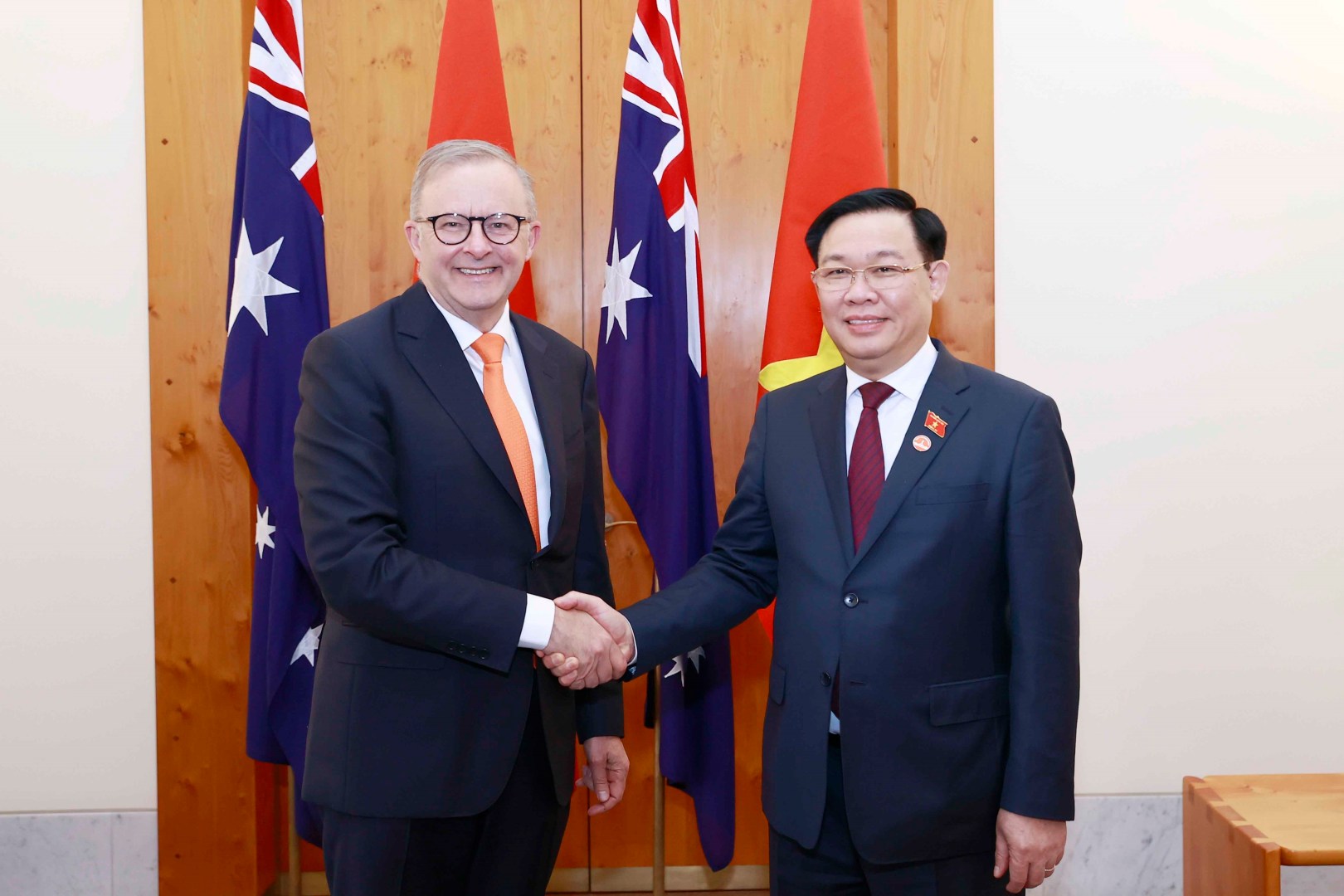
El presidente de la Asamblea Nacional, Vuong Dinh Hue, se reúne con el primer ministro de Australia, Anthony Albanese.

Hace 50 años, el 26 de febrero de 1973, Vietnam y Australia establecieron las relaciones diplomáticas bilaterales. Durante más de medio siglo, sus nexos han experimentado un desarrollo fructífero, brindando beneficios a ambos pueblos.

Desde el establecimiento de los vínculos diplomáticos en 1973, Australia y Vietnam han construido una relación fuerte con intereses diversos y crecientes. Vietnam se considera uno de los socios más importantes del país oceánico. En marzo de 2018, las dos naciones elevaron sus nexos a nivel de asociación estratégica, abriendo una nueva página para las relaciones bilaterales.

El ministro de Relaciones Exteriores Bui Thanh Son asiste y pronuncia un discurso en el acto conmemorativo por 50 aniversario del establecimiento de los vínculos diplomáticos entre Vietnam-Australia.  (Fuente: VNA)

El ministro de Relaciones Exteriores Bui Thanh Son: “Pasando cinco décadas de desarrollo con oportunidad y desafíos entrelazados y en el contexto de los cambios constantes de la situación regional e internacional, ahora Vietnam y Australia se han convertido en socios confiables mutuos en el marco tanto bilateral como multilateral”.

En los últimos años, la cooperación entre las dos naciones se ha ampliado rápidamente en todos los campos, desde la seguridad, defensa, comercio, inversión hasta la educación, turismo e innovación.

“La comunidad de vietnamitas en Australia cuenta con alrededor de 350 mil personas, quienes desempeñan un papel de puente importante e inevitable en el fortalecimiento de las relaciones de amistad y comprensión mutua entre los dos pueblos. Las contribuciones de ese grupo de personas son reconocidas ampliamente en Australia”, dijo el embajador vietnamita en esa nación, Nguyen Tat Thanh.

Australia apoyó activamente a Vietnam en la lucha contra la pandemia de la COVID-19, al donar más de 26,4 millones de dosis de vacunas a los adultos y más de 14,4 millones de dosis a los niños, convirtiéndose en el segundo patrocinador de vacuna del país, por detrás de Estados Unidos.

“Puedo decir con confianza que nunca ha habido un momento en la historia en que las relaciones entre nuestros países hayan sido tan fuertes y desarrolladas como lo son hoy. Los nexos bilaterales se construyen sobre la base de la confianza mutua, así como la cooperación práctica y efectiva en diversos campos”,

Embajador australiano en Vietnam, Andrew Goledzinowski

Los dos países se han convertido en socios comerciales importantes, especialmente después de que los dirigentes acordaron elevar los nexos a nivel de asociación estratégica en marzo de 2018 y aprobaron la Estrategia de fortalecer la cooperación económica Vietnam-Australia en noviembre de 2021.

En particular, mientras Australia se convirtió en uno de los siete socios comerciales más grandes de Vietnam, el país indochino también devino el décimo socio de Australia. Se trata de una de las bases importantes para que ambos países se dirijan hacia el objetivo de establecer la asociación estratégica integral en un momento apropiado.

Según el profesor Carl Thayer, un experto sobre Vietnam que trabaja en la Academia de Defensa de Australia, de la Universidad de Nueva Gales del Sur, las relaciones entre las dos naciones se basan en diferentes pilares, pero el comercio e inversión sigue siendo la primera prioridad.

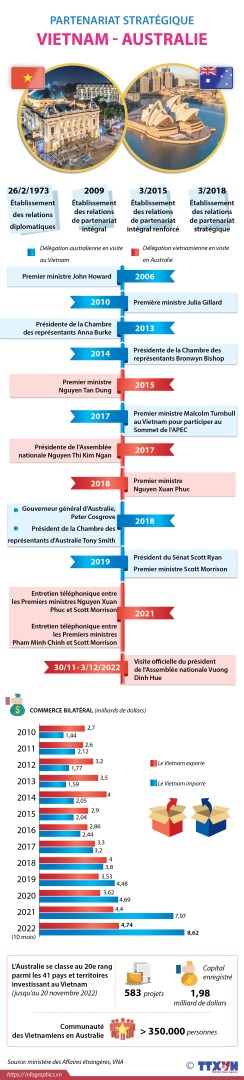
Las estadísticas muestran que el comercio bilateral alcanzó 15,7 mil millones de dólares en 2022, un aumento interanual de 26,9 por ciento; de esta cifra, las exportaciones vietnamitas fueron de 5,6 mil millones de dólares y las importaciones se aproximaron a los 10,1 mil millones.

Además, Vietnam y Australia comparten muchos marcos de cooperación económica, incluido el Tratado Integral y Progresivo de Asociación Transpacífico (CPTPP) que apoya fuertemente los vínculos comerciales e inversionistas entre los dos países.

Hasta finales de 2021, Australia invirtió en unos 550 proyectos en Vietnam con un valor de casi dos mil millones de dólares. Además, el país oceánico se ubicó en el puesto 19 entre las naciones con inversión extranjera directa en Vietnam.

Embajador de Australia en Vietnam, Andrew Goledzinowski

Según el embajador Andrew Goledzinowski, en la visita oficial a Australia del presidente de la Asamblea Nacional, Vuong Dinh Hue, los dirigentes de las dos partes acordaron considerar la posibilidad de elevar sus nexos al nivel de asociación estratégica integral en un momento apropiado. Se espera que la mejora de sus relaciones contribuya a promover la cooperación en muchos campos, como cambio climático, transición energética o alta tecnología.

“Esta es una señal muy positiva. Hasta ahora, solo cuatro países han establecido una asociación estratégica integral con Vietnam, a saber, China, Rusia, India y más recientemente Corea del Sur. Entonces, si Australia puede ser el próximo país en establecer esta relación con Vietnam, sería genial”, enfatizó el diplomático australiano./.
50 лет вьетнамско-австралийским отношениям: на пути к всеобъемлющему стратегическому партнерству

Председатель Национального собрания Выонг Динь Хюэ имел встречу с премьер-министром Австралии Энтони Альбанезе

50 лет назад, 26 февраля 1973 года, Вьетнам и Австралия официально установили дипломатические отношения. Оглядываясь назад на последние 50 лет, отношения сотрудничества между двумя странами развивались очень положительно, принося много пользы двум народам.
С момента установления дипломатических отношений в 1973 году Австралия и Вьетнам построили прочные и устойчивые отношения с разнообразными и растущими интересами. Двусторонние отношения продолжают укрепляться, сегодня Вьетнам считается одним из важнейших двусторонних партнеров Австралии. В марте 2018 года две страны официально повысили свои отношения до уровня стратегического партнерства, открыв новую страницу в двусторонних отношениях.

На церемонии празднования 50-летия установления дипломатических отношений между Вьетнамом и Австралией выступил министр иностранных дел Буй Тхань Шон. (Фото: ВИА)

Министр иностранных дел Буй Тхань Шон: «За пять десятилетий развития с переплетением возможностей и преимуществ, а также трудностей и вызовов, в условиях постоянных колебаний региональной и международной ситуации, Вьетнам и Австралия стали надежными партнерами друг друга в рамках двусторонних и многосторонних механизмов».

В последние годы сотрудничество между двумя странами стремительно расширяется. Отношения двух стран охватывают многие сферы: от безопасности, обороны, торговли и инвестиций до образования, туризма и инноваций. Это развитие стало возможным благодаря решительной приверженности высших руководителей двух стран посредством визитов на высоком уровне.

 «Вьетнамская община в Австралии в настоящее время насчитывает около 350.000 человек, играя важную и незаменимую роль в продвижении дружбы и взаимопонимания между двумя народами. За прошедшие годы вклад вьетнамского сообщества получил широкое признание в Австралии», — сказал посол Вьетнама в Австралии Нгуен Тат Тхань.

Австралия также активно поддерживает Вьетнам в профилактике и борьбе с COVID-19, предоставив более 26,4 млн. доз вакцин, в том числе 12 млн. доз для взрослых и более 14,4 млн. доз для детей, став вторым после США спонсором.

«Я могу с уверенностью сказать, что никогда в истории отношения между нашими двумя странами не были такими крепкими и развитыми, как сегодня. Двусторонние отношения строятся на прочном взаимном доверии, а также на практическом, многогранном и эффективном сотрудничестве»,

Чрезвычайный и Полномочный Посол Австралии во Вьетнаме Эндрю Голедзиновски в интервью корреспонденту ВИА.

Две страны стали все более важными торговыми партнерами друг для друга, особенно после того, как в марте 2018 года высшие лидеры двух стран договорились повысить уровень своих отношений до уровня стратегического партнерства и приняли Стратегию усиления экономического сотрудничества в ноябре 2021.

Австралия стала одним из семи крупнейших торговых партнеров Вьетнама, а Вьетнам также является 10-м крупнейшим торговым партнером Австралии. Это одна из важных основ для того, чтобы две страны стремились повысить уровень своих отношений до всеобъемлющего стратегического партнерства в подходящее время в ближайшем будущем.

По словам профессора Карла Тайера, эксперта по Вьетнаму, в настоящее время работающего в Академии сил обороны Австралии (Университет Нового Южного Уэльса), отношения между двумя странами основаны на множестве разных столпов, но торговля и инвестиции всегда были в числе главных.

Статистика показывает, что объем двусторонней торговли в 2022 году достиг 15,7 млрд. долл. США, что на 26,9% больше, чем в 2021 году, при этом товарный экспорт из Вьетнама на рынок Австралии достиг 5,6 млрд. долл. США, увеличившись на 26,2%. В обратном направлении импортный оборот товаров из Австралии достиг 10,1 млрд. долл. США, увеличившись на 27,3%.

This image has an empty alt attribute; its file name is vna_potal_50_nam_quan_he_viet_nam_%E2%80%93_australia_huong_toi_muc_tieu_doi_tac_chien_luoc_toan_dien_6596593.jpg

Более того, Вьетнам и Австралия имеют много общих рамок экономического сотрудничества, среди которых Всеобъемлющее и прогрессивное соглашение о Транстихоокеанском партнерстве (CPTPP) решительно поддерживает торговые и инвестиционные отношения между двумя странами.

CPTPP является рычагом для увеличения инвестиций. К концу 2021 года Австралия инвестировала около 550 проектов во Вьетнаме общей стоимостью около 2 млрд. долл. США. Кроме того, Австралия также является 19-й по величине страной с прямыми иностранными инвестициями (ПИИ) во Вьетнаме.

Посол Австралии во Вьетнаме Эндрю Голедзиновски

По словам посла Австралии во Вьетнаме Эндрю Голедзиновски, во время официального визита в Австралию председателя Национального собрания Выонг Динь Хюэ лидеры двух сторон согласились поддержать рассмотрение вопроса о повышении уровня отношений до всеобъемлющего стратегического партнерства в нужное время. Поднятие отношений между двумя странами на новый уровень станет важной движущей силой двустороннего сотрудничества во многих областях, таких как изменение климата, энергетический переход и высокие технологии.

«Это очень позитивный сигнал. До сих пор только 4 страны установили всеобъемлющее стратегическое партнерство с Вьетнамом – это Китай, Россия, Индия, а последняя – Южная Корея. Поэтому, если Австралия может стать следующей страной, которая установит такого рода отношения с Вьетнамом, это будет здорово», — сказал посол Австралии во Вьетнаме Эндрю Голедзиновски./.

50 ans de relations Vietnam-Australie : Vers un partenariat stratégique intégral

Chủ tịch Quốc hội Vương Đình Huệ hội kiến Thủ tướng Australia Anthony Albanese

Le 26 février 1973, le Vietnam et l’Australie ont officiellement établi leurs relations diplomatiques. Ces 50 dernières années, les relations de coopération entre le Vietnam et l’Australie se sont développées heureusement, apportant de nombreux avantages aux deux peuples.

Depuis l’établissement de leurs relations diplomatiques en 1973, les deux pays ont cultivé les relations solides et durables apportant des intérêts divers et croissants. Actuellement, les relations bilatérales continuent de s’envoler et le Vietnam est considéré comme l’un des partenaires les plus importants de l’Australie. En mars 2018, les deux pays ont officiellement porté leurs relations au niveau de partenariat stratégique, ouvrant une nouvelle page dans les relations bilatérales.

Le ministre des Affaires étrangères Bui Thanh Son à la cérémonie marquant le 50e anniversaire de l’établissement des relations diplomatiques Vietnam-Australie. Photo : VNA

Le ministre des Affaires étrangères Bui Thanh Son: “Après cinq décennies de développement de leurs relations avec des opportunités, des difficultés et défis et dans le contexte des fluctuations continues de la situation régionale et internationale, actuellement, le Vietnam et l’Australie sont devenus des partenaires fiables l’un pour l’autre dans les cadres bilatéraux et multilatéraux”.

Ces dernières années, la coopération bilatérale s’est rapidement développée. Les relations des deux pays couvrent de nombreux domaines, allant de la sécurité, de la défense, du commerce, de l’investissement à l’éducation, au tourisme et à l’innovation. Leur développement s’explique par les engagements vigoureux des hauts dirigeants des deux pays, à travers des visites de tous les niveaux.

“La communauté vietnamienne en Australie compte actuellement environ 350.000 personnes, jouant un rôle de passerelle important et indispensable dans la promotion de l’amitié et de la compréhension mutuelle entre les deux peuples. Au fil des ans, les contributions de la communauté vietnamienne ont été largement reconnues dans de nombreux domaines en Australie” a déclaré l’ambassadeur du Vietnam en Australie, Nguyen Tat Thanh.

L’Australie a soutenu le Vietnam dans la prévention et le contrôle du COVID-19, fournissant plus de 26,4 millions de doses de vaccins, dont 12 millions pour adultes et plus de 14,4 millions pour enfants, devenant le deuxième plus grand sponsor de vaccin au Vietnam, après les États-Unis.

“Je peux dire avec confiance que jamais dans leur histoire, les relations entre les deux pays n’ont été tellement solides et développées qu’aujourd’hui. Les relations bilatérales ont été construites sur la base d’une forte confiance mutuelle, de la coopération efficace dans de nombreux domaines”

Selon l’ambassadeur d’Australie au Vietnam Andrew Goledzinowski

Les deux pays sont devenus des partenaires commerciaux de plus en plus importants l’un pour l’autre, notamment après l’établissement de leur partenariat stratégique en mars 2018 et l’adoption de la Stratégie de renforcement de la coopération économique Vietnam-Australie en novembre 2021.

L’Australie est devenue l’un des sept principaux partenaires commerciaux du Vietnam et ce dernier est le 10e partenaire commercial de l’Australie. Il s’agit de l’une des bases importantes pour que les deux pays visent à porter leurs relations au niveau de “partenariat stratégique intégral” à un moment approprié dans un avenir proche.

Selon le professeur Carl Thayer de l’Académie australienne des forces de défense de l’Université de la Nouvelle-Galles du Sud, les relations entre les deux pays repose sur de nombreux piliers différents, mais le commerce et l’investissement ont toujours été parmi les principales priorités.

Les statistiques montrent qu’en 2022, le commerce bilatéral a atteint 15,7 milliards de dollars amériains, dont 5,6 milliards des exportations vietnamiennes et 10,1 milliards des exportations australiens, en hausse respectivement de 26,9%, de 26,2% et de 27,3% en glissement annuel.

De plus, le Vietnam et l’Australie partagent de nombreux cadres de coopération économique dont l’Accord de partenariat transpacifique global et progressiste (CPTPP) qui soutient fortement les relations commerciales et d’investissement entre les deux pays.

Non seulement sur le plan commercial, le CPTPP est un levier pour accroître les investissements entre les deux pays. Fin 2021, l’Australie a investi au total près de deux milliards de dollars américains dans environ 550 projets au Vietnam. En outre, l’Australie est également le 19e grand investisseur étranger au Vietnam.

L’ambassadeur d’Australie au Vietnam Andrew Goledzinowski

Selon le diplomate australien au Vietnam Andrew Goledzinowski, lors de la visite officielle du président de l’Assemblée nationale Vuong Dinh Hue dans son pays, les deux parties ont convenu de soutenir l’examen de la mise à niveau des relations bilatérale vers un partenariat stratégique intégral à un moment approprié. La mise à niveau des relations bilatérale sera un moteur important pour la coopération bilatérale dans de nombreux domaines tels que le changement climatique, la transition énergétique ou la haute technologie…

“C’est un signal positif. Jusqu’à présent, seuls quatre pays ont établi un partenariat stratégique intégral avec le Vietnam. Il s’agit de la Chine, la Russie, l’Inde et la République de Corée. Donc, si l’Australie peut établir un partenariat stratégique intégral avec le Vietnam, ce sera formidable” a souligné l’ambassadeur d’Australie au Vietnam Andrew Goledzinowski./.

Vietnam, Australia eye comprehensive strategic partnership after 50 years of relations

Chairman of the National Assembly Vuong Dinh Hue (R) meets Australian Prime Minister Anthony Albanese in Canberra on November 30, 2022 as part of his official visit to Australia. (Photo: VNA)

Fifty years ago, on February 26, Vietnam and Australia officially set up diplomatic relations. In the past five decades, bilateral relations have developed rapidly and sustainably, bringing about various benefits to the two countries.

Since the establishment of diplomatic ties, the two countries have built a strong and enduring relationship with diverse and increasing interests, which unceasingly grows stronger and stronger. Vietnam is currently considered one of Australia’s most important bilateral partners. In March 2018, the two nations officially upgraded their ties to a Strategic Partnership level, opening a new page in bilateral relations.

Foreign Minister Bui Thanh Son speaks at a ceremony held in Hanoi on February 24, 2023 to celebrate the 50th anniversary of diplomatic relations between Vietnam and Australia (Photo: VNA).

Vietnamese Foreign Minister Bui Thanh Son: “After five decades of development with both opportunities and challenges, facing the constant fluctuation of international situations, Vietnam and Australia have today become reliable partners in both bilateral and multilateral frameworks”.

In recent years, bilateral cooperation has expanded rapidly, covering various fields from security, defence, trade and investment to education, tourism and innovation. This development is evidence of the strong commitment of the two countries through high-level visits.

“The 350,000-strong Vietnamese community in Australia is an indispensable bridge in promoting friendship and understanding between the two peoples. Over the past years, their contributions have been widely recognized in many fields in Australia,” Vietnamese Ambassador to Australia Nguyen Tat Thanh said.

Australia has also supported Vietnam’s COVID-19 prevention and control, particularly through the supply of over 26.4 million vaccine doses, including 14.4 million doses for children. This makes Australia the Southeast Asian nation’s second biggest vaccine supplier, after the US.

“I think I can say very confidently that at no time in history has our relationship been stronger or better than it is today. It’s built on a very strong feeling of mutual trust and on practical cooperation across so many fields over so many years,”

– Australian Ambassador Andrew Goledzinowski –

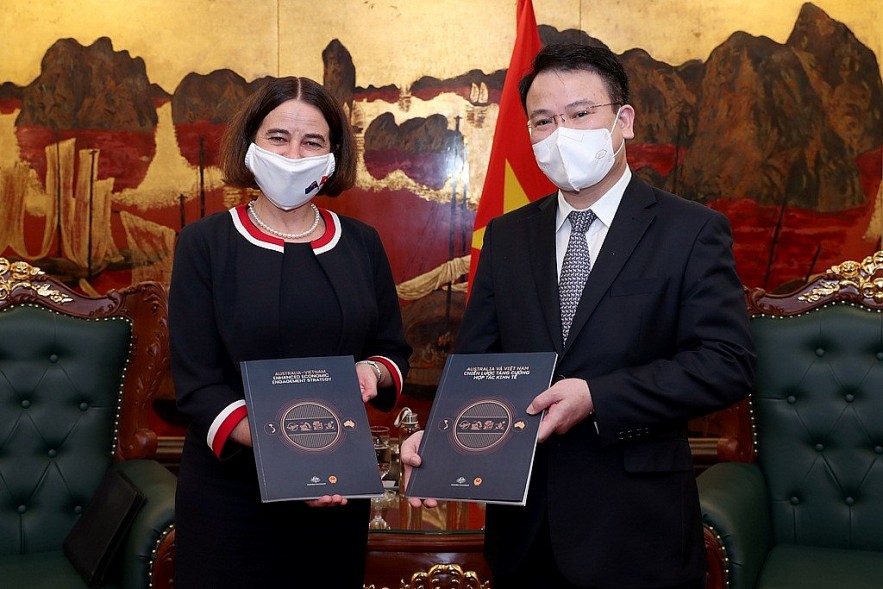
The two countries have become increasingly important trade partners of each other, especially after their senior leaders agreed to upgrade their relations to a Strategic Partnership in March 2018 and adopted the Enhanced Economic Engagement Strategy in November 2021.

Notably, while Australia has become one of the seven largest trade partners of Vietnam, the Southeast Asian nation is also Australia’s 10th largest trader. This is one of the important foundations for the two to upgrade their ties to a Comprehensive Strategic Partnership at an appropriate time in the near future.

Prof. Carl Thayer, an expert on Vietnamese studies from the University of New South Wales (UNSW): “The bilateral relationship has geo-strategic convergence. It is based on many different pillars, but trade and investment have always been among the top priorities”.

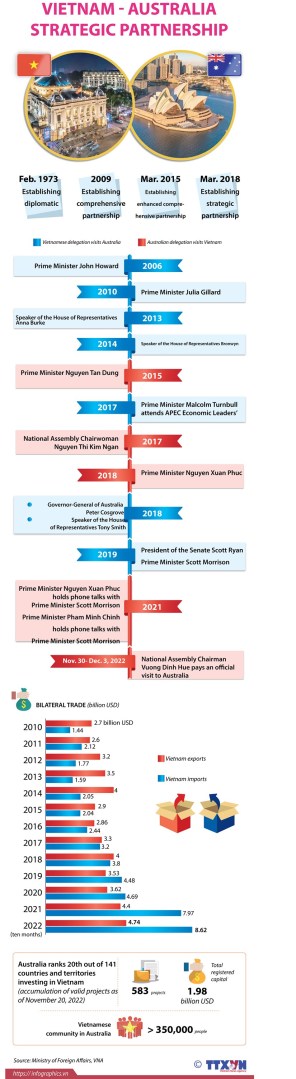
Statistics show that two-way trade recorded a year-on-year rise of 26.9% to 15.7 billion USD last year, of which 5.6 billion USD came from Vietnam’s exports, and 10.1 billion USD from its imports, up 26.2% and 27.3%, respectively.

Moreover, Vietnam and Australia share many economic cooperation frameworks, in which the Comprehensive and Progressive Agreement for Trans-Pacific Partnership (CPTPP) strongly supports bilateral trade and investment relations.

Not only trade, CPTPP is a lever to increase investment between the two countries. By the end of 2021, Australia had invested nearly 2 billion USD in around 550 projects in Vietnam, ranking 19th among countries and territories pouring capital into Vietnam.

Australian Ambassador to Vietnam Andrew Goledzinowski

Ambassador Goledzinowski recalled that during the official visit to Australia from November 30 – December 3, 2022, by National Assembly Chairman Vuong Dinh Hue, leaders of the two sides unanimously supported the two countries in upgrading their relationship to a comprehensive strategic partnership at a suitable time. The upgrade of the relationship to a new height will be an important driving force for bilateral cooperation in various fields such as climate change, energy transition and high technology.

“I think this is a very positive sign. As you probably know, until recently, there were only three countries that had that level of relationship with Vietnam.
Those were China, Russia, and India. And then in December, (the Republic of) Korea was included in that list. If we can be the next country, we’ll be very happy,” Ambassador Andrew Goledzinowski said./.

TRUNG 50 năm quan hệ Việt Nam-Australia: Hướng tới quan hệ Đối tác chiến lược toàn diện

Cách đây 50 năm, ngày 26/2/1973, Việt Nam và Australia chính thức thiết lập quan hệ ngoại giao. Nhìn lại chặng đường 50 năm qua, quan hệ hợp tác Việt Nam-Australia phát triển rất tốt đẹp, mang lại nhiều lợi ích cho nhân dân hai nước.

Kể từ khi thiết lập quan hệ ngoại giao vào năm 1973, Australia và Việt Nam đã xây dựng một mối quan hệ mạnh mẽ và bền bỉ với lợi ích đa dạng và ngày càng tăng. Quan hệ song phương giữa hai nước tiếp tục phát triển ngày càng mạnh mẽ và hiện nay Việt Nam được coi là một trong những đối tác song phương quan trọng nhất của Australia. Tháng 3/2018, hai nước chính thức nâng cấp quan hệ lên mức Đối tác chiến lược, mở ra trang mới trong quan hệ song phương.

Bộ trưởng Ngoại giao Bùi Thanh Sơn dự lễ và phát biểu tại Lễ kỷ niệm 50 năm thiết lập quan hệ ngoại giao Việt Nam-Australia.  Ảnh: TTXVN

Bộ trưởng Ngoại giao Bùi Thanh Sơn: “Trải qua 5 thập kỷ phát triển với các cơ hội và thời cơ cũng như khó khăn và thách thức đan xen, trong sự biến động không ngừng của tình hình khu vực và quốc tế, ngày nay Việt Nam và Australia đã trở thành các đối tác tin cậy của nhau cả trong khuôn khổ song phương và đa phương”.

Trong những năm gần đây, sự hợp tác giữa hai quốc gia đã mở rộng nhanh chóng. Quan hệ hai nước trải rộng trên nhiều lĩnh vực, từ an ninh, quốc phòng, thương mại, đầu tư cho đến giáo dục, du lịch, đổi mới sáng tạo. Có được bước phát triển này là nhờ những cam kết mạnh mẽ của lãnh đạo cấp cao hai nước, thông qua các chuyến thăm cấp cao và các cấp.

“Cộng đồng người Việt Nam ở Australia hiện khoảng 350.000 người, giữ vai trò cầu nối quan trọng, không thể thiếu trong việc thúc đẩy quan hệ hữu nghị, hiểu biết giữa nhân dân hai nước. Trong những năm qua, đóng góp của cộng đồng người Việt được ghi nhận rộng rãi trên nhiều lĩnh vực tại Australia,” Đại sứ Việt Nam tại Australia Nguyễn Tất Thành nói.

Australia cũng tích cực hỗ trợ Việt Nam phòng, chống COVID-19, cung cấp cho hơn 26,4 triệu liều vaccine, trong đó có 12 triệu liều cho người lớn và hơn 14,4 triệu liều cho trẻ em, trở thành nhà tài trợ vaccine lớn thứ hai của Việt Nam, sau Hoa Kỳ.

“Tôi có thể tự tin nói rằng, chưa có thời điểm nào trong lịch sử mà mối quan hệ giữa hai nước chúng ta lại bền chặt và phát triển tốt đẹp như hiện nay. Mối quan hệ song phương được xây dựng dựa trên sự tin cậy mạnh mẽ lẫn nhau cũng như sự hợp tác thiết thực, hiệu quả trên nhiều lĩnh vực,”

Đại sứ Đặc mệnh toàn quyền Australia tại Việt Nam Andrew Goledzinowski

Hai nước đã trở thành đối tác thương mại ngày càng quan trọng của nhau, đặc biệt là sau khi Lãnh đạo cấp cao hai nước nhất trí nâng cấp quan hệ thành “Đối tác chiến lược” tháng 3 năm 2018 và thông qua Chiến lược Tăng cường hợp tác kinh tế Việt Nam – Australia vào tháng 11 năm 2021.

Đáng lưu ý, trong khi Australia trở thành 1 trong 7 đối tác thương mại lớn nhất của Việt Nam, ngược lại, Việt Nam cũng đang là đối tác thương mại lớn thứ 10 của Australia. Đây là một trong những cơ sở quan trọng để hai nước hướng tới mục tiêu nâng cấp quan hệ lên “Đối tác chiến lược toàn diện” vào thời điểm phù hợp trong thời gian tới.

Theo nhận định của Giáo sư Carl Thayer – chuyên gia nghiên cứu về Việt Nam, hiện đang làm việc tại Học viện Quốc phòng Australia (Đại học New South Wales), quan hệ giữa hai nước dựa trên nhiều trụ cột khác nhau, song thương mại và đầu tư vẫn luôn thuộc nhóm những ưu tiên hàng đầu.

Thống kê cho thấy, quy mô thương mại song phương năm 2022 đã đạt 15,7 tỷ USD, tăng 26,9% so với năm 2021; trong đó, kim ngạch xuất khẩu hàng hóa của Việt Nam sang thị trường Australia đạt 5,6 tỷ USD, tăng 26,2%. Ở chiều ngược lại, kim ngạch nhập khẩu hàng hóa từ Australia đạt 10,1 tỷ USD, tăng 27,3%.

Hơn nữa, Việt Nam và Australia có chung rất nhiều khuôn khổ hợp tác kinh tế; trong đó, có Hiệp định Đối tác Toàn diện và Tiến bộ xuyên Thái Bình Dương (CPTPP) đang bổ trợ mạnh mẽ cho quan hệ thương mại, đầu tư giữa hai nước.

Không chỉ thương mại, Hiệp định CPTPP là đòn bẩy để tăng đầu tư giữa hai nước. Tính đến cuối năm 2021, Australia đã đầu tư khoảng 550 dự án tại Việt Nam với tổng trị giá chỉ gần 2 tỷ USD. Ngoài ra, Australia còn là quốc gia có vốn đầu tư nước ngoài (FDI) lớn thứ 19 tại Việt Nam.

Đại sứ Đặc mệnh toàn quyền Australia tại Việt Nam Andrew Goledzinowski

Theo Đại sứ Đặc mệnh toàn quyền Australia tại Việt Nam Andrew Goledzinowski, trong chuyến thăm chính thức Australia của Chủ tịch Quốc hội Vương Đình Huệ, lãnh đạo hai bên đã nhất trí ủng hộ việc xem xét nâng cấp quan hệ lên Đối tác Chiến lược Toàn diện trong thời điểm thích hợp. Việc hai nước nâng cấp mối quan hệ lên một tầm cao mới sẽ là động lực quan trọng thúc đẩy hợp tác song phương trong nhiều lĩnh vực như biến đổi khí hậu, chuyển đổi năng lượng hay công nghệ cao…

“Đây là một tín hiệu rất tích cực. Đến nay, mới có 4 quốc gia thiết lập quan hệ Đối tác Chiến lược Toàn diện với Việt Nam – đó là Trung Quốc, Nga, Ấn Độ và mới nhất là Hàn Quốc. Vì vậy, nếu Australia có thể là quốc gia tiếp theo thiết lập mối quan hệ này với Việt Nam, điều đó sẽ thật tuyệt vời,” Đại sứ Đặc mệnh toàn quyền Australia tại Việt Nam Andrew Goledzinowski nhấn mạnh./.

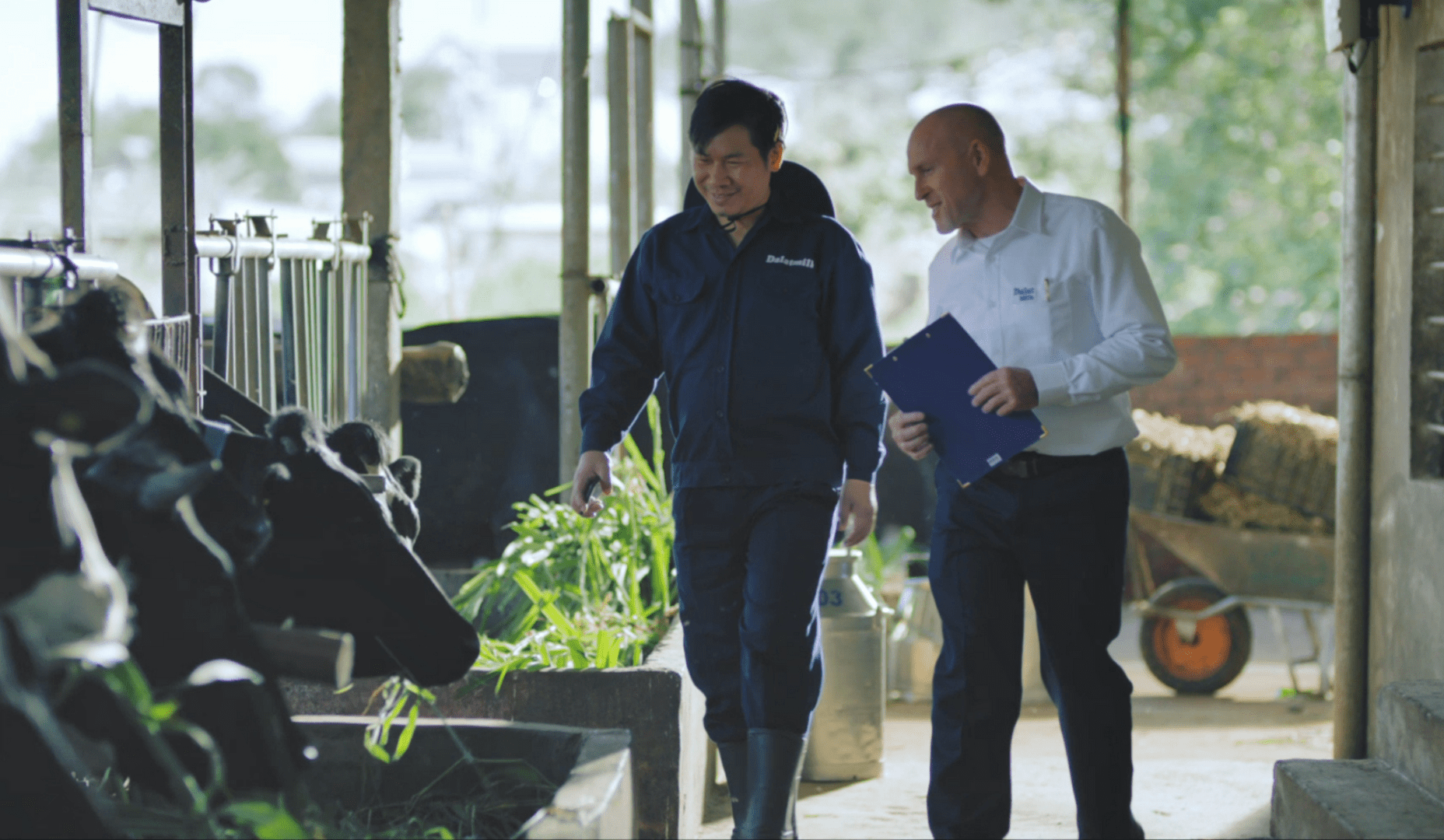
Changing the face of the Central Highlands: TH Group develops green, circular economy

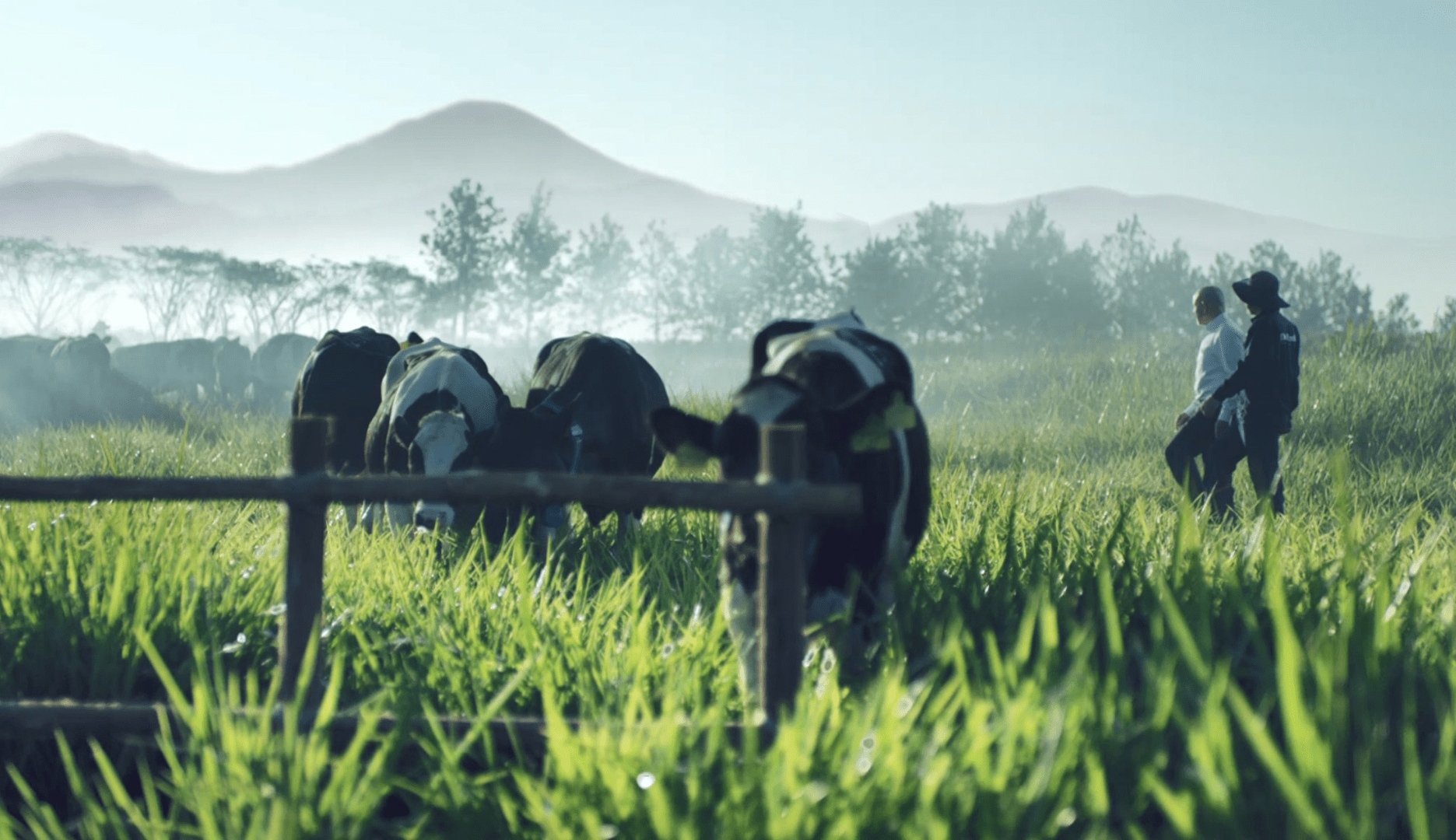
Following the company’s resounding success thanks to a combination of high technology and agricultural science in many localities, TH Group is stepping up preparations for a project that applies high technology with the green, knowledge-based, and circular economy model in the Central Highlands.

On November 20, 2022, the dairy producer officially signed memoranda of understanding with the People’s Committees of Lam Dong and Dak Lak provinces, a move expected to contribute to the sustainable development of the Central Highlands. The signing took place at a conference chaired by Prime Minister Pham Minh Chinh to implement the Politburo’s Resolution No 23-NQ/TW on development orientations for this high-potential region.

From a broad perspective of reality…

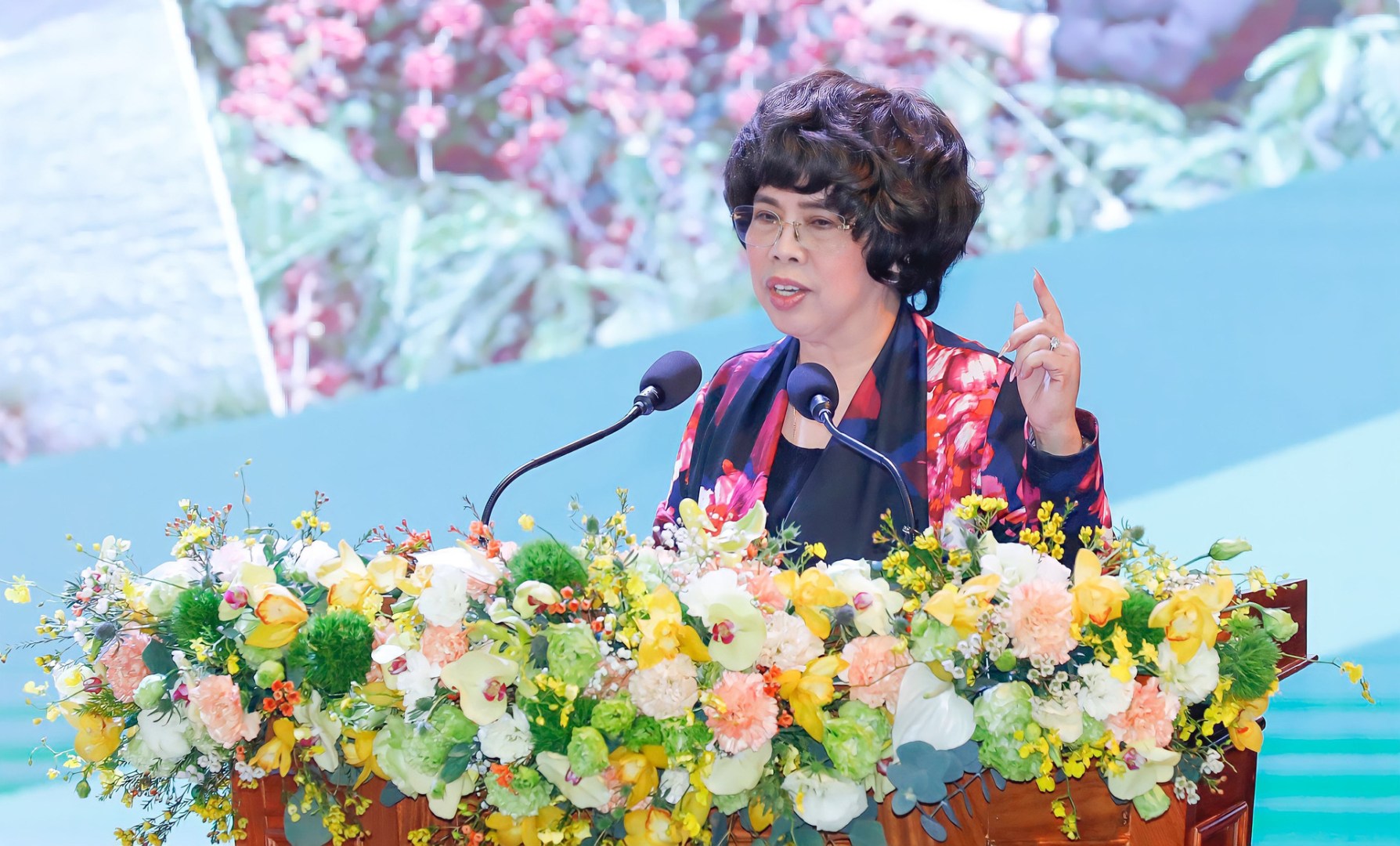
At that conference, Labour Hero Thai Huong, founder and Chairwoman of the Strategy Council of TH Group, delivered a noteworthy speech. She voiced support for Resolution No 23-NQ/TW’s ambitious goal of turning the Central Highlands into a region with green and circular economy, based on sustainable development that maximises resources, including land and climate, so as to guarantee social equality and improves the quality of life for local residents.

However, she also emphasised that today’s growth and development must not be cited as an excuse for environmental consequences for future generations.

Huong said she came to the Central Highlands early, shortly after setting up TH Group in 2008, folliwng a circular economy model that uses high technology. Present in Kon Tum province for the last two years, the business has farmed 500ha of a new durian variety. It is planning to expand the cultivation here and in the Central Highlands.

Labour Hero Thai Huong addresses the conference. (Photo: VietnamPlus)

The Central Highlands has yet to live up to its development potential. Large enterprises have yet to set up shop here, thus the Government needs to set up appropriate policies to attract them here. Meanwhile, the region boasts a vast area of land. The conundrum is how to best make use of the land resource for developing a green and circular economy, she pointed out.

The TH Group leader elaborated that the Central Highlands boasts a land-related advantage, but that advantage has remained untapped for decades. Many areas that used to be home to forests have suffered from deforestation or flooding. When the group proposed developing green economic activities there, local authorities were concerned about forest conservation. Therefore, she requested that a map of the local land status be re-drawn.

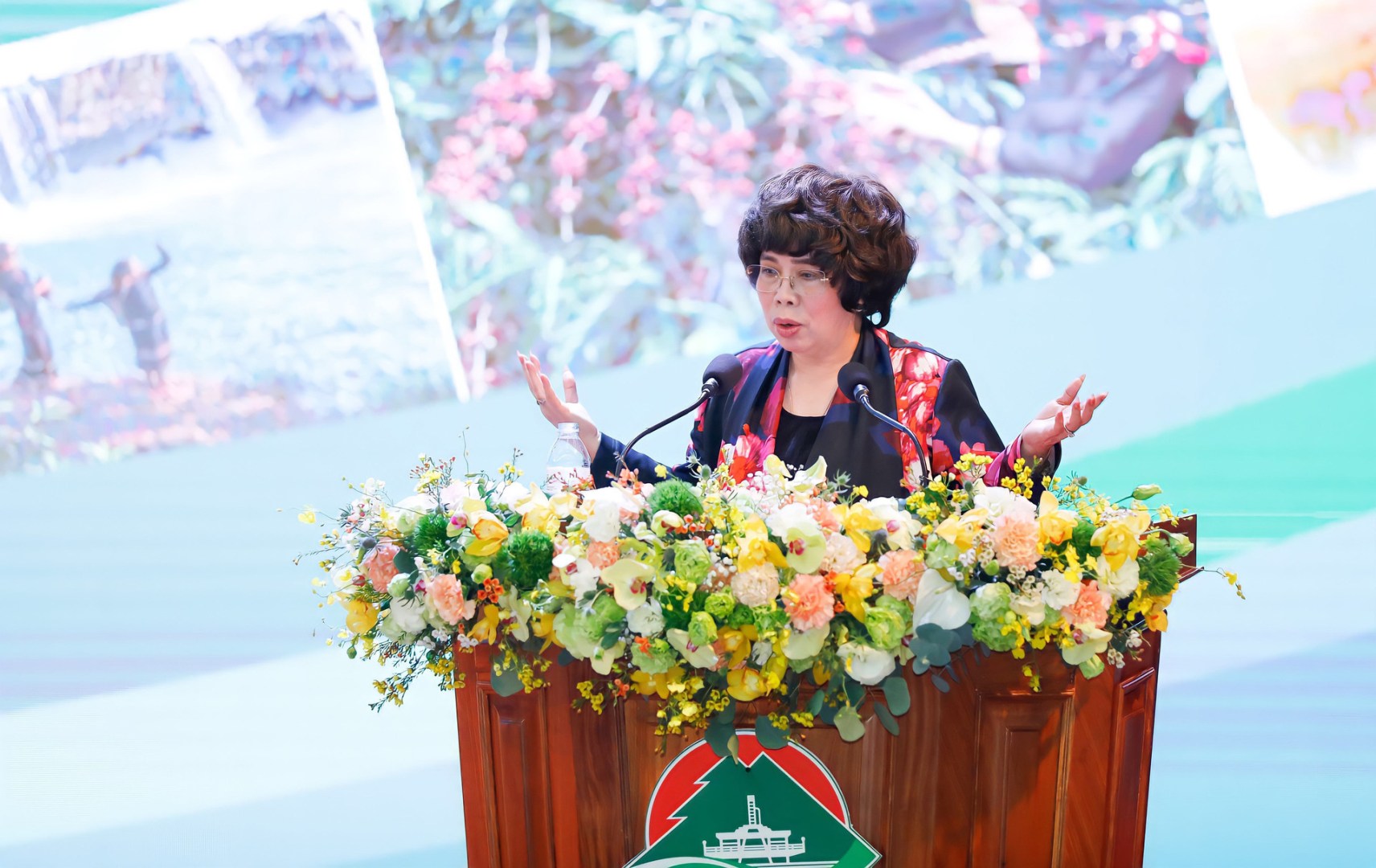
A green economy is one that efficiently uses natural resources, thus creating a basis for sustainable development, guaranteeing social equality, and does not cause environmental impact on future generations. (Photo: VietnamPlus)

Many things can be developed in the Central Highlands, but it is necessary to have large-scale production models, create national-level brands meeting international standards, and using high technology. The world has obtained many achievements in the development of technology, artificial intelligence (AI), cloud computing, and big data, and Vietnam should make use of these to raise labour productivity, reduce production costs, and improve product quality to meet international standards, Thai Huong told the conference.

These ideas, to date, have been successfully applied to TH Group projects.

She noted that a green economy is one that efficiently uses natural resources, thus creating a basis for sustainable development, guaranteeing social equality, and does not cause environmental impact on future generations.

Labour Hero Thai Huong addresses the conference. (Photo: VietnamPlus)

The group identified six pillars of sustainable development, namely nutrition, the environment, the community, education, animal welfare, and human, of which human forms the core pillar and the most important driving force.

To build a sustainable ecosystem based on those pillars, since 2008, it has applied green technologies with high intellectual content and the latest technology to dairy farming so as to utilise resources in the most efficient manner.

In its production model, all organic materials and waste from farms are collected and treated to become organic fertiliser or biological padding used in farms. Farming wastewater is used to improve soil after being treated. Besides, solar power systems are installed on the roofs of dairy farms, concurrently helping generate electricity and reducing the roofs’ absorption of temperature, and easing the heat stress on cattle in summer.

… to four key areas for Central Highlands development

With the potential of the Central Highlands and her experiences and capacity, Labour Hero Thai Huong identified four areas that can help with the development of this region.

She said that the Central Highlands boasts sufficient conditions to strongly develop large-scale and hi-tech animal husbandry.

TH will bring the chain-based hi-tech concentrated dairy farming model that it is implementing in the central province of Nghe An to the Central Highlands. The group is working on a plan to carry out this model in Dak Nong province and nearby areas so as to link farmers to the production chain, she stressed in her remarks at the November conference.

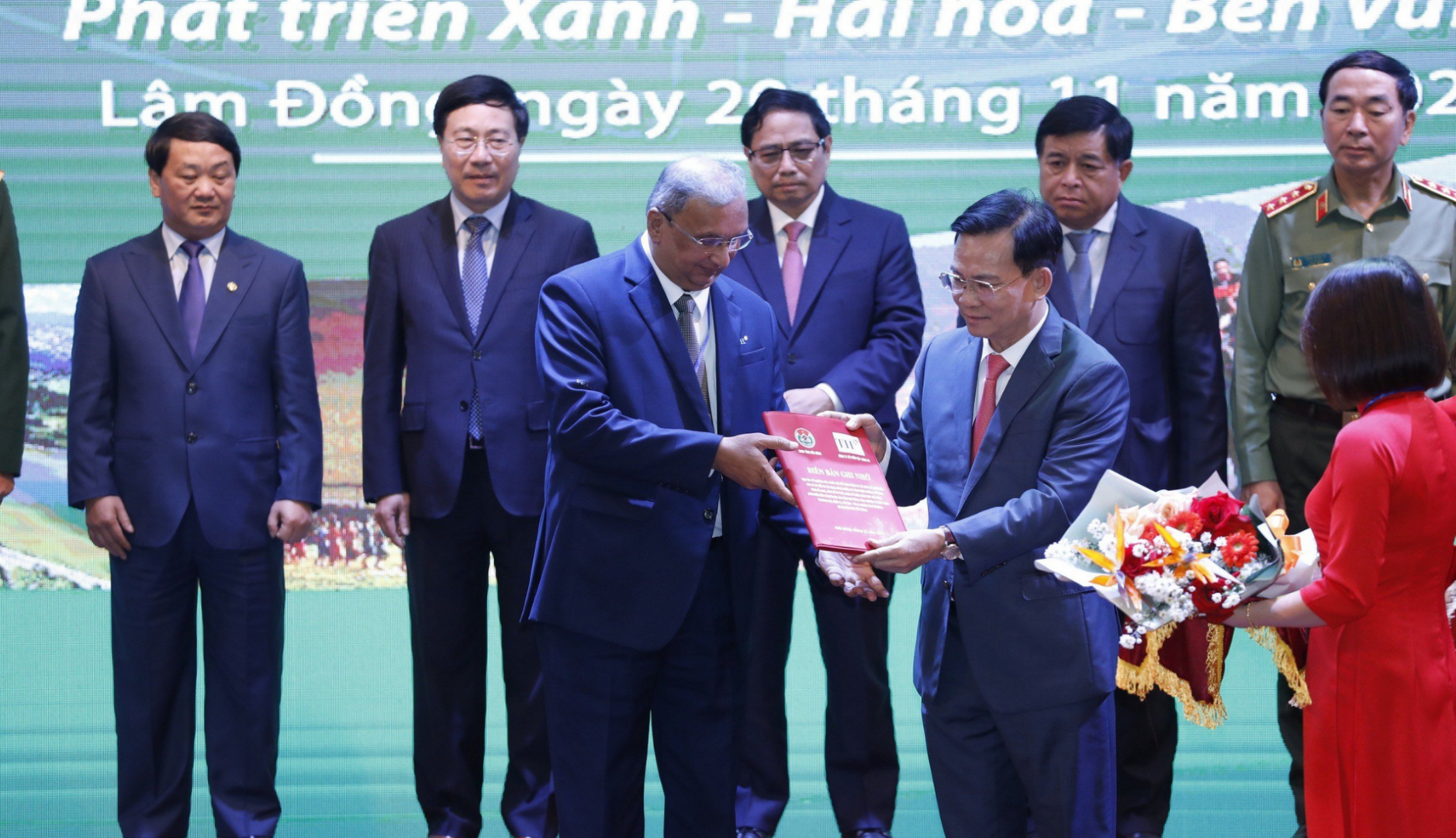
Chairman of the Dak Nong provincial People’s Committee Ho Van Muoi hands over the memorandum of understanding on cooperation to Vijay Kumar Pandey, a representative of the Board of Directors of TH Group. (Photo: VietnamPlus)

In terms of mining, as the region possesses large bauxite reserves, the Government should make planning early and strongly apply science and technology to mining activities.

Only when modern scientific advances are applied can a green economy develop and exploitation impacts be avoided, she said, adding that fruit and herbal plant farming should be developed in the areas with little reserves instead of trying to mine at all costs.

In addition, groundwater is also a field in which TH Group is planning to focus its investment in the future.

Huong said the Central Highlands is home to good groundwater resources thanks to a volcanic ecosystem, and that she had suggested her business invest in groundwater exploitation in Dak Nong. “Vietnamese consumers deserve the purest water and best nutritional sources.”

In her speech, she also noted as this region gathers all the necessary conditions for tourism development, authorities should make plans to enrich the diversity of cultural, culinary, and craft village tourism instead of merely “bringing a whole Disneyland from the US here”.

Labour Hero Thai Huong addresses the conference. (Photo: VietnamPlus)

To help carry out the Politburo’s Resolution No 23-NQ/TW to give a facelift to the Central Highlands, TH Group signed two cooperation agreements with the People’s Committees of Lam Dong and Dak Nong provinces to develop investment projects applying high technology in different fields.

The group is taking the lead in the fresh milk market of Vietnam and has recorded double-digit revenue growth annually. While the land area in the northern region is limited, making it hard for the firm to expand production, the company realised that the Central Highlands, especially Dak Nong and Lam Dong, holds great potential for becoming the capital of dairy farming and a milk production centre for the southern market of Vietnam.

Prime Minister Pham Minh Chinh visits an exhibition of local products at the conference. (Photo: VietnamPlus)

Here, TH Group will give guidance on the production process, technology, and management to farmers, provide them with calves, and purchase products so as to generate considerable economic benefits for farmers.

They also propose fruit and herbal plant farming and processing projects that apply high technology, a water production plant, a logistics centre, a mineral mining project, and sustainable tourism development projects.

In Lam Dong, the enterprise will continue promoting hi-tech dairy farming, cultivating fruit and herbal plants in accordance with VietGAP, GlobalGAP, and organic standards, and developing fruit and herb processing.

On the sidelines of the conference, Labour Hero Thai Huong said that to develop the Central Highlands under a green economy model towards sustainable development, capable and visionary enterprises need to apply global technology to help locals develop.

To capitalise on these achievements, it is necessary to issue some appropriate policies and mechanisms for each period and each sector to translate aspirations into reality and create enormous strength for the nation. This will allow Vietnam to become prosperous and civilised, comparable with developed countries across five continents as late President Ho Chi Minh had envisioned, the businesswoman added.

TH Group runs many production and business projects, including TH true MILK – a project on hi-tech concentrated dairy farming and processing. Implemented in October 2009, the project, with total investment of 1.2 billion USD, covers dairy farming, processing, and distribution. It has nearly 70,000 cows in Nghe An province, establishing itself as the world’s largest concentrated dairy farm.

According to Nielsen statistics, TH Group has recorded continuous growth in its fresh milk market share, nearly 45% in urban areas in 2021, maintaining its No. 1 position in Vietnam.

Aside from fresh milk, the firm also operates food, beverage, vegetable, fruit, and herb cultivation projects; the TH School system; along with a five-star international general hospital and an electronic health centre network in Hanoi./.

Туризм во Вьетнаме – подтверждение привлекательности и ожидание нового скачка

В 2023 году Вьетнамский туризм поставил цель принять 110 млн. туристов, включая 8 млн. иностранных, 102 млн. внутренних туристов, а общий доход от туристов составит 650.000 млрд. донгов.

Впечатляющий рост после пандемии

Генеральный директор Национальной администрации туризма Вьетнама Нгуен Чунг Кхань заявил, что в 2022 году из-за колебаний мировой экономической и политической ситуации мировой туризм не восстановился, как прогнозировалось, а медленнее, особенно в Азии.

Внутри страны Министерство культуры, спорта и туризма, сектор туризма активно реализовывали множество решений и задач, добившись выдающихся результатов, внеся важный вклад в восстановление постпандемического экономического развития.

2022 год является первым годом восстановления туристической деятельности в новых нормальных условиях, а с 15 марта и до сих пор в области туризма достигнуты очень обнадеживающие результаты.

По словам генерального директора Нгуен Чунг Кхана, количество иностранных туристов в 2022 году, по оценкам, достигло 3,66 млн. человек (что составило более 70% от целевого показателя, установленного в начале года). Число внутренних туристов достигло 101,3 млн., что намного превышает количество в 85 млн. в 2019 году до пандемии COVID-19. Общий доход от туристов оценивается в 495 трлн. донгов или 66% по сравнению с 2019 годом.

Впечатляющий рост внутреннего туристического рынка после эпидемии COVID-19 является ярким пятном, подтверждающим роль этого рынка в развитии туристической индустрии в контексте глобальных трудностей на рынке международного туризма.

С возобновлением туристической деятельности с 15 марта 2022 года Вьетнам оценивается Всемирной туристской организацией (ЮНВТО) как одна из стран с самой открытой политикой в мире. Вьетнам также является одной из первых стран, открывшихся в регионе.

Согласно отчету Всемирного экономического форума за 2022 год, по индексу потенциала развития туризма Вьетнама в 2021 году страна заняла 52-е место, что на 8 позиций выше по сравнению с 2019 годом. Вьетнам находится в группе из 3 стран с наиболее ярким улучшением в мире.

На World Travel Awards 2022 вьетнамский туризм получил 16 высших наград в мире и 48 высших наград в Азии.

За последние 5 лет Вьетнам 3 раза признавался ведущим объектом всемирного наследия, 4 раза получал звание «Лучшее направление Азии», Вьетнам в 6-й раз получил титул «Лучшее направление для гольф-туризма в Азии» на World Golf Awards 2022 и множество других престижных международных титулов для вьетнамских населенных пунктов и предприятий.

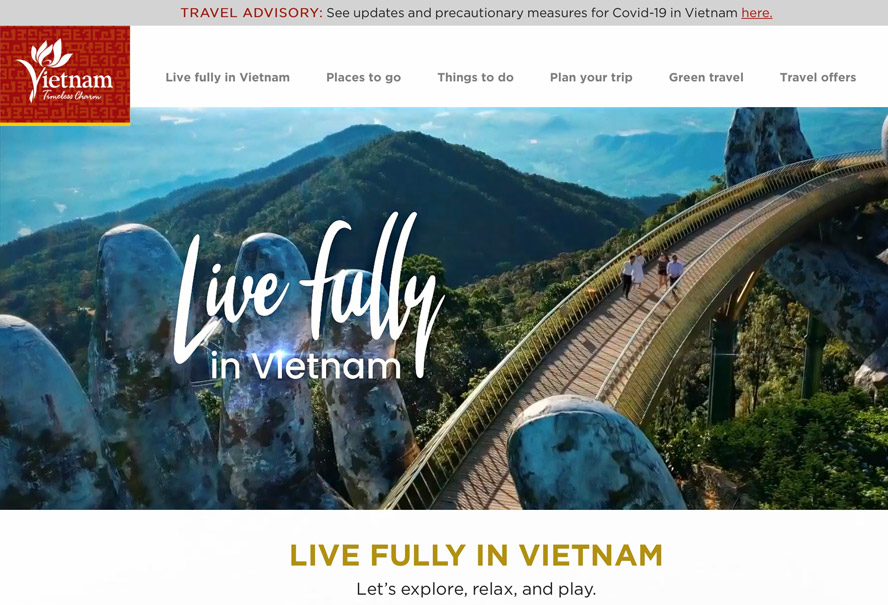
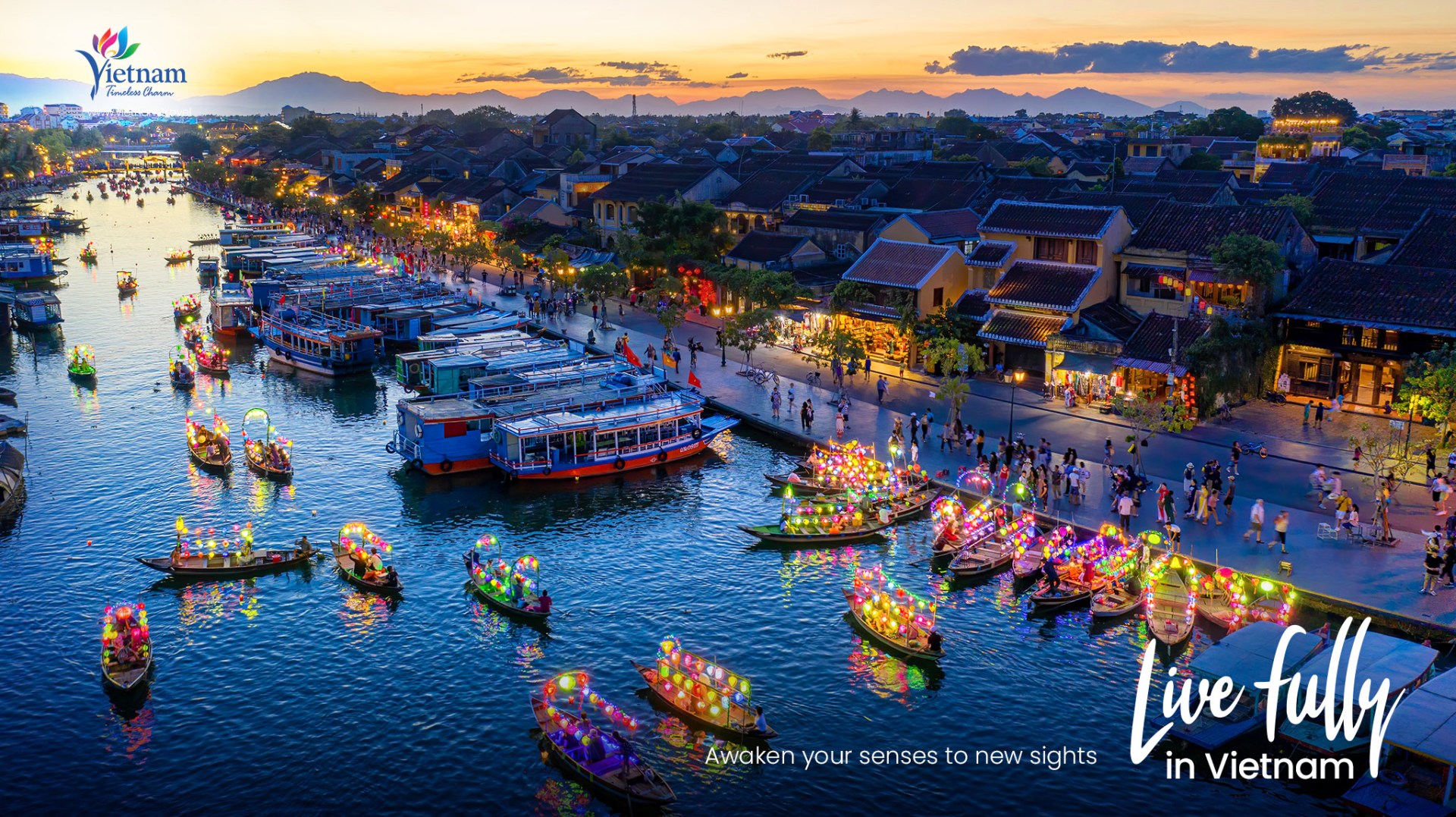
Сразу после возобновления туризма Вьетнам сосредоточился на продвижении коммуникационной программы на тему «Жить полноценно во Вьетнаме» для привлечения иностранных посетителей.

По случаю 31-х Игр Юго-Восточной Азии, состоявшихся во Вьетнаме, туристическая индустрия активно продвигала образ безопасного, дружелюбного и привлекательного туризма во Вьетнаме среди спортивных делегаций и иностранных туристов, способствуя успеху Игр. По этому случаю Вьетнам выпустил фильм «Вьетнам: путешествуем, чтобы полюбить! – Давайте сиять и жить полноценно!».

В ожидании прорывов

Помимо «впечатляющего» возвращения после COVID-19, индустрия туризма по-прежнему сталкивается с некоторыми трудностями и проблемами.

Мировой туризм продолжает восстанавливаться, но не вернулся на уровень 2019 года, а внутренний туризм продолжает расти, но его темпы замедлились, поскольку многие из основных туристических рынков Вьетнама еще не полностью открылись.

В 2023 году туристическая отрасль Вьетнама ставит перед собой цель принять 110 млн. туристов, из которых около 8 млн. иностранных и 102 млн. внутренних туристов, общий доход от туристов составит около 650 трлн.

Сектор туризма сосредоточится на ключевых задачах, таких как реализация «Планирования туристической системы Вьетнама на период 2021–2030 гг. с перспективой до 2045 года» после утверждения правительством, реализация маркетинговой стратегии туризма Вьетнама до 2030 года, проекта «Применение технологий индустрии 4.0 для развития умного туризма, продвижение туризма как передового сектора экономики», проекта развития общественного туризма после утверждения.

В рекламной работе сектор туризма будет участвовать в международных туристических мероприятиях, таких как Туристический форум АСЕАН ATF 2023 в Индонезии; Туристическая ярмарка ITB в Берлине, Германия; ярмарка путешествий WTM в Лондоне, Великобритания; Медиа-организация Vietnam Tourism на телеканале CNN и некоторых крупных международных медиаканалах. Сектор также организует программы по представлению вьетнамского туризма на ключевых рынках в АСЕАН, Северо-Восточной Азии, Австралии, Европе, Северной Америке, совместно с провинцией Биньтхуан проведит Год национального туризма 2023 года в Биньтхуане на тему: «Биньтхуан – Зеленая конвергенция»…/.

Там Ханг<br>Корреспондент ВИА
Там Ханг
Корреспондент ВИА