El pueblo y los derechos humanos son el centro, el objetivo, el sujeto y el motor del desarrollo de Vietnam

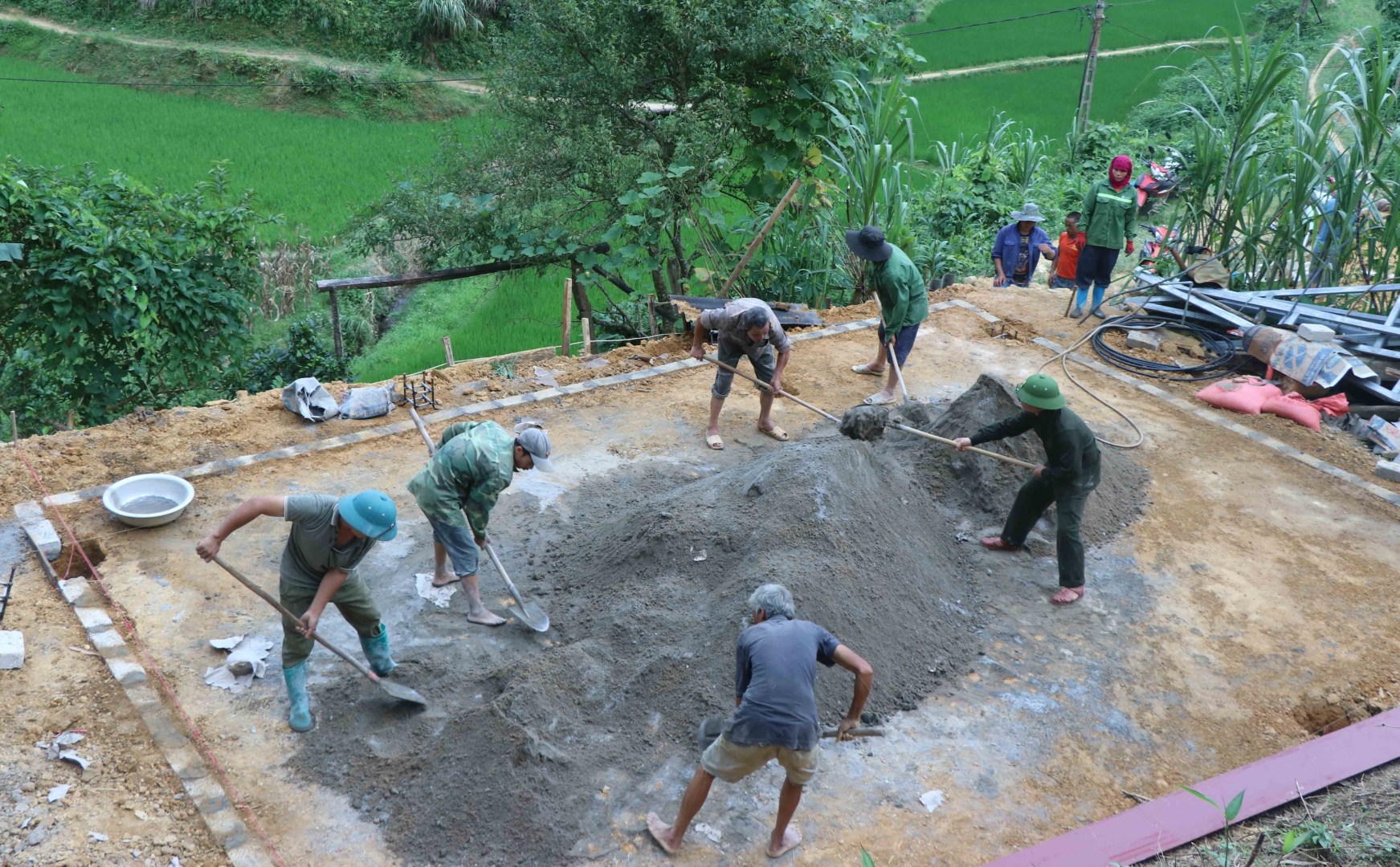
La alegría de los niños en las tierras altas. (Foto: VNA)

En todas las etapas de la revolución, la postura coherente y constante de nuestro Partido y Estado sobre los derechos humanos es liberar al ser humano de la opresión y la explotación, proporcionar libertad, bienestar y felicidad al pueblo. Bajo esta ideología, el ser humano y los derechos humanos son tanto el objetivo como el motor de la revolución vietnamita.

La primera plataforma política del Partido, aprobada en la Conferencia para unificar las organizaciones comunistas y fundar el Partido Comunista de Vietnam (febrero de 1930), trazó la línea fundamental de la revolución, en la cual se enfatizaba: lograr que Vietnam sea completamente independiente, que la gente tenga libertad de organización, y hombres y mujeres tengan los mismos derechos.

En el proceso de renovación integral del país, nuestro Partido y Estado siempre han afirmado que los derechos humanos son un valor común de la humanidad; “el pueblo es la raíz”, el ser humano es tanto el objetivo como el motor de la causa de la construcción y defensa de la patria; garantizar y promover los derechos humanos es un factor importante para el desarrollo sostenible; los derechos humanos son promovidos y garantizados de manera firme por las instituciones del Estado de derecho socialista del pueblo, por el pueblo y para el pueblo.

El secretario general del Partido Comunista de Vietnam, To Lam. (Fuente: VNA)

“El ser humano es tanto el objetivo como el motor de la causa de la construcción y defensa de la patria; garantizar y promover los derechos humanos es un factor importante para el desarrollo sostenible”

Después de casi 40 años de llevar a cabo el proceso de renovación, nuestro país ha alcanzado grandes logros, con un significado histórico en el desarrollo económico, la erradicación de la pobreza, el desarrollo integral del ser humano, la garantía de progreso y justicia social, lo cual ha sido altamente valorado por la comunidad internacional. Los derechos humanos fundamentales, como el derecho a la atención médica y a la educación, la garantía del bienestar social, los derechos de libertad y democracia en el ámbito político, la libertad religiosa, de creencias, de prensa, y el acceso a la información han logrado avances notables… Nuestro Partido y Estado están construyendo y perfeccionando gradualmente el sistema de opiniones, políticas, líneas de trabajo y leyes sobre el desarrollo humano, el respeto, la garantía y la protección de los derechos humanos y ciudadanos. Esto se ha reafirmado y reflejado de manera coherente en los documentos más importantes del Partido.


Festival de la Solidaridad Nacional se celebra en el distrito de Tien Yen, provincia de Quang Ninh. Este es uno de los distritos montañosos donde viven muchas minorías étnicas y las condiciones económicas y socioculturales están mejorando cada vez más, lo que reduce la tasa de pobreza. (Foto: VNA)
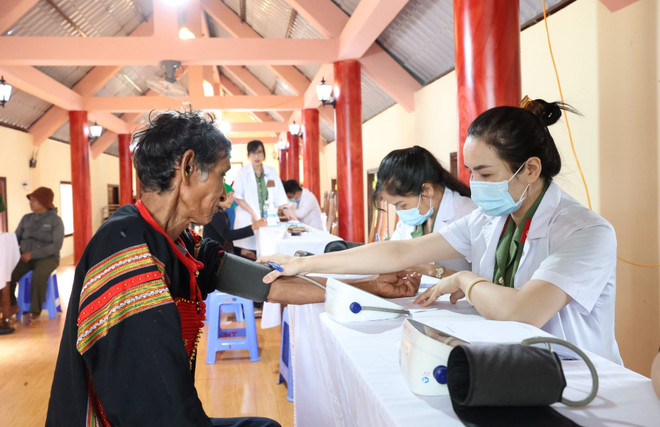
Examen de salud para minorías étnicas en la ciudad de Buon Ho, provincia de Dak Lak. (Foto: VNA)

En cada congreso, en cada etapa de desarrollo, nuestro Partido y Estado continúan ampliando y desarrollando la conciencia sobre la democracia socialista, y cada vez se amplía más, asegurando que todo el poder pertenezca al pueblo, en beneficio del pueblo.

La postura del Partido de que “nuestro Estado es el principal instrumento para llevar a cabo el derecho de soberanía del pueblo, y es un Estado de derecho del pueblo, por el pueblo y para el pueblo” y “la democracia socialista es el carácter de nuestro régimen, es tanto el objetivo como el motor del desarrollo del país”, ha sido y sigue siendo gradualmente materializada y claramente reflejada en los logros alcanzados en 40 años de renovación del país.

El fomento de la idea “el pueblo es la raíz” y la adición de la frase “el pueblo supervisa y disfruta” al principio de la afirmación “el pueblo sabe, discute, hace y supervisa” en los Documentos del XIII Congreso Nacional del Partido surge del proceso de resumen profundo de la práctica del Partido y es un paso nuevo en la conciencia sobre la promoción del papel de los ciudadanos como dueños del país. Por lo tanto, “el pueblo disfruta” no es un lema vacío. Es el resultado inevitable en el desarrollo de la conciencia y la máxima de que el pueblo debe disfrutar en el sistema de democracia socialista.

“El pueblo disfruta” no es un lema vacío. Es el resultado inevitable en el desarrollo de la conciencia y la máxima de que el pueblo debe disfrutar en el sistema de democracia socialista”

La práctica ha demostrado que, en los últimos años, nuestro pueblo sigue disfrutando de los logros de la renovación del país en todos los aspectos, mejorando continuamente la vida material y espiritual de la gente. El propósito supremo de todas las políticas de desarrollo económico, cultural y social, la construcción de un sistema legal y la gestión social es siempre para el ser humano, brindando lo mejor para la gente, quienes gozan de todos los frutos del desarrollo del país.

Gracias a estos resultados, en 2021, Vietnam entró en el grupo de alto índice de desarrollo humano según la Oficina del Programa de las Naciones Unidas para el Desarrollo en Hanoi (alcanzando un nivel de 0,703). Además, el índice de felicidad, basado en los criterios del Producto Interno Bruto per cápita, apoyo social, esperanza de vida, derechos y libertad para elegir un estilo de vida, generosidad y percepción de la corrupción del país también aumentó 12 posiciones, pasando del lugar 77 en 2022 al 65 en 2023.
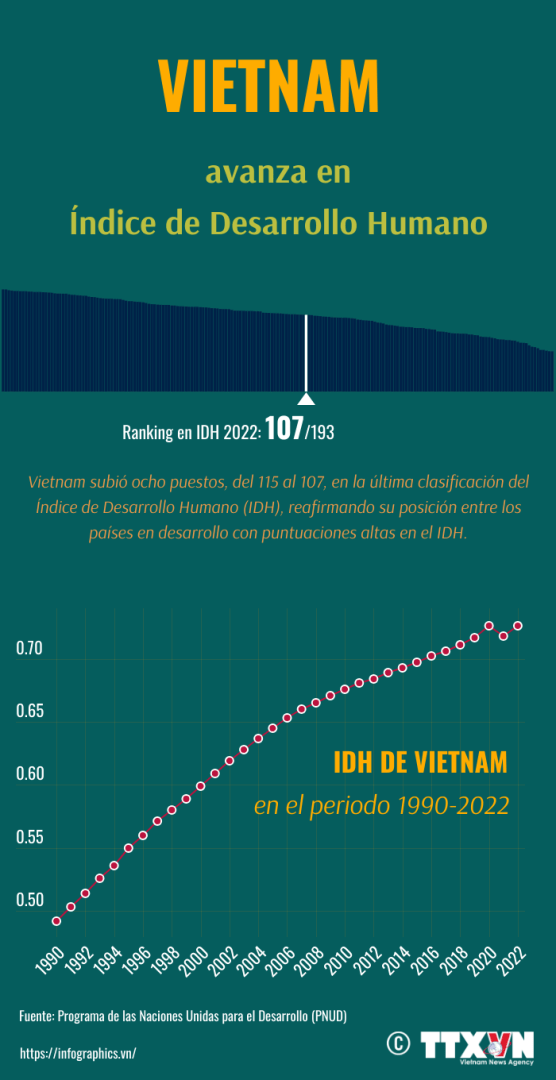
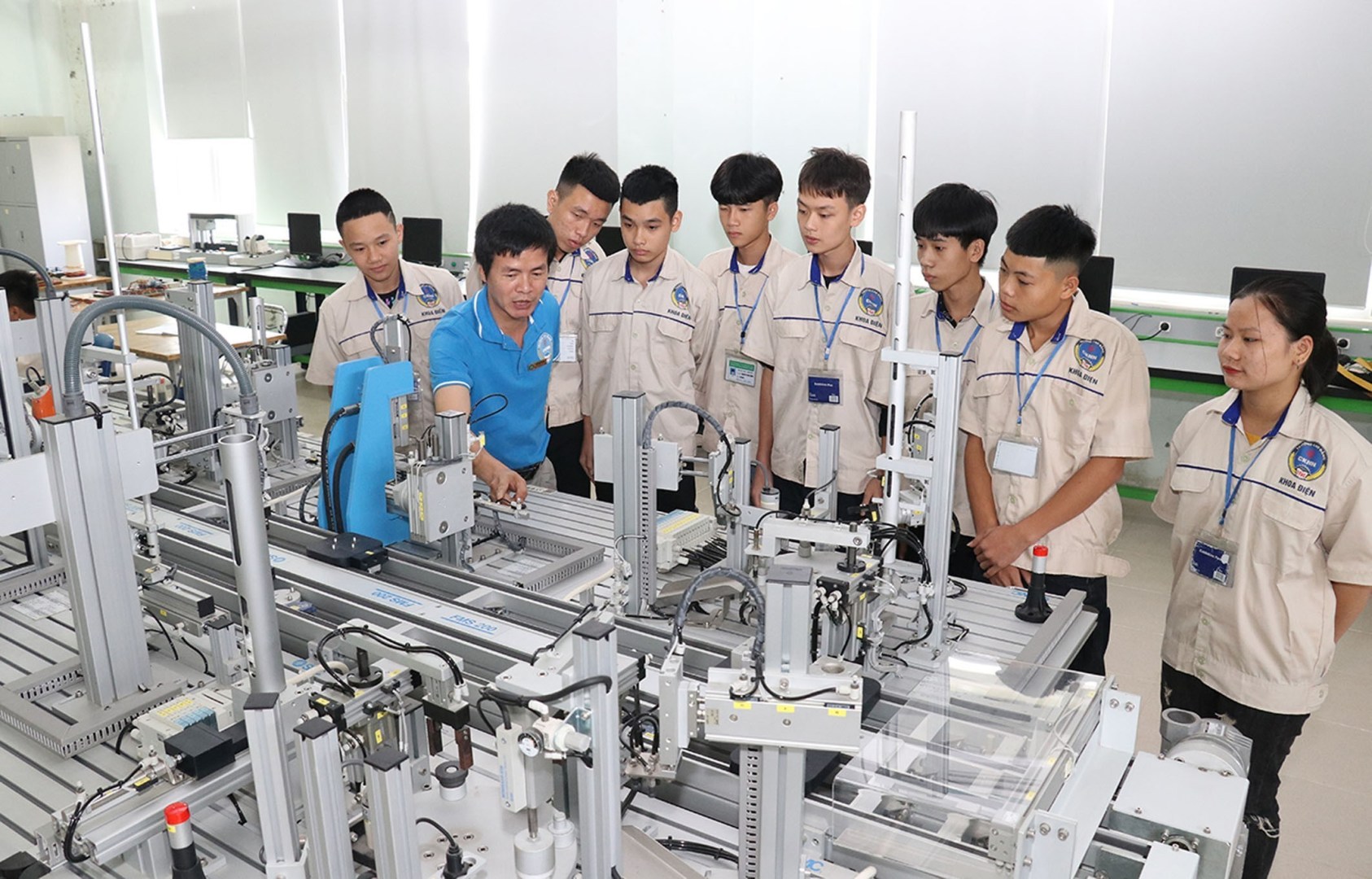
Los índices de desigualdad de género y pobreza multidimensional también han mejorado. Paralelamente, los indicadores relacionados con la educación, la salud, el nivel de vida e ingresos han aumentado. Esas son cifras elocuentes y demuestran que, aunque Vietnam es un país en desarrollo, los indicadores sobre la vida y la calidad de vida de la gente siguen mejorando año tras año. Esta tendencia es una muestra de cómo los derechos, beneficios y el disfrute del pueblo vietnamita han sido y están siendo elevados de manera sostenible.

El pueblo ha disfrutado de las ventajas de las políticas correctas, lo que ha generado un cambio positivo en la vida de la gente. Los derechos de la gente están en el centro de las decisiones y políticas del Partido.

Cada vietnamita sigue disfrutando de los frutos de la renovación y del proceso de desarrollo del país, con un entorno de vida pacífico, estable y seguro, con el objetivo de “darle a todos la oportunidad de desarrollarse” y “nadie se queda atrás”.

Después de casi 40 años de implementación de la renovación iniciado y dirigido por el Partido, nuestro país ha alcanzado logros significativos de gran valor histórico, desarrollándose de manera fuerte y más integral en comparación con los años previos a este proceso.
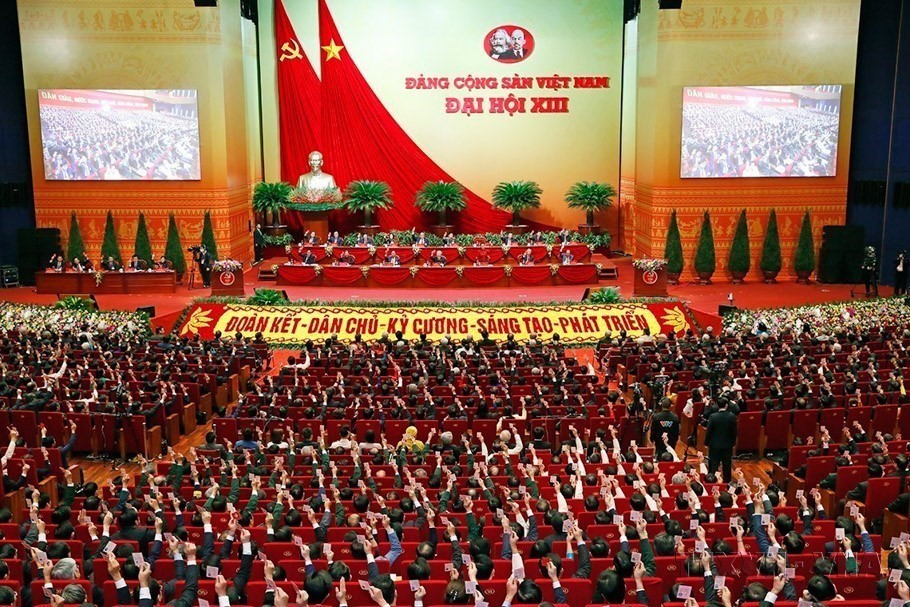
El difunto secretario general del Partido Comunista Nguyen Phu Trong afirmó que “nuestro país nunca ha tenido la fortuna, el potencial, la posición y el prestigio internacional que tiene hoy”. Estos avances son producto de la creatividad acumulada, el resultado de un proceso continuo de esfuerzo y perseverancia de todo el Partido, el pueblo y el ejército, de la fuerza del bloque de gran unidad nacional bajo el liderazgo del Partido Comunista, reafirmando que el camino hacia el socialismo es correcto y adecuado a las reglas objetivas, a la realidad de Vietnam y a las tendencias de desarrollo de la era.

El secretario general del Partido Comunista de Vietnam, Nguyen Phu Trong. (Fuente: VNA)

“Nuestro país nunca ha tenido la fortuna, el potencial, la posición y el prestigio internacional que tiene hoy”

Con la posición y el poder adquiridos, las nuevas oportunidades y retos, estamos ante una oportunidad histórica para llevar a la nación hacia una nueva era, la de ascenso de la nación, lo que plantea la urgente necesidad de continuar desarrollando nuevas formas de pensamiento y de concepción sobre el ser humano y los derechos humanos socialistas con el fin de movilizar al máximo los recursos humanos, desbloquear todas las fortalezas y crear un impulso fuerte para un desarrollo transformador.

Por lo tanto, necesitamos continuar implementando de manera efectiva las políticas y lineamientos del Partido, los mecanismos, políticas y leyes del Estado para garantizar los derechos humanos; institucionalizar completamente y llevar a cabo de manera efectiva los contenidos sobre los derechos humanos establecidos por la Constitución de 2013; continuar renovando y mejorando la calidad de las políticas sociales en una dirección integral, moderna, inclusiva y sostenible, con el espíritu de poner al pueblo en el centro.

La protección de los derechos humanos debe reflejarse en los siguientes aspectos: que las personas vivan felices, saludables, seguras y en un entorno verde; que todos tengan libertad para actuar dentro del marco de la Constitución y las leyes, maximizando sus propios intereses y contribuyendo a la comunidad y a la sociedad; que la gente tenga una vida cada vez más próspera y feliz, año tras año.

Foto de ilustración.

La era de ascenso exige que los derechos humanos y civiles sean reconocidos, respetados, garantizados y protegidos de manera efectiva, y según la perspectiva y la dirección del secretario general To Lam, “no permitir que algunas leyes se conviertan en puntos de bloqueo que obstaculicen la implementación de los derechos humanos y civiles y el desarrollo socioeconómico”.

Cuando los derechos humanos y civiles sean respetados, garantizados y protegidos de manera efectiva, y las personas tengan una vida próspera y feliz, sin duda alcanzaremos con éxito los objetivos estratégicos en la era de ascenso de la nación, llevando al país a un desarrollo integral, fuerte y transformador./.

12 mil atletas participan en el Maratón Internacional del Patrimonio de Hanoi (Foto: VNA)

Leer más:

Yagi y los derechos humanos en Vietnam: otra batalla ganada
Eliminar viviendas precarias  para que nadie se quede atrás en la era de ascenso de la nación
La libertad y la democracia en Vietnam son innegables

VIETNAM SIEMPRE PRESTA ATENCIÓN A LAS PERSONAS CON DISCAPACIDAD

El primer ministro Pham Minh Chinh visitó y entregó obsequios a infantes en el Centro de Hanoi para la Atención de Niños Discapacitados en la ciudad de Chuc Son, distrito de Chuong My (31 de mayo de 2024). (Foto: VNA)

Vietnam es uno de los países con una tasa relativamente alta de personas con discapacidad en la región de Asia y el Pacífico, así como en el mundo.

En los últimos tiempos, el Partido y el Estado han emitido numerosas políticas y directrices para proteger los derechos de las personas con discapacidad, creando un marco jurídico adecuado. La comunidad social también apoya activamente a estas personas, especialmente creando oportunidades de aprendizaje y trabajo, ayudándolas a mejorar sus vidas.

Enciende la fe

Momentos felices de parejas con discapacidad y en circunstancias especialmente difíciles en la ceremonia nupcial masiva “Un sueño hecho realidad”. (Foto: VNA)
La atleta Trinh Thi Bich Nhu (centro) ganó una medalla de oro, rompiendo el récord de los Juegos Paralímpicos de la ASEAN en los 100 metros libres femeninos, categoría para discapacitados S6, en los 12 Juegos Paralímpicos de la ASEAN. (Foto: VNA)

Según el viceministro de Trabajo, Inválidos de Guerra y Asuntos Sociales, Nguyen Van Hoi, Vietnam tiene actualmente más de siete millones de personas con discapacidad, lo que representa el 7,06% de la población de dos años o más, de las cuales casi el 29% tienen discapacidades graves y extremadamente graves.
Aunque nació ciega, Duong Thi Mai Phuong (estudiante del grado 11 de la Escuela Secundaria para Superdotados Ha Tinh) ha hecho esfuerzos para superar las dificultades, mejorar su vida e integrarse con sus amigos. En 2020, ganó el tercer premio en el Concurso Nacional de Estudiantes Excelentes en Historia. (Foto: VNA)

En 2014, la Asamblea Nacional de Vietnam ratificó la Convención de las Naciones Unidas sobre los Derechos de las Personas con Discapacidad. En 2019, Vietnam ratificó el Convenio 159 de la Organización Internacional del Trabajo (OIT) sobre rehabilitación profesional y empleo de personas con discapacidad. En 2022, se adhirió al Tratado de Marrakech para facilitar el acceso a la alfabetización y a las obras intelectuales para las personas con discapacidad de la Organización Mundial de la Propiedad Intelectual.

El viceministro de Trabajo, Inválidos de Guerra y Asuntos Sociales, Nguyen Van Hoi

Vietnam seguirá concretando la Convención y los compromisos internacionales en leyes nacionales a un nuevo nivel, con el objetivo de alcanzar los objetivos de desarrollo sostenible e inclusivo y garantizar que nadie quede atrás, especialmente las personas con discapacidad“.

Para cumplir con la Constitución y los compromisos internacionales, el Gobierno presentó a la Asamblea Nacional la Ley sobre Personas con Discapacidad en 2010. Además, el primer ministro estableció el Comité Nacional para las Personas con Discapacidad en Vietnam para ayudar al jefe de Gobierno a dirigir la resolución de cuestiones relacionadas con el trabajo de estas personas.

Actualmente, el sistema de seguridad social está constantemente ampliando su cobertura y mejorando la calidad de las políticas para las personas con discapacidad. A nivel nacional, hay más de 1,6 millones de personas con discapacidad grave que reciben prestaciones sociales mensuales y el 96% de las personas con invalidez tienen tarjetas de seguro médico.

Se apoya a los niños con minusvalía para que se integren en las instituciones educativas. A los infantes que no pueden integrarse en la sociedad general se les apoya para que estudien en centros educativos especializados.

También se ha apoyado a toda la fuerza laboral de personas discapacitadas (casi cuatro millones) en formación profesional, creación de empleo, medios de subsistencia o préstamos con tasas de interés preferenciales para encontrar su propio trabajo. También reciben atención y trato preferente a la hora de participar en el tráfico, entrar en zonas de ocio, obras culturales y reliquias históricas con entradas gratuitas o reducidas.

Al compartir la atención del Partido y el Estado hacia este sector de la población, el vicepresidente permanente de la Asociación de Personas con Discapacidad de Vietnam, Dang Van Thanh, afirmó que se ha proporcionado el mejor apoyo para que las personas con discapacidad se integren a la vida, creando igualdad en la sociedad. Es por eso que sus vidas están mejorando día a día y sus derechos se están garantizando gradualmente.

Dominando la tecnología

El señor Le Huy Tich (nacido en 1978) quedó paralizado de ambas piernas debido a un accidente de tráfico. Investigó y creó un tractor para sillas de ruedas que ayuda a los discapacitados a desplazarse. El tractor para silla de ruedas ETIC de Le Huy Tich ganó el tercer premio en el concurso provincial de ideas creativas para jóvenes en 2018 y el concurso creativo SDG Challenge para personas con discapacidad en 2019. (Foto: VNA)

Con el lema de no dejar a ninguna persona discapacitada atrás, a lo largo de los años, todo el sistema político ha intervenido para apoyar a las personas incapacitadas para que se integren a la comunidad. Apoyarlas especialmente en el acceso y uso de las tecnologías de la información, creando condiciones para que se integren a la vida de forma más cómoda y completa.

Gracias a las ayudas de accesibilidad, la tecnología de la información se ha convertido en las manos, oídos y ojos de los discapacitados físicos, auditivos y visuales. Los avancen tecnológicos también ayudan a reducir la brecha entre las personas con y sin discapacidad.

Dang Van Thanh, vicepresidente permanente de la Asociación de Personas con Discapacidad de Vietnam

El desarrollo de la ciencia y la tecnología ha contribuido significativamente a apoyar a las personas con discapacidad, promoviendo el proceso de integración plena e igualitaria en la comunidad social. La tecnología es de gran ayuda para las personas con discapacidad ya que permite eliminar distancias, comunicarse, buscar información y trabajo...

Para ayudarlos acceder y dominar la tecnología, en los últimos tiempos, la Asociación de Vietnam para Personas con Discapacidad y 50 organizaciones miembros han abierto regularmente clases sobre el tema.

La Asociación también cooperó con el Instituto de la Industria del Software y Contenido Digital de Vietnam, perteneciente al Ministerio de Información y Comunicaciones, para desarrollar software para datos sobre personas con discapacidad. De esta manera, se pueden recopilar estadísticas sobre cuántas personas tienen discapacidad, qué tipo de invalidez tienen y cuántas necesitan educación, atención médica, empleo, entre otras. Con base en estas cifras, la Asociación propondrá y promoverá modificaciones de políticas para apoyar mejor a los grupos vulnerables.

En el taller “Tendencias globales en el empleo de tecnología de la información para personas con discapacidad” celebrado en Hanoi. (Foto: VNA)
Nguyen Thi Van, presidenta del Consejo Fundador del Centro para la Voluntad de Vivir, habló en el taller. Foto: VNA

De acuerdo con Dang Van Thanh, en la era digital, los discapacitados enfrentan muchas dificultades, especialmente para acceder a la tecnología debido a los altos costos. Además, también tienen limitaciones de recursos y barreras cognitivas por parte de la sociedad y la familia.

Las personas con discapacidad en el distrito de Thang Binh, provincia de Quang Nam, reciben apoyo vocacional del Proyecto “Toma mi mano”. (Foto: VNA)
Clase de formación vocacional en tecnología de la información para estudiantes discapacitados en la Escuela de Capacitación Vocacional y Rehabilitación para Discapacitados Tien Lu, provincia de Hung Yen. (Foto: VNA)
Los discapacitados trabajan en la fábrica con otros trabajadores normales en la Compañía Electrónica Chilisin Vietnam. (Foto: VNA)

En el próximo tiempo, la Asociación de Personas con Discapacidad de Vietnam y 50 organizaciones miembros llevarán a cabo actividades, especialmente enseñanza de tecnología de la información y capacitación en habilidades de ventas en línea para personas con discapacidad. Al mismo tiempo, se promoverán políticas para ayudar a las personas con discapacidad a acceder a la tecnología, mejorar sus vidas y reducir su dependencia de la sociedad.

Después de 10 años de ratificar la Convención de las Naciones Unidas sobre los Derechos de las Personas con Discapacidad y más de una década de implementación de la Ley de Personas con Discapacidad, Vietnam ha realizado esfuerzos para mejorar la accesibilidad de estos ciudadanos a través de muchas soluciones, con los esfuerzos conjuntos de todos los niveles, sectores y la sociedad.

La transformación digital en muchos ámbitos ha avanzado mucho, promoviendo los derechos y la inclusión de las personas con discapacidad. Sin embargo, es necesario contar con más mecanismos y políticas para permitirles familiarizarse con la tecnología desde una edad temprana, ayudándolas a acceder a ella y dominarla, teniendo así la oportunidad de encontrar mejores empleos y contribuir positivamente a la sociedad./.

Entrenadores y atletas con incapacidad recibieron Certificados de Mérito del Primer Ministro en el programa para celebrar el Día de las Personas con Discapacidad de Vietnam (18 de abril de 2024). (Foto: VNA)

越南重视残疾人事业 不让任何人掉队

2024年5月31日,越南政府总理范明政走访位于章美县祝山镇的河内残疾儿童抚养中心,与儿童们亲切交流并向他们赠送慰问品。图自越通社

越南是亚太地区乃至世界上残疾人比例较高的国家之一。

除了党和国家出台的许多针对残疾人的具体方针政策,为保障残疾人权益建立法律体系外,社会各界还积极为广大残疾人提供学习、就业机会,激励残疾人增强信心,迎难而上。

点亮信心

一对残疾夫妇在集体婚礼中的幸福时刻。图自越通社
运动员郑氏碧如(左二)在第12届东南亚残疾人运动会女子100米自由泳S6级比赛中夺得金牌,打破东盟残疾人运动会纪录。图自越通社

越南劳动、荣军与社会部副部长阮文回表示,越南残疾人目前有超过700万,占2岁及以上人口的7.06%,其中近29%的是重度和极重度残疾人。

患有先天性视力障碍的杨氏梅芳(河静省重点高中二年级学生)2020年以优异的成绩获得全国高中历史写作竞赛三等奖。图自越通社

2014年,越南国会批准了《联合国残疾人权利公约》。2019年,越南批准了国际劳工组织(ILO)关于残疾人职业康复和就业的第159号公约。2022年,越南加入《马拉喀什条约》,这是为促进视力障碍和其他阅读障碍者获得出版作品权利的国际性条约。

越南劳动、荣军与社会部副部长阮文回

“我们正在努力将国际《公约》、国际法规则转化为国内法,并将其提升至新的高度,确保实现可持续和包容性发展目标,不让任何人掉队,特别是残疾人

为落实宪法和国际法,政府于2010年向国会提请颁布《残疾人法》。政府总理还成立了国家残疾人委员会,以帮助政府总理指导解决与残疾人有关的事务。

当前,残疾人社会保障体系覆盖面不断扩大,政策质量不断提高。全国有超过160万重度残疾人每月领取补贴,96%的残疾人拥有医保卡。

政府支持残疾儿童在教育培训机构学习,支持无法正常学习的残疾儿童在特殊教育机构学习。

全部残疾人劳动力(近400万人)都有机会接受技能培训、创造就业或获得优惠贷款。他们在搭乘公共交通工具、进入娱乐场所、文化历史遗迹时都获得门票减免等优惠政策。

越南残疾人联合会常务副主席邓文青表示,党、国家对残疾人的关心关爱是残疾人融入社会生活、创造社会平等的最佳支持。凭借这些支持,越南残疾人的生活日益改善,残疾人的权益逐步得到保障。

掌握技术技能

黎辉迹(生于1978年)因交通事故双腿瘫痪,他研究制造轮椅拖拉机(ETIC),方便残疾人出行。2018年,他的轮椅拖拉机产品荣获全省青少年创意创业大赛三等奖,2019年获得SDG残疾人创新大赛冠军。图自越通社

秉持“不让任何一个残疾人掉队”理念,近年来,各级政府及有关部门都致力支持残疾人融入社会。特别是支持残疾人掌握信息技术,为他们更加便捷、深度融入社会生活创造条件。

凭借上述支持,信息技术成为了行动不便者的手、听力障碍者的耳朵和盲人的眼睛。数字技术还助力缩小残疾人与非残疾人之间的差距。

越南残疾人联合会常务副主席邓文青

科学技术的发展为残疾人带来很大的帮助,尤其是助力残疾人充分、平等地融入社会,消除距离、增加沟通、查找信息、实现就业等。

为了支持残疾人掌握技术,近年来,越南残疾人联合会和其50个成员定期开设信息技术培训班。

该联合会还与越南信息与传媒部软件产业和数字内容研究院配合,制定残疾人数据软件,对残疾人进行分类,从而确定残疾人的教育、医疗和就业需求。越南残疾人联合会将在此基础上提出并推动政策修改,以为弱势群体提供最好的支持。

有残疾人在信息技术领域寻求就业机会的研讨会场景。图自越通社
生存意志中心创始委员会主席阮氏芸女士在研讨会上发言。图自越通社

邓文青表示,在数字技术时代,残疾人面临着技术成本高等挑战。此外,残疾人及其家人还存在资源困难、认知障碍等问题。

“牵起我的手”项目支持广南省升平县残疾人获取就业机会。图自越通社
兴安省仙旅残疾人康复与职业培训学校的一个培训班。图自越通社
越南奇力新(Chilisin)电子有限公司的残疾工人与其他工人一起在工厂工作。图自越通社

今后,越南残疾人联合会和其50个会员将开展多项活动,尤其是促进残疾人信息技术教学和在线销售技能培训。同时,促进落实残疾人信息技术扶持政策,帮助残疾人改善生活,减少对社会福利和补贴的依赖。

越南批准《联合国残疾人权利公约》10年后,尤其是《残疾人法》生效10多年后,越南在各级、各部门和全社会的支持下,采取了多种措施,不断努力为残疾人创造无障碍环境。

数字化转型在各领域取得了长足进展,为促进残疾人权益的保障和融入社会做出贡献。现实表明,需要有更多的机制和政策为残疾人更早熟悉技术创造条件,从而帮助残疾人尽早掌握技术,以便在未来找到更好的工作,为社会做出积极贡献。(完)

2024年4月18日,残疾教练员和运动员在越南残疾人日纪念活动上获得政府总理的奖状。图自越通社

Vietnam’s anti-IUU fishing efforts: Insights from global experts

Xuan Hai fishing wharf, Xuan Hai commune, Song Cau town, south-central coastal province of Phu Yen (Photo: VNA)

Vietnam has been working hard to realise the European Commission’s (EC) recommendations on combating illegal, unreported, and unregulated (IUU) fishing for the last seven years. During its on-site visits to Vietnam following the issuance of the “yellow card” warning in 2017, the EC delegation has recognised Vietnam’s positive progress in tackling IUU fishing.

The upcoming inspection by the EC scheduled for October 2024 is expected to present another opportunity for Vietnam to demonstrate its strong political commitment from the central to local levels and stringent measures against IUU fishing, according to international experts.

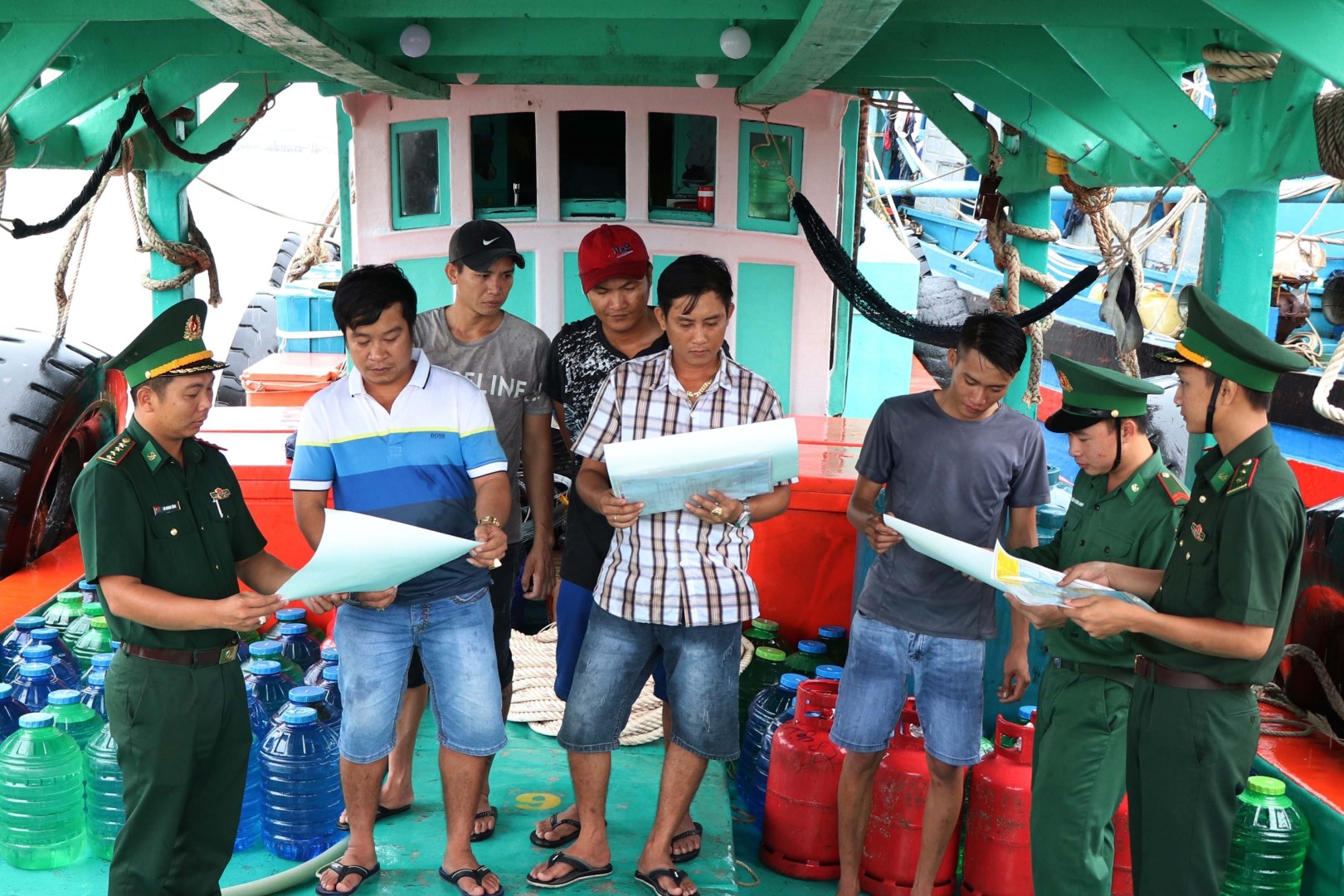
Vietnam Coast Guard officers present the national flag to fishermen (Photo: VNA)

James Borton, a non-resident senior fellow at Johns Hopkins SAIS Foreign Policy Institute told the Vietnam News Agency that Vietnamese authorities have demonstrated an eagerness and willingness to strengthen its legal framework and improve traceability and transparency in seafood trade. “These commitments underscore the significance of collaborative engagement in addressing IUU fishing challenges,” he said.

Borton was of the view that IUU fishing continues to be a problem of the Vietnamese fishing industry that is a cornerstone of the country’s economy. “As a result, Vietnam has taken urgent steps to move towards greater marine stewardship since the South China Sea (called the East Sea in Vietnam) – one of the richest fishing grounds in the world – has suffered depletion of fish stocks.”

Since Vietnam is one of the major seafood exporters worldwide, authorities know that they must succeed in fortifying its legal framework and improve traceability and transparency, Borton added.

Certainly, there remains a significant need for improvement, particularly in enforcing regulations and regularly updating the database of licensed fishing vessels, Borton added.

According to Stephen Nagy, Director of Policy Studies for the Yokosuka Council of Asia-Pacific Studies (YCAPS), a key challenge in tackling IUU is that developing states have neither the advanced technology nor capacity to deal with violations. “That means the number of vessels necessary to monitor and enforce local and international law is limited.”

What we see is ships that are engaged in these activities turn off their vessel monitoring system (VMS) devices, which is why we call them “dark vessels,” and they engage in mass illegal and unregulated, undocumented fishing. As long as this continues to be the case, it will be difficult to protect and sustain maritime resources for future generations.

Stephen Nagy, Director of Policy Studies for the Yokosuka Council of Asia-Pacific Studies. (YCAPS) (Photo: VNA)

Therefore, having access to technologies that can help identify dark vessels or those vessels that are engaged in IUU activities will be important. “That means countries like Vietnam need to look beyond their regional partners for technologies and for further assistance. For example, Canada has worked actively with the Philippines in terms of dark vessel technology, which allows the Filipinos to detect ships engaged in IUU fishing, thus contributing to their efforts to successfully remove the EC’s yellow card. This will be an area of future cooperation,” Nagy added.

Jean-Jacques Bouflet, EuroCham Vice-Chairman in charge of Advocacy, said Vietnam did make some significant progress lately in terms of reinforcing the legal framework and increasing attempts to achieve better enforcement. However, the “yellow card” issue still remains partially due to the lack of resources, personnel, and enforcement. The main issue lies with the vessel monitoring system (VMS) device, which requires measures to ensure that these devices are used effectively and consistently.

Sharing the same view, Nagy highlighted that many countries, including Vietnam and other Southeast Asian nations, face challenges in combating IUU fishing due to the lack of resources, maritime domain awareness, and the ability to enforce local and international law.

Vietnam should strengthen the inspection of the vessel monitoring system (VMS) to ensure its effective use. It is also necessary to increase awareness among fishermen and seafood product buyers about IUU fishing issues.

Jean-Jacques Bouflet, EuroCham Vice-Chairman in charge of Advocacy (Photo: EuroCham Vietnam)

Rhea Moss-Christian, Executive Director of the Western and Central Pacific Fisheries Commission (WCPFC) said IUU fishing undermines the very foundation of sustainable fisheries management, threatening marine ecosystems and the livelihoods and food security of communities, particularly in small developing island states and participating territories in the Western Pacific Ocean.

In the WCPFC context, Vietnam is cooperating in and contributing to supporting the sustainable management of highly migratory fish stocks under the purview of the WCPFC Convention, through national and subregional cooperative activities in the Western Pacific and East Asia Seas.

Rhea Moss-Christian, Executive Director of the Western and Central Pacific Fisheries Commission (Photo: WCPFC)

Since 2009, Vietnam has been one of the three participating countries in the WCPFC’s Western Pacific East Asia Improved Tuna Monitoring (WPEA-ITM) Project, which has directly helped improve fisheries data collection and is addressing important data gaps in stock assessments for tropical tunas.

She said that the WCPFC attended a Regional Workshop on Operationalising Cooperative Mechanisms to Combat IUU Fishing host by Vietnam in the central coastal city of Da Nang late April. The event saw the participation of international and regional experts in fisheries law enforcement from 12 countries, namely Australia, Canada, Indonesia, Japan, the Republic of Korea, Malaysia, the Philippines, Thailand, the UK, the US, and Vietnam.

Through that workshop, Vietnam informed the meeting of the national measures, including Port State activities, that are supporting efforts to combat IUU fishing in Western Pacific and East Asia Seas.

Video: 2024 crucial for Vietnam to prove efforts in IUU Fight

Anti-IUU fishing requires buy-in from all stakeholders

Experts underlined key factors that help countries combat IUU fishing effectively and ensure the protection and sustainable use of marine resources for future generations. They include whole-of-government coordination and data sharing; collaboration among national coast guard personnel, port inspectors and regional fisheries management organisations; and cooperation with neighbouring countries for sharing of the best practices on approaches to combat IUU fishing and exchanging information on maritime threats.

Drawing from its experience in implementing activities for improving monitoring, traceability and sustainability, EuroCham is willing to share, collaborate, and actively engage more with relevant parties such as the Vietnam Association of Seafood Exporters and Producers (VASEP) to ensure that “VASEP members when they buy fish product in Vietnam for re-exporting to Europe, they ensure themselves, also double check for the respect of the legislation,” according to Bouflet.

Meanwhile, Borton suggested that Vietnam can take leadership once again in ASEAN by rallying support for the Regional Fisheries Management Organizations (RFMOs) and hosting or encouraging other neighbouring countries to stage workshops on best practices in fishing governance. “After all, all of the Southeast Asian countries have their nets in the water and all of them are dependent on the marine fisheries as their main source of revenue, employment and food security,” he said.

He added that the fisheries sector is of the highest priority for ASEAN economic integration. It is time to renew the emphasis and build on the progress, which has been so far limited, on the Strategic Plan of Action for ASEAN Cooperation on Fisheries 2021-2025, according to Borton.

“An anti-IUU fishing mandate requires buy-in from all fishermen, whether they be artisanal or commercial, coastal communities and the citizens at large,” Borton said./.

Fishing vessels in south central coastal province of Ninh Thuan (Photo: VNA)

Linh Ha – Bich Huong

General Vo Nguyen Giap in the heart of int’l friends

More than a decade has passed since millions of Vietnamese people and international friends paid their final respects to General Vo Nguyen Giap as he was laid to rest in his homeland of Quang Binh province (October 4, 2013). Renowned as an exceptional military strategist in Vietnam’s history, particularly for his pivotal role in the resounding victory of 1954 Dien Bien Phu campaign, the image of the humble, sincere, and devoted general, who dedicated his whole life to the nation and people, is not only revered and admired by the Vietnamese people but has also left an indelible mark in the hearts of international friends.

General Giap lives on in people’s mind

General Vo Nguyen Giap was a military leader of the greatest stature, a strategist of the “people’s war” and a faithful representative of the thought of President Ho Chi Minh, said Algerian Ambassador to Vietnam Sofiane Chaib.

The diplomat highlighted that besides the prestige and respect he won through his victories on the military field, the General devoted his entire life to serving his homeland and his people. “His destiny as a hero who gloriously accomplished his patriotic duty is intertwined with the most significant stages in the history of Vietnam.”

“This is undoubtedly the reason why General Giap remains present in the memory of the friendly Vietnamese people, as I was able to notice during the recent funeral of his late wife, which I personally attended. He is also present for the Algerian people who will never forget this friend whose name will always remain engraved in their memory.”

Algerian Ambassador to Vietnam Sofiane Chaib writes in a condolence book on the passing of Associate Professor Dang Bich Ha, spouse of General Vo Nguyen Giap. (Photo courtesy of the Algerian Embassy in Vietnam)

For the Algerian people, General Giap represents a central link in the historic relations of solidarity between Algeria and Vietnam, serving as a key figure in the most beautiful chapters of the two countries’ shared history, both before and after Algeria’s independence, according to the diplomat.

“This military hero of Vietnamese independence had special ties with Algeria, which he visited several times and where he delivered his famous speech in 1980 declaring that colonialists are bad students of history. This formula has remained proverbial in Algeria and my country always strives to perpetuate this collective memory which represents an inestimable heritage in the historical relations of friendship, solidarity and cooperation uniting us with Vietnam.”

General Giap’s legacy transcends borders

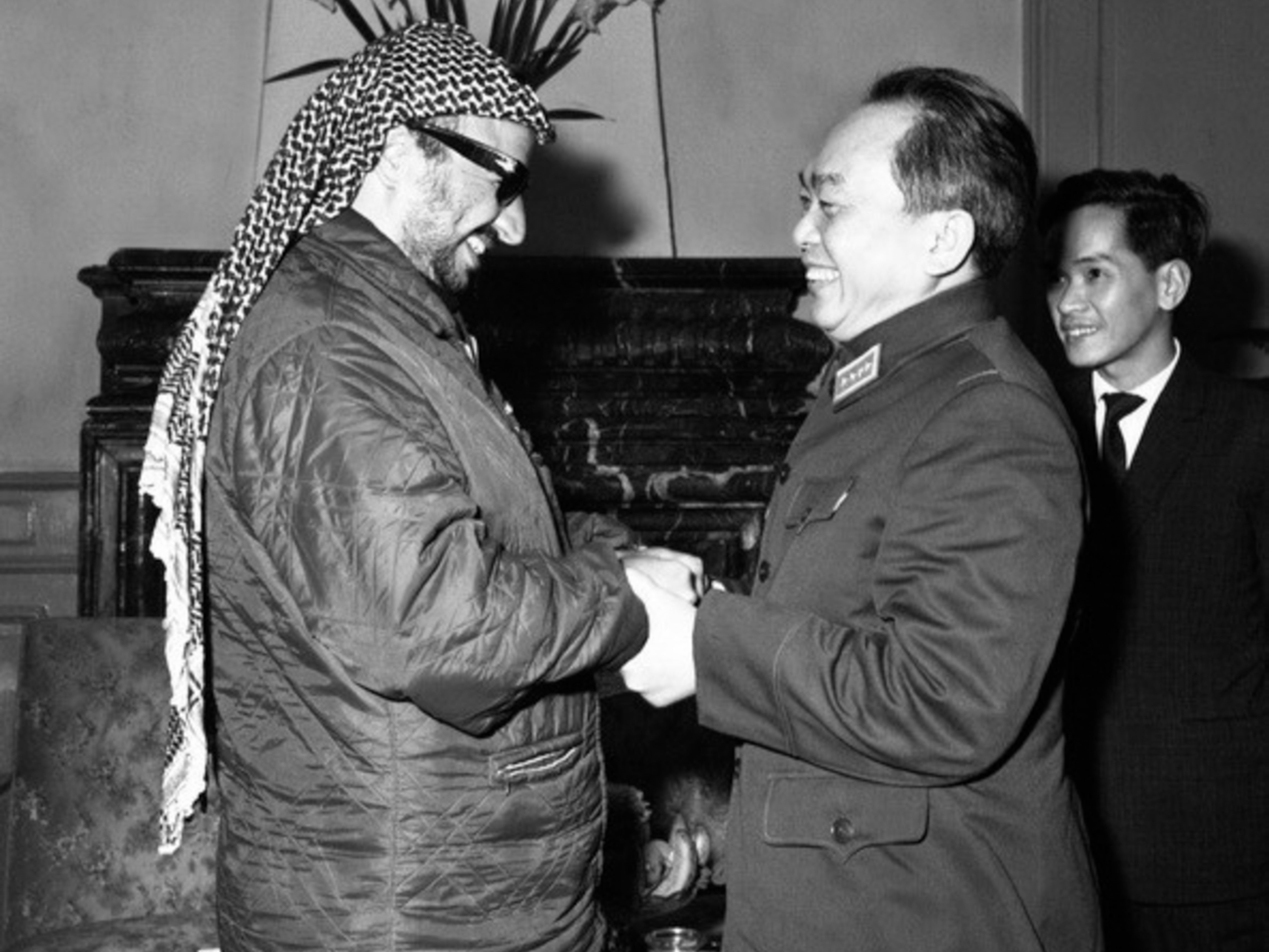
General Vo Nguyen Giap, Minister of National Defense, receives Chairman of the Palestine Liberation Organization, President Yasser Arafat in Hanoi in 1970. (File Photo: VNA)
General Vo Nguyen Giap presents the “Dien Bien Phu Soldier” badge to Cuban Prime Minister Fidel Castro in Hanoi in September 1973. (File Photo: VNA)
General Vo Nguyen Giap meets with President of the Republic of Mozambique Samora Machel in November 1980. (File Photo: VNA)
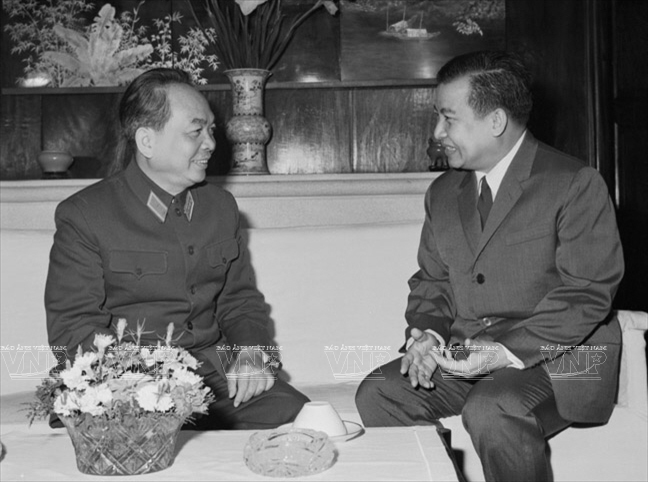
General Vo Nguyen Giap talks with Head of State of the Kingdom of Cambodia Samdech Norodom Sihanouk in 1972. (File Photo: VNA)

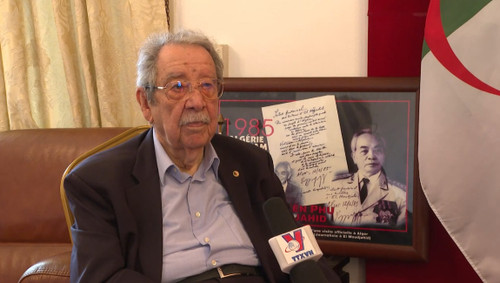
For Djoudi Noureddine, Chairman of the International Association of Algerian Revolution Friends, the memories of the legendary General remain fresh in his mind despite his old age. “General Giap’s legacy transcends borders, not only holding a deep place in the hearts of the Vietnamese people but also resonating globally,” he said.

The 90-year-old Chairman shared that he had the privilige to meet Giap once in Algiers and once in Hanoi, saying the General left a very strong impression on the Algerian people. “General Giap is an outstanding historical figure and a reference for the liberation movements, not only a military man who organised the Vietnamese liberation army and succeeded in defeating the army of colonisers.”

Djoudi Noureddine, Chairman of the International Association of Algerian Revolution Friends (Photo: VNA)

For us, obviously, the name of General Giap and Dien Bien Phu are closely linked. We had the opportunity to see him when he came to Algeria several times and we always have a lot of respect for him because he is truly an icon on the international level.

Noureddine quoted General Giap’s speech in Algeria during his historic tour to 12 African countries in October 1980: “The imperialists are bad students. We have given them lessons properly … But they learn the lessons poorly, although they are lessons of historical significance.”

“Giap’s words served as a source of inspiration for numerous Africans who strived to rise and struggle for their independence.”

“For example, the Mozambicans, the Angolans, and the Guinea-Bissaus, they were inspired by both the action of General Giap in Vietnam and the liberation war in Algeria. He was a man who went beyond the borders of Vietnam and a man of the international community,” Noureddine said.

He added that along with President Ho Chi Minh, General Vo Nguyen Giap remains forever in the memory of the African peoples and especially those who fought for their independence.”

During her official visit to Vietnam and attendance at APEC-14 held in Hanoi in 2006, President of Chile
Michelle Bachelet Jeria visits General Vo Nguyen Giap at his private residence (Photo: VNA)
General Vo Nguyen Giap with former US Secretary of Defense Robert McNamara (June 1997). (File Photo: VNA)
General Vo Nguyen Giap with French President Jacques Chirac (1997). (File Photo: VNA)

General Giap and the historic Dien Bien Phu victory

Carl Thayer, Emeritus Professor at the University of New South Wales, described General Giap as a self-taught military strategist who combined elements of Vietnamese military tradition and the theory of the people’s war, adding Giap learned through battlefield experience how to conduct people’s war. “It was General Vo Nguyen Giap who defeated the French, one of the most modern military forces in the world at his time.”

Carl Thayer, Emeritus Professor at the University of New South Wales (Photo: VNA)

The Dien Bien Phu victory under General Giap’s command brought to an end the anti-French resistance war, and this sounded not only the death knell of the French rule in Indochina but also the beginning of the end of colonialism in Asia and Africa.

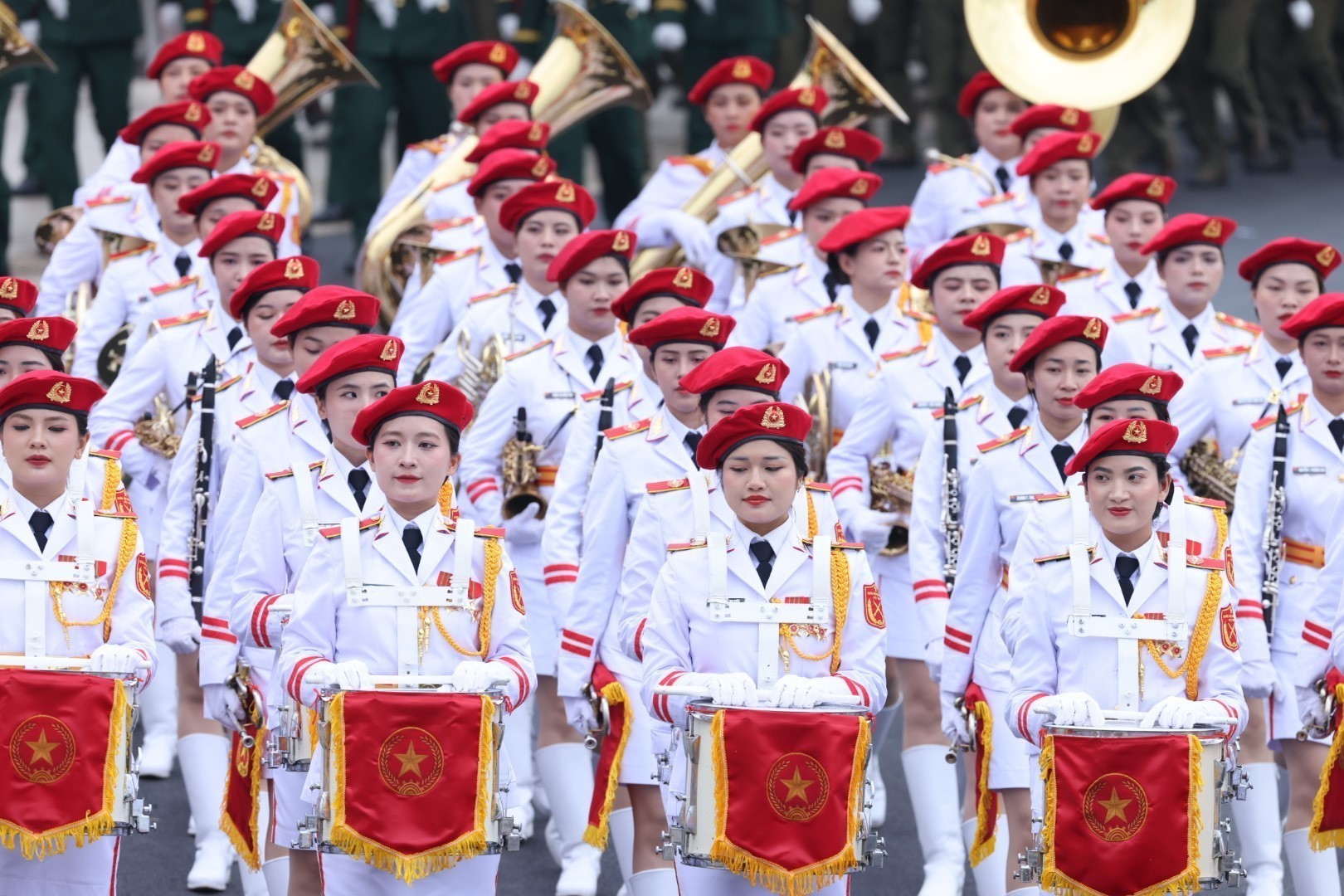
Photos: Parades Marking the 70th Anniversary of the Dien Bien Phu Victory (Source: VNA)

Pierre Asselin, Professor of History at San Diego State University, said General Giap is often lauded as a brilliant military leader, particularly thanks to his role in the battle of Dien Bien Phu. His standout quality during this battle was his flexibility.

“He was very flexible,” Asselin said, elaborating that initially aiming for a quick victory, Giap adjusted his tactics multiple times in response to the evolving situation. He transitioned from “fast strike, fast victory” to “steady attack, steady advance” strategy, eventually leading to success. “This adaptability and willingness to change plans in the face of adversity were crucial to the Vietnamese victory,” Asselin said.

General Giap’s ability to acknowledge and rectify mistakes sets him apart as a great leader, embodying a Vietnamese bamboo strategy characterised by adaptability and utility. This flexibility was instrumental in securing victory over the French forces at Dien Bien Phu.

Pierre Asselin, Professor of History at San Diego State University (Photo: VNA)

Experts said because of these accomplishments, General Giap is widely respected by international leaders and friends as the military strategist who mastered the art of the people’s war by combining political struggle with military one in a protracted war that defeated both France and the US in the cause of Vietnamese independence against foreign aggression.

General Giap is also widely viewed as a symbol of the Vietnamese nation thanks to his remarkable lifelong contributions to the cause of national building and defense, as well as the nation’s peaceful socio-economic development./.

Biography of General Vo Nguyen Giap

(August 25, 1911 – October 4, 2013)

Native place: Loc Thuy commune, Le Thuy district, the central province of Quang Binh.

  • 1925-1926: join students’ movement in Hue.

  • 1927: participate in the Tan Viet (New Vietnam) Revolutionary Party (a predecessor of the Dong Duong Communist Party and now the CommunistParty of Vietnam).

  • 1930: arrested and imprisoned two years by the enemy. After being released, he continued to involve in revolutionary activities, developing revolutionary bases among the youth.

  • 1936: work as an editor for the Party’s newspapers, including Lao Dong (Labour), Tieng noi chung ta (Our Voice), Tien len (Advance), and Thoi bao Co Giai phong (Liberation Flag Times). He was appointed to be the chair of the Bac Ky (North) Press Committee.

  • 1940: admitted to the Dong Duong Communist Party and sent abroad to meet comrade Nguyen Ai Quoc (Ho Chi Minh).

  • 1941: return to the country, taking part in activities to prepare for an armed uprising in the Cao-Bac-Lang revolutionary base.

  • 1944: Nguyen Ai Quoc assigned him the task of setting up the Vietnam Propaganda Liberation Army (now the Vietnam People’s Army).

  • 1945: appointed to the Bac Ky (North) Military Committee.

  • From May 1945: serve as commander of the new armed revolutionary forces (then merged to be the Vietnam liberation army).

  • June 1945: assigned by Nguyen Ai Quoc to set up the provisional Commanding Committee of the liberated area.

  • August 1945: Appointed to the Party Central Committee and the National Uprising Committee. At the Tran Trao National People’s Congress, he was elected to the Vietnam National Liberation Committeeand Minister of Interior Affairs in the provisional government of the Democratic Republic of Vietnam.

  • March 1946: become military chairman, member of the coalition government. Then he became Secretary of the Central Military Commission when the commission was formed.

  • October 1946: become Minister of Defence and authorised by President Ho Chi Minh to be Commander in Chief of the Vietnam People’s Army and Militia.

  • 1948: conferred the highest ranking of General, Commander in Chief of the Vietnam People’s Army.

  • 1951: elected to the Party Central Committee at the second National Party Congress and the Party Central Committee then elected him to the Political Bureau.

  • September 1955 – December 1979: serve as Deputy Prime Minister and Defence Minister.

  • September 1960 – December 1976: re-elected to the Party Central Committee and the Political Bureau.

  • From January 1980: serve as Standing Deputy Prime Minister.

  • April 1981 – December 1986: serve as Deputy Chairman of the Council of Ministers.

In recognition of his great contributions to the Party and country’s revolutionary cause, General Vo Nguyen Giap was conferred with the Gold Star Order, the Ho Chi Minh Order, the 70-year Party membership badge and other noble orders and medals of Vietnam and foreign countries and organisations.

Panoramic painting depicts the historic victory of the Dien Bien Phu Campaign, closely associated with General Vo Nguyen Giap. (Photo: VNA)

Linh Ha – Thu Huong

Trung Khanh – Ngoc Tu

VIETNAM PLACES GREAT IMPORTANCE ON RIGHTS, WELFARE OF THE DISABLED

Prime Minister Pham Minh Chinh visits and presents gifts to children with disabilities at the Hanoi Centre for Disabled Children in Chuc Son town, Chuong My district on May 31, 2024. (Photo: VNA)

Vietnam is one of the countries with a relatively high percentage of persons with disabilities in the Asia-Pacific region and the world.

In addition to the various policies that support the group, enacted by the Party and State to create a legal framework for the care and protection of their rights, society also supports them through education and employment to help them become more self-reliant and improve the quality of life.

Lighting the path to confidence

Happy moment of couples with disabilities at the “Dream Come True” mass wedding ceremony. (Photo: VNA)
Athlete Trinh Thi Bich Nhu (center) wins a Gold Medal and breaks the ASEAN Para Games record in the women’s 100m freestyle, S6 disability class, at the 12th ASEAN Para Games. (Photo: VNA)

According to Deputy Minister of Labour, Invalids, and Social Affairs Nguyen Van Hoi, Vietnam currently has over 7 million persons with disabilities, accounting for 7.06% of the population aged 2 and older, with nearly 29% experiencing severe or particularly severe disabilities.

Born with congenital blindness, Duong Thi Mai Phuong (an 11th grader at Ha Tinh High School for the Gifted) has made great efforts to overcome difficulties, and integrate with her peers. In 2020, she excellently wins third prize in the History subject at the National Exam for Excellent Students. (Photo: VNA)

In 2014, the National Assembly ratified the United Nations Convention on the Rights of Persons with Disabilities. In 2019, Vietnam ratified the International Labour Organisation (ILO)’s Convention 159 on vocational rehabilitation and employment for people with disabilities. In 2022, it joined the World Intellectual Property Organisation’s Marrakesh Treaty to Facilitate Access to Published Works for Persons Who Are Blind, Visually Impaired or Otherwise Print Disabled.

Deputy Minister of Labour, Invalids, and Social Affairs Nguyen Van Hoi

“We continue to translate the conventions and international commitments into national law to take them to the next level, ensuring the achievement of sustainable development goals that are inclusive and leave no one, especially people with disabilities, behind”.

To realise the Constitution and international commitments, the Government submitted the Law on People with Disabilities to the National Assembly in 2010. In addition, the Prime Minister established the National Committee for Vietnamese Persons with Disabilities to assist in addressing relevant issues.

Currently, the social welfare system continues to expand its coverage and improve the quality of policies for the disabled. Over 1.6 million people with severe disabilities in the country receive monthly social allowances, and 96% of the disabled have health insurance cards.

Children with disabilities are assisted to receive inclusive education at educational institutions. For those who cannot participate in inclusive education, they are helped to attend specialised educational institutions.

The entire workforce of people with disabilities (nearly 4 million people) has been supported with vocational training, job creation, livelihoods, or access to loans with preferential interest rates to solve their own employment needs. They have also been given special attention and benefits when using transportation or visiting entertainment areas, cultural sites, and historical monuments, where they receive discounts or free entry.

Dang Van Thanh, Permanent Vice President of the Vietnam Federation on Disability, said the Party and State has provided the best support for them to integrate into life, thus creating equality in society. As a result, the life quality of the disabled has increasingly improved and their rights been ensured.

Rising to master technology

Le Huy Tich (born in 1978), who suffers paraplegia after a traffic accident, researches and creates electric wheelchairs to assist with mobility for people with disabilities. In 2019, his ETIC wheelchair wins a prize in the SDG Challenge innovation competition for people with disabilities. (Photo: VNA)

In order to leave no persons with disabilities behind, over the past years, the entire political system has engaged in assisting the group to integrate into the community, especially helping them access and use information technology (IT) so that they can assimilate into life more conveniently and fully.

Thanks to such support, IT has become the “hands” of physically disabled persons, the “ears” for the hearing impaired, and the “eyes” for those visually impaired. Digital technology has also helped bridge the gap between people with disabilities and those without.

Dang Van Thanh, Permanent Vice President of the Vietnam Federation on Disability (Photo: VNA)

“The development of science and technology has proved greatly useful for supporting people with disabilities, promoting their full integration and equality in society. Technology plays a significant role, helping to eliminate barriers and facilitate communication, information search, and job opportunities”.

To support them in accessing and mastering technology, the federation, along with 50 member organisations, has regularly organised IT training classes.

It has also collaborated with the Vietnam Institute of Software and Digital Content Industry under the Ministry of Information and Communications to develop software that provides statistics on the number of persons with disabilities, the types of disabilities, and their needs in areas like education, health care, and employment. Based on this data, the federation will propose and promote amendments to policies in order to best support vulnerable groups.

An overview of the seminar on global trends in employment for people with disabilities in IT sector, held in Hanoi. (Photo: VNA)
Nguyen Thi Van, Chairwoman of Chairwoman of Co-founder Board of the Will to Live Centre, delivers a speech at the seminar. (Photo: VNA)

According to Thanh, in the digital age, the disabled face many difficulties and challenges such as access and costs. Additionally, there are challenges related to resources and barriers linked with the perception towards them and their families.

People with disabilities in Thang Binh district, Quang Nam province, receive vocational support from “Hold My Hand” Project. (Photo: VNA)
An information technology vocational class for students with disabilities in Hung Yen province. (Photo: VNA)
Persons with disabilities working at a factory of Chilisin Vietnam Electronics Co., Ltd. (Photo: VNA)

In the coming time, the federation and its 50 member organisations will hold various activities to promote IT education and train online sales skills for persons with disabilities. At the same time, attention will be paid to assisting them to access information technology, thus helping improve their lives and reduce their dependency on society.

Over 10 years since the UN Convention on the Rights of Persons with Disabilities was ratified and more than a decade since the Law on Persons with Disabilities came into effect, Vietnam has worked tirelessly to improve the accessibility for this vulnerable group.

Among these efforts, digital transformation in various fields has made significant progress, contributing to promoting the rights and assimilation of people with disabilities. It is a fact that more mechanisms and policies are still needed to help them to master technology earlier in life, leading to better job opportunities in the future and contributing more to society./.

Coaches and athletes with disabilities receive Certificates of Merit from the Prime Minister in a programmme celebrating Vietnam Day for Persons with Disabilities (April 18) in 2024. (Photo: VNA)

Le Vietnam accorde toujours une attention particulière aux personnes handicapées

Le Premier ministre Pham Minh Chinh a visité et offert des cadeaux aux enfants handicapés au Centre d’éducation des enfants handicapés de Hanoï, au chef-lieu de Chuc Son, district de Chuong My (31 mai 2024). Photo: VNA

Le Vietnam est l’un des pays où le taux de personnes handicapées est relativement élevé dans la région Asie-Pacifique et dans le monde.

Outre les nombreuses politiques et directives émises par le Parti et l’État en faveur des personnes handicapées, créant un cadre juridique pour protéger leurs droits, la communauté sociale joue également un rôle actif en soutenant un grand nombre de personnes handicapées. Elle leur offre des opportunités d’apprentissage et de travail afin qu’elles puissent améliorer leur vie de manière proactive.

Allumer la foi

Un marriage collectif pour les handicapés. Photo : VNA
L’athlète Trinh Thi Bich Nhu (centre) a remporté une médaille d’or en battant le record de l’ASEAN ParaGames au 100 m nage libre féminin, catégorie handicap S6, lors des 12e ASEAN ParaGames . Photo : VNA

Selon le vice-ministre du Travail, des Invalides de guerre et des Affaires sociales, Nguyen Van Hoi, le Vietnam compte actuellement plus de 7 millions de personnes handicapées, soit 7,06 % de la population âgée de 2 ans et plus, dont près de 29 % sont gravement ou extrêmement handicapées.

Duong Thi Mai Phuon, une lycéenne de Ha Tinh, née malvoyante, a remporté le troisième prix du concours national d’excellence des étudiants en histoire 2023. Photo : VNA

En 2014, l’Assemblée nationale du Vietnam a ratifié la Convention des Nations Unies relative aux droits des personnes handicapées. En 2019, le Vietnam a ratifié la Convention 159 de l’Organisation internationale du travail (OIT) sur la réadaptation professionnelle et l’emploi des personnes handicapées. En 2022, le Vietnam a ratifié le Traité de Marrakech de l’Organisation mondiale de la propriété intellectuelle, garantissant ainsi un meilleur accès à la culture pour les personnes aveugles et malvoyantes.

Le vice-ministre du Travail, des Invalides et des Affaires sociales Nguyen Van Hoi. Photo : VNA

“Nous continuons à concrétiser la Convention et les engagements internationaux dans les lois nationales et à un nouveau niveau, en garantissant la mise en œuvre des objectifs de développement durable et inclusif et en ne laissant personne de côté, en particulier les personnes handicapées”.

Pour mettre en œuvre la Constitution et les engagements internationaux, le gouvernement a soumis à l’Assemblée nationale la Loi sur les personnes handicapées de 2010. En outre, le Premier ministre a créé le Comité national pour les personnes handicapées du Vietnam, afin de les aider à résoudre les problèmes liés à l’emploi des personnes handicapées.

Actuellement, le système de sécurité sociale élargit constamment sa couverture et améliore la qualité des politiques destinées aux personnes handicapées. À l’échelle nationale, plus de 1,6 million de personnes gravement handicapées reçoivent des prestations sociales mensuelles et 96 % d’entre elles disposent d’une carte d’assurance maladie.

Les enfants handicapés sont soutenus pour s’intégrer dans les établissements scolaires. Ceux qui ne parviennent pas à s’intégrer dans le système éducatif ordinaire bénéficient d’un soutien pour étudier dans des établissements spécialisés.

Les travailleurs handicapés (près de 4 millions de personnes) bénéficient d’un soutien en matière de formation professionnelle, de création d’emplois, de moyens de subsistance ou de prêts à taux d’intérêt préférentiels pour trouver leur propre emploi. Ils bénéficient également d’une attention particulière et de traitements préférentiels lorsqu’ils participent à la circulation, entrent dans des zones de divertissement, des sites ou des reliques historiques avec des billets gratuits ou à prix réduit.

“Cette attention a fourni le meilleur soutien aux personnes handicapées pour s’intégrer dans la vie, créant ainsi l’égalité dans la société. C’est pourquoi la vie des personnes handicapées au Vietnam s’améliore de jour en jour et leurs droits sont progressivement garantis.” a déclaré le vice-président permanent de l’Association des personnes handicapées du Vietnam, Dang Van Thanh.

Maîtriser la technologie

Le Huy Tich (né en 1978) a été paralysé des deux jambes suite à un accident de la circulation. Il a étudié et créé un tracteur pour fauteuil roulant pour aider les personnes handicapées à se déplacer. En 2018, son produit a remporté le troisième prix du concours provincial d’idées créatives de startups pour les jeunes et aussi le concours créatif SDG Challenge pour les personnes handicapées en 2019. Photo : VNA

Avec pour devise de “ne laisser personne de côté”, le système politique vietnamien a travaillé pendant des années pour soutenir l’intégration des personnes handicapées au sein de la communauté, notamment en facilitant l’accès aux technologies de l’information pour qu’elles puissent s’intégrer plus facilement et pleinement dans la vie.

Grâce aux mesures d’accessibilité, les technologies de l’information sont devenues les mains des personnes handicapées physiques, les oreilles des malentendants et les yeux des malvoyants. Le numérique contribue également à combler le fossé entre les personnes handicapées et celles qui ne le sont pas.

Dang Van Thanh, vice-président permanent de l’Association vietnamienne des personnes handicapées

Le développement de la science et de la technologie a contribué de manière significative à soutenir les personnes handicapées, en favorisant leur intégration pleine et égale dans la communauté sociale. La technologie est essentielle pour aider les personnes handicapées à éliminer les distances, communiquer, rechercher des informations, trouver des emplois, etc.

Afin d’aider les personnes handicapées à accéder à la technologie et à la maîtriser, l’Association des personnes handicapées du Vietnam et ses 50 organisations membres ont récemment mis en place des cours réguliers sur les technologies de l’information.
L’association et l’Institut de l’industrie du logiciel et du contenu numérique du Vietnam (ministère de l’Information et de la Communication) ont développé un logiciel de gestion des données relatives aux personnes handicapées. Ce logiciel permet de collecter des statistiques sur le nombre de personnes handicapées, leur type de handicap et leurs besoins en matière d’éducation, de soins de santé, d’emploi, etc. Sur la base de ces données, l’association proposera des amendements politiques pour mieux soutenir les groupes vulnérables.

L’atelier « Tendances mondiales en matière d’emploi dans le secteur informatique pour les personnes handicapées » à Hanoi. Photo : VNA
Mme Nguyen Thi Van, présidente du conseil fondateur du Centre pour la volonté de vivre, a pris la parole lors d’un l’atelier. Photo : VNA

Selon Dang Van Thanh, à l’ère numérique, les personnes handicapées rencontrent de nombreuses difficultés et défis, tels que l’accès limité aux technologies en raison de leur coût élevé, ce qui rend leur accès à la technologie encore plus restreint. De plus, des obstacles tels que le manque de ressources et des barrières psychologiques pour les personnes handicapées et leurs familles viennent compliquer la situation.

Les personnes handicapées du district de Thang Binh, province de Quang Nam, bénéficient d’un soutien professionnel grâce au projet « Hold My Hand ». Photo : VNA
Un cours de formation professionnelle en technologie de l’information pour étudiants handicapés à l’École de réadaptation et de formation professionnelle pour handicapés de Tien Lu, Hung Yen. Photo : VNA
Les travailleurs handicapés travaillent dans même usine que d’autres travailleurs normaux de Chilisin Electronics Vietnam Co., Ltd. Photo : VNA

À l’avenir, l’Association des personnes handicapées du Vietnam et ses 50 organisations membres mèneront de nombreuses activités, telles que la promotion de l’enseignement des technologies de l’information, la formation aux techniques de vente en ligne et la mise en œuvre de politiques visant à soutenir les personnes handicapées dans l’accès aux technologies de l’information, afin de les aider à améliorer leur qualité de vie et à réduire leur dépendance à la société.

Après 10 ans de ratification de la Convention des Nations Unies relative aux droits des personnes handicapées et plus de 10 ans depuis l’entrée en vigueur de la Loi sur les personnes handicapées, le Vietnam a continué à déployer des efforts pour améliorer l’accessibilité des personnes handicapées grâce à de nombreuses solutions, avec la coopération de tous les niveaux, secteurs et de l’ensemble de la société.

En particulier, la transformation numérique dans de nombreux domaines a permis de grandes avancées, contribuant à promouvoir les droits et l’intégration des personnes handicapées. Cependant, il est nécessaire de renforcer davantage les mécanismes et les politiques pour permettre aux personnes handicapées de se familiariser avec la technologie dès leur jeune âge. Cela leur permettra d’accéder rapidement à la technologie, de la maîtriser et d’avoir de meilleures opportunités d’emploi dans le futur, contribuant ainsi positivement à la société./.

Les entraîneurs et les athlètes handicapés ont reçu des certificats de mérite du Premier ministre dans le cadre du programme de célébration de la Journée vietnamienne des personnes handicapées (18 avril 2024). Photo: – VNA

Eradicating substandard housing: Building fair and prosperous society

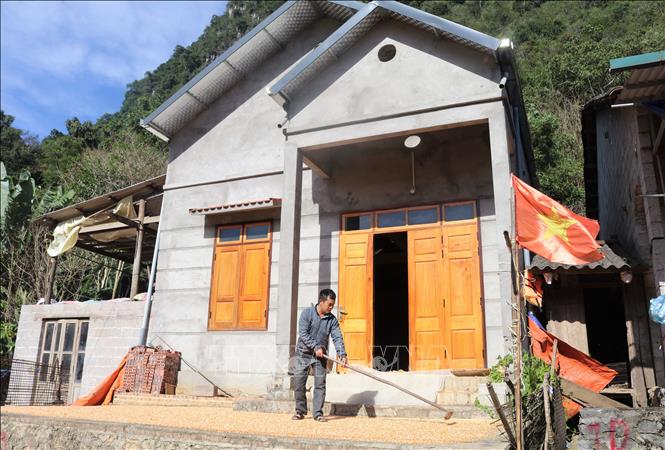
Twenty-nine households in Huoi Lap Village, Quang Lam Commune, Muong Nhe District, Dien Bien Province were facing serious threats from a large landslide zone due to prolonged heavy rain.
The area is part of Project 79, a resettlement and socio-economic development initiative aimed at ensuring national defense and security in Muong Nhe District. (Photo: VNA)

Vietnam is on a mission to eliminate temporary and dilapidated housing in 2025, a crucial step in its commitment to poverty reduction and social equity. This initiative aims to ensure safe, dignified living conditions for all, particularly vulnerable communities.

Quang Ngai strives to eliminate temporary and dilapidated houses for poor and near-poor households. (Photo: VNA)
Joining hands to build homes for disadvantaged communities in Lai Chau. (Photo: VNA)
Temporary in Cao Bang province (Photo: VNA)

Aligned with Resolution No. 42 of the 13th Central Committee of the Communist Party of Vietnam, this effort seeks to enhance social policy and position of Vietnam as a leader in social welfare and sustainable development, in accordance with its goals as part of the United Nations.

A national commitment to secure housing

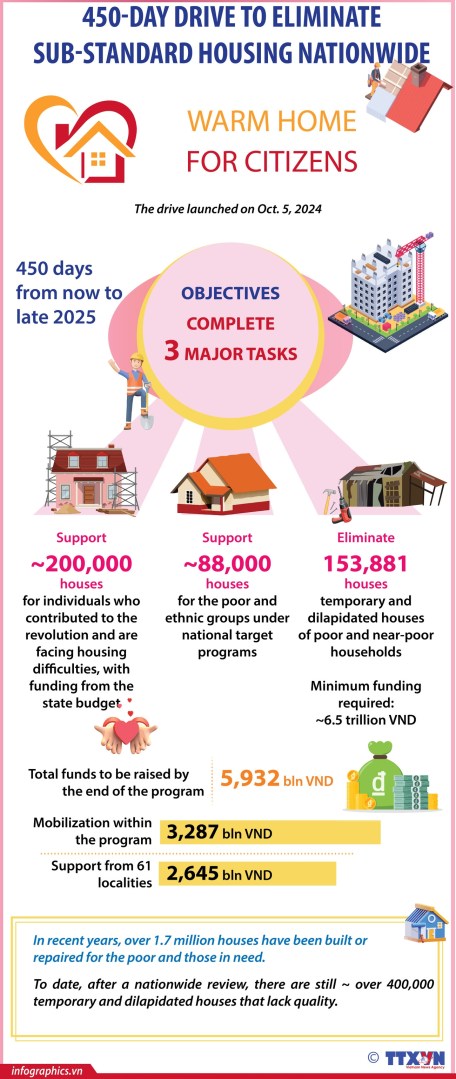
On April 13, 2024, Prime Minister Pham Minh Chinh launched a nationwide campaign to eradicate substandard housing. The initiative targets three key areas. These include housing support for 200,000 individuals with meritorious services funded by the state. It also includes assistance for 88,000 households through national programmes, and the eimination of unsafe housing for remaining impoverished families.

On the morning of April 13, 2024, in Da Bac district, Hoa Binh province, Prime Minister Pham Minh Chinh attended the launching ceremony of the nationwide emulation movement “Eradicating temporary and dilapidated housing” from now until 2025. Photo: VNA

Local government data reveals that beyond those covered by state programmes, 153,881 impoverished households still live in inadequate conditions, requiring an estimated 6.5 trillion VND (255.7 million USD) for support.

The 450-day campaign

To accelerate progress, the Government and the Vietnam Fatherland Front Central Committee launched the project, “A Home for Fellow People” on October 5, 2024. The effort rallies resources to support over 150,000 struggling households. The campaign aims to provide homes meeting the “three-solid” standard—secure roofs, floors, and walls.

At the campaign launch ceremony, Prime Minister Chinh underscored the urgency, “With only 450 days left until 2025, we must act swiftly. I call upon the entire nation—citizens, soldiers, and local governments —to unite. Those with wealth contribute financially, those with skills contribute labour, and those with limited means contribute in any way possible. Together, we will end temporary housing, especially in remote and border regions,” he said.

Progress and impact

Since the Central Steering Committee’s first meeting on November 10, 2024, the Government, the Vietnam Fatherland Front, and ministries have taken decisive action.

Prime Minister Pham Minh Chinh emphasised that the programme has been effectively implemented thanks to the spirit of great national unity and the nation’s deep-rooted tradition of resilience—rising even stronger in times of difficulty and challenge. Its success is also attributed to the Party Central Committee’s sound policies, the collective engagement of the entire political system, the government’s decisive, timely, and effective leadership, as well as the strong support and active participation of the business community and people from all walks of life. Additionally, ministries, agencies, and localities have demonstrated initiative, proactiveness, flexibility, and creativity in implementation.

This effort is not just about poverty reduction—it embodies Vietnam’s spirit of unity and resilience, laying the foundation for a fairer, more prosperous future.

The successful implementation of the National Programme to Eliminate Temporary and Dilapidated Housing in 2025 carries profound significance. It realizes the Party’s policies and guidelines while reflecting the fundamental values of our system—ensuring a prosperous and happy life for the people.

A brighter future for vulnerable communities

A secure home is more than shelter—it provides stability, health, and opportunity. For families living in makeshift houses, safe housing is their dream.

Nguyen Van Hau, from Soc Trang, has struggled for years in poor conditions, compounded by Agent Orange exposure.

“At night, moonlight streamed through the holes in our roof. All I ever wished for was a house that could shield us from the rain and sun,” Hau shared.

Minister of Labour, Invalids, and Social Affairs Dao Ngoc Dung emphasised the initiative’s humanitarian values. “Providing secure housing is not just about shelter—it ensures dignity, security, and a foundation for a better life,” he said.

Thanks to the programme, families like Nguyen Van Hau’s in Lao Cai or Bui Van Moi’s in Hoa Binh now have safe, permanent homes. “We no longer fear the storms. We finally have a place to call home,” Moi said gratefully.

Eliminating unsafe housing is more than a poverty-reduction strategy—it is a testament to Vietnam’s commitment to solidarity and shared prosperity. By ensuring access to secure homes, the programme empowers families to break free from poverty.

Advancing human rights and development

Prime Minister Chinh stated, “The greatest human right in Vietnam is ensuring a prosperous, happy, and peaceful life for our 100 million citizens, where security and democracy are upheld, and human potential is maximised.”

According to the UNDP’s 2024 Human Development Report, Vietnam’s Human Development Index (HDI) ranking rose from 115th to 107th out of 193 nations. The country’s happiness ranking climbed 11 spots to 54th out of 143 countries. Its Sustainable Development Goals (SDGs) index improved to 54th out of 166.

As an active member of the UN Human Rights Council for the 2023-2025 term, Vietnam continues to advocate for equitable and sustainable progress.

Professor Nguyen Xuan Thang, Director of the Ho Chi Minh National Academy of Politics, highlighted this shift. “In this new era, human rights are not just a goal but a driving force for progress. Vietnam is prioritising the well-being and rights of its people,” he said.

With a national commitment to eradicating substandard housing, Vietnam is laying the groundwork for a stronger, more prosperous future. By 2045, the country aims to become a high-income developed economy—one where no one is left behind.

Vietnam will not sacrifice social progress and welfare for mere economic growth. “We are committed to building a fair, just, and sustainable society.”

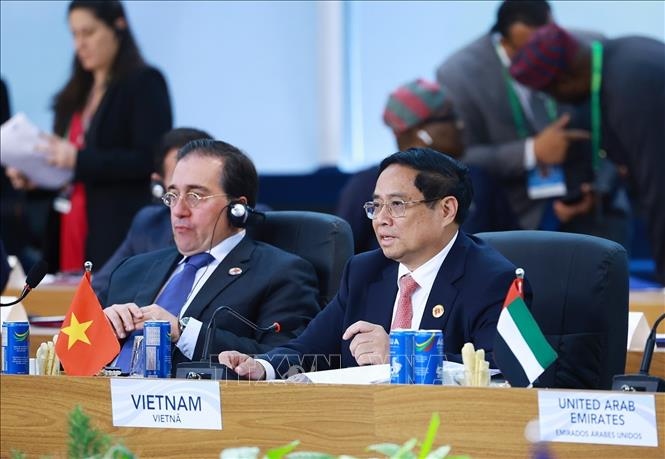
Prime Minister Pham Minh Chinh at the 2024 G20 Summit in Rio de Janeiro.

In an interview with a Vietnam News Agency correspondent in the UK, Kyril Whittaker, a political and historical researcher on Vietnam and a member of the Communist Party of Britain, praised the country’s achievements.

“The government’s push to eliminate substandard housing by 2025 showcases Vietnam’s commitment to fairness and human rights. This isn’t just about respecting human rights—it’s about protecting them in the best way possible,” Whittaker said./.

The nationwide campaign “Eliminating Temporary and Dilapidated Houses” is not only an effort to eradicate substandard housing for poor households but also aims to lay the foundation for sustainable poverty reduction and improve the quality of life for disadvantaged communities. (Photos: VNA)

Author: Phuong Vu, Trang Nhung / Editor: Hoang Nhuong

Streamlining state apparatus key to Vietnam’s new breakthroughs

Streamlining the state apparatus is both an urgent necessity and a natural progression for Vietnam to advance in the new era, solidifying its position in the region and the world. This is the view shared by domestic and international experts regarding Vietnam’s commitment to reforming its organisational structure.

Since the 12th Central Committee of the Communist Party of Vietnam adopted Resolution No. 18 in October 2017, aimed at reforming and restructuring the political system for greater efficiency and effectiveness, Vietnam has made remarkable efforts to streamline its political apparatus. While notable progress has been achieved, the restructuring process remains inconsistent, overlapping, and multilayered, leading to risks of corruption, wastefulness, and other negative phenomena.

Stephen Nagy, Director of Policy Studies at Yokosuka Council of Asia-Pacific Studies

According to Party General Secretary To Lam, despite the significant changes the country has undergone over the past 40 years of implementing Doi Moi (reform) policies, the restructuring of the political system mainly follows outdated models, with many issues no longer aligned with current conditions and developmental trends. As a result, reforming and restructuring the state apparatus is crucial for Vietnam to make breakthroughs in the new era.

Gemalink, the largest deep-sea container port in the southern province of Ba Ria-Vung Tau’s Cai Mep – Thi Vai seaport complex (Photo: VNA)

Acknowledging the challenge as “difficult, even very difficult,” Party General Secretary To Lam stressed that it “must be done” as it aligns closely with the nation’s aspirations in the new era. “These aspirations include transforming Vietnam into a developing country with modern industry and upper-middle income by 2030 and a developed socialist country with high income by 2045.”

Carl Thayer, Professor at University of New South Wales

According to the Ministry of Home Affairs, the Vietnamese government is undergoing significant restructuring, with plans to reduce the number of ministries to 13 and agencies at the same level to four. This includes cutting five ministries, three government agencies, and eliminating 12 out of 13 general departments and similar organisations. Additionally, 677 departments and equivalents within ministries and agencies, as well as 190 public service units, will be reduced, surpassing the government’s original targets.

Minister of Home Affairs Pham Thi Thanh Tra (Photo: VNA)

“After the restructuring and consolidation, the number of organisations within the government will decrease by 35-40 percent, while the remaining will undergo further restructuring to reduce at least 15 percent. These figures are significant, reflecting the determination of the entire political system.”

Dr. Nguyen Khac Giang, expert from the Institute of Southeast Asian Studies (ISEAS – Yusof Ishak) in Singapore, said with high political determination and strong reform mindset, Vietnam continues to carry out the institutional reform in the spirit of “running and queing at the same time” – a metaphor of General Secretary To Lam to emphasise the urgency and deciveness in the implementation process.

“Vietnam will draw practical lessons during the process of streamlining the state apparatus to adjust and address shortcomings, rather than waiting for perfection before starting. This proactive mindset helps prevent the apparatus from oversizing and wasting resources,” Giang said.

The right time is now

According to experts, this is the “right time” for Vietnam to carry out an institutional revolution, as the country now possesses the necessary resources to achieve breakthroughs in the new era. This includes the country’s increasingly high diplomatic position in the global arena, outstanding economic development, and the advantage of the golden population period.

In terms of diplomacy, as of November 2024, Vietnam established a comprehensive strategic partnership with nine countries, namely China, Russia, India, the Republic of Korea, the US, Japan, Australia, France and Malaysia.

Economically, after nearly 40 years of reform, Vietnam’s economic size reached 430 billion USD in 2023, placing it among the 40 largest economies in the world and the top 5 economies in the Association of Southeast Asian Nations (ASEAN). The country’s per capita GDP has reached nearly 4,300 USD, and the multidimensional poverty rate has dropped to just 2.9 percent.

Notably, Vietnam boasts economic and trade relations with 230 countries and territories. The country has engaged in over 500 bilateral and multilateral agreements, including 17 free trade agreements (FTAs).

Furthermore, Vietnam is currently in the period of golden population structure – a period when the proportion of the working-age population (15-64 years old) is higher than the dependent population (under 15 years old and over 64 years old). According to the General Statistics Office, Vietnam’s golden population structure will last until 2041. This is an opportunity for Vietnam to promote economic and social development.

All of the above advantages are a complete springboard for Vietnam to break through to a new stage with more remarkable achievements, experts said.

PODCAST: Streamling state apparatus – leverage for Vietnam’s breakthroughs in new era

From a business perspective, Csaba Bundik, former director of EuroCham Vietnam, shared his expectation that the streamlining of the state apparatus in Vietnam will be carried out swiftly and effectively. “If administrative procedures can be simplified and handled efficiently, it will allow businesses to focus on their core activities, such as developing production, services, and attracting customers.”

A streamlined and efficient state apparatus will help Vietnam free up resources for investment in such crucial areas as education, social welfare and infrastructure development, which bring practical benefits to the Vietnamese citizens.

Acknowledging Vietnam’s efforts and determination in streamlining the state apparatus, experts held that implementing changes within a large system is always a challenge. Therefore, this process must be carried out objectively, transparently, and fairly.

Listening to and consulting with the people is extremely important to create a truly democratic environment and help Vietnamese leaders formulate policies that align with the needs and aspirations of the people, experts said./.

Illustrative image: Hanoi’s infrastructure has been modernised and synchronised, contributing significantly to attracting investment. (Photo: VNA)

Linh Ha – Nguyen Yen

Streamlining apparatus to drive digital transformation in Vietnam

Vietnam is striving to create breakthroughs in science, technology, innovation, and national digital transformation (Photo generated by AI)

Streamlining the state apparatus is a crucial step for Vietnam to accelerate its digital transformation, enhance management efficiency, and improve the quality of public services, according to foreign experts.

In a recent interview granted to the Vietnam News Agency, Bruno Jaspaert, Chairman of EuroCham Vietnam, said: “Vietnam is still a country relying on lengthy processes, with a lot of paperwork, numerous checks, and multiple steps involving different ministries. The ministerial overhaul announced at the end of last year is a positive step in the right direction.”

The state restructuring may slow things down in the short term; however, it is ultimately expected to lead to a more efficient and proactive government, Jaspaert added.

The launch of 5G mobile services nationwide is expected to open up new space for socio-economic development while marking a significant leap forward in its digital transformation journey and Industry 4.0 aspirations. (Photos: VNA)

Vietnam is actively promoting digital transformation to implement the Politburo’s Resolution No. 57-NQ/TW, dated December 22, 2024, with the goal of creating breakthroughs in science, technology, innovation, and national digital transformation. However, the cumbersome and multi-layered organisational structure remains a major bottleneck, hindering further progress.

In his article titled “Digital transformation: Crucial driving force for advancing productive forces and refining production relations to propel the nation into a new era,” Party General Secretary To Lam highlighted Vietnam’s significant socio-economic achievements in recent years. However, he noted that Vietnam’s digital transformation progress lags behind many other countries worldwide, mainly due to a cumbersome organisational structure with multiple intermediary levels and inefficient operations.

Allocating up to 70% of the state budget for monthly salary payments has left limited resources for investment and development, including the information technology infrastructure essential for digital transformation, according to the Party chief.

Consequently, reforming the organisational structure is imperative to advance digital transformation efforts. This will result in higher labour productivity to drive socio-economic development, he said.

PODCAST: Streamling apparatus to drive Vietnam’s digital transformation

The Party chief highlighted the gradual decline in Vietnam’s labour productivity growth rate. For instance, during the 2021-2025 period, it is estimated to be around 4.8%, down from 6.1% in 2016-2018. The target for 2021-2025 is 6.8%, but there is a significant risk of not meeting this goal. Therefore, it is necessary to promote digital transformation to increase labour productivity, Party General Secretary To Lam said.

He added that: “Over the past 40 years, we have achieved great development milestones, but compared to countries in the region like China, Japan, the Republic of Korea, and India, we still lag far behind.”

Workers at a foreign direct investment (FDI) firm in the northern province of Thai Nguyen (Photo: VNA)

Experts said streamlining the state apparatus is not only aimed at improving the country’s management efficiency but also the economy’s competitiveness.

This process must go hand in hand with improving the skill level of the workforce, particularly in the technology sector, which will help Vietnam better leverage on advanced technologies such as artificial intelligence to boost labour productivity and accelerate digital transformation, according to Stephen Nagy, Director of Policy Studies at the Yokosuka Council on Asia Pacific Studies (YCAPS).

“Part of streamlining the state apparatus involves upgrading the skills of the Vietnamese workforce so that they can adapt to and effectively use advanced technologies like artificial intelligence. This is crucial as Vietnam pushes forward with digital transformation to ensure that the Vietnamese workforce is fully equipped with the necessary skills to meet the country’s current and future development needs.”

Stephen Nagy, Director of Policy Studies at Yokosuka Council on Asia Pacific Studies

Sharing the same view with Nagy, Professor Carl Thayer from the Australian Defence Force Academy, University of New South Wales, said streamlining the state apparatus would provide Vietnam with more resources to invest in developing a highly skilled and tech-savvy workforce.

“This, in turn, would boost labour productivity and help Vietnam escape from the “middle-income trap” while achieving its strategic goals of becoming a developing country with modern industry and upper-middle income by 2030 and a developed socialist country with high income by 2045.”

Carl Thayer, Professor at University of New South Wales

Technology training at a university in the northern province of Vinh Phuc (Photo: VNA)

Meanwhile, the EuroCham Chairman underlined the significant role of the public-private partnerships in promoting innovation and digital transformation. “With the current stage of development in Vietnam, leveraging resources from investors and private companies is crucial,” Jaspaert said.

“Removing bottlenecks in the process of handling administrative procedures is essential. Vietnam can focus on “low-hanging fruit” areas such as online visa application, customs regulations, business establishment and online tax declaration. These examples not only reduce the amount of labour required from the government side but also make it easier for investors to do business in the country,” Jaspaert said.

To accelerate the digital transformation process, experts highlighted the need for a lean, compact, and efficient apparatus that eliminates unnecessary intermediary procedures. This approach is a crucial solution to accelerating digital transformation in Vietnam, while simultaneously optimising the state apparatus, reducing operational costs, and improving overall efficiency and effectiveness./.

Illustrative image generated by AI

Linh Ha – Nguyen Yen