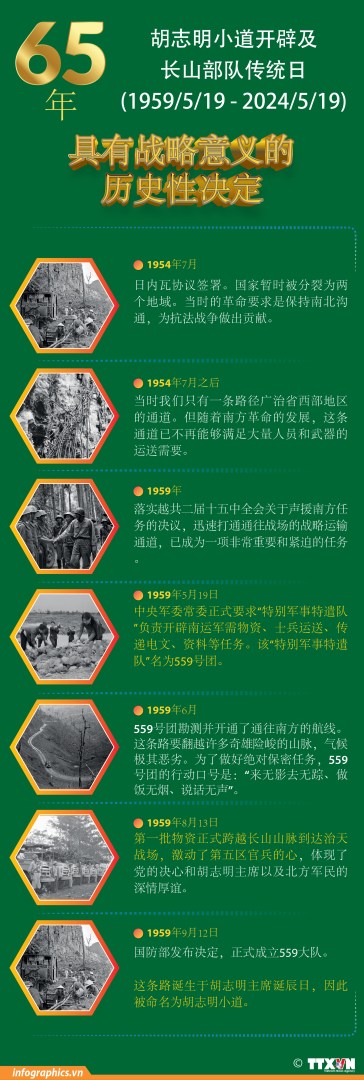
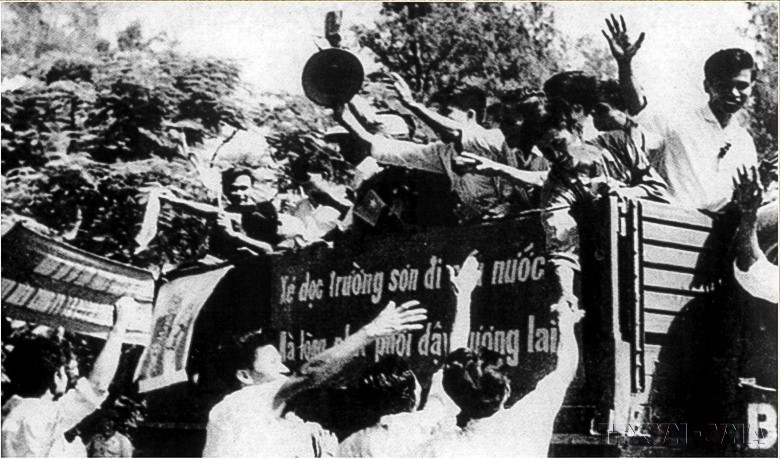
Во время войны сопротивления против США и борьбы за спасение страны существовал стратегический маршрут, сыгравший важную роль в достижении Великой победы весной 1975 года, освобождении Юга и объединении страны. Это была легендарная дорога Чыонгшон – тропа Хошимин, ставшая результатом несгибаемой решимости, железной воли, отваги и необыкновенного творчества вьетнамского народа.
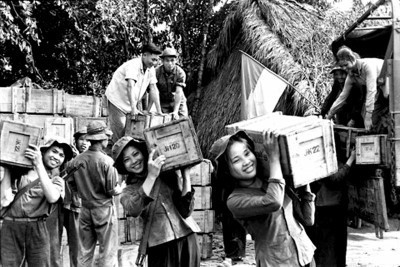
Перевозка камней для строительства дороги Чыонгшон. Фото: ВИА.
В 1959 году, согласно указаниям Политбюро и президента Хо Ши Мина, Генеральная Центральная военная комиссия (ныне Центральная военная комиссия) принял решение о создании «Специальной военной рабочей группы» (впоследствии известной как группа 559), задачей которой было прокладывание маршрута через хребет Чыонгшон на юг – так появилась дорога Чыонгшон – тропа Хошимин.
Процесс строительства и развития стратегического маршрута «Дорога Чыонгшон – тропа Хошимин» прошёл через множество этапов, связанных с периодами развития южной революции в борьбе против американской агрессии и за спасение страны. Наши войска и народ преодолевали дожди бомб, град снарядов, палящее солнце, ливни в лесах, чтобы открыть маршрут и доставить силы и вооружение на поле боя.
От первых «тропинок», где основным способом транспортировки были ручные переноски, за 16 лет (1959–1975) транспортная линия Чыонгшон превратилась в систему взаимосвязанных дорог протяжённостью в тысячи километров, включающую 5 продольных магистралей, 21 поперечную трассу, почти 17 000 км механизированных дорог, свыше 3 000 км межсоединительных путей, около 1 400 км трубопроводов для нефти, тысячи километров речных и ручейных дорог и линию связи, проходящую вдоль всего маршрута.
Стратегический транспортный маршрут Чыонгшон превратился в «магическую восьмиугольную схему, пронизывающую джунгли», соединяющую крупный тыл на Севере с важнейшим фронтом на Юге, обеспечивая поддержку всех боевых направлений с различными способами транспортировки.
Легендарная тропа Хошимин стала также комплексным полем боя, ареной ожесточённой борьбы между нашими силами и противником. Американская империя и марионеточный режим Шайгона вскоре осознали чрезвычайно важную стратегическую роль системы дорог Хошимина для сопротивления наших войск и народа в Юге, а также для исхода их агрессивной войны, и потому они прибегали ко всем возможным средствам, чтобы её блокировать и разрушить.
Отряд молодёжных добровольцев №39 прокладывает дорогу Чыонгшон. Фото: ВИА.
Они превратили тропу Хошимин в испытательное поле для множества тактических приёмов, новейших на тот момент видов вооружения и средств ведения войны, проводя «стратегию сдерживания» и «удушающую войну» с целью разорвать линии снабжения огромного тыла Севера для южного фронта.
Однако под талантливым и дальновидным руководством Партии, Центральной военной комиссии и Министерства обороны, благодаря мужеству, ума, смекалке и творческому духу наши войска и народ на полях Чыонгшон преодолели все трудности, лишения и жертвы, разгромили все методы сдерживания противника и блестяще выполнили задачу по обеспечению поддержки и снабжения для южных боевых операций.
Стратегический транспортный маршрут Чыонгшон превратился в «магическую восьмиугольную схему, пронизывающую джунгли», соединяющую крупный тыл на Севере с важнейшим фронтом на Юге, Фото: ВИА.
За 16 лет стратегический маршрут поддержки Чыонгшон перевёз более миллиона тонн вооружения, техники и грузов; обеспечил транспортировку и поддержку более 2 миллионов офицеров и бойцов для участия в боях на Юге, а также эвакуацию десятков тысяч раненых на Север для лечения… Только в ходе Всеобщего наступления и восстания весной 1975 года стратегический транспортный маршрут Чыонгшон перевёз 413 450 тонн вооружения и грузов, совершив великие подвиги, внесшие важный вклад в победу в борьбе против американской агрессии и за спасение страны.
Транспортные войска 4-го военного округа преодолевают высокогорный перевал, доставляя грузы на передовую, март 1971 года. Фото: ВИА.
Продолжаем писать новую страницу истории
Если во время борьбы против американской агрессии и за спасение страны путь Чыонгшон был ярким выражением жгучего стремления вьетнамского народа к независимости, свободе и воссоединению Родины, то в мирное время дорога Чыонгшон – тропа Хошимин несёт новую миссию в эпоху строительства и развития страны.
Осознавая стратегическое положение тропы Хошимин, который одновременно является стратегическим маршрутом безопасности и обороны, а также важным маршрутом для экономического развития страны, 3 декабря 2004 года Национальное собрание приняло Резолюцию № 38/2004/QH11 о инвестиции в строительство маршрута Хошимин.
15 февраля 2007 года Премьер-министр подписал Решение № 242/QĐ-TTg, утвердив общее планирование маршрута Хошимин. Согласно этому, маршрут проходит через 30 провинций и городов, начиная с Пакбо (провинция Каобанг) и заканчивая на мысу провинции Камау. Общая протяжённость маршрута составляет 3 167 км, из которых основная линия – 2 667 км, а западное ответвление – 500 км.
Тропа Хошимин — это одновременно стратегический маршрут в сфере обороны и безопасности и важный маршрут для развития экономики страны. Фото: ВИА.
5 апреля 2000 года на паромной переправе Суаншон в уезде Бочак, провинция Куангбинь, Премьер-министр отдал приказ о начале строительства тропы Хошимин. Хотя тропа Хошимин ещё не полностью введена в эксплуатацию, она уже демонстрирует свою реальную эффективность, чётко проявляя стратегическую роль в развитии страны: играет важную роль в соединении регионов, снижает нагрузку на национальную трассу 1А, способствует социально-экономическому развитию, обеспечению безопасности, политической стабильности и укреплению обороны на границе.
На фото: Тропа Хошимин, проходящая через город Хюэ. Фото: ВИА.
Этот маршрут также расширяет торговые связи с Лаосом и Таиландом, постепенно формируя центр восточно-западного экономического коридора в Северном Центральном регионе. В провинции Хатинь тропа Хошимин способствует развитию торговли с Лаосом через международный пограничный пункт Каучео. В Куангбине этот маршрут создаёт условия для расширения экономических зон, развития туризма в Фонгнха – Кебанг и исторических памятников. В Центральном нагорье (Тэйнгуен) тропа Хошимин помогает соединять регионы, производящие кофе и перец, с внутренним и международным рынками. Местные власти используют этот маршрут для развития сельскохозяйственной экономики, привлечения инвестиций и улучшения уровня жизни населения, внося вклад в устойчивое развитие страны./.
Если во время борьбы против американской агрессии и за спасение страны путь Чыонгшон был ярким выражением жгучего стремления вьетнамского народа к независимости, свободе и воссоединению Родины, то в мирное время дорога Чыонгшон – тропа Хошимин несёт новую миссию в эпоху строительства и развития страны. Фото: ВИА.
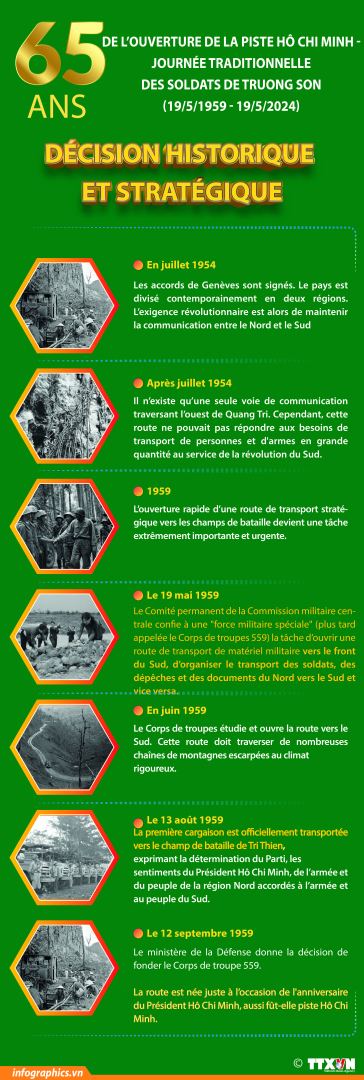
Pendant la résistance contre les Américains pour le salut national, une route stratégique a joué un rôle crucial dans la grande victoire du printemps 1975 : la libération du Sud et la réunification du pays. Il s’agit de la légendaire piste Truong Son, appelée aussi piste Hô Chi Minh, symbole de la volonté de fer, du courage et de la créativité exceptionnelle du peuple vietnamien.
Transport de roches au service de la construction de la route de Truong Son. Photo: VNA
En 1959, suivant la direction du Bureau politique et du Président Hô Chi Minh, la Commission militaire centrale décida de créer une “force militaire spéciale” (plus tard appelée le Corps de troupes 559) chargée d’ouvrir une piste traversant la cordillère de Truong Son vers le Sud. Cette piste fut baptisée Truong Son ou Hô Chi Minh, devenant un réseau de transport stratégique et contribuant de manière décisive à la grande victoire de la guerre de résistance anti-américaine et à la lutte pour la libération nationale.
Le processus de construction et de développement de la route stratégique Truong Son est étroitement associé aux périodes de développement de la révolution du Sud dans la guerre de résistance contre les États-Unis.
Le processus d’organisation et de construction de la force de transport stratégique sur la piste Hô Chi Minh traversa de nombreuses étapes, liées aux périodes de développement de la révolution du Sud.
Pendant 16 ans (1959-1975), la piste se transforma en un réseau de transport de milliers de kilomètres, comprenant cinq axes le long de la cordillère de Truong Son et 21 axes horizontaux continus d’une longueur totale de 20 000 km. Elle comprenait également près de 17 000 km de route pour automobiles et un pipeline de carburant de près de 1 400 km.
Cet axe fut devenu un “champ de bataille à travers la jungle”, reliant l’arrière-garde du Nord et le front au Sud.
La piste Hô Chi Minh fut non seulement une artère de ravitaillement et une base militaire stratégique, mais aussi un théâtre d’affrontements acharnés.
Des jeunes volontaires participent à l’ouverture de la route Truong Son. Photo: VNA
L’armée américaine et le gouvernement de Saïgon déployèrent d’innombrables moyens pour la détruire, transformant la piste en un champ d’expérimentation de stratégies telles que la “guerre préventive”, la “guerre électronique” et la “guerre chimique”, employant un arsenal d’armes, d’équipements et de véhicules de guerre sophistiqués.
Pourtant, sous la direction clairvoyante du Parti, de la Commission militaire centrale et du ministère de la Défense, animés par le courage, l’intelligence et la créativité, notre armée et notre peuple surmontèrent toutes les épreuves, déjouèrent les tactiques ennemies et assurèrent avec succès le ravitaillement du Sud.
Cet axe fut devenu un “champ de bataille à travers la jungle”, reliant l’arrière-garde du Nord et le front au Sud.
En seize ans, les forces de Truong Son acheminèrent plus d’un million de tonnes d’armes, de véhicules, de matériel divers et de marchandises, garantissant le passage sécurisé de plus de deux millions d’officiers et de soldats vers le Sud et le retour de dizaines de milliers de blessés au Nord. Rien qu’au cours de l’offensive générale et du soulèvement du Printemps 1975, 413 450 tonnes d’armes et de marchandises transitèrent par cette voie, contribuant de manière significative à la victoire finale.
Des troupes de transport de la région militaire 4 franchissent des cols élevés pour livrer des marchandises au front, mars 1971. Photo : VNA
OUVRIR UNE NOUVELLE PAGE DE L’HISTOIRE
Pendant la guerre de résistance contre les impérialistes américains, la piste Truong Son était une manifestation vibrante du désir d’indépendance, de liberté et de réunification nationale du peuple vietnamien. En temps de paix, elle porte une nouvelle mission dans la période de construction et de développement national.
Reconnaissant la position stratégique de la piste Hô Chi Minh, qui est à la fois une route stratégique pour la sécurité et la défense et une route importante pour le développement économique du pays, le 3 décembre 2004, l’Assemblée nationale a adopté la résolution n° 38/2004/QH11 sur la politique d’investissement pour la construction de la route Hô Chi Minh en tant que projet clé national, d’une longueur totale de 3 167 km, s’étendant de Pac Bo (province de Cao Bang) au Cap Ca Mau, d’une longueur de 2 667 km.
Conformément à la résolution de l’Assemblée nationale du 15 février 2007, le Premier ministre a approuvé le plan directeur de la route Hô Chi Minh par la décision n° 242/QD-TTg.
La route Hô Chi Minh est à la fois une route stratégique de sécurité et de défense et une route importante pour le développement économique du pays. Photo : VNA
Le 5 avril 2000, au terminal des ferries de Xuân Son, district de Bô Trach, province de Quang Binh (Centre), le Premier ministre a donné le coup d’envoi du projet. Cette route stratégique, deuxième axe transvietnamien après la Nationale 1A, renforce la connectivité entre les régions du Nord, du Centre et du Sud et améliore l’infrastructure pour valoriser le potentiel des vastes territoires de l’Ouest.
Un tronçon de la route Hô Chi Minh traversant la ville de Huê Photo: VNA
Cet axe routier contribue à renforcer les échanges commerciaux avec le Laos et la Thaïlande, posant progressivement les bases d’un centre du corridor économique Est-Ouest dans la région Nord-Centre du Vietnam. À Hà Tinh, la route Hô Chi Minh stimule le commerce transfrontalier via le poste-frontière international de Câu Treo. Dans la province de Quang Binh, elle favorise l’expansion des zones économiques, le développement du tourisme à Phong Nha-Ke Bàng ainsi que la valorisation des sites historiques. Dans les Hauts Plateaux du Centre, cette route relie les zones de production de café et de poivre aux marchés nationaux et internationaux. Les localités tirent parti de cette infrastructure pour développer l’agriculture, attirer les investissements et améliorer les conditions de vie des populations, contribuant ainsi au développement durable du pays./.
Pendant la guerre de résistance contre les impérialistes américains, la piste Truong Son était une manifestation vibrante du désir d’indépendance, de liberté et de réunification nationale du peuple vietnamien. En temps de paix, elle porte une nouvelle mission dans la période de construction et de développement national. Photo: VNA
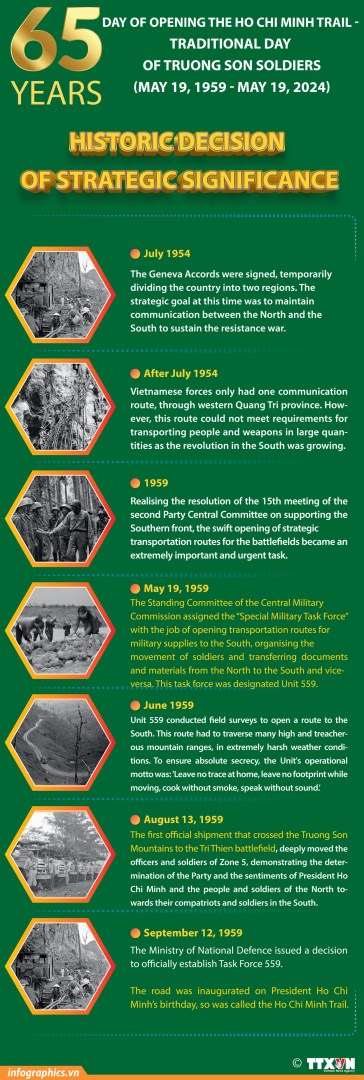
During the resistance war against the US, a strategic route played a significant role in the Great 1975 Spring Victory, which liberated the South and reunified the country. That legendary route was Truong Son Trail – also known as Ho Chi Minh Trail, a symbol of Vietnam’s unwavering determination, extraordinary courage, and remarkable ingenuity.
Transporting rocks to build the Truong Son Trail (Photo: published by VNA)
In 1959, under the leadership of the Politburo and President Ho Chi Minh, the General Military Commission (now the Central Military Commission of the Communist Party of Vietnam) established a “special military task force” (later known as Group 559) tasked with constructing a strategic supply route through the rugged Truong Son Mountain Range to support the Southern battlefield. This route was later named Truong Son Trail – Ho Chi Minh Trail.
The construction and development of the strategic Truong Son – Ho Chi Minh Trail is closely tied to the various phases of the Southern revolution during the resistance war against the US. (VNA Infographics)
The construction and development of this strategic route evolved through various stages, closely tied to the revolutionary progress in Southern Vietnam during the resistance war against the US. Vietnamese soldiers and civilians braved relentless bombings, harsh weather conditions, and unforgiving terrain to clear paths, establish routes, and transport personnel and supplies to the frontlines.
From its initial state as a network of narrow trails used for manual carrying and hauling, the Truong Son supply route evolved over 16 years (1959–1975) into an extensive transportation system stretching thousands of kilometres. It comprised five vertical trunk roads, 21 horizontal routes, nearly 17,000 km of roads for motorised vehicles, over 3,000 km of communication pathways, about 1,400 km of fuel pipelines, along with numerous river crossings and communication lines along the route.
This strategic network became a lifeline, linking Northern Vietnam – the rear base – with the Southern battlefield while supporting multiple combat fronts with diverse transport methods.
The legendary Ho Chi Minh Trail itself was also a fierce battlefield where Vietnamese forces faced relentless enemy attacks. The US imperialists and the puppet Saigon regime swiftly identified the trail’s vital strategic role in sustaining resistance efforts in the South, a factor that could determine the success or failure of their invasion. Consequently, they spared no effort in attempting to block and destroy the trail.
Youth Volunteer Unit 39 clearing the way for the Truong Son Trail. (Photo: Published by VNA)
In response, they launched extensive campaigns to destroy it, transforming the trail into a testing ground for advanced warfare tactics and cutting-edge weaponry. Employing strategies like “interdiction tactics” and “strangulation warfare”, they sought to sever this vital supply link.
Despite these efforts, under the wise leadership of the Party, the Central Military Commission, and the Ministry of National Defence, Vietnamese soldiers and civilians displayed remarkable bravery, resilience, and ingenuity to overcome every difficulty, hardship, and sacrifice, defeating all ruses of the enemy and ensuring a continuous flow of supplies and personnel to the Southern frontlines.
The strategic Truong Son transport route becomes a “labyrinthine battlefield through the jungle,” connecting the vast rear base in the North with the major frontline in the South.
In its 16 years of operation, Truong Son Trail transported over one million tonnes of weapons, equipment, and other supplies while facilitating the movement of over two million soldiers to the frontlines and evacuating tens of thousands of wounded troops to the North for treatment. During the critical 1975 Spring General Offensive and Uprising alone, the route delivered 413,450 tonnes of vital supplies, marking a significant contribution to Vietnam’s ultimate victory.
Logistics troops from Military Region 4 traversing high mountain passes to transport supplies to the front lines, March 1971. (Photo: VNA)
A new chapter in national development
If Truong Son Trail symbolised the burning desire for national independence and reunification during wartime, in peacetime, Ho Chi Minh Trail has assumed a new mission of driving national development.
Recognising the strategic significance of Ho Chi Minh Trail as both a critical security – defence route and a vital economic development corridor, the National Assembly issued Resolution No. 38/2004/QH11 on December 3, 2004, approving the investment policy for the Ho Chi Minh Highway construction project.
On February 15, 2007, the Prime Minister signed Decision No. 242/QD-TTg, approving the master plan for Ho Chi Minh Highway. This ambitious project spans 30 provinces and cities, beginning at Pac Bo (the northern border province of Cao Bang) and ending at Dat Mui (the southernmost province of Ca Mau). The total planned route length is 3,167 km, including a 2,667 km main route and a 500 km western branch.
The Ho Chi Minh Trail serves not only as a strategic route for national defence and security but also as a vital artery for the country’s economic development. (Photo: VNA)
On April 5, 2000, at the Xuan Son Ferry Terminal in Bo Trach district, the central province of Quang Binh, the Prime Minister officially launched work on Ho Chi Minh Highway. Today, over 90% of the project has been completed, and despite not being fully operational yet, the road has been demonstrating its critical role in enhancing connectivity among regions, easing pressure on National Highway 1A, fostering socio-economic development, and guaranteeing border security and defence.
In the photo: The Ho Chi Minh Road passing through Hue city. (Photo: VNA)
The highway has also helped bolster trade links with Laos and Thailand, positioning itself as an important component of the East – West Economic Corridor in North-Central Vietnam. In Ha Tinh province, it has facilitated trade with Laos through the Cau Treo International Border Gate. In Quang Binh, it has enabled economic zone expansion and boosted tourism at Phong Nha-Ke Bang National Park and historical relic sites. In the Central Highlands, the route has linked coffee and pepper production zones with domestic and international markets. By capitalising on this road’s potential, localities have fostered agricultural growth, attracted investment, and improved living standards, thereby contributing significantly to Vietnam’s sustainable development journey./.
During the resistance war against the US, the Truong Son Trail symbolized the aspiration for independence, freedom, and national reunification. In peacetime, the Truong Son Trail – Ho Chi Minh Trail carries the mission of building and developing the country. (Photo: VNA)
Durante la guerra de resistencia contra el imperialismo estadounidense para la salvaguarda nacional, hubo un camino estratégico que contribuyó significativamente a la gran victoria de la primavera de 1975, que liberó al Sur de Vietnam y reunificó al país. Ésta es la legendaria ruta de Truong Son-Ho Chi Minh, una muestra de la inquebrantable determinación, valentía y extraordinaria creatividad del pueblo vietnamita.
Transportación de piedras para construir la ruta Truong Son (Foto: VNA)
En 1959, siguiendo la dirección del Buró Político y del Presidente Ho Chi Minh, la Comisión Militar Central decidió otorgar a las fuerzas militares especiales (más tarde llamada División 559) la tarea de abrir una carretera a través de la cordillera de Truong Son hacia el Sur, denominada ruta Truong Son-Ho Chi Minh.
El proceso de construcción y desarrollo de este itinerario estratégico pasó por muchas etapas, asociadas con la evolución de la Revolución en la guerra de resistencia contra el imperialismo estadounidense en el Sur. (Infografía: VNA)
El proceso de construcción y desarrollo de ese itinerario estratégico pasó por muchas etapas, asociadas con la evolución de la Revolución en la guerra de resistencia contra el imperialismo estadounidense en el Sur. El Ejército y el pueblo vietnamitas superaron lluvias de bombas y balas, la topografía irregular de las montañas y selvas y condiciones climáticas adversas para abrir vías que llevaran fuerzas y armas al campo de batalla.
A partir de los senderos iniciales, que sólo permitían el transporte de mercancías en bicicletas, después de 16 años (1959-1975), la ruta Truong Son se convirtió en un sistema vial continuo que se extiende por miles de kilómetros, incluyendo cinco vías verticales y 21 horizontales, casi 17.000 kilómetros de carreteras motorizadas, más de 3.000 kilómetros de caminos de enlace, casi 1.400 kilómetros de oleoductos y gasoductos, miles de vías fluviales y líneas de comunicación.
La ruta de transporte estratégico Truong Son-Ho Chi Minh se convirtió en un “mapa bagua (ocho trigramas) a través de la jungla”, que conectaba la gran retaguardia del Norte con la línea del frente del Sur, llegando a todas las direcciones del campo de batalla con diferentes medios de transporte.
Esta legendaria carretera fue también un campo de batalla integral y feroz entre el Ejército vietnamita y el enemigo. Los imperialistas estadounidenses y el gobierno títere de Saigón pronto descubrieron el papel estratégico extremadamente importante de la ruta Truong Son-Ho Chi Minh para la resistencia del Ejército y el pueblo vietnamitas en el Sur y para el éxito o el fracaso de su guerra de agresión, por lo que no dudaron en utilizar cualquier medio para destruir este sistema.
Los jóvenes voluntarios vietnamitas trabajan para abrir la ruta Truong Son-Ho Chi Minh (Foto: VNA)
Convirtieron la vía en un campo de batalla para probar una serie de trucos tácticos, armas y los medios de guerra más modernos y avanzados en ese momento, implementando una estrategia de contención y estrangulamiento para cortar el apoyo de la base de retaguardia del Norte a la región meridional.
Sin embargo, bajo el liderazgo talentoso y sabio del Partido, la Comisión Militar Central y el Ministerio de Defensa, con un espíritu de coraje, inteligencia, ingenio y creatividad, el Ejército y el pueblo vietnamitas superaron todas las dificultades, penurias y sacrificios en la contienda en Truong Son para derrotar todas las tácticas de impedimento del enemigo y cumplir excelentemente la misión de suministrar apoyo humano y material a los combatientes en el Sur.
La ruta de transporte estratégico Truong Son-Ho Chi Minh se convirtió en un “mapa bagua (ocho trigramas) a través de la jungla”, que conectaba la gran retaguardia del Norte con la línea del frente del Sur (Foto: VNA)
Durante 16 años, la línea de suministro estratégico de Truong Son garantizó el transporte de más de un millón de toneladas de armas, vehículos y mercancías, así como la marcha de más de dos millones de oficiales y soldados para combatir en el Sur, además del traslado de decenas de miles de heridos al Norte para recibir tratamiento. Durante la Ofensiva General y el Levantamiento de la Primavera de 1975, el recorrido aseguró la conducción de 413.450 toneladas de armas y bienes, lo que contribuyó enormemente a la victoria sobre los imperialistas estadounidenses.
Durante la Ofensiva General y el Levantamiento de la Primavera de 1975, el recorrido aseguró la conducción de 413.450 toneladas de armas y bienes, lo que contribuyó enormemente a la victoria sobre los imperialistas estadounidenses. (Foto: VNA)
Escribir un nuevo capítulo en la historia
Si durante la guerra de resistencia contra el imperialismo norteamericano para la salvaguarda del país, la ruta Truong Son-Ho Chi Minh era una manifestación vívida del ardiente deseo de independencia, libertad y reunificación nacional del pueblo vietnamita, entonces en tiempos de paz, lleva consigo una nueva misión durante el período de construcción y desarrollo de la Patria.
Reconociendo la posición estratégica de la vía, que no sólo es una carretera estratégica para la seguridad y defensa, sino también un camino importante para el desarrollo económico del país, la Asamblea Nacional emitió la Resolución No. 38/2004/QH11, el 3 de diciembre de 2004, sobre la política de inversión para la ruta Ho Chi Minh.
El 15 de febrero de 2007, el Primer Ministro promulgó la Decisión No. 242/QD-TTg aprobando el Plan Maestro de la Ruta Ho Chi Minh. Según el documento, la vía pasa por 30 provincias y ciudades, comenzando en Pac Bo en la provincia norteña de Cao Bang y terminando en Dat Mui en la localidad sureña de Ca Mau. La longitud total del recorrido es de 3.167 kilómetros, incluidos 2.667 kilómetros de la línea principal y 500 kilómetros del ramal occidental.
La ruta Truong Son-Ho Chi Minh no sólo es una carretera estratégica para la seguridad y defensa, sino también un camino importante para el desarrollo económico del país. (Foto: VNA)
El 5 de abril del 2000, el Jefe de Gobierno lanzó la reconstrucción de la ruta Ho Chi Minh en el ferry de Xuan Son, distrito de Bu Trach, provincia central de Quang Binh. Hasta el momento, se ha completado más del 90% de la carretera. Aunque todavía no se ha abierto totalmente al tráfico, la vía ha demostrado sus beneficios prácticos y su papel como carretera de desarrollo estratégico. Juega un papel importante en la conexión de varias regiones, aliviando la carga en la Carretera Nacional 1A, promoviendo el desarrollo socioeconómico y garantizando la seguridad política y la defensa fronteriza.
El tramo de la ruta Truong Son-Ho Chi Minh en la ciudad de Hue (Foto: VNA)
La ruta Truong Son-Ho Chi Minh también amplía el comercio con Laos y Tailandia, formando gradualmente el centro del corredor económico Este-Oeste en la región centro-norte. En la provincia central de Ha Tinh, el itinerario facilita el comercio con Laos a través del cruce fronterizo internacional de Cau Treo. En Quang Binh, favorece la expansión de las zonas económicas y el desarrollo de actividades turísticas en Phong Nha-Ke Bang y sitios históricos. En la Altiplanicie Occidental, conecta las zonas de producción de café y pimienta con los mercados nacionales e internacionales. Las localidades aprovechan esta vía para desarrollar la economía agrícola, atraer inversiones y mejorar el nivel de vida de las personas, en pos del desarrollo sostenible del país./.
Si durante la guerra de resistencia contra el imperialismo norteamericano para la salvaguarda del país, la ruta Truong Son-Ho Chi Minh era una manifestación vívida del ardiente deseo de independencia, libertad y reunificación nacional del pueblo vietnamita, entonces en tiempos de paz, lleva consigo una nueva misión durante el período de construcción y desarrollo de la Patria. (Foto: VNA)
С высокими идеалами, стремлением утвердить себя и внести вклад во благо Родины, поколения членов Союза коммунистической молодёжи Хо Ши Мина, как в военное, так и в мирное время, не страшились трудностей и всегда были готовы отдать свою молодость и силу на службу стране.
Молодёжные добровольцы расчищают камни, прокладывая путь для проезда автомобилей на дороге Чыонгшон. Фото: ВИА.
Особенно в самые напряжённые моменты сопротивления против американского империализма, силы молодёжных добровольцев стали «ударным пламенем», разжёгшим дух самоотверженности и борьбы во всех слоях населения, внёсшим значительный вклад в общую победу нации.
Всё – ради фронта
В 1954 году, после победного завершения сопротивления против французского колониализма, страна всё ещё оставалась разделённой. Вьетнамский народ одновременно выполнял две стратегические задачи: Строил социализм на Севере и вёл народно-демократическую революцию на Юге с целью воссоединения Родины.
Осознавая историческую миссию и ответственность молодёжи, бурное и мощное революционно-патриотическое движение охватило молодое поколение по всей территории северных провинций. Фото: ВИА.
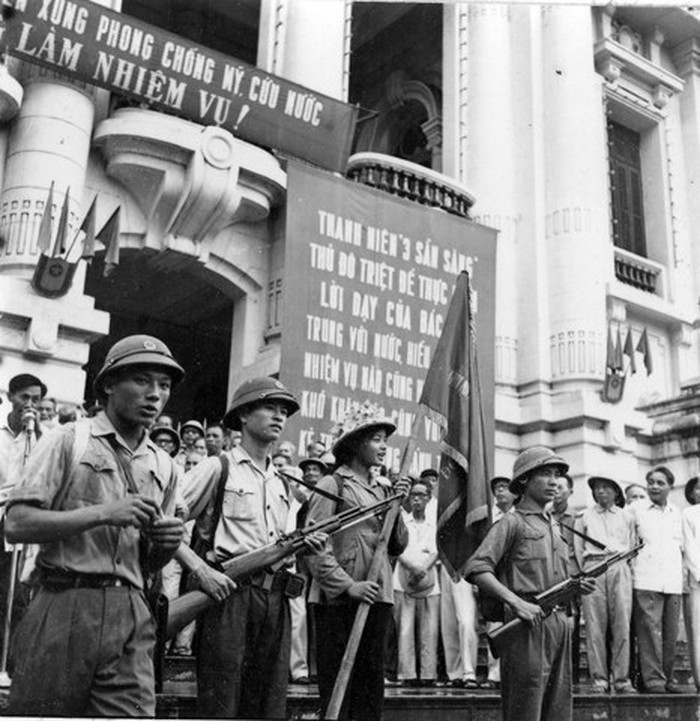
На фото: Председатель Хо Ши Мин тепло беседует с делегатами Всеобщего съезда передовиков движения молодёжных добровольцев Северного Вьетнама по борьбе против США за спасение Родины, 12 января 1967 года. Фото: ВИА.
С 1964 года американский империализм расширил агрессию, начав «локальную войну» на Юге и усилив бомбардировки Севера, что ещё больше разжигало в стране дух сопротивления. Осознавая историческую миссию и ответственность молодёжи, бурное и мощное революционно-патриотическое движение охватило молодое поколение по всей территории северных провинций.
В условиях острой необходимости, 21 июня 1965 года Премьер-министр издал Указ №71/TTg-CN о создании «Молодёжных добровольных отрядов по борьбе с американцами и спасению Родины», задачей которых было транспортное обеспечение на ключевых маршрутах .
На фото: Отряд молодёжных добровольцев провинции Бактхай срезает горы и выравнивает холмы для строительства дороги в борьбе против США за спасение Родины (1966 год). Фото: ВИА.
В течение десяти лет, с 1965 по 1975 годы, около 290 тысяч молодых людей вступили в ряды молодёжных добровольцев, выполняя разнообразные задачи: прокладывали дороги, перевозили продовольствие, грузы и оружие на южный фронт, занимались лесным хозяйством, эвакуацией складов и портов, спасением раненых… Силы молодёжных добровольцев на Севере страны проложили 102 стратегические дороги общей протяжённостью 4130 км. Они также перевезли более 100 тысяч тонн оружия, боеприпасов и продовольствия; засыпали десятки тысяч воронок от бомб и обезвредили более 10 тысяч различных вражеских боеприпасов.
Массовые движения, организованные силами молодёжных добровольцев, такие как «Три готовности» и «Пять добровольных действий», стали яркими факелами, освещающими путь патриотической традиции, вдохновляя дух самоотверженности и служения Родине во всех слоях общества.
«Три готовности» и стремление молодёжи Севера
Церемония запуска движения «Три готовности», организованная Союзом молодёжи Ханойского педагогического университета на кладбище павших героев Майзик, Ханой, 30 апреля 1964 года. Фото: ВИА.
В 1964 году Ханойский педагогический университет инициировал движение «Три любых» среди ячеек и межячеек Союза молодёжи: «Поехать в любое место, где нуждается Родина; выполнять любую работу, которую поручают Партия и народ; принимать любые условия и режимы». 9 августа 1964 года Постоянный комитет Союза коммунистической молодёжи Хо Ши Мина принял решение переименовать движение и запустить его под названием «Три готовности» среди всей столичной молодёжи. Движение «Три готовности» стало пламенем, разжёгшим дух добровольного служения у молодого поколения, особенно среди школьников и студентов Севера, с тремя основными направлениями:
1
Готовность к бою, мужественное сражение и готовность вступить в ряды армии (регулярной армии, местных войск и народное ополчение).
2
Готовность преодолевать любые трудности, активно трудиться, учиться и работать в любых условиях.
3
Готовность поехать в любое место и выполнять любую задачу, когда этого требует Родина.
Молодёжь Северного Вьетнама откликнулась на движение «Три готовности» и с воодушевлением отправилась на военную службу. Фото: ВИА.
Движение «Три готовности» породило волну добровольного участия молодёжи в боевых действиях. Статистика не способна передать весь масштаб жертвенности и пыла одного поколения. Лишь за месяц после начала кампании более 1,5 миллиона молодых людей подали заявки на участие; почти 90% студентов университетов Ханоя написали заявления с готовностью покинуть учебные аудитории и отправиться на фронт. С 1965 по 1972 год около 30 000 учащихся, студентов и преподавателей из более чем 30 вузов и школ Севера вступили в ряды вооружённых сил. Их багажом в смертельной битве были не только оружие и боеприпасы, но и мечты, юношеские устремления, а также вера и стремление к свободному будущему для Родины.
Движение «Три готовности» стало одним из крупнейших революционных молодежных движений во Вьетнаме в XX веке. Фото: ВИА.
6 сентября 1971 года на территории множества университетов состоялась крупнейшая церемония отправки на фронт. Образ тысяч юношей и девушек Ханоя, громко произносящих клятву «Три готовности», клятву «разделить огонь с родным Югом», отправляющихся спасать Родину, стал незабываемым символом молодёжи столицы, внёсшей свой вклад в славную и героическую страницу истории поколения, вставшего на путь сопротивления.
Более 5 миллионов членов Союза молодёжи приняли участие в этом движении, причём большая часть – это были девушки. Фото: ВИА.
Движение «Три готовности» стало одним из крупнейших революционных молодёжных движений Вьетнама в XX веке, сформировав самую массовую армию добровольцев в истории борьбы народа против внешней агрессии. Более 5 миллионов членов Союза молодёжи приняли участие в этом движении, причём большая часть – это были девушки. Почти 1,5 миллиона молодых, лучших сынов и дочерей страны пали, с горящим в сердце пламенем самопожертвования, десятки тысяч отдали кровь и часть своей жизни на жестоких фронтах. Героическая песнь этого поколения, написанная мужеством и кровью, навсегда останется звучать в историческом потоке нации.
«Пять добровольных действий» – призыв, объединивший тысячи молодёжей Юга
Вместе с движением «Три готовности» на Севере, молодёжное движение «Пять добровольных действий» на Юге Вьетнама стало мощной силой, вдохновляющей и мобилизующей молодёжь Юга преодолевать трудности и лишения, с решимостью освободить Юг и воссоединить Родину.
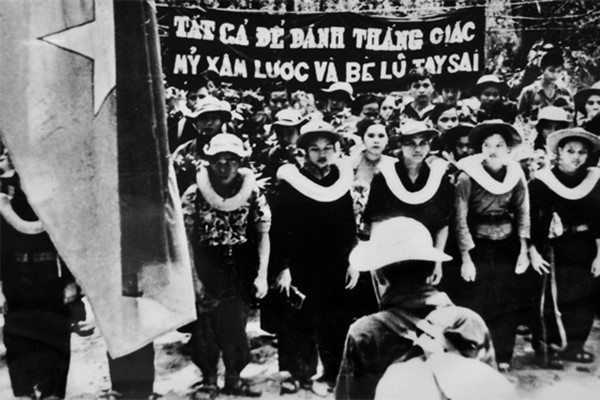
В поддержку движения «Пять добровольных действий» с 1965 года многочисленные члены Союза молодёжи, девушки и юноши южных провинций Вьетнама вступали в ряды молодёжных добровольцев и отправлялись на фронт с клятвой: «Всё — ради победы над американскими агрессорами и их марионетками». Фото: Архив/предоставлено ВИА.
Движение «Пять добровольных действий» было инициировано в марте 1965 года и включало пять основных направлений:
1
Добровольно уничтожать как можно больше живой силы противника
2
Добровольно вступать в армию и участвовать в партизанской войне
3
Добровольно идти в народные рабочие отряды и молодёжные добровольческие формирования для поддержки фронта
4
Добровольно участвовать в политической борьбе и сопротивляться принудительной мобилизации
5
Добровольно трудиться в сельском хозяйстве в рамках крестьянских союзов
Вместе с молодежным движением «Три готовности» и армейским движением «Три наилучших показателя», в начале 1965 года Съезд Революционного народного союза молодёжи Южного Вьетнама выдвинул движение «Пять добровольных дел» по борьбе против США и защите Родины. Фото: Архив/предоставлено ВИА.
С тех пор движение «Пять добровольных действий» неуклонно развивалось, становясь источником вдохновения и мобилизации для тысяч молодёжей Юга, побуждая их преодолевать все тяготы и испытания ради борьбы и победы. Соревнательные движения за звания «Боец, решительно идущий к победе», «Боец, уничтоживший бронированную технику и сбивший самолёт» также широко охватили членов Союза молодёжи на местных регионах, что привело к появлению боевых молодёжных коллективов, таких как «Отряд молодёжей-смертников», «Отряд молодёжей-победителей», «Отряд восставшей молодёжи» и других.
С 1966 года движение «Пять добровольных действий» перешло на новый уровень, внёсший значительный вклад в срыв сухопутных операций по «поиску и уничтожению» и «умиротворению» юга, проводимых США и марионеточным режимом в сезоне 1966–1967 годов.
Движение стало неотъемлемой частью боевой жизни молодёжи Юга, проявляясь в различных гибких и многообразных формах: сопротивление принудительной мобилизации, пропаганда революционных идей среди населения, добровольное участие в снабжении фронта, вступление в партизанские отряды, обслуживание фронтовых нужд и ведение борьбы в городах.
Движения «Три готовности» и «Пять добровольных действий» пробудили и максимально раскрыли боевой дух и решимость молодёжи как севера, так и юга страны, создавая тем самым выдающиеся подвиги. Молодёжные добровольцы внесли важный вклад в общую победу сопротивления против американского империализма, полное освобождение юга и достижение воссоединения, независимости и свободы Родины./.
Успех движения «Три готовности» на Севере и движение «Пять добровольных дел» на Юге разбудили, закалили и воодушевили пылкий дух молодёжи, повели миллионы юношей и девушек на передовую линию сопротивления, внеся огромный вклад в победу в деле сопротивления американской агрессии, освобождения Южного Вьетнама и воссоединения страны. Фото: ВИА.
Animées par de nobles idéaux, la soif de s’affirmer et de contribuer, que ce soit en temps de guerre ou de paix, des générations de jeunes vietnamiens ne craignent pas les difficultés, et restent prêts à consacrer leur force et leur jeunesse au pays.
Dans les moments difficiles de la guerre de résistance contre les impérialistes américains, les jeunes volontaires constuent une force de choc, apportant une grande contribution à la victoire globale de la nation. Photo: VNA
En particulier, dans les moments difficiles de la guerre de résistance contre les impérialistes américains, les jeunes volontaires constuent une force de choc, allumant l’esprit de dévouement et de combat dans toutes les couches de la population, apportant une grande contribution à la victoire globale de la nation.
Tous pour le front
En 1954, la guerre de résistance contre les colonialistes français s’est terminée victorieusement, mais le pays reste divisé. Notre peuple réalisait simultanément deux tâches stratégiques : la construction du socialisme au Nord et la poursuite de la révolution nationale et démocratique populaire au Sud, en vue de parvenir véritablement à l’indépendance et à la réunification nationales.
Conscient de la mission historique et du rôle et de la responsabilité de la jeunesse, le mouvement révolutionnaire patriotique a fait tâche d’huile parmi la jeune génération dans toutes les provinces du Nord. Photo: VNA
Le président Hô Chi Minh rencontre les délégués participant au Congrès d’émulation des jeunes volontaires pour lutter contre les impérialistes américains et sauver le pays, le 12 janvier 1967. Photo : VNA
Depuis 1964, les impérialistes américains ont étendu leur guerre d’agression, mené une «guerre locale» dans le Sud, intensifié leurs attaques contre le Nord, et le pays tout entier vibrait d’un esprit résistance. Conscient de la mission historique et du rôle et de la responsabilité de la jeunesse, le mouvement révolutionnaire patriotique a fait tâche d’huile parmi la jeune génération dans toutes les provinces du Nord.
Face aux besoins urgents de la guerre, le Premier ministre a émis, le 21 juin 1965, la Directive n°71/TTg-CN sur l’organisation des «Brigades de choc de la jeunesse anti-américaines pour le salut national», avec pour mission de fluidifier la circulation sur les axes importants et d’assurer l’acheminement des approvisionnements du Nord vers le champ de bataille du Sud.
La Force des jeunes volontaires du Nord a ouvert 102 routes stratégiques d’une longueur totale de 4.130 km. Photo: VNA
En 10 ans, de 1965 à 1975, le nombre des jeunes volontaires s’est élevé à près de 290.000. La Force des jeunes volontaires du Nord a ouvert 102 routes stratégiques d’une longueur totale de 4.130 km, transporté plus de 100.000 tonnes d’armes, de munitions et de nourriture, rebouché des dizaines de milliers de cratères pour remettre les routes en état et désamorcé plus de 10.000 bombes ennemies.
«Trois prêts» et «Cinq volontariats»
Les grands mouvements de jeunes volontaires tels que «Ba san sàng» (Trois prêts) et «Nam xung phong» (Cinq volontariats) ont non seulement contribué à la victoire générale du pays, mais ont également été un témoignage de la force de l’unité, de l’esprit créatif et de la capacité à surmonter les difficultés du peuple vietnamien.
Cérémonie de lancement du mouvement “Trois prêts’ à l’Université nationale d’éducation de Hanoi, le 30 avril 1964. Photo: VNA
Lancé par les jeunes de Hanoi en 1964, le mouvement «Trois prêts» appelle les jeunes à être prêts à combattre, à rejoindre les forces armées et à aller partout où la Patrie en a besoin.
1
Prêt à combattre
2
Prêt à rejoindre les forces armées
3
Prêt àaller partout où
la Patrie en a besoin
Plus de 5 millions de jeunes gens ont rejoint les forces armées dans la lutte de résistance. Photo: VNA
Plus de 5 millions de membres de l’Union de la jeunesse et jeunes gens ont rejoint les forces armées dans la lutte de résistance ; plus de 133.000 membres de l’Union de la jeunesse, dont plus de 69.000 femmes, ont participé aux brigades de jeunes volontaires.
Le mouvement «Trois prêts» est devenu l’un des plus grands mouvements révolutionnaires de la jeunesse vietnamienne au 20e siècle. Photo : VNA
Lancé dans le Sud en mars 1965, le mouvement «Nam xung phong» (Cinq volontariats) témoigne de la détermination des jeunes du Sud à combattre l’ennemi et à libérer leur terre natale.
Plus de 133.000 membres de l’Union de la jeunesse, dont plus de 69.000 femmes, ont participé aux brigades de jeunes volontaires. Photo: VNA
Il consiste à se porter volontaire pour détruire de nombreuses forces ennemies, à se porter volontaire pour rejoindre l’armée et participer à la guérilla, à se porter volontaires comme travailleurs civils et comme jeunes volontaires pour servir en première ligne, à se porter volontaires pour lutter politiquement, et à se porter volontaires dans la production agricole.
Le mouvement «Cinq volontariats» témoigne de la détermination des jeunes du Sud à combattre l’ennemi et à libérer leur terre natale. Photo: VNA
Le mouvement «Cinq volontariats» s’est renforcé de plus en plus, devenant un appel à des milliers de jeunes du Sud à surmonter toutes les difficultés et les épreuves pour combattre et gagner.
1
Volontariat pourdétruire de nombreuses forces ennemies
2
Volontariat pourrejoindre l’armée et participer à la guérilla
3
Volontariat comme travailleurs civils et comme jeunes volontaires pour servir en première ligne
4
Volontariat pourlutter politiquement
5
Volontariat dans la production agricole
Lancé dans le Sud en mars 1965, le mouvement “Cinq volontariats” témoigne de la détermination des jeunes du Sud à combattre l’ennemi et à libérer leur terre natale. Photo: VNA
Depuis 1966, le mouvement «Cinq Volontariat» a été porté à un nouveau niveau, contribuant de manière significative à briser le plan de «recherche et destruction » et de «pacification» des forces américano-fantoches pendant la saison sèche de 1966-1967.
Avec le mouvement «Trois prêts», il a créé un fort élan révolutionnaire, contribuant ainsi à la victoire finale. Ces mouvements ont suscité le patriotisme et l’esprit d’engagement de millions de jeunes, créant une puissante vague révolutionnaire. Les jeunes volontaires ont apporté une contribution importante à la victoire globale de la guerre de résistance contre les impérialistes américains, à la libération du Sud et à la réunification nationale./.
Les grands mouvements de jeunes volontaires ont suscité le patriotisme et l’esprit d’engagement de millions de jeunes, créant une puissante vague révolutionnaire. Photo: VNA
Con ideales nobles y el deseo de contribuir a la patria, ya sea en tiempos de guerra o paz, los miembros de las organizaciones juveniles de Vietnam no temen las dificultades y están dispuesto a entregar su juventud y energía por el bienestar del país.
Los jóvenes voluntarios empujan piedras, abriendo el camino para el paso de vehículos en la ruta Truong Son. Foto: VNA
En particular, en los momentos más difíciles de la lucha contra el imperialismo estadounidense, los jóvenes voluntarios fueron la chispa que encendió el espíritu de sacrificio y lucha en todos los sectores de la sociedad, desempeñando un papel fundamental en la victoria común de la nación.
Todo por el frente
En 1954, la guerra de resistencia contra el colonialismo francés concluyó con una victoria, pero el país seguía dividido. La nación comenzó a llevar a cabo dos tareas estratégicas: construir el socialismo en el norte y realizar una revolución democrática popular nacional en el sur, con el objetivo final de reunificar el país.
Conscientes de su misión histórica y el papel de los jóvenes, el movimiento patriótico y revolucionario creció con fuerza en toda la generación joven, extendiéndose por todas las provincias del norte. Foto: VNA
En la foto: El Presidente Ho Chi Minh habla amigablemente con los delegados que participaron en el Congreso de la Juventud Voluntaria en la lucha contra el imperialismo estadounidense y por la liberación nacional en el norte, el 12 de enero de 1967. Foto: VNA
A partir de 1964, el imperialismo estadounidense expandió su agresión, implementando la “guerra limitada” en el sur y aumentando los ataques en el norte, lo que avivó el espíritu de resistencia en todo el país. Conscientes de su misión histórica y el papel fundamental de la juventud, el movimiento patriótico revolucionario se extendió con fuerza entre las nuevas generaciones, principalmente en el norte del país.
Ante la urgencia de la guerra, el 21 de junio de 1965, el Primer Ministro emitió el Decreto 71/TTg-CN sobre la formación de las “unidades de jóvenes voluntarios contra los imperialistas estadounidenses, por la salvación de la patria”, con la tarea de garantizar el transporte en las principales rutas clave.
En la foto: El equipo de jóvenes voluntarios de la provincia de Bac Thai despeja montañas y llanuras para construir caminos durante la lucha contra el imperialismo estadounidense y por la liberación nacional (1966). Foto: VNA
Entre 1965 y 1975, cerca de 290 mil jóvenes se unieron a las fuerzas voluntarias, realizando diversas tareas, como abrir caminos, transportar alimentos, armas y suministros para el frente del sur, trabajar en la silvicultura, cuidar a heridos, entre otras labores. Las fuerzas de jóvenes voluntarios del norte lograron abrir 102 caminos estratégicos con un total de cuatro mil 130 kilómetros de longitud, además de transportar más de 100 mil toneladas de armas, municiones y suministros. También rellenaron miles de cráteres de bombas y desactivaron más de 10 mil explosivos.
Los grandes movimientos de jóvenes voluntarios, como “Tres Listos” y “Cinco Voluntarios”, se convirtieron en símbolos de lucha, iluminando la tradición patriótica y guiando el espíritu de dedicación en toda la población.
“Tres listos” y la aspiración de la juventud del norte
Ceremonia de lanzamiento del movimiento “Tres listos” de la Universidad Pedagógica de Hanoi en el Cementerio de Mártires Mai Dich, Hanoi, el 30 de abril de 1964. Foto: VNA
En 1964, la Universidad Pedagógica de Hanoi lanzó el movimiento “Tres Listos” entre sus estudiantes que incluía las siguientes tareas: “Ir a donde sea necesario para servir a la patria; Hacer cualquier tarea que el Partido y el pueblo soliciten; Aceptar cualquier condición que se presente”. El 9 de agosto de 1964, el Buró Ejecutivo de la Unión de Jóvenes de Hanoi decidió ampliar el movimiento “Tres Listos” a toda la juventud de la capital. Este movimiento encendió un fervor de sacrificio voluntario entre la juventud, especialmente en los estudiantes del norte, con tres grandes principios:
1
Estar listo para luchar, combatir valientemente y alistarse (ya sea en tropas regulares, locales o fuerzas de autodefensa)
2
Estar listo para superar cualquier dificultad, impulsando la producción, el trabajo y el estudio en cualquier situación
3
Estar listo para ir a cualquier lugar y hacer cualquier tarea cuando la patria lo necesite
Los jóvenes del norte se suman al movimiento “Tres listos” y se alistan con entusiasmo. Foto: VNA
El movimiento “Tres Listos” generó una ola de jóvenes que se alistaron voluntariamente para ir al frente. En solo un mes desde su lanzamiento, más de 1,5 millones de jóvenes se registraron; casi el 90% de los universitarios en Hanoi firmaron para dejar sus aulas y unirse al campo de batalla. Entre 1965 y 1972, aproximadamente 30 mil estudiantes, profesores y personal de más de 30 universidades del norte participaron directamente en las unidades militares. No solo llevaron armas a la guerra, sino también sus sueños, aspiraciones juveniles y la esperanza de un futuro libre para su patria.
“Tres listos” se convirtió en uno de los movimientos de acción revolucionaria más grandes de la juventud vietnamita en el siglo XX. Foto: VNA
El 6 de septiembre de 1971, se celebró la mayor ceremonia de salida en los patios de varias universidades. Miles de jóvenes de Hanoi, firmes, leyeron el juramento “Tres Listos”, “compartir el fuego con el sur querido” y se marcharon a salvar la patria. Esta imagen quedó grabada como un hito inolvidable de la juventud de Hanoi, contribuyendo a una época histórica gloriosa y heroica de la generación de jóvenes en la resistencia.
Más de 5 millones de jóvenes participaron en el movimiento “Tres listos”, con una gran participación de mujeres. Foto: VNA
“Tres Listos” se convirtió en uno de los mayores movimientos de acción revolucionaria de la juventud vietnamita en el siglo XX, creando el ejército de voluntarios más grande en la historia de la lucha contra una agresión extranjera. Más de cinco millones de jóvenes participaron en el movimiento, muchos de ellos mujeres. Cerca de 1,5 millones de jóvenes valientes cayeron, con la llama del sacrificio ardiendo en sus corazones. Miles dejaron su sangre en los campos de batalla. El himno de valentía de esta generación dedicada se escribió con coraje y sangre, resonando eternamente en la historia de la nación.
“Cinco Voluntarios” llama a miles de jóvenes del sur
Junto con el movimiento “Tres Listos” de los jóvenes del norte, el movimiento “Cinco Voluntarios” de los jóvenes del sur creó una gran fuerza, movilizando a la juventud de la región meridional para superar dificultades y luchar con determinación para liberar el sur y unificar el país.
En apoyo al movimiento “Cinco voluntarios”, desde 1965, numerosos jóvenes de las provincias del sur se unieron a los equipos de jóvenes voluntarios en la guerra contra el imperialismo estadounidense con el juramento “Todo por derrotar al imperialismo estadounidense y sus lacayos”. Foto: VNA
El movimiento “Cinco Voluntarios” se lanzó en marzo de 1965 con cinco principios:
1
Voluntarios para eliminar a tantas fuerzas enemigas como sea posible
2
Voluntarios para alistarse y participar en la guerra de guerrillas
3
Voluntarios para ser trabajadores civiles y servir en las unidades de jóvenes voluntarios en el frente
4
Voluntarios para la lucha política y contra el reclutamiento forzado
5
Voluntarios para producir alimentos en las cooperativas agrícolas
Junto con el movimiento “Tres listos” de los jóvenes, el movimiento “Tres mejores” en el ejército, a principios de 1965, el Congreso de la Juventud Revolucionaria del Pueblo del Sur estableció el movimiento “Cinco voluntarios” contra el imperialismo estadounidense y por la liberación nacional. Foto: VNA
El movimiento “Cinco Voluntarios” se expandió rápidamente, convirtiéndose en un llamado que movilizó a miles de jóvenes del sur a superar todas las dificultades y luchar por la victoria. Los movimientos de competencia por el título de “Héroe del triunfo decisivo” y “Héroe por destruir vehículos y aviones enemigos” atrajeron a muchos jóvenes a unirse a las unidades de combate.
Desde 1966, el movimiento “Cinco Voluntarios” se intensificó, desempeñando un papel crucial en la ruptura de los planes de “destrucción” y “pacificación” de Estados Unidos y el gobierno títere del sur durante la temporada seca de 1966-1967.
El movimiento “Cinco Voluntarios” cambio la forma de pensar de los jóvenes del sur con muchas formas flexibles y diversas, como la resistencia al reclutamiento para las fuerzas enemigas, la propaganda revolucionaria para el pueblo, la participación en el suministro al frente y la lucha en las zonas urbanas.
Los movimientos “Tres Listos” y “Cinco Voluntarios” despertaron y fomentaron al máximo el espíritu de lucha de los jóvenes en todo el país, creando milagros extraordinarios. Los voluntarios desempeñaron un papel fundamental en la victoria contra el imperialismo estadounidense, liberando completamente el sur y haciendo realidad los sueños de independencia, libertad y reunificación de la patria./.
El éxito del movimiento “Tres listos” en el norte, junto con el movimiento “Cinco voluntarios” en el sur, despertó, fortaleció y alentó el espíritu ardiente de la juventud, llevando a millones de jóvenes a la vanguardia de la lucha, contribuyendo enormemente a la victoria en la guerra de resistencia contra los imperialistas estadounidenses, la liberación del sur y la reunificación del país. Foto: VNA
With noble ideals and a thirst for devotion to the nation, whether in wartime or peace, generations of young Vietnamese people have overcome difficulties, staying ready to dedicate their youth to the country.
Youth volunteers remove stones, clear the way for vehicles on the Truong Son Trail. (Photo: VNA)
During the most challenging moments of the resistance against American imperialism, the youth volunteer force served as a vibrant flame, igniting the spirit of dedication and resistance across all social strata, and making significant contributions to the nation’s ultimate victory.
All for Frontline
In 1954, the resistance war against French forces ended successfully, yet the country remained divided. Vietnamese people simultaneously undertook two strategic tasks: building socialism in the North and conducting a national democratic revolution in the South, aiming for the goal of national reunification.
Vibrant, strong revolutionary patriotic movements spread to young people across the northern provinces. (Photo: VNA)
President Ho Chi Minh warmly addresses delegates at the Emulation Congress of Volunteer Youth Fighting against American Aggression to Protect the Nation in the North of Vietnam, January 1967. (Photo: VNA)
From 1964, American imperialists expanded aggression in Vietnam, conducting “localised warfare” in the South and escalating attacks on the North, stirring up the spirit of resistance throughout the country. Aware of their historical mission and the responsibilities, the youth engaged in revolutionary movements which spread strongly across northern provinces.
In response to the urgent requirements of the struggle, on June 21, 1965, the Prime Minister issued Directive No. 71/TTg-CN regarding the establishment of “Youth Volunteer Groups for the Resistance against American Imperialism and National Salvation” which was tasked with ensuring transportation on vital routes.
A youth volunteer team from Bac Thai province build roads for the anti-American struggle in 1966. (Photo: VNA)
During the 1965-1975 period, nearly 290,000 young people joined the force, performing various tasks such as building roads, transporting food and weapons to the Southern battlefield, doing forestry work, loading vessels at warehouses and docks, and providing medical aid.
The youth volunteer force in the North opened 102 strategic roads with a total length of 4,130 km. They also transported over 100,000 tonnes of weapons, ammunition, and food; filled tens of thousands of bomb craters, and dismantled over 10,000 bombs of all types.
Their major movements such as the “Three Readinesses” and “Five Volunteerisms” emerged as powerful emblems of patriotic fervour, igniting a widespread spirit of dedication throughout all strata of society.
“Three Readinesses” and youth’s aspirations in the North
The launch ceremony of the “Three Readinesses” movement by the Hanoi National University of Education at Mai Dich Martyrs’ Cemetery, Hanoi, on April 30, 1964. (Photo: VNA broadcasts)
In 1964, Hanoi National University of Education launched the three-action movement: “Go anywhere the Fatherland needs; Do any work required by the Party and the people; Accept any form of remuneration.”
On August 9, 1964, the standing board of the Hanoi youth union decided to rename the university’s movement and launch the “Three Readinesses” movement among all the youth of the capital. The movement ignited voluntary commitment among the youth, especially students in the North, with three major components:
1
Ready to fight, to fight bravely, and to enlist, whether in regular troops, local forces, or militia.
2
Ready to overcome any difficulties, to boost production, work, and study in any situation.
3
Ready to go anywhere, do anything when the Fatherland needs.
Youth in the North enthusiastically respond to the “Three Readinesses” movement, eagerly enlisting in the army. (Photo: VNA broadcasts)
The movement sparked a wave of young volunteers heading to the frontlines. The statistics cannot fully capture the sacrifices and enthusiasm of a generation. Within a month, over 1.5 million young people registered; nearly 90% of university students in Hanoi submitted applications to leave their classrooms for the battlefield. From 1965 to 1972, about 30,000 students, lecturers, and staff from over 30 universities and colleges in the North directly joined military units. Their baggage into the life-and-death battlefield included not only weapons but also dreams and aspirations of youth, along with hopes and beliefs in future freedom for their homeland.
“Three Readinesses” became one of the largest revolutionary action movements of Vietnamese youth in the 20th century. (Photo: VNA broadcasts)
On September 6, 1971, the largest mobilisation ceremony took place at many university campuses. The image of thousands of young boys and girls from Hanoi reciting the three pledges, and the commitment to “sharing the burden with the beloved South,” and setting out to save the country became an indelible mark, contributing to a glorious and heroic chapter in the history of Vietnamese youth during the resistance.
More than 5 million young people participated in the “Three Readinesses” movement, with a significant portion being girls. (Photo: VNA)
The “Three Readinesses” became one of the largest revolutionary action movements of Vietnamese youth in the 20th century, creating the largest volunteer force in the history of the nation’s resistance against foreign invaders. More than 5 million youth participated in the movement, with young girls making up the majority. Nearly 1.5 million of them died with the flame of dedication still burning in their hearts, and tens of thousands left their blood and parts of their bodies on the fierce battlefields. The epic tale of a dedicated generation, written with courage and sacrifice, will forever resonate in the flow of the nation’s history.
“Five Volunteerisms” attracts thousands of youth in the South
Alongside the “Three Readinesses” movement in the North, the “Five Volunteerisms” movement in the South created tremendous strength, encouraging and mobilising young people to overcome difficulties and hardships, determined to liberate the South and reunify the country.
In response to the ” Five Volunteer” movement starting in 1965, youth from the southern provinces joined volunteer teams to fight against America with the vow “Do anything to defeat the American invaders and their henchmen.” (Photo: VNA broadcasts)
The “Five Volunteerisms” movement was launched in March 1965 with five components:
1
Volunteer to eliminate as many enemy forces as possible;
2
Volunteer to enlist and participate in guerrilla warfare;
3
Volunteer to serve as frontline labourers and youth volunteers at the front;
4
Volunteer to engage in political struggle and resist conscription;
5
Volunteer to produce agriculture in agricultural cooperatives.
Together with the “Three Ready” movement of the youth, and the “Three First” movement in the military, at the beginning of 1965, the Southern Revolutionary People’s Youth Union initiated the “Five Volunteers” movement against America for national salvation. (Photo: VNA broadcasts)
The movement has grew stronger, becoming a call to thousands of Southern youth to overcome all difficulties to fight and win. The emulation movement to achieve the titles of “victory warrior” and “warrior for destroying vehicles and shooting down aircraft” also attracted a large number of youth in various areas, leading to the establishment of many youth combat groups.
From 1966, the “Five Volunteerisms” movement took a new step, playing an essential role in undermining the “search and destroy” and “pacification” plans of the US-puppet regime during the dry season of 1966 – 1967.
The movement became an integral part of the revolutionary life of Southern youth, taking on diverse and flexible forms such as resisting conscription, spreading revolutionary messages among the people, volunteering to support the frontlines, joining guerrilla forces, serving in battlefield operations, and expanding the struggle within urban areas.
The movements awakened and maximised the pioneering spirit of youth across both North and South Vietnam, giving rise to extraordinary feats. The young volunteers played a vital role in the overall victory of the resistance war against American imperialism, contributing to the complete liberation of the South as well as national unity, independence, and freedom today./.
The success of the “Three Readinesses” movement in the North, and the “Five Volunteerisms” movement in the South ignited, nurtured, and encouraged the fervent spirit of youth, leading millions to the front lines of the resistance, significantly contributing to the victory in the struggle against America, liberating the South, and unifying the nation. (Photo: VNA)