Forty years after the victory of the Southwestern border defence war and the international mission helping the Cambodian people to overthrow the Pol Pot genocidal regime, Gen. Pham Van Tra (former Politburo member, former Minister of National Defence) couldn’t forget the days of fighting in the neighbouring country. He called those days as the period during which the justice won the cruelty and volunteer Vietnamese soldiers – the “Buddhist army” as called by the Cambodian people – heightened the spirit of internationalism.
On the occasion of the 40th anniversary of the victory of the Southwestern border defence war and the joint victory of Vietnam and Cambodia over the Pol Pot genocidal regime (January 7, 1979 – January 7, 2019) e-newspaper VietnamPlus had an interview with Gen. Pham Van Tra.
“We want to maintain peace with the Cambodian people”
During the Southwestern border defence war, Gen. Pham Van Tra held the post of head of Division 330, Military Region 9. Afterwards, he was appointed as Deputy Commander of Battlefield 979.
Reporter: Could you please talk about the historical context of the Southwestern border defence war as well as the struggle against the Pol Pot genocidal regime?
Gen. Pham Van Tra: In fact, not until 1977, had the Pol Pot troops attacked us. Since April 1975, after taking power in Cambodia, Pol Pot usually spread distorted information about Vietnam and sent its troops to disturb and invade our nation’s territory in the Southwestern sea. They even occupied Tho Chu island and several other islets of Vietnam, cruelly killing many civilians.
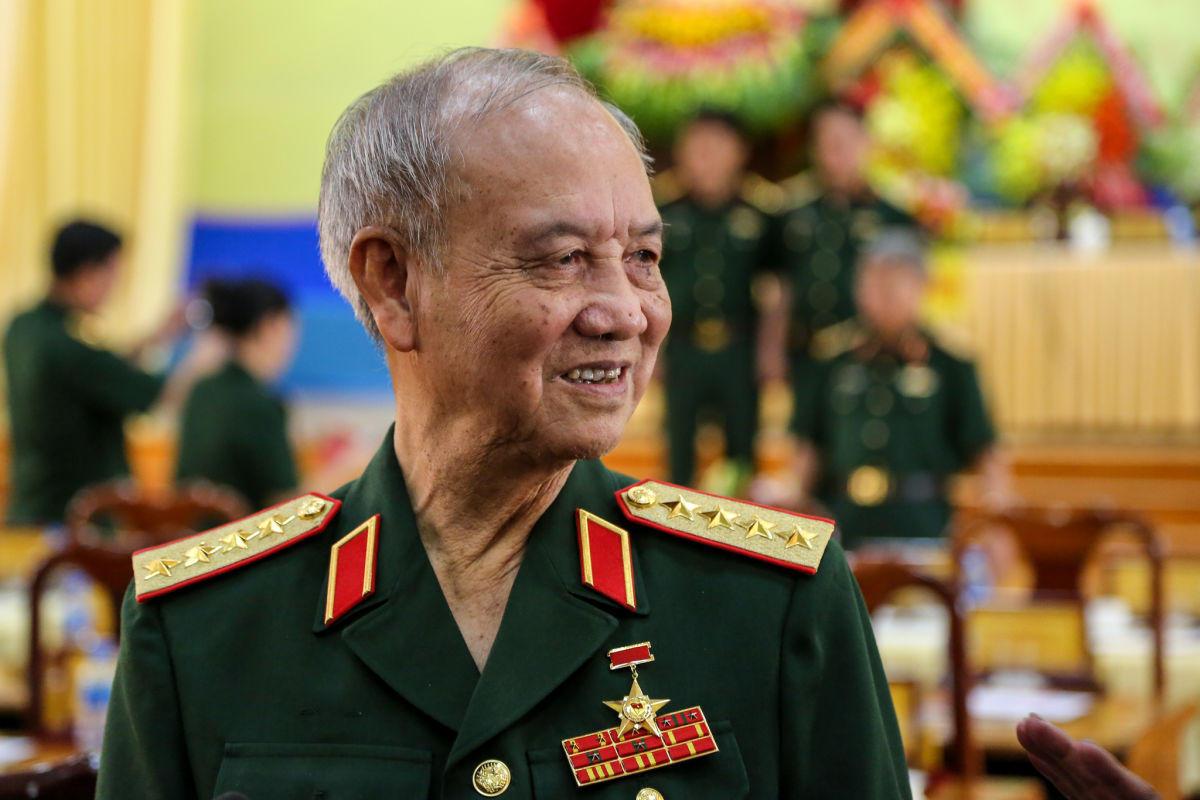
Gen. Pham Van Tra, former Politburo member, former Minister of National Defence (Photo: VietnamPlus)
At that time, after the resistance war against the US ended, I was assigned to continue commanding Regiment 1 U Minh and then Division 4 of Military Region 9, to directly participate in the fight against the invasion of the reactionary force Pol Pot-Ieng Sary, regain Vietnam’s sovereignty over Phu Quoc, Tho Chu, Hon Ong and Hon Ba islands and safeguard the country’s borderline from Tinh Bien (An Giang) to Ha Tien (Kien Giang).
However, at the end of 1976, the Pol Pot troops increased and expanded attacks and invasion of our country’s territory and somewhere 15km into our domain, causing tensions along the Southwestern border. These attacks were not unprompted actions but directed systematically and prepared carefully. In the night of April 30, 1977, the Pol Pot deployed troops at the division level and local forces to stage large-scale attacks along our country’s Southwestern border.
Reporter: When receiving information about the Pol Pot troops’ official invasion of Vietnam’s territory, how did you feel?
Gen. Pham Van Tra: At the time, I was head of U Minh 1 Regiment. This was a very special period when the resistance war against the US imperialists just ended. The regiment’s officers and soldiers were very happy as the country was liberated and regained peace and thought that they could visit their homeland after many years.
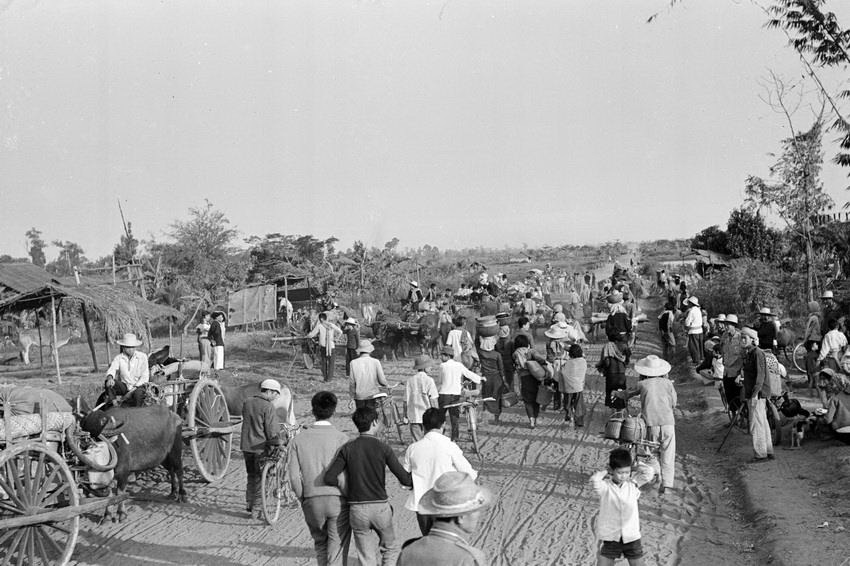
Cambodian people flee to Vietnam on national road 22 in the southwestern province of Tay Ninh because they cannot live under the Pol Pot – Ieng Sary genocidal regime (Photo: VNA)
Hence, when hearing the news the Pol Pot troops invaded Vietnam’s territory, I was very surprised and felt indignant. The Ministry of National Defence decided to send us to the sea to liberate islands such as Tho Chu and Phu Quoc.
It is necessary to say that at that time we fought to defend our Fatherland but not combat against the Cambodian people. Our officers and soldiers were all ready to sacrifice to regain the islands occupied the Pol Pot troops.
In 1975, on Tho Chu island alone, the Pol Pot troops killed 500 Vietnamese civilians. If the Vietnam People’s Army did not come early, Phu Quoc island would also fell into the same situation.
In 1975, on Tho Chu island alone, the Pol Pot troops killed 500 Vietnamese civilians. If the Vietnam People’s Army did not come early, Phu Quoc island would also fell into the same situation. We also promptly protected islands that the Pol Pot troops had not occupied yet.
Reporter: In the following years, the fighting along the Southwestern border continued escalating when the Pol Pot troops staged comprehensive attacks along the border. At the time, how was the general spirit of our army and people?
Gen. Pham Van Tra: At the end of April 1977, the Pol Pot troops used divisions and local forces of border provinces to concurrently attack and invade the Southwestern border. At that time, our people, especially those along the border, were very panic. On the border of Military Region 9 alone, they mobilised up to seven battalions and local forces of Takeo and Kandal provinces to attack 13 stations of the armed police and 14 out of 16 communes from Vinh Gia to Vinh Xuong (An Giang).
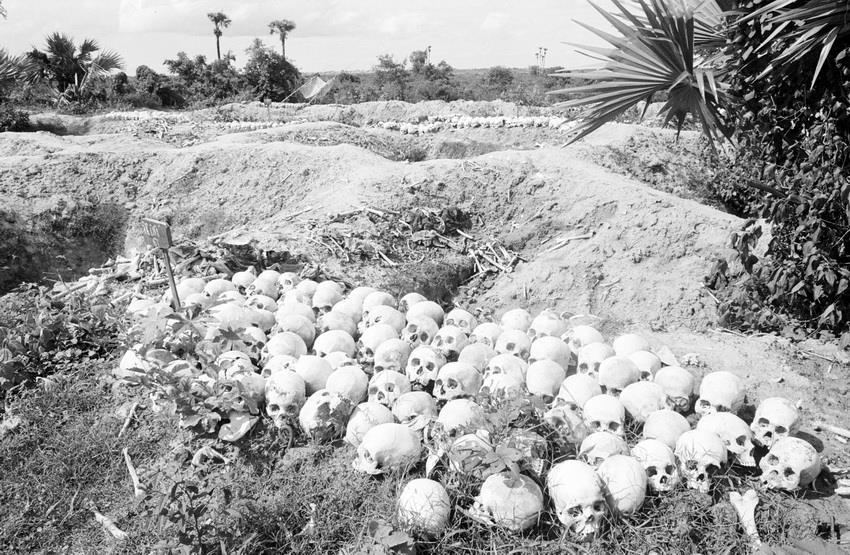
Mass graves of innocent people killed by the Pol Pot – Ieng Sary genocidal regime are unearthed after the liberation day on January 7, 1979 on the “Killing Field” Choeung Ek, about 17km to the South of Phnom Penh. Choeung Ek is the largest and most terrible mass grave among almost 100 mass graves throughout Cambodia (Source: VietnamPlus)
At that moment, our people, especially those along the border, were very panic. But regular troops were immediately mobilised from divisions to coordinate with local armed forces and armed police. Our soldiers fought back fiercely to protect our people and every sacred inch of soil of the Fatherland and gradually pushed the enemy back to the other side of the border.
If we did not combat, people in the border areas would continue to be killed and have to live in the miserable situation. In fact, this war was a compulsory struggle and we did not take the initiative. The Pol Pot troops attacked us first and trespassed upon our territory, forcing us to fight back. We were all determined to safeguard every inch of soil of the homeland to the last.
The attack of justice
Reporter: When the Vietnam People’s Army pushed the war back to the other side of the border, there were many public opinions that were not really objective from the international community. What are your viewpoints on this issue?
Gen. Pham Van Tra: In fact, the Southwestern border defence war and the fight against the Pol Pot regime had three stages. The first stage was the resistance war to safeguard the Fatherland’s border. The second state was to liberate the Cambodian people. In the final stage from 1980-1985, the Pol Pot regime restored its forces along the border with Thailand after it received support from foreign nations.
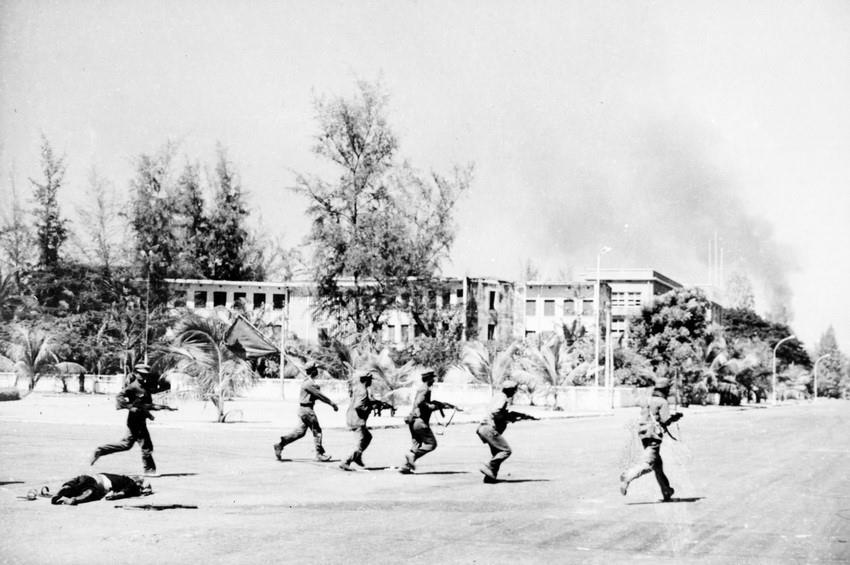
Cambodia’s revolutionary army forces liberate Phnom Penh at noon on January 7, 1979 (Photo: VNA)
When our soldiers liberated the Cambodian people from the Pol Pot genocidal regime, an American later told me that: “When the Vietnamese army entered Cambodia, the whole world condemned, including the US. But until now, we think that the world must thank and support Vietnam as it early detected and annihilated international terrorists.”
The Cambodian people also supported Vietnamese volunteer soldiers. They called the Vietnamese soldiers the “Buddhist army” because we liberated tens of thousands of Cambodian people from concentration camps.
After the first round of fighting in Cambodia, when our soldiers withdrew, many Cambodian people cried. They told us that if the Vietnamese soldiers did come they would be killed all. They wanted us to stay…
Especially, after the first round of fighting in Cambodia, when our soldiers withdrew, many Cambodian people cried. They told us that if the Vietnamese soldiers did come they would be killed all. They wanted us to stay, but at that time, we received the order from the Ministry of National Defence. When we came back later and stayed, the Cambodian people were very excited.
Reporter: What is your assessment of the Southwestern border defence war and the struggle against the Pol Pot genocidal regime 40 years ago?
Gen. Pham Van Tra: First, the Southwestern border defence war was a struggle of justice. For the justice, the whole people supported the war. When we attacked the Pol Pot troops in Cambodia’s territory, the justice continued to be shown. If it was not for the justice, the Cambodian people would never support and the Pol Pot regime would not be defeated.
Vietnamese and Cambodian soldiers protect the Angkor Wat Temple (July 1982) (Photo: VNA)
Reporter: 40 years after the victor over the Pol Pot genocidal regime. Vietnam and Cambodia have continued to promote cooperation in many fields and jointly built the shared border of peace and friendship. What is your assessment of the bilateral cooperative relations?
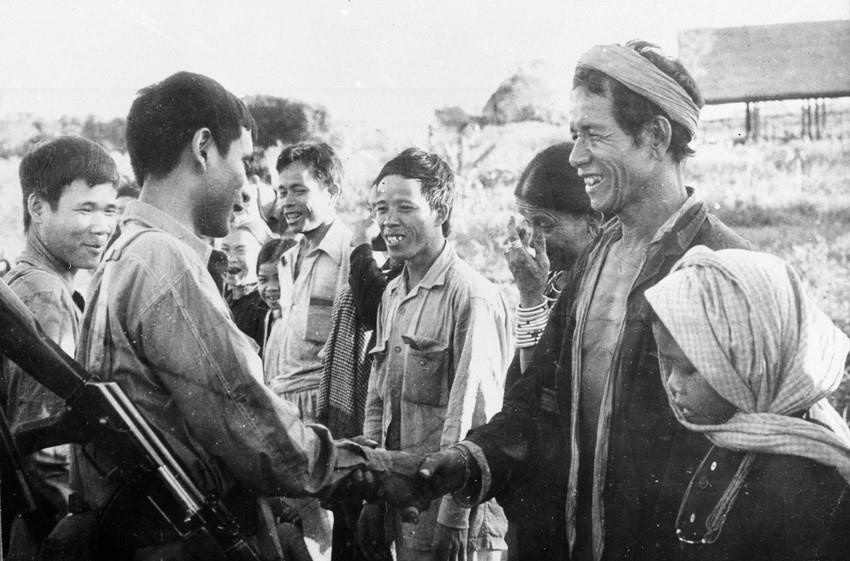
Local people in Cambodia’s northeastern Ratanakiri province welcome Cambodian revolutionary armed forces and Vietnamese volunteer soldiers coming to liberate their villages (Photo: VNA)
Gen. Pham Van Tra: I’m very delighted to know that the planting of markers along the Vietnam-Cambodia shared border has been basically completed. There are now several sections left. But the work will be accomplished sooner or later. We have still relied on the French colonial maps because the borderline in the maps was the most accurate. We also invited French experts to witness the planting of border markers.
Cambodian people in the victory celebration which is held on January 25, 1979 at Olympic Stadium in Phnom Penh (Photo: VNA)
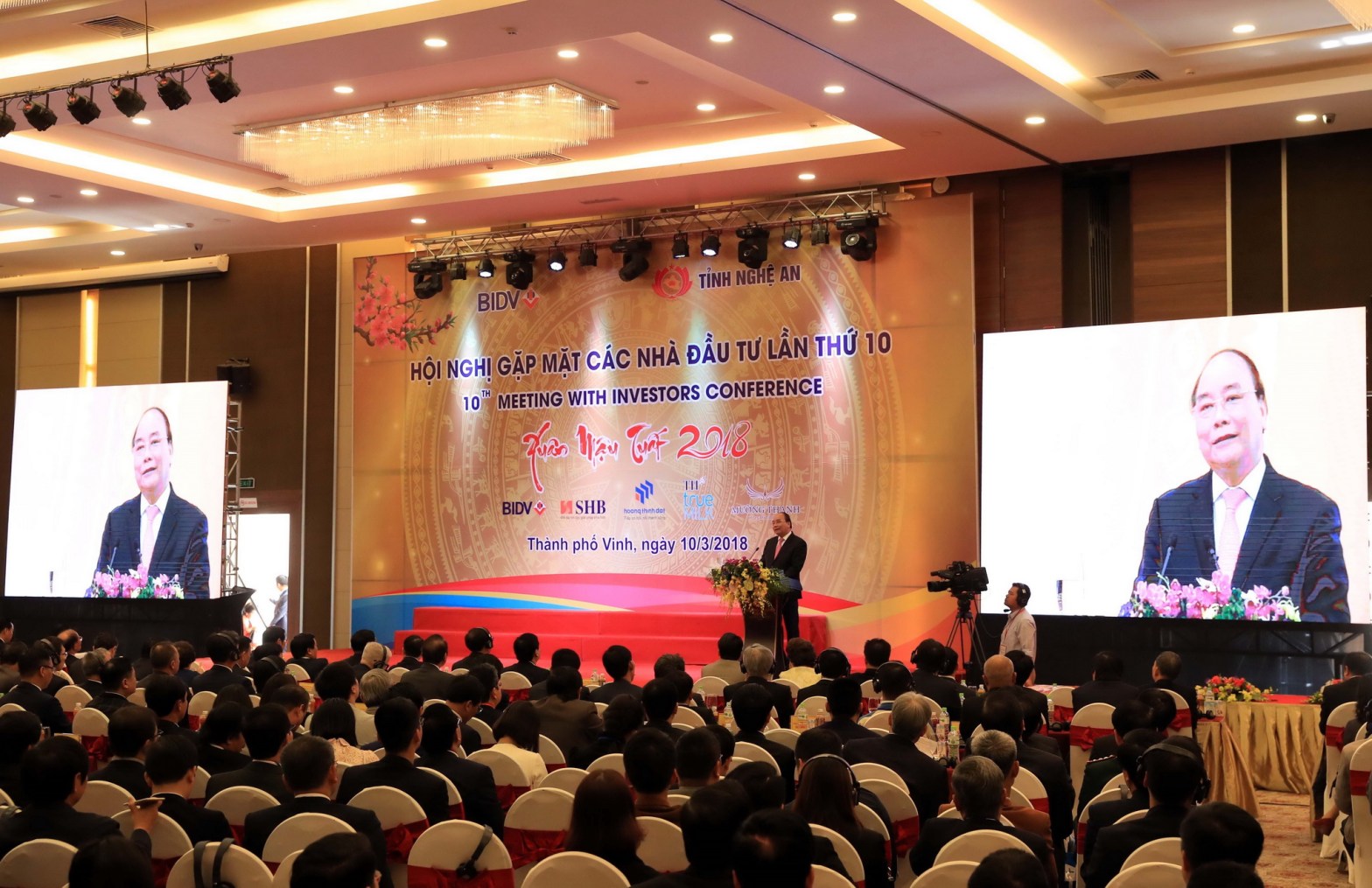
As part of a series of events to celebrate the 50th anniversary of the implementation of President Ho Chi Minh’s testament, a get-together for investors on the occasion of the Lunar New Year 2019 was held by the central province of Nghe An and the Joint Stock Commercial Bank for Investment and Development of Vietnam (BIDV) in Cua Lo town on February 23.
The event was attended by about 700 delegates, including Party and State leaders and officials from ministries, agencies, and localities that have close ties with Nghe An province; along with nearly 500 delegates from organisations, corporations, businesses, business associations, and investors inside and outside country; as well as representatives from international organisations in Vietnam.
The provincial authorities took the occasion to deliver a message on their strong commitment to administrative reforms. They pledged to continue accompanying and continuing to be a reliable, long-term, and sustainable partner of investors.The locality also hoped to benefit from the instructions of the Prime Minister and officials from ministries and central agencies, and recommendations made by other localities, investors and the business circle, in order to reform the way of thinking and doing in socio-economic management in general and investment attraction in particular.The meeting, an initiative of the BIDV and the Party Committee for the Central Business Bloc, has been organised by the provincial People’s Committee since 2009 with the aim of creating a forum to honour investors and enterprises that have made great contributions to the locality’s socio-economic development; while enhancing investment connection and promoting the image of Nghe An to domestic and foreign investors.
A corner of Vinh city (Source: Nghe An Newspaper)
Investment attraction results for the 2014-2018 period as seen in figures
In the 2014-2018 period, Nghe An attracted 690 investment projects with total registered capital of nearly 143 trillion VND, comprising 650 domestic projects worth 133.5 trillion VND and 40 foreign direct investment (FDI) projects valued at 9.5 trillion VND.
Classification of projects based on implementation progressProjects already operational: 55 projects with total investment capital of 42.86 trillion VND, accounting for 48 percent of the total registered investment capital.
Projects in the stage of procedure processing and construction: 74 projects with total investment of 34.42 trillion VND, accounting for 39 percent of the total registered investment capital.
For projects with investment of over 100 billion VND each, the province has attracted 150 projects
Projects yet to be launched or having licences withdrawn: 21 projects with total investment of 11.84 trillion VND, accounting for 14 percent of the total registered investment capital. Of those projects, 11 with total investment of over 3.21 trillion VND are yet to be implemented, and 10 have had their licences withdrawn.
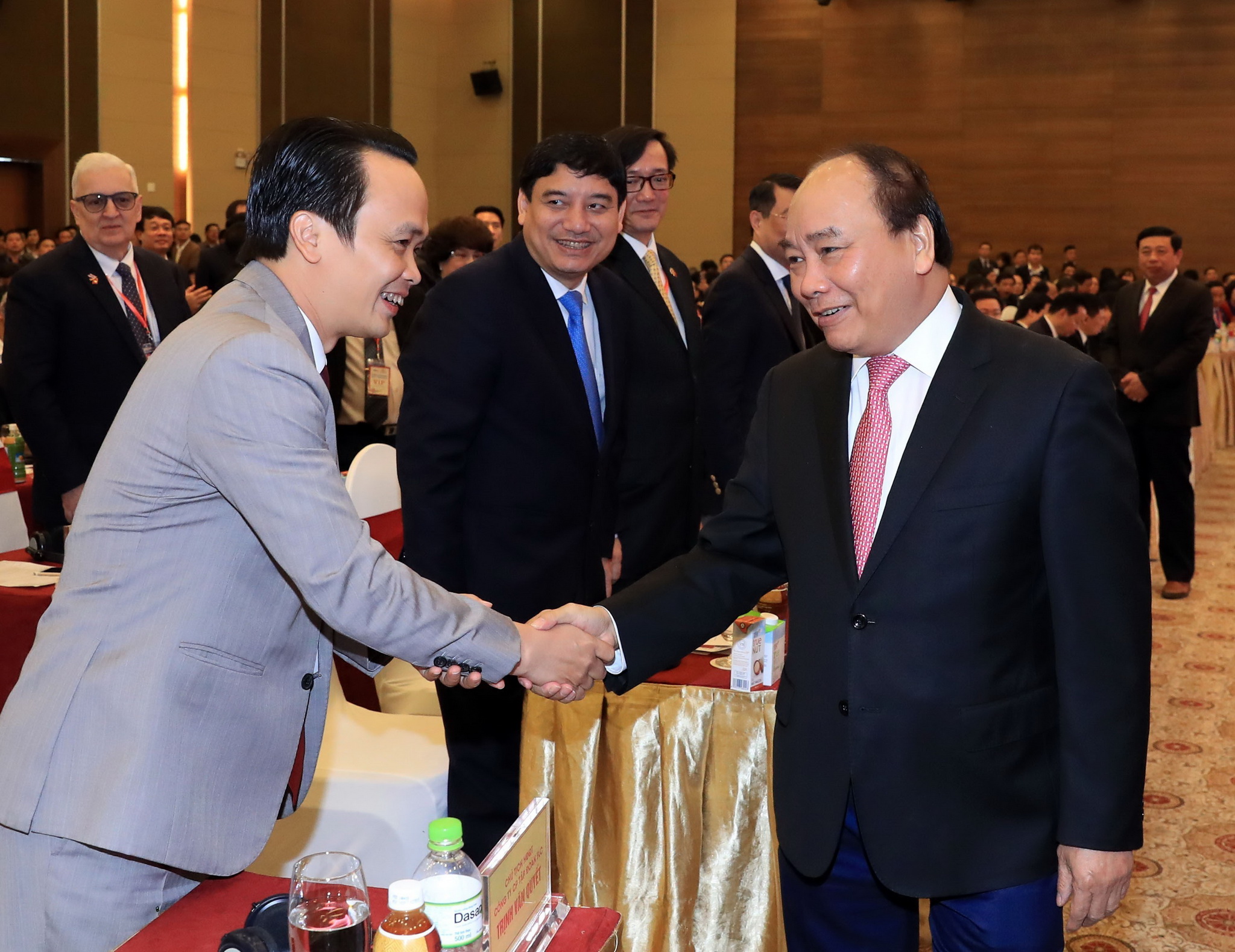
Prime Minister Nguyen Xuan Phuc (R) shakes hands with a delegate to the get-together (Source: VietnamPlus)
Classification based on investment sectors
Industrial sector: 75 projects with total registered investment of 47.64 trillion VND, accounting for 53 percent of the total investment, of which:
– The group of operational projects: 32 projects with total investment capital of 29.74 trillion VND, accounting for 62 percent of the total registered investment in the field.
– The group of projects in the stage of procedure processing and construction: 32 projects with total investment of 13.55 trillion VND, making up 28 percent of total registered investment in this field.
– The group of projects that are yet to be implemented or have had investment licences withdrawn: 11 projects with total investment of over 4.34 trillion VND, making up 9 percent of the total registered investment in this field.
Nghe An launched an investment promotion website with four languages in 2013 (Source: VietnamPlus)
Construction sector: 36 projects with total investment of 20.54 trillion VND, accounting for 23 percent of total investment, of which:
– The group of operational projects: 8 projects with total investment of 4.94 billion VND, making up 24 percent of total registered capital in the field.
– The group of projects in the stage of procedure processing and construction: 23 projects with total investment of 11.9 trillion VND, accounting for 58 percent of total registered capital in the field.- The group of projects that are yet to be implemented or have had investment licences withdrawn: 5 projects with total investment of over 3.66 trillion VND, making up 18 percent of the total registered investment in this field.
Trade and service sector: 25 projects with total investment of 10.51 trillion VND, accounting for 12 percent of total investment, of which:
– The group of operational projects: 11 projects with total investment of over 5.6 trillion VND, accounting for 53 percent of total registered investment in the field.
– The group of projects in the stage of procedure processing and construction: 11 projects with total investment of over 4.44 trillion VND, accounting for 42 percent of total registered capital in the field.
– The group of projects that are yet to be implemented or have had investment plans/investment licences withdrawn: 3 projects with total investment of over 457 billion VND, making up 4 percent of the total registered investment in this field.
At the event, local authorities continued to deliver the message on their strong commitment to administrative reforms.
Agricultural sector: 10 projects with total registered investment of 8.613 billion VND, making up 10 percent of total investment, of which:
-The group of operational projects: 2 projects with total investment of over 1.16 trillion VND, accounting for 14 percent of total registered investment in the field.
– The group of projects in the stage of procedure processing and construction: six projects with total investment of 4.07 trillion VND, accounting for 47 percent of total registered capital in the field.
– The group of projects that are yet to be implemented or have had investment licences withdrawn: two projects with total investment of over 3.37 billion VND, making up 39 percent of the total registered investment in this field.
Social investment in education, healthcare, and culture: four projects with total registered capital of over 1.8 billion VND, accounting for 2 percent of total investment, of which:
– The group of operational projects: one project with total investment of 1.3 trillion VND, accounting for 71 percent of total registered investment in the field.
– The group of projects in the stage of procedure processing and construction: three projects with total investment of 525 billion VND, accounting for 29 percent of total registered capital in the field.
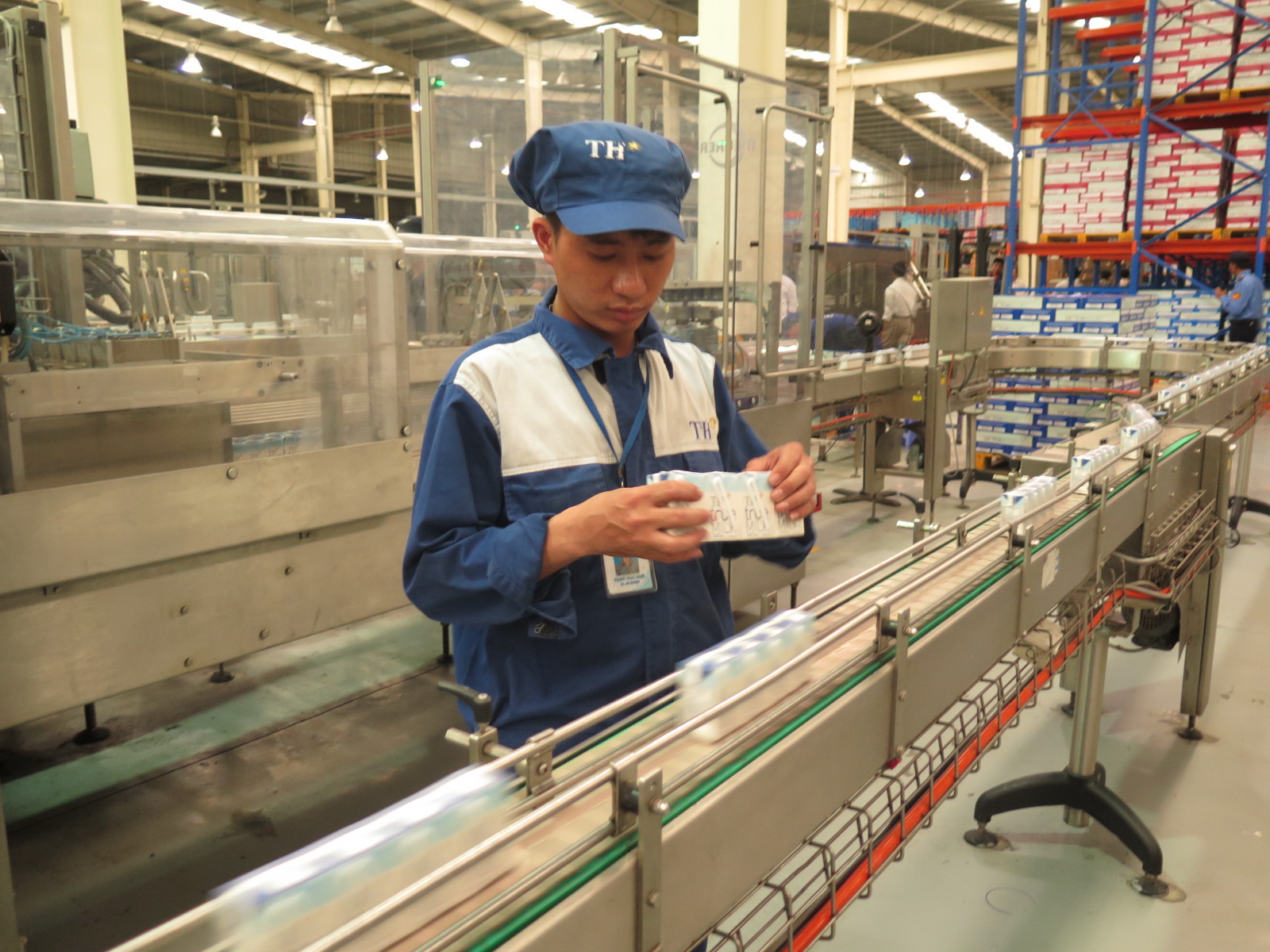
TH milk factory is an effective investment attraction project in the western area of Nghe An province. (Photo: Nguyen Van Nhat/ VietnamPlus)
The aforementioned statistics show that the registered capital in projects that have become operational or are being implemented accounts for a large proportion (87 percent), showing that investment attraction from 2014 until now has met the province’s target.
At present, many investors and reputable corporations have been effectively implementing investment projects in Nghe An. They include Vingroup, Masan, T&T, BRG, FLC, TH, The Vissai, Hoa Sen, Muong Thanh, Vinamilk, VSIP, and WHA Industrial Zone.
Many large projects using high technology have come into operation effectively, contributing to creating jobs for local people.
TH Group has received investment licences for 10 projects with a total registered capital of over 12.06 trillion VND, of which 4 projects worth over 8 trillion VND have already become operational. Meanwhile, Vissai Group invested over 12.1 trillion VND in Nghe An, with two projects put into operation worth over 11.6 trillion VND. Hoa Sen Group has two operational investment projects in the locality with total investment of 8.01 trillion VND.
The Vissai international port in Nghi Thiet, Nghi Loc district, Nghe An province (Source: Nghe An Newspaper)
Results of investment attraction in 2018
In 2018, Nghe An authorities granted investment licences to 114 projects with total registered capital of 9.12 trillion VND, and allowed the addition of 1.28 trillion to eight existing projects.
A number of new projects included a Masan beer and beverage factory in Zone B of the Nam Cam Industrial Park (1.66 trillion VND); the Trung Do construction material production complex in Nghi Van commune, Nghi Loc district (1.02 trillion VND); the Hai Chau II confectionery factory (360.3 billion VND); Biomass Fuel Vietnam at VSIP Industrial Park (20 million USD); Em-Tech Vinh factory at VSIP Industrial Park (11.82 million USD); the Nghe An Pharmaceutical Factory (315 billion VND).At the meeting, the provincial authorities presented decisions approving investment proposals and investment licences for nine projects, and signed 16 investment agreements. Among them, one project was put into operation at the end of 2018, and 8 out of 9 projects are being implemented at scheduled pace. Meanwhile, 3 out of the 16 signed agreements have later been granted approval of investment proposals, and investors under 9 other agreements have submitted investment dossiers to the provincial authorities,while investors under the remaining 4 agreements are conducting study and completing investment dossiers.
In the 2014-2018 period, Nghe An’s annual budget collection increased by about 1.2 trillion VND.
The success of investors’ meetings has contributed to creating a strong change in attracting investment in Nghe An, as seen in the increasing number and scale of projects through the years, creating jobs for more than 37,500 labourers each year.
In the 2014-2018 period, Nghe An’s budget collection increased by about 1.2 trillion VND every year. In 2018, the locality collected over 13.9 trillion VND for the State budget, reaching 109.8 percent of the estimate and increasing by 9.4 percent compared to those of 2017.
Per capita GRDP reached 38 million VND. The capital flow also contributed to shifting the structure of investment towards higher proportion of investment in industry, construction, and trade-services.
The locality has paid attention to luring investment in agricultural production, the processing industry, and tourism services, creating a fundamental impetus for its socio-economic development and contributing to successfully achieving the targets set in both the Politburo’s Resolution No.26-NQ/TW dated July 31, 2013 on the orientation of and tasks for the development of Nghe An towards 2020, and the 18th provincial Party Congress’ resolution. –VNA
Exporting iron sheets of Hoa Sen factory to the US (Source: VietnamPlus)
2018 was a successful year with industry and trade sector as all set targets were surpassed. Notably, export grew 13.8% or 244.7 billion USD. Export turnover of 29 items exceeding 1 billion USD.
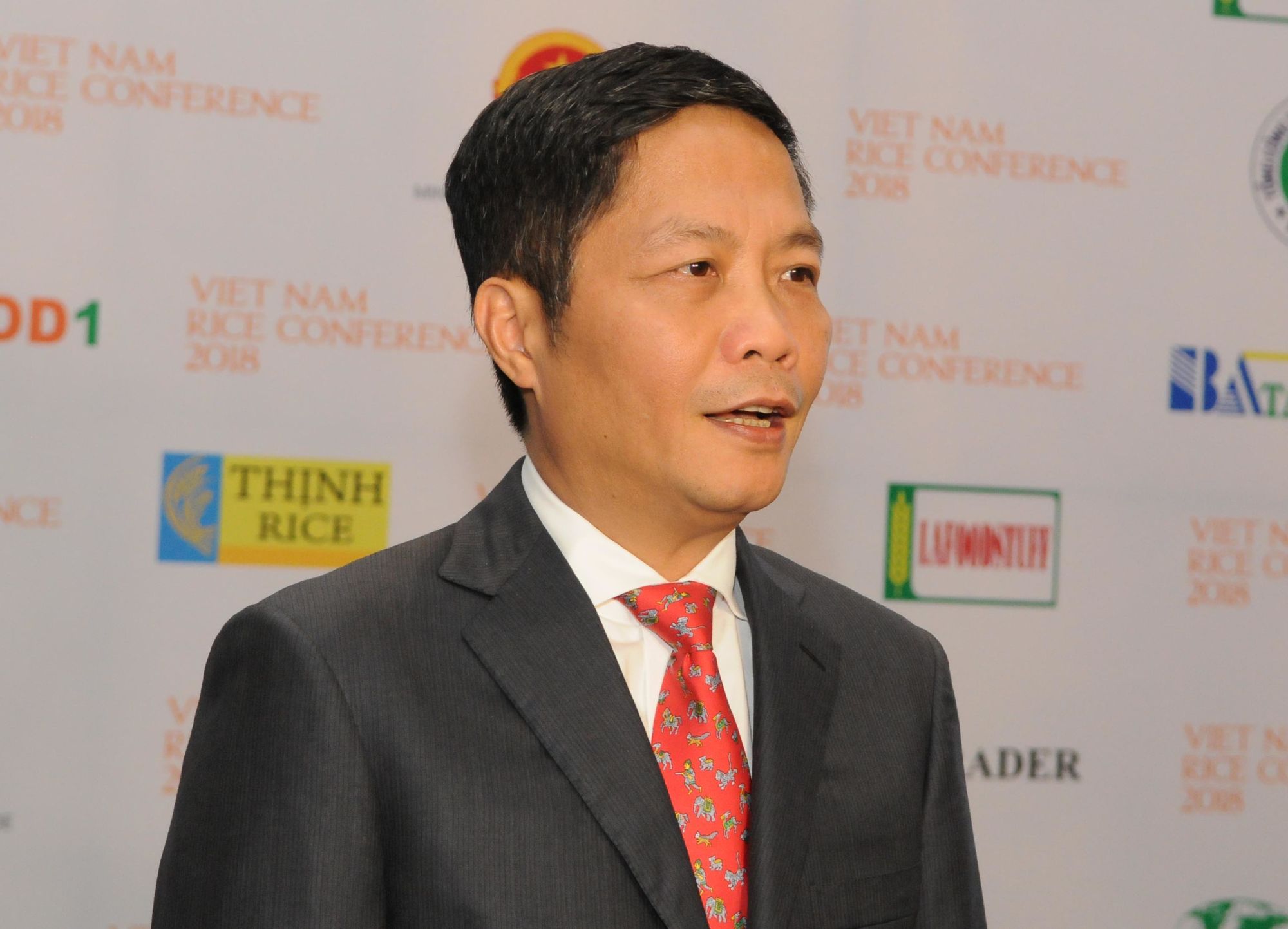
With the aforementioned achievements, Minister of Industry and Trade Tran Tuan Anh said Vietnam has become a big exporter in the world, adding that the export sector has greatly contributed to realizing the target of high economic growth in line with macro-stabilisation and inflation control last year.
In the very first days of 2019, Minister Tran Tuan Anh granted an interview to reporters on the ministry’s concrete steps to fulfill the mission of ‘making breakthroughs’ set by Prime Minister Nguyen Xuan Phuc in his new-year message.
First, could you please share some information regarding national economic growth in 2018?
We have witnessed all-out efforts by the political system as a whole, especially the coherent, comprehensive and aggressive management and direction by the government. The GDP growth of 7.08% last year was a positive signal as it surpassed the economic target set out earlier that year.
The impressive achievement is attributable to drastic guidance by the Government in the very beginning of 2018, especially detailed economic assessments and forecasts, which lay a firm foundation for practical measures and solutions to keep the economic growth on track. Economic outcomes of each quarter are all positive with numerous economic highlights. Therefore, the overall economic growth last year was high with various sectors being kept stable, including export, processing and manufacturing industries, domestic trade, etc. The impressive economic performance of those sectors greatly contributed to the fulfilment of set targets by the government.
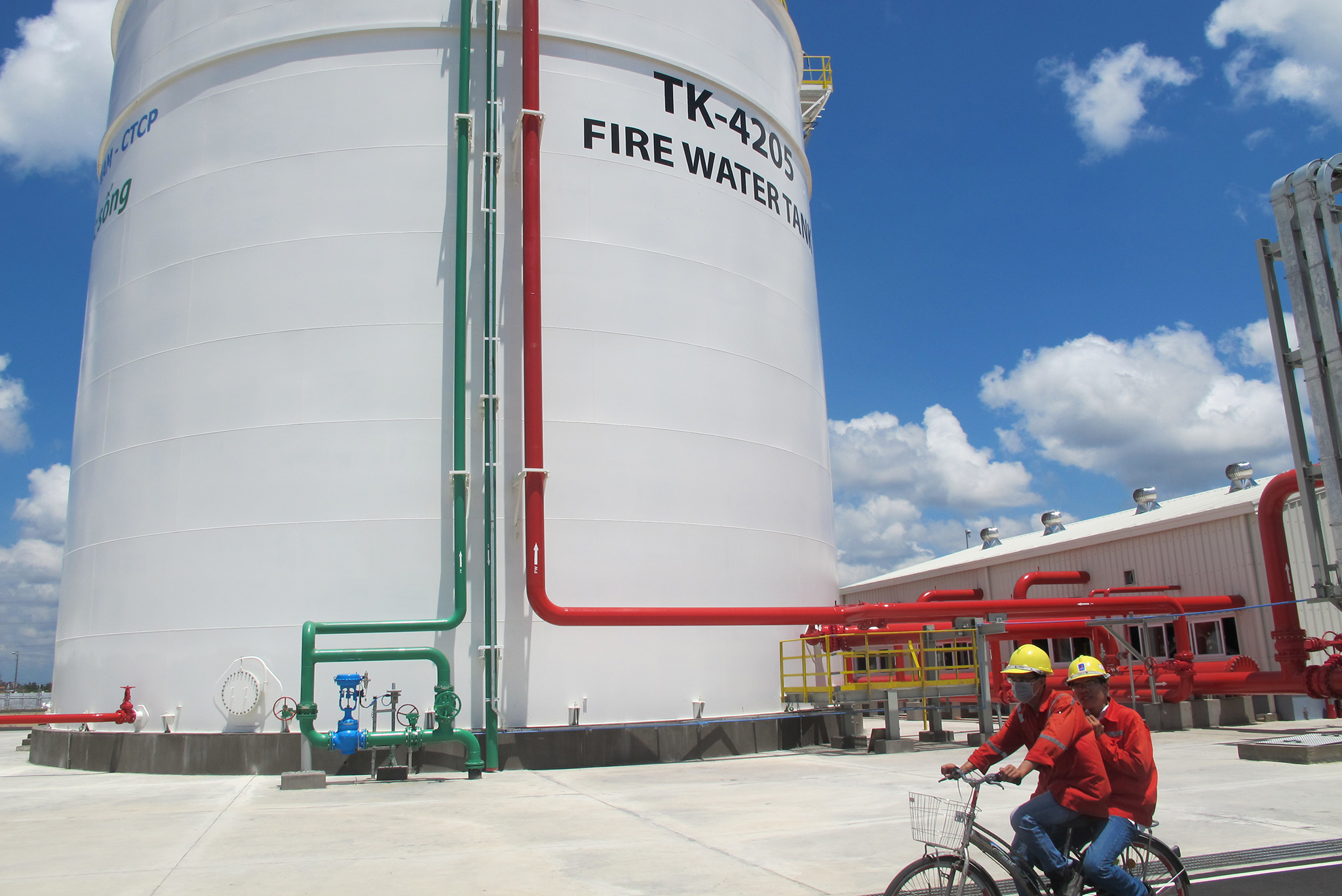
Ca Mau Gas-Power-Fertilizer Complex (Photo: VNA)
We have witnessed all-out efforts by the political system as a whole, especially the coherent, comprehensive and aggressive management and direction by the government.
Particularly, I want to highlight processing and manufacturing, which played their role as momentums for the impressive growth of national index of industrial production (IIP) and GDP.
In 2019, the Government continues to set out GDP growth target of 6.9 to 7% with processing and manufacturing industries and services being the economic driving forces. Could you please share with us the Ministry’s plans to achieve the goal?
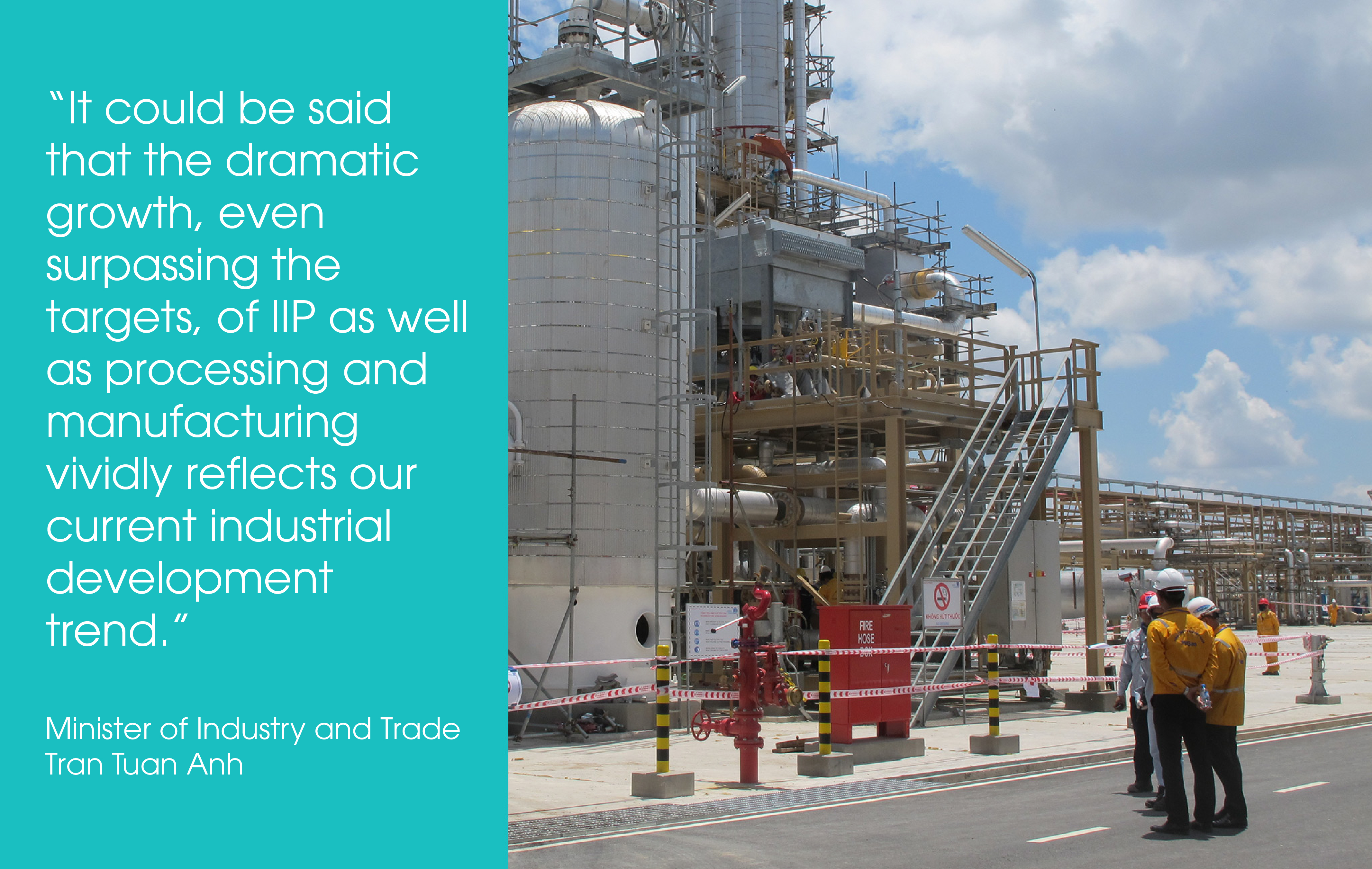
It could be said that the dramatic growth, even surpassing the targets, of IIP as well as processing and manufacturing vividly reflects our current industrial development trend.
As I mentioned earlier, the results are largely attributable to the Government’s aggressive guidance in improving business climate and easing bottlenecks in particular sectors and products, especially processing and manufacturing. The positive outcomes of national economy last year also prove effectiveness of the ongoing economic reform, specifically orientations, policies and measures to conduct economic reform.
Ca Mau Gas-Power-Fertilizer Complex (Photo: VNA)
Besides the impressive growth of processing and manufacturing, lower inventory index also signals improvements of the market, as well as of Vietnamese enterprises’ competitiveness and integration into industrial supply chains.
2018 also marked the third consecutive year Vietnam has enjoyed a trade surplus. Domestic enterprises also actively contributed to export sector in 2018. What do you think about the results and the Ministry’s roles in boosting exports and expanding exporting markets?
In my opinion, the industry and trade sector has exerted great efforts in managing export activities.
In fact, the growth rate of 13.8% in 2018 proves that Vietnam has become a big exporter in the world. Especially given the volatility in a gloomy world trade context with new-style protectionism and unilateralism, Vietnam export value still overwhelmingly exceeded all set targets.
Instead of controlling trade deficit at below 3%, we even reach a trade surplus of 7.2 billion USD.
The same story goes with industry sector as it also met double targets of dramatic growth and trade deficit control. It could be seen that instead of controlling trade deficit at below 3%, we even reach a trade surplus of 7.2 billion USD.
Naming numbers sounds easy but realising it requires all-out efforts by the political system. The numbers proved the effectiveness of our economic reforming and growth model changing through sustainable export strategies, as well as comprehensive and coherent global integration strategies.
Another highlight that worth noticing is Vietnam’s rank in global export map at various goods is high.
For example, besides world’s leading export growth, Vietnam has also affirmed its name in global supply and value chains.
Specifically, Vietnam ranks third worldwide for footwear export and 7th for textile. Other commodities such as rice, coffee and rubber also affirm their position of world leading export values.
But what I mean here is not only Vietnam’s export in general but also individual enterprises in particular. Many firms have become links in global supply chains thanks to their own efforts in improving their capacity and competitive edge.
Notably, domestic enterprises engaging in export activities witnessed an impressive growth of 15.9% in 2018. Meanwhile, foreign direct investment sector, which had always enjoyed trade surplus and high growth in previous years, only saw 13.6% growth in 2018, yet still a remarkable growth rate.
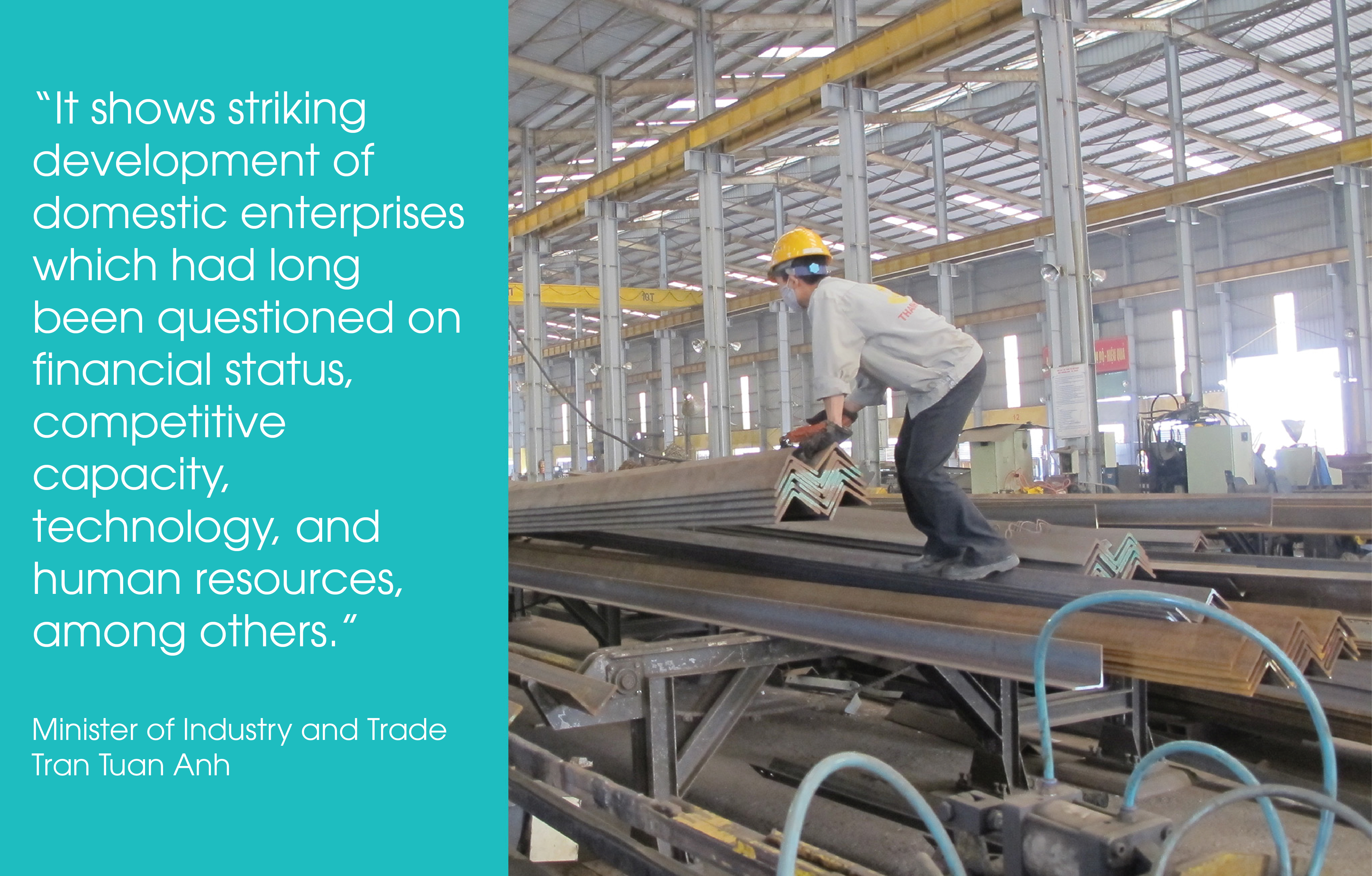
It shows striking development of domestic enterprises which had long been questioned on financial status, competitive capacity, technology, and human resources, among others.
In 2018, 29 sectors and products enjoy export turnover of over one billion USD with five of which gaining over 10 billion USD from export.
I think this was a great momentum for us to enhance capacity of enterprises and expand exporting markets given opportunities brought by multilateral trade system with new-style free trade agreements having been signed and taken effect.
Besides long-term economic reform strategies in industry, agriculture and import-export, the Government has also exerted efforts in management and business environment improvement.
Besides long-term economic reform strategies in industry, agriculture and import-export, the Government has also exerted efforts in management and business environment improvement.
So how does the Ministry deal with domestic trade?
With a market size of nearly 97 million people, Vietnam has also witness the development of various economic sectors. Trade infrastructure system has been improved with more closely-connected and sustainable supply chains.
A huge influx of investment from both foreign and domestic enterprises to develop local retail systems could also be observed.
Given Vietnam has been striving for fulfilling integration commitments, we face both challenges and opportunities. Yet overall, they are all driving forces for economic growth. Integration also results in diversification of consumers’ choices and improvement of distribution channels.
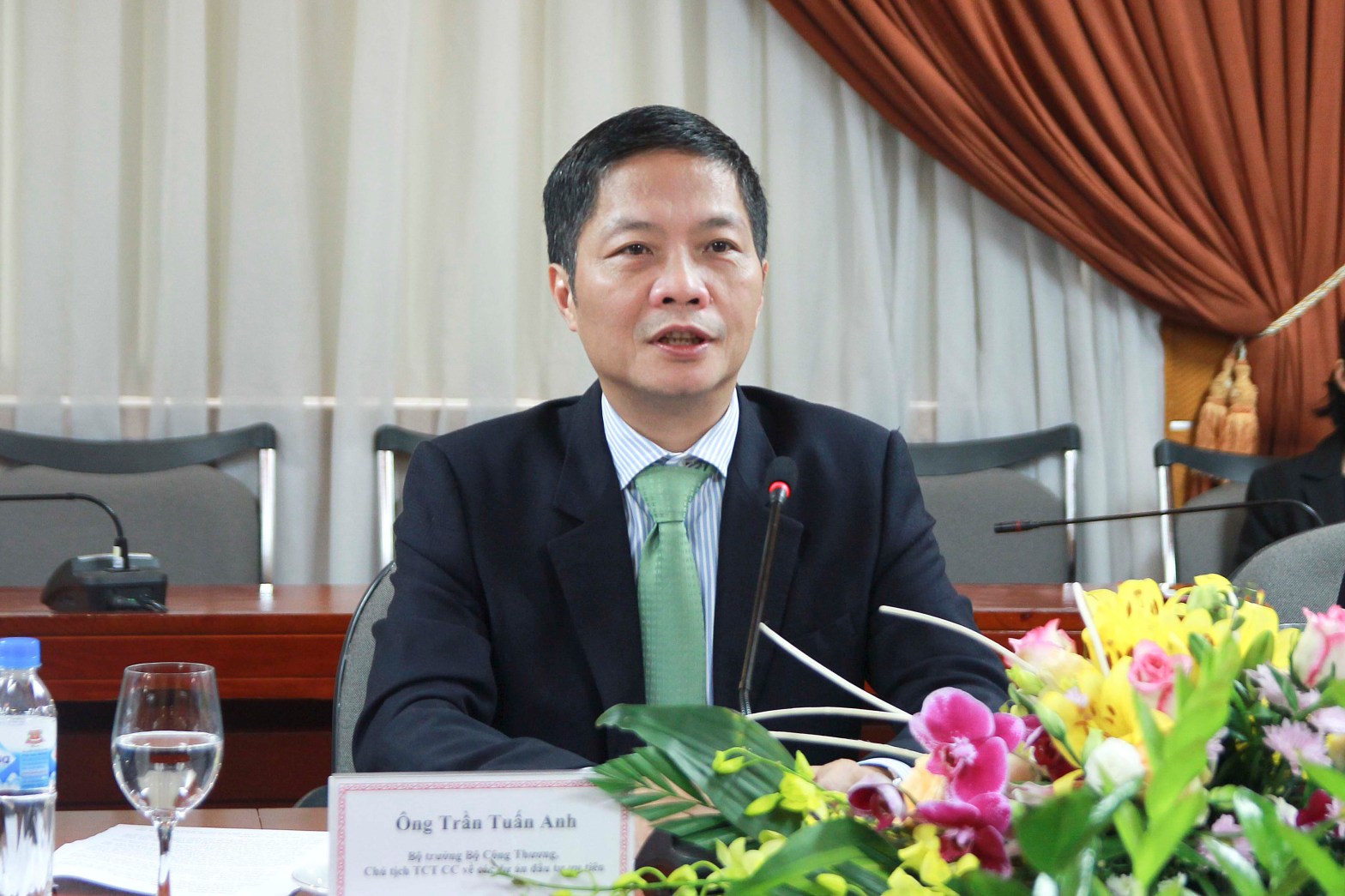
Minister of Industry and Trade Tran Tuan Anh
Given Vietnam has been striving for fulfilling integration commitments, we face both challenges and opportunities. Yet overall, they are all driving forces for economic growth.
Could you please share with us some key approaches to fulfill targets set for 2019?
The first target the Ministry of Industry and Trade sets for this year is deploying action programmes in line with the Government’s Resolution on measures to ensure socio-economic development and budget collection in 2019.
Next, the Ministry will stick to targets and objectives approved by the National Assembly, then map out concrete plans and growth prospects for industry, trade and service sectors in every quarter and major periods of time.
We have also paid heed to developing detailed plans for focal products in particular periods of time. Besides long-term solutions, urgent plans should also be devised in response to volatile occurrences in the world.
The first urgent plan is energy supply. It is necessary to set out an oblige target of ensuring sufficient electricity for both economic growth and social demands. The Ministry of Industry and Trade has mapped out four scenarios for this.
Secondly, domestic trade development is the Ministry’s major task, especially given Vietnam’s extensive global integration. Opening domestic market in line with commitments driven from global integration results in more FDI enterprises investing in Vietnam, which expands domestic distribution and retail market. Accordingly, domestic enterprises participating in the distribution market also face fiercer competition. Not to mention, local infrastructure also carries more onerous burden. Given the urgent situation, appropriate legal framework and policies should be devised. Therefore, it is also our focus in this period.
2019 is expected to welcome many favourable conditions while new mechanisms will be improving and proving effective, especially policies aiming at sustainability and stability.
What do you think about growth prospects of sectors under management of the Ministry of Industry and Trade?
In my opinion, with positive and sustainable performance results we have achieved, 2019 is expected to welcome many favourable conditions. New mechanisms will be improving and proving effective, especially policies aiming at sustainability and stability in line with the strategy for sustainable import-export and strategy for economic reforming and growth model transforming.
We have mapped out detail guidelines in concrete plans for each year and specific periods of time. Moreover, we have a lot of experiences being drawn from our journey of global integration, from which we have taken more cautious and confident steps. I do believe that those experiences will help a lot in the Government’s policy making and management in 2019, especially given more new-generation FTAs coming into force, creating a growth momentum for the economy.
I think the socio-economic growth in general and for sectors under the Ministry’s management in particular will achieve fruitful outcomes in 2019.
Golf lovers have praised Vietnam as an attractive destination with high-quality golf courses, scenic landscapes and favourable weather conditions. Despite such potential, the golf tourism sector is yet to optimise its advantages.
At a recent working session with representatives from the Vietnam National Administration of Tourism (VNAT), legendary golfer Greg Norman, who was appointed Tourism Ambassador of Vietnam for 2018-2021, has committed to assisting Vietnam in making a short film on its golf courses and a video clip on how the sport is played in the country.
It is better late than never for the tourism sector and enterprises to tap this ‘goldmine’ and turn Vietnam into a destination on the world golf map.
Vietnam has become the destination of many high quality golf courses. (Photo: VietnamPlus)
A ‘goldmine’ for tourism
Nguyen Cong Hoan, director of the travel company HanoiRedtours, said golf tourism is lucrative as its target customers are often willing to pay for luxury hotels and restaurants and return several times.
In recent years, following the development of tourism infrastructure in Vietnam, golf courses have also received investment. Most major tourism areas have started paying attention to building golf courses alongside resorts.
Also, thanks to favourable weather conditions, golfers can come to Vietnam year-round. Particularly in winter, when golf courses in Northeast Asia and Northern Europe are on hiatus, Vietnamese ones in the central and southern regions maintain normal operation.
Golfers join a tournament in Vietnam (Photo: VietnamPlus)
In winter, when golf courses in Northeast Asia and Northern Europe are on hiatus, Vietnamese ones in the central and southern regions maintain normal operation.
“Developing golf tourism, Vietnam sees chances to attract a large number of international tourists from key markets where demand for the sport is high like the Republic of Korea, Japan, Taiwan, and China. Last winter, all golf courses in the central and southern regions were fully booked, with their customers mostly coming from Northeast Asia,” Hoan said.
To serve such demand, the Vietnam Tourism Association (VITA) has established the Vietnam Golf Tourism Association (VIGTA). The organisation works to include the sport in local tourism products, and organise golf tournaments, workshops and fairs, among other activities in Vietnam and abroad, aiming to increase budget collection and boost Vietnamese golf’s position in the region and in the world.
According to golf course managers, the number of people visiting Vietnam to play golf accounts for a large proportion of foreign visitors to the country.
According to golf course managers, the number of people visiting Vietnam to play golf accounts for a large proportion of foreign visitors to the country. As such the VIGTA establishment is a right move to help fulfill growth demand of golf tourism.
“We expect the VIGTA to carry out activities to make golf tourism an important factor of Vietnam tourism. However, such a goal is not easy as it relies on how we actually do the work and how golf courses and travel agencies are linked together,” noted Vice Chairman of the VITA Vu The Binh.
How to promote Vietnamese golf tourism?
The dish is ready; the point is how to make it appeal to international friends.
Hanoi plans to organise golf tournaments and fairs.
Hoan said: “For a long time, we have focused on promoting Vietnam as a country of scenic sites, long history and diverse culture and food. Now, the situation has changed, apart from the traditional tourist markets, we now offer services for those interested in meeting, incentive, convention and exhibition (MICE) and golf tourism.”
Hanoi plans to hold more golf tournaments and exhibitions to give Vietnam’s tourism a fresh look to draw higher number of visitors, increase revenue and ensure sustainable development.
According to Binh, in the framework of the recent Vietnam International Travel Mart (VITM) 2019 in Hanoi, golf tourism promotion just stopped at the establishment of the VIGTA. As for further promoting golf tourism overseas, he said there are two ways, which are via golf organisations and via travel companies. If the two parties work together, information on Vietnamese golf tourism will spread further, he added.
Ngo Hoai Chung, deputy director general of the VNAT, said the agency is committed to supporting the VITA and VIGTA for the overall growth of the tourism sector.
The establishment of the VIGTA will help develop high-quality tourism, he said.
The dish is ready; the point is how to make it appeal to international friends.
In such a context, domestic tourism firms have become aware of the ‘goldmine’ and wish to form a strong connection with golf courses in promoting the sport and attracting more visitors./.
Becoming the destination of golf tourism is the goal of Vietnam’s tourism industry.
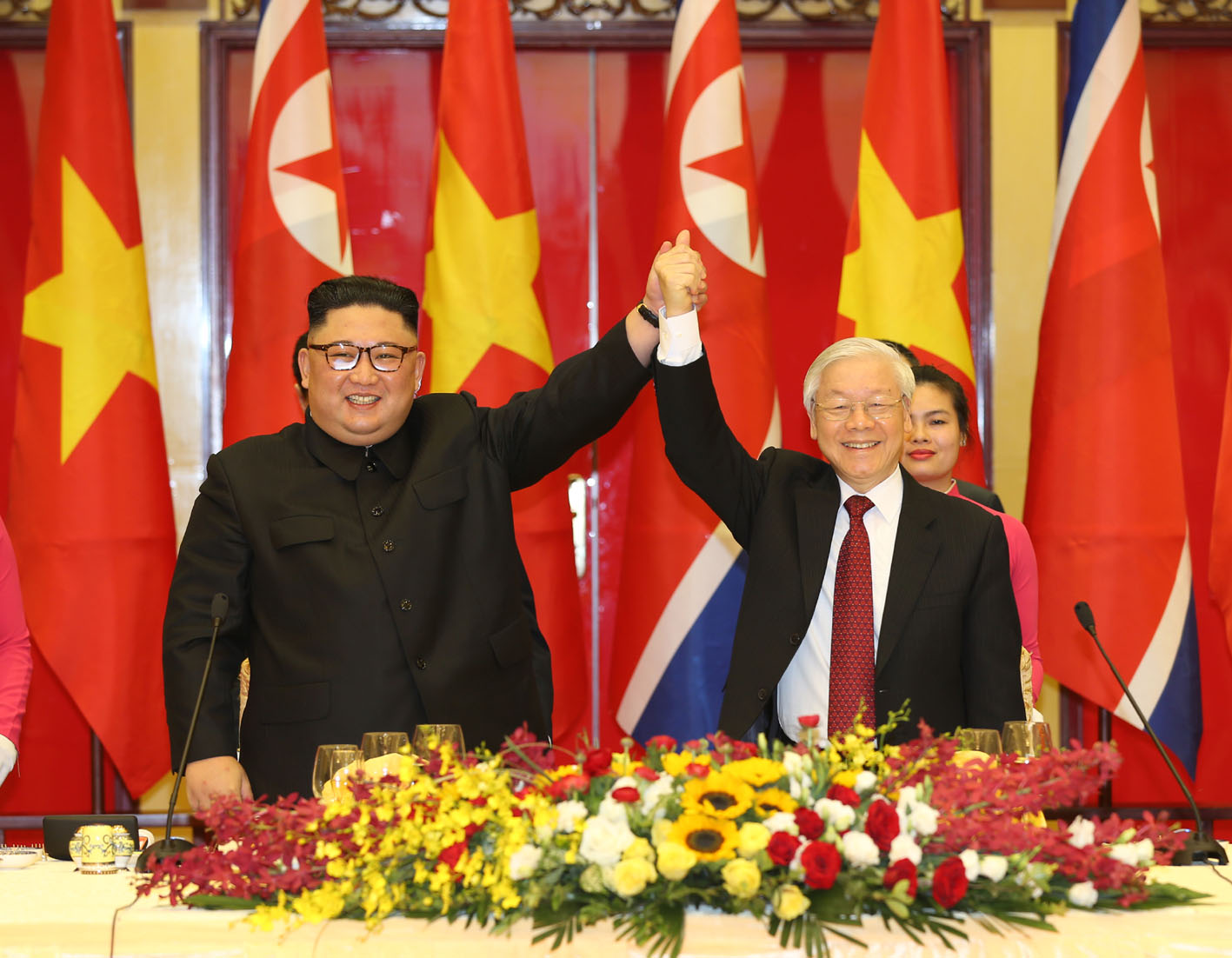
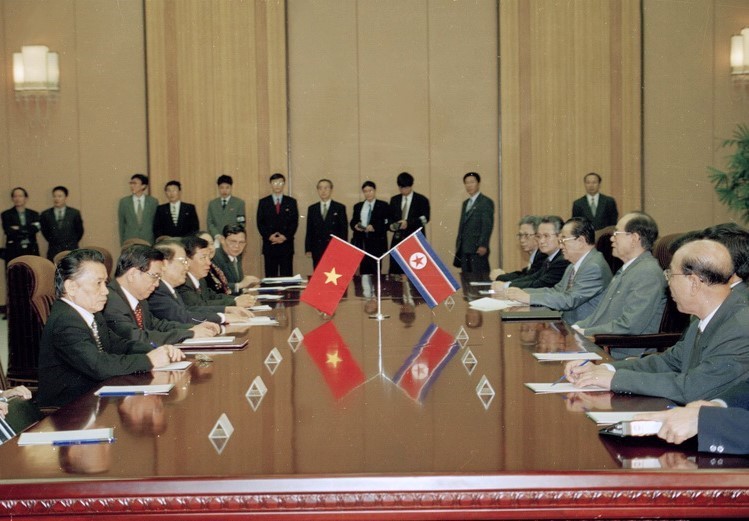
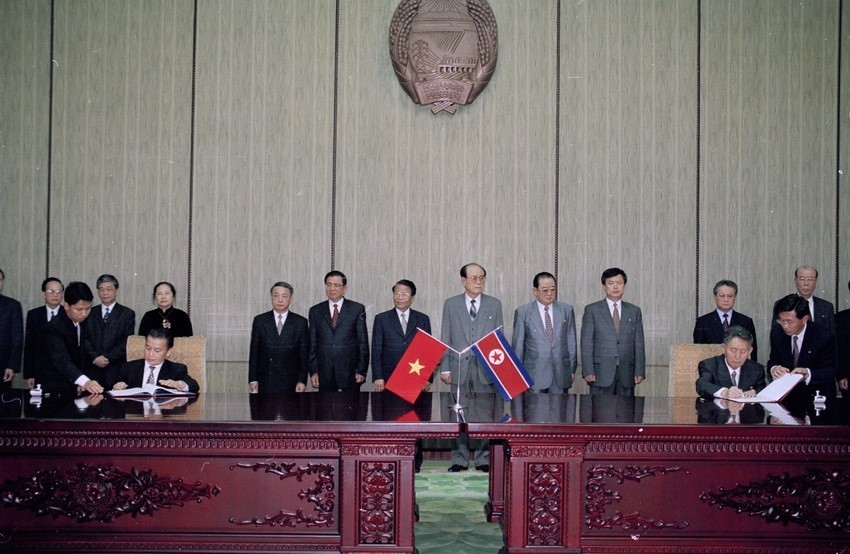
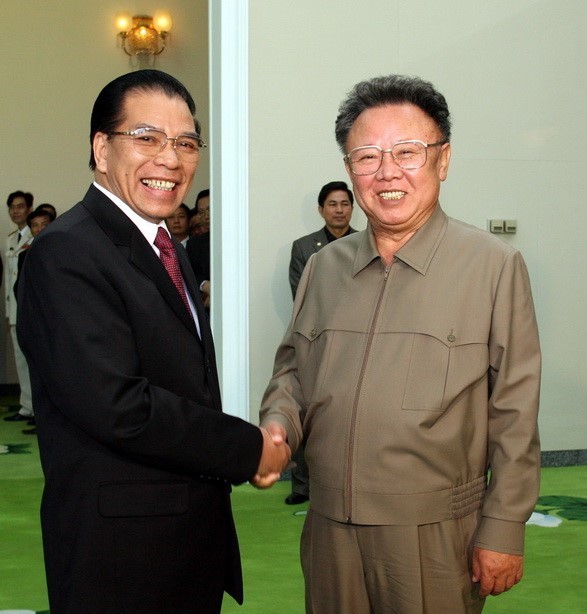
Chairman of the Workers’ Party and the State Affairs Commission of the Democratic People’s Republic of Korea (DPRK) Kim Jong-un paid an official friendship visit to Vietnam at the invitation of General Secretary of the Communist Party of Vietnam Central Committee and President Nguyen Phu Trong.
Taking place more than 60 years after the first visit to Vietnam by DPRK founder Chairman Kim Il Sung in 1958 and ahead of the 70th anniversary of bilateral diplomatic ties in 2020, Chairman Kim’s visit will mark a new historical milestone in the rich relations between the two countries and two parties. Vietnam-DPRK friendship unceasingly consolidated, developed The bilateral diplomatic relations, founded and nurtured by President Ho Chi Minh and DPRK Chairman Kim Il-sung on January 31, 1950, have been increasingly strengthened over the past seven decades, evidenced by the exchange of visits with more than 50 delegations at the ministerial level and above.
The bilateral diplomatic relations have been increasingly strengthened over the past seven decades.
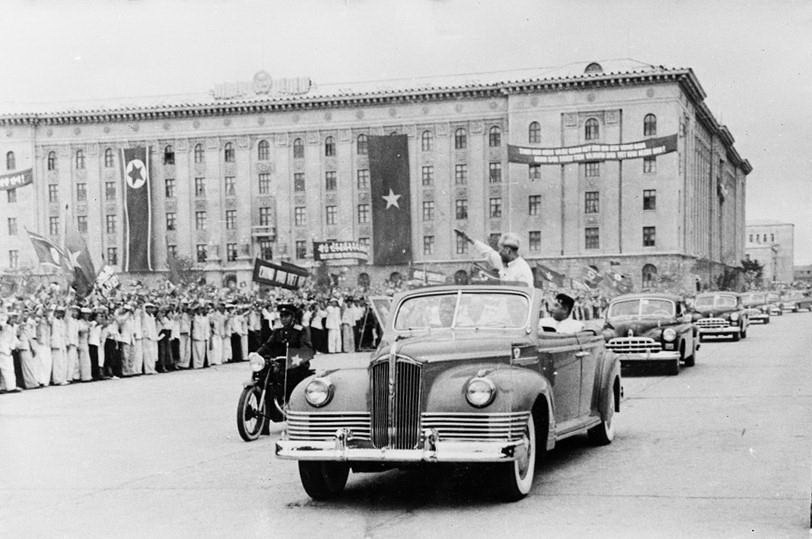
Seven years after the establishment of the bilateral diplomatic relations, President Ho Chi Minh paid the first official visit to the Northeast Asian country from July 8-12, 1957. A grand ceremony was held to welcome the Vietnamese leader and a high-ranking delegation from the country’s Party and State.
On July 8, 1957, people in Pyongyang extend a warm welcome for President Ho Chi Minh and the Vietnamese delegation. (Photo: VNA
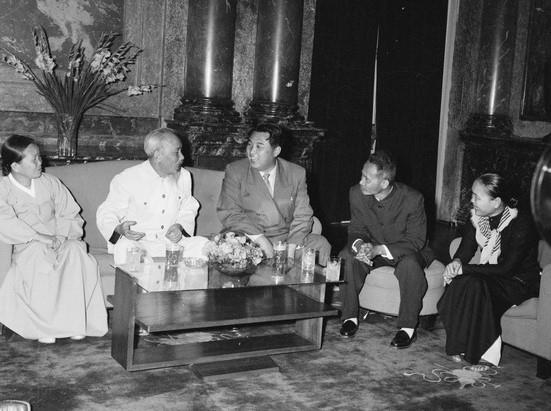
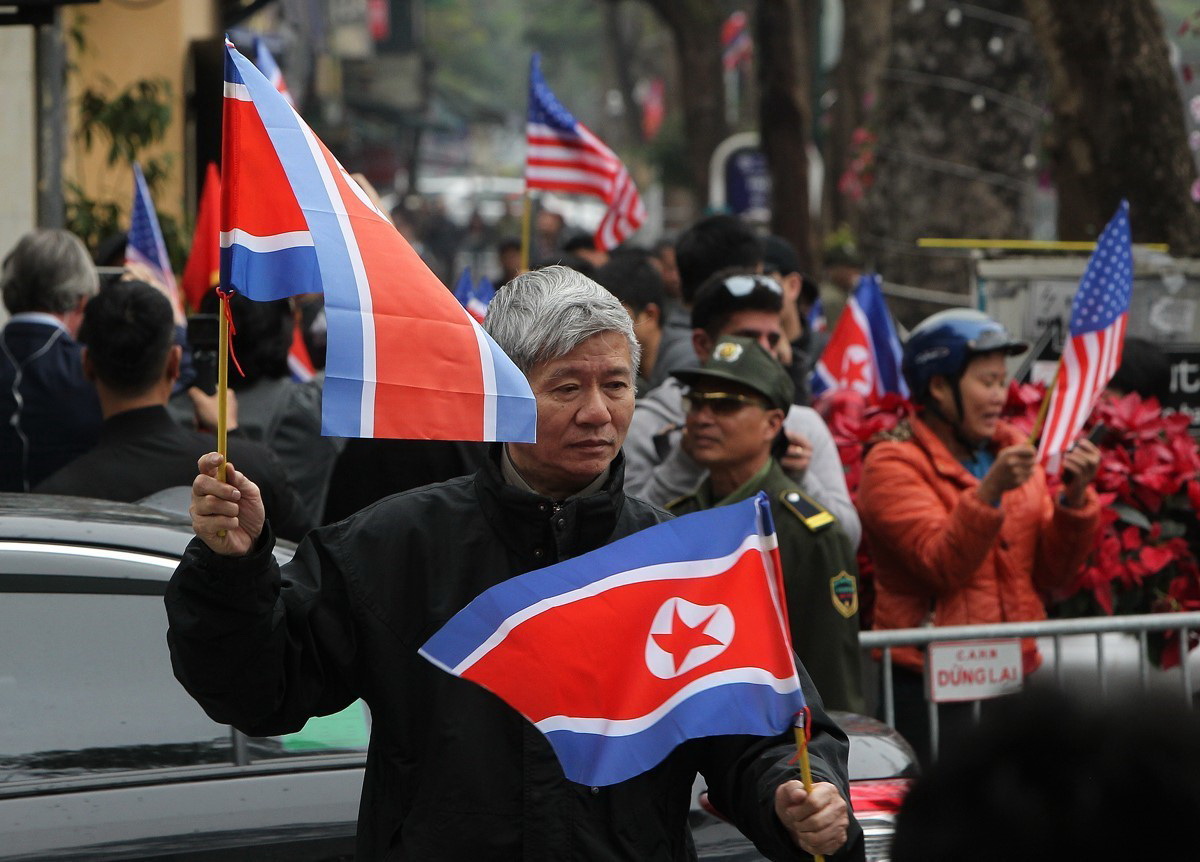
One year later, DPRK Prime Minister Kim Il-sung visited Vietnam from October 28 to December 2. Vietnamese people waved nationals flags of both countries on Hanoi streets.
President Ho Chi Minh receives Prime Minister Kim Il-sung, who is leading a DPRK delegation to make a friendship visit to the Southeast Asian country from November 27 to December 3, 1958 (Photo: VNA).
During his six-day trip to Vietnam, PM Kim visited Nam Dinh textile factory, Vietnam Military Museum, and an agricultural cooperative in Quan La village, Xuan La commune, Hanoi city’s Tu Liem district, which was later called Vietnam-DPRK friendship cooperative.
Highlights of Kim’s visit in 1958 were the Vietnam-DPRK Joint Statement and the signing of the Vietnam-DPRK trade agreement. Kim returned for another trip to Vietnam in 1964. From the end of 2000s, the Vietnam-DPRK diplomatic relations have been fortified, with DPRK visits by Party General Secretary Nong Duc Manh in 2007 and Minister of Public Security Le Hong Anh in 2008, and Vietnam visits by DPRK President of the Presidium of the Supreme People’s Assembly Kim Yong-nam in 2001 and Premier Kim Yong-Il in 2007.
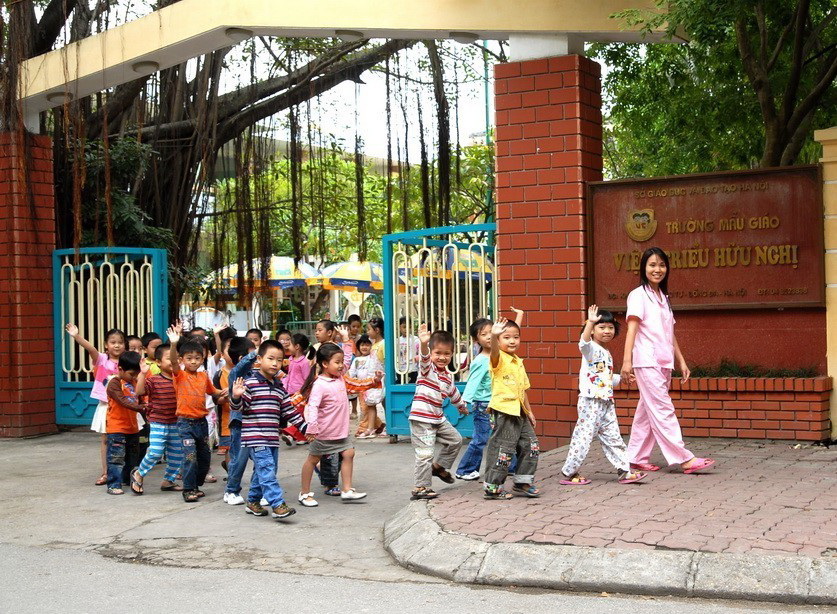
A highlight in bilateral relations is the Vietnam-DPRK Friendship Kindergarten in Hanoi and the Vietnam-DPRK Friendship Kyongsang Kindergarten in Pyongyang. The construction and facilities of the Hanoi school were supported by the DPRK.
The Vietnam-DPRK friendship kindergarten was constructed by the DPRK in 1978 with four classrooms and 120 children. Facilities and quality of human resources at the school have been improved over the years (Photo: VNA).
Vietnam offered the DPRK 100 tonnes of rice aid in 1995 and another 13,000 tonnes in 1997. From 2000 to 2012, it supported the DPRK with 22,700 tonnes of rice, 5 tonnes of material rubber, and 50,000 USD in emergency aid. It offered 70,000 USD in flood relief to the Northeast Asian nation in 2016.
In the 1960s and 1970s, the DPRK helped train hundreds of Vietnamese students. At present, its Education Commission and the Vietnamese Ministry of Education and Training are promoting the signing of an educational cooperation agreement. Meanwhile, since 2013, Vietnam has sent art troupes every two years to attend the April spring arts festival in Pyongyang. Shortly after arriving in Hanoi for the second summit with the US on February 26, Chairman Kim Jong-un visited the DPRK Embassy and urged the embassy’s staff to work harder to promote the cooperation and friendship between the two Parties and States. Vietnam, DPRK bolster all-round cooperation Over the past few years, the two countries have held rotary policy discussions at the deputy foreign ministerial level and meetings of the inter-governmental committee for economic, scientific and technical cooperation. Many important deals have been inked, including agreements on cultural cooperation, scientific-technical cooperation, trade and navigation, healthcare and civil air transport cooperation. In 2002, the two sides signed agreements on sea transport, trade, mutual legal assistance, investment promotion and protection, and double-taxation avoidance. In a visit to Vietnam in November 2018, DPRK Foreign Minister Ri Yong-ho emphasised the DPRK Party and Government’s consistent stance of treasuring and fostering the traditional friendship with Vietnam. The DPRK side also agreed to coordinate with Vietnam to consider suitable measures for strengthening bilateral ties. During the visit, the two sides also agreed to keep working closely at international and regional forums like the United Nations, the Non-Aligned Movement, and the ASEAN Regional Forum, as well as to increase the exchange of views on issues of common concern. The MoU signing ceremony in agricultural technical cooperation between the Ministry of Agriculture and Rural Development and the Academy of Agricultural Science of the DPRK on October 30, 2014 (Photo: VNA) Most recently, from February 12 to 14, Vietnamese Deputy Prime Minister and Foreign Minister Pham Binh Minh paid an official visit to the DPRK. He affirmed that based on the consistent foreign policy of independence, self-reliance, peace, cooperation and development, diversification and multilateralisation of international relations, being friend and reliable partner and responsible member of the international community, the Vietnamese Party, Government and people want to maintain and promote the traditional friendship with the DPRK’s counterparts.
DPRK Party and Government’s consistent policies are to treasure and consolidate the traditional friendship with Vietnam
DPRK Party and Government’s consistent policies are to treasure and consolidate the traditional friendship with Vietnam
Aside from the bilateral friendship, the two countries’ economic links have also continually been strengthened, although they remain modest. Bilateral trade reached 8 million USD in 2014 and 11.6 million USD in 2015. Vietnam’s exports to the DPRK were estimated at 2.99 million USD in 2016, 7.32 million USD in 2017, and 497,000 USD in the first nine months of 2018. This latest official visit to Vietnam by Chairman Kim Jong-un aims to step up cooperation between the two Parties and countries in line with each country’s interests, laws, and international commitments and thereby contributing to regional peace, cooperation, and development.
A Hanoian welcomes DPRK Chairman Kim Jong-un (Photo: VNA)
Vietnam set up diplomatic ties with the Democratic People’s Republic of Korea (DPRK) in early 1950. Over the past nearly seven decades, the close-knit ties between the two countries have been tightened.
Vietnam News Agency (VNA)’s reporters, who were in the DPRK from 1988 to 2002, shared their experiences in the peaceful but mysterious East Asian nation.
Focus on national defence
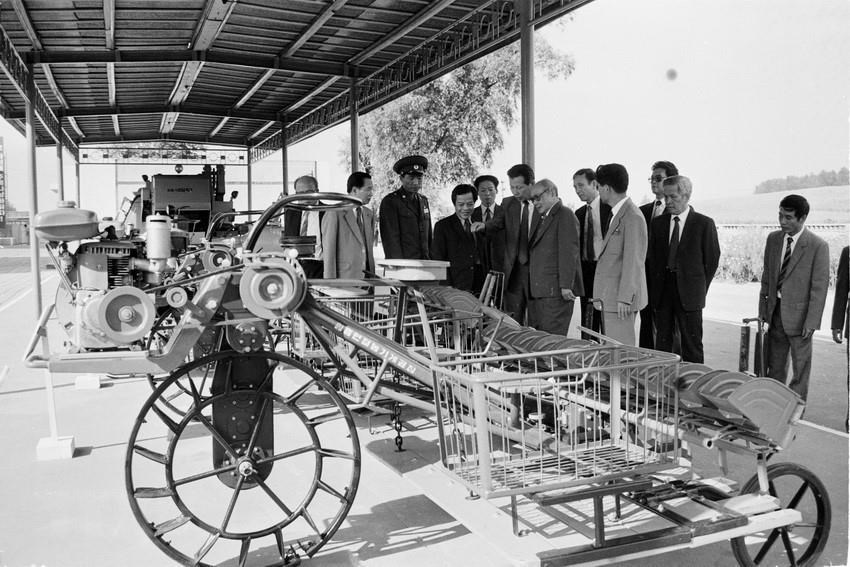
In September 1988, President of the State Council Vo Chi Cong visited and presented the Golden Star Order to DPRK leader Kim Il-sung. Minh Dien, an experienced photo-journalist of the VNA who was lucky to join the delegation accompanying President Cong, said he was impressed by the host country’s focus on national defence.
President of the State Council Vo Chi Cong visits the Juche Tower situated on the banks of the Taedong River in Pyongyang, as part of his visit to the DPRK and attendance at thecountry’s 40th founding anniversary in September 1988. Photo: Minh Dien-VNA
Minh Dien wrinkled his eyebrow and said that“DPRK people keep disciplined and do not elbow their way through a crowd, even when they meet foreigners. Locals, even farmers working in fieldsstop working and wave their hands to say hello to foreign visitors.”
The Vietnamese guests were impressed most by the locals’ keen focus onnational defence.
Road similar to Vietnam’s 17th parallel in the past
Minh Dien took a sip of his tea and said“Ancient trees along the about 40-km roadfrom Panmunjom to the city we travelled through were cut on one side so that they could fall down onto the roadway as obstacles. The path was similar to Vietnam’s 17th parallel in the past.
The path was similar to Vietnam’s 17th parallel in the past.
“The delegation was warmly welcomed by the host side. DPRK leader Kim Il-sung met with President Vo Chi Cong and the Vietnamese officials three or four times, including the reception, talks and the ceremony to hand over the Golden Star Order,” Minh Dien said.
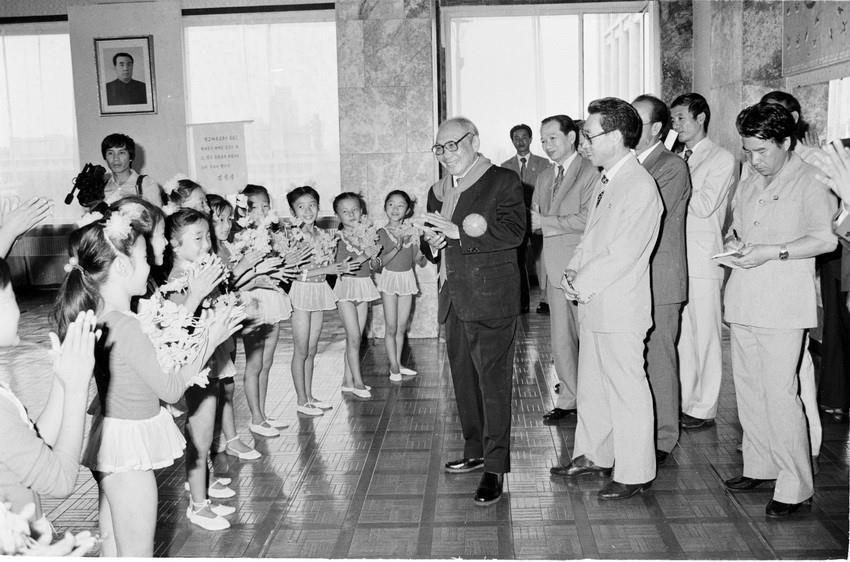
President of the State Council Vo Chi Cong and DPRK children during his visit to the country in September 1988. Photo: Minh Dien-VNA
Enigmatic but peaceful nation
Following the visit by President of the State Council Vo Chi Cong in 1988, State President Tran Duc Luong paid an official visit to the DPRK in May 2002. As one of the reporters accompanying the leader, Trong Nghiep from the VNA stayed in Pyongyang for four days. The short trip made a sizeable impression on him, especially in terms of the country’s mysteriousness, peace and hospitality.
“Before the trip, I tried to study the country through documents, which were limited in the 2000s”he said.
President Tran Duc Luong holds talks with President of the Presidium of the Supreme People’s Assembly of the DPRK, Kim Yong-nam, on May 3, 2002 in Pyongyang, as part of his official visit to the DPRK from May 2-5, 2002. Photo: Trong Nghiep-VNA
Following welcome ritualsffter arriving at Sunan international airport, the delegation headed towards Pyongyang – an enigmatic capital as Trong Nghiep said.
“It is a strange city as there were very few people and vehicles in the street. Most of the vehicles were produced by the former Soviet Union. No shops were open at night. The hotel where the Vietnamese delegation was staying had only a counter offering only wine and ginseng candy, no foreign products,” the journalist recalled.
President Tran Duc Luong and President of the Presidium of the Supreme People’s Assembly of the DPRK Kim Yong-nam witness the signing ceremony of a cooperation agreement between the two countries on May 3, 2002 in Pyongyang, within the official visit to the DPRK by the Vietnamese leader from May 2-5. Photo: Trong Nghiep-VNA
It was hard to communicate with locals in 2002. Trong Nghiep said the hotel’s staff did not talk with foreigners and only shook their heads when asked a question in English.
Even the roads were strange 17 years ago.
“Travelling from Pyongyang to the memorial site dedicated to late President Kim Il-sung, we recognised that the country’s transport system was very good, since the about 100-km road was asphalt. However, during the trip, we saw only one or two trucks and some people wearing backpacks and riding bikes leisurely,” he said.
Working as a foreign journalist in the DPRK wasnot normal or easy.
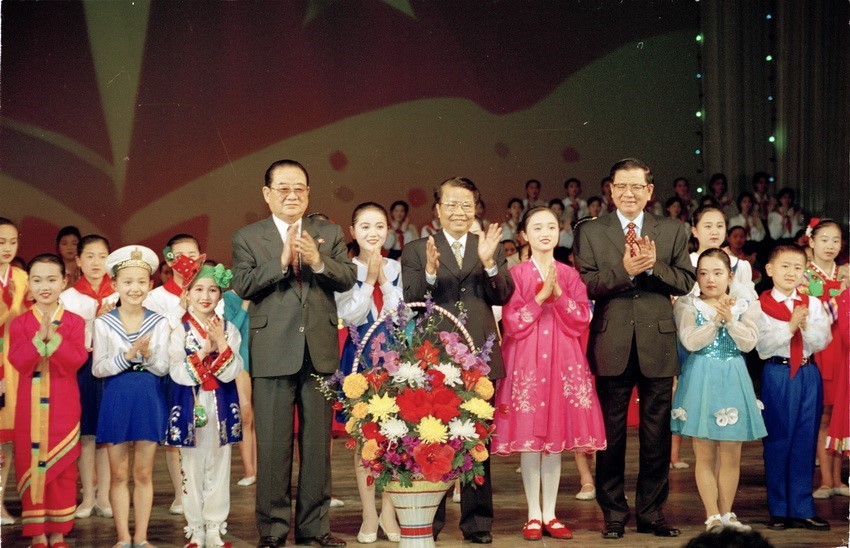
President Tran Duc Luong visits the Children’s Palace in Pyongyang and presents flowers to local kids who staged performances to welcome him on May 3, 2002, as part ofhis official visit to the DPRK from May 2-5. Photo: Trong Nghiep-VNA
Trong Nghiep stopped for a while and continued to say that “Unlike talks in other countries, photo-journalists were not allowed to gonear the leaders. A group of guards kept journalists distance from the meeting of the two countries’ leaders. We took their photos from outside and got all information from the department of foreign relations under the Presidential Office and the Ministry of Foreign Affairs.”
The views reminded him of Vietnam’s northern countryside in the 1970s.
Local views reminiscent of Vietnam’s northern countryside in the 1970s
The DPRK seemed somewhat familiar to the Vietnamese guests. Through car windows, they could see small farms located on hills and rows of box-shaped houses with windows open and old people sunbathing. Nghiep said, the views reminded him of Vietnam’s northern countryside in the 1970s.
A modernising DPRK
Five years after Trong Nghiep’s trip to Pyongyang, another photo-journalist from the VNA visited the country. In October 2007, Xuan Tuan accompanied Party General Secretary Nong Duc Manh and a high-ranking Vietnamese delegation during an official visit to the country at the invitation of Kim Jong-il, General Secretary of the Workers’ Party and Chairman of the National Defence Commission of the DPRK.
The visit took place amid progress in the reconciliation on the Korean Peninsula through the six-party talks. The freshly-finished second inter-Korean summit also reaped positive results.
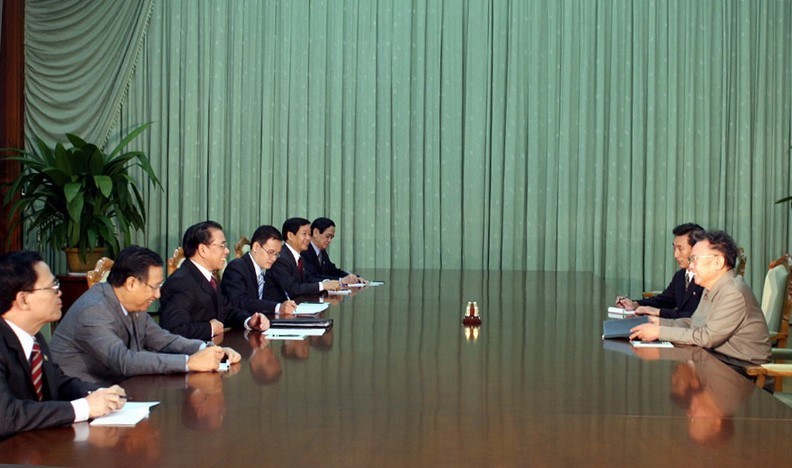
Party General Secretary Nong Duc Manh and General Secretary of the Workers’ Party of the DPRK Kim Jong-il at a welcome ceremony at Sunan international airport in Pyongyang on October 16, 2007, during the Vietnamese leader’s official visit to the DPRK from October 16-18. Photo: Dinh Xuan Tuan-VNA
Party General Secretary Nong Duc Manh’s visit aimed to enhance the traditional friendship and showedthat Vietnam treasures and wishes to develop its friendship and traditional cooperation with the DPRK Party, Government and people so to take the bilateral ties to the next level.
After arriving in Pyongyang, he was stunned to see a modenising DPRK
Like other journalists, before the trip, Xuan Tuan pictured a DPRK which was facing a range of difficulties. However, after arriving in Pyongyang, he was surprised to see a modernising DPRK.
After arriving in Pyongyang, he was surprised to see a modernising DPRK.
“Pyongyang people in traditional clothes gathered at the airport and lined up on both sides of the street from the airport to the Government’s Guest House, waving flowers and flags to welcome Party General Secretary Nong Duc Manh and his entourage. I felt that we were welcomed by all people in Pyongyang as close friends and guests. From the welcome ceremony to the reception and see-off ceremony, the Vietnamese delegation was held in high esteem by the hosts. President Kim Jong Il was also present at the events,” he said.
Party General Secretary Nong Duc Manh and General Secretary of the Workers’ Party of the DPRK Kim Jong-il. Photo: Dinh Xuan Tuan-VNA
Xuan Tuan said at that time, infrastructure in Pyongyang was planned scientifically. The streets had pavements andthe public transport network was very good.
“Thanks to local people’s high awareness, and good management and operation methods, all things were in order although the equipment was rather outdated,” he said.
Pyongyang in particular and the DPRK in general did not appear to be desolate as he had thought. On the contrary, he saw modern urban areas and peaceful rural areas. He still remembers an ancient village he visited during the trip. Houses and courtyards stood next to the others without fences or walls. Local people arranged their agricultural products in fields after harvesting, without worrying about thieves.
“Local people treated each other wholeheartedly. Their lifestyle changed our views on the land and people of the DPRK,” Xuan Tuan said.
Party General Secretary Nong Duc Manh in talks with General Secretary of the Workers’ Party of the DPRK Kim Jong-il on October 17 as part of his official visit to the DPRK from October 16-18, 2007. Photo: Dinh Xuan Tuan-VNA
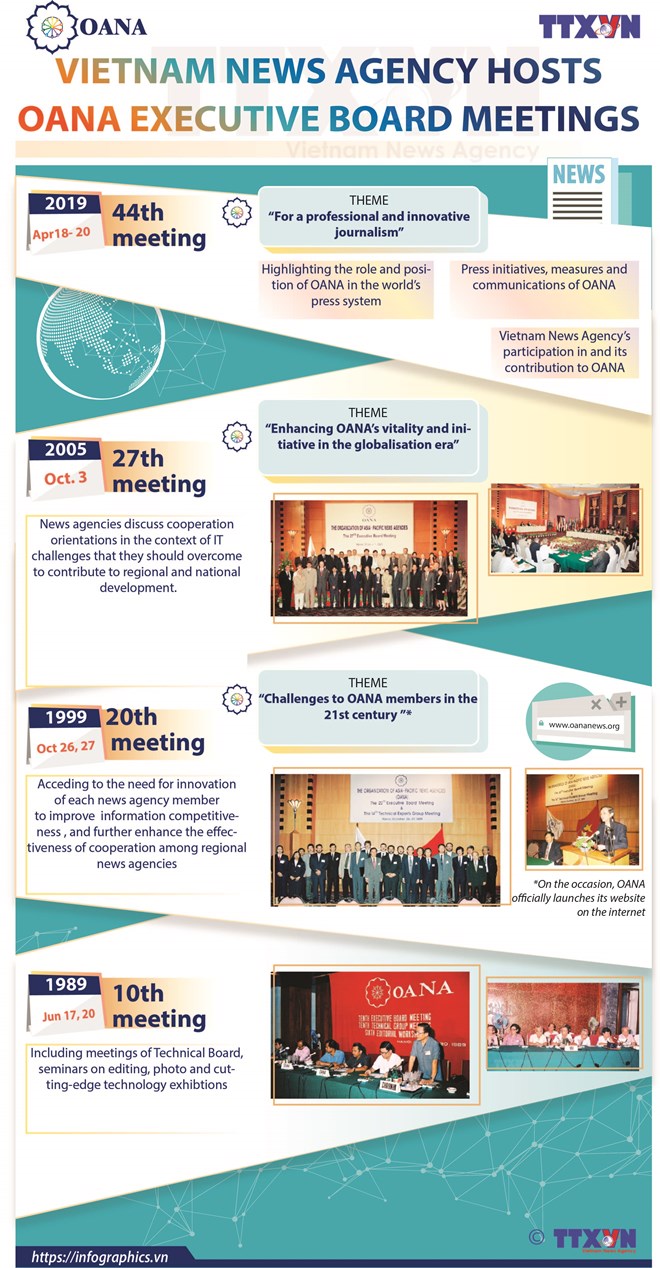
The Vietnam News Agency (VNA) will host the 44th Meeting of the Organisation of Asia-Pacific News Agencies (OANA) Executive Board in Hanoi from April 18-20, under the theme “For a professional and innovative journalism”, with the participation of senior officials from 44 member news agency from 35 countries.
VNA’s hosting of the event affirms and promotes the role of the national news agency at the prestigious and effective regional multilateral press forum.
The OANA was established in Bangkok on December 22, 1961, as an initiative of the United Nations Educational, Scientific and Cultural Organisation (UNESCO). The association aims to strengthen and create favourable conditions for the direct and free popularisation and exchange of information among news agencies in the Asia-Pacific, a dynamic developing region home to over 50 percent of the global population.
ANA gathers 44 news agencies from 35 regional countries
At present, the OANA brings together 44 news agencies from 35 countries, including Xinhua (China), Kyodo (Japan), Yonhap (the Republic of Korea), ITAR-TASS (Russia), and Antara (Indonesia). The OANA members are responsible for two-thirds of information circulated throughout the world.
Every day, the OANA member news agencies publish around 200 news stories, photos, and video clips on the OANA website.
The OANA holds its Executive Board meeting annually under the host of one of its members on a rotary basis. The meeting provides a venue for leaders of news agencies to share experience, update each other on new journalism development trends in the world, and discuss measures to consolidate professional cooperation.
Photo: VNA
Since the VNA joined the OANA in 1969, it has become an active member of the association. The VNA has been elected as the OANA Executive Board member for two consecutive three-year tenures since 2013. Over the years, the news agency hosted meetings of OANA Executive Board in 1989, 1999, and 2005, positively contributing to the realisation of the organisation’s goals.
Enhancing cooperation efficiency among OANA member news agencies
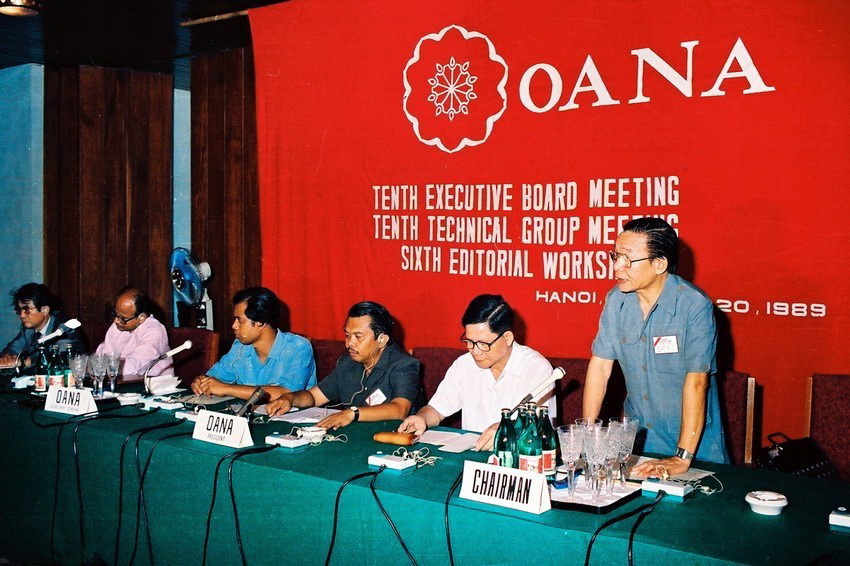
From June 17-18, 1989, the agency organised the 10th OANA Executive Board Meeting, the 10th Technical Group Meeting, and the sixth Editorial Workshop. This was the first hosting of such meetings by the VNA.
Opening the 10th OANA Executive Board Meeting, Vice Chairman of the Council of Ministers Nguyen Khanh highlighted the important role of information and communication in relations between individuals and collectives in each country, as well as in the development of friendship and cooperation between countries. The delegates adopted a review report of the meeting and an action programme for the OANA for 1990 in order to continue realising the targets of enhancing cooperation between regional news agencies, improving OANA news quality on the ANN in terms of both content and technology, expanding the exchange of photo news, training journalists and technicians, and pushing ahead with the computerisation of the information work of the news agencies, contributing to safeguarding peace, building stable friendship and cooperation for mutual development between countries in the region, and establishing international order in information and communication.
VNA General Director Dao Tung addresses the opening of the 10th OANA Executive Board, which took place in Hanoi from June 17-18 (Photo: VNA)
Its second hosting of the event was in 1999. The 20th OANA Executive Board Meeting in Hanoi on October 26-27, 1999, saw the participation of 29 delegates representing nine out of the 11 members of the OANA Executive Board.
In his opening remarks, Deputy Prime Minister Pham Gia Khiem said the coming into being and existence of the OANA has signalled efforts by journalists to contribute to equal integration, cooperation and friendship between countries, for regional peace, friendship, security and development.
The Vietnamese Government highly values the support and endeavours of the OANA member agencies, he said.
VNA joined OANA in 1969, becoming one of the most active members of the association
Former VNA General Director Ho Tien Nghi said that the 20th OANA Executive Board Meeting took place in the context that members of the organisation were applying more drastic and effective measures to overcome challenges, especially cooperation solutions, ahead of the new millennium.
The delegates agreed on the need to reform the news agencies to raise their competiveness in the new context and improve the efficiency of collaboration between agencies, especially in professionalism and technical skills.
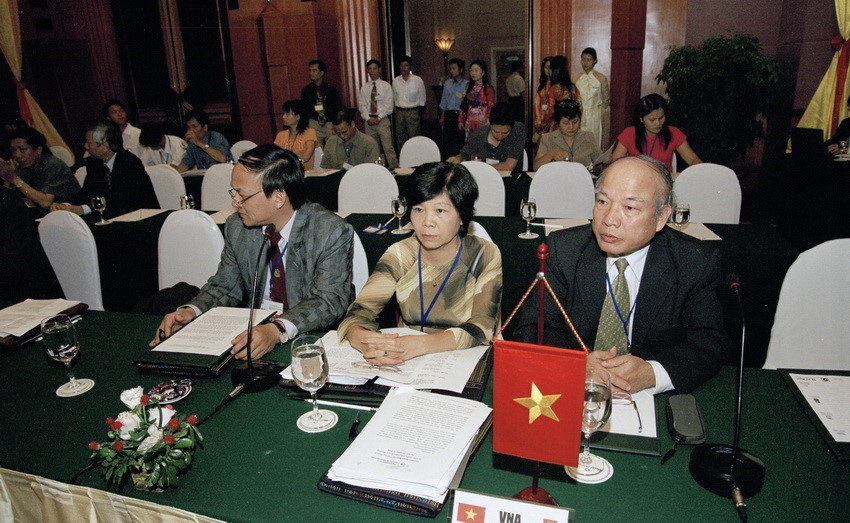
The VNA hosted the 27th OANA Executive Board Meeting and the 21st meeting of the Editorial and Technical Experts Group in Hanoi on October 3, 2005, with the theme “Enhancing the dynamism and creativity of OANA in the globalisation era”. The VNA delegation at the event (Photo: VNA)
Making OANA a dynamic, creative organisation
The 27th OANA Executive Board Meeting and the 21st meeting of the Editorial and Technical Experts Group took place in Hanoi on October 3, 2005. This was the third time that the VNA had hosted the event.
Addressing the opening of the event, Deputy PM Pham Gia Khiem Khiem stressed the importance of information and of the OANA member news agencies. Khiem emphasised that information is a tool that serves the governance and management of each nation, expanding exchanges and increasing mutual understanding between countries, and a source of knowledge for the public and a resource for socio-economic development.
Participants agreed on the necessity of studying measures to spread information quickly to the public when natural disasters occur, while applying advanced technology to diversify services.
They also touched upon challenges posed by the mushrooming of websites and increasing number of internet users. Given that, news agencies need to maintain the speed, accuracy, and reliability of information.
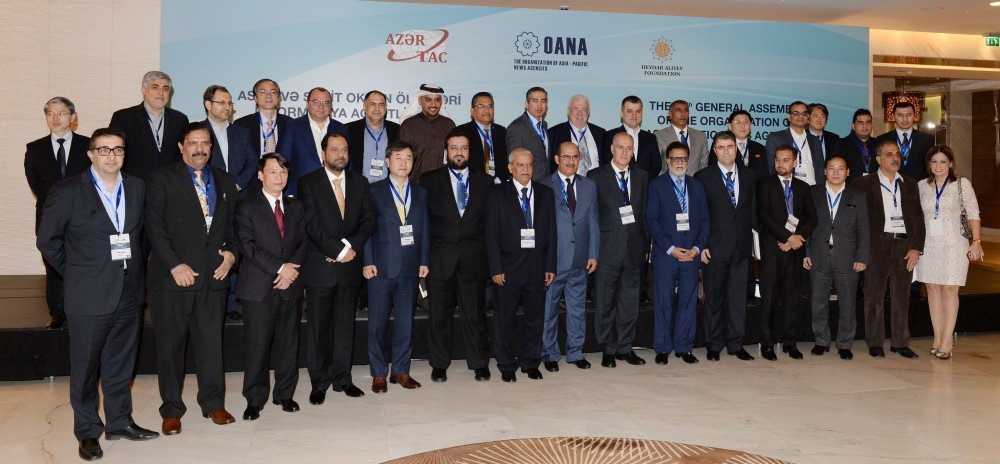
VNA General Director Nguyen Duc Loi (first line, third from left) poses for a photo with leaders of OANA member news agencies who attended the 16th OANA General Assembly on November 18, 2016 in Baku. (Photo: VNA).
The VNA’s third-time hosting of the OANA Executive Meeting means it has rich experience in preparing and engaging in the meeting’s agenda, according to former VNA General Director Le Quoc Trung. It is also able to give solutions for the enhancement of operational quality of the organisation in information, as well as proposals on how to post more news from the OANA members to the Internet and provide more reliable information, added Trung.
Trung held that the VNA’s role as the host of the OANA Executive Board demonstrates the trust of OANA members in the VNA. The organisation of the event also creates favourable conditions for experts of the OANA member news agencies to gain a better understanding of Vietnam and the VNA.
At the same time, the meeting gathers many major news agencies in the region, giving chances for the VNA to promote its position in the region, as well as spread news of Vietnam to the region and the word, he said.
“The VNA’s hosting of the OANA Executive Board demonstrates the trust of OANA members in the agency” (former VNA General Director Le Quoc Trung)
Former VNA Deputy General Director Ha Minh Hue, who prepared the agenda for the 27th OANA Executive Board Meeting and the 21st meeting of the Editorial and Technical Experts Group, said that the annual event gives regional news agencies an opportunity to discuss various issues, especially amidst the rise of the globalisation and the spreading of the Internet. At this meeting, Vietnam proposed the theme of “Strengthening the vitality and creativity of OANA in the globalisation era”.
With the outcomes of this and previous meetings, news agencies agreed to post news to the OANA website everyday, and sought ways to make the news of regional countries full, accurate, and official.
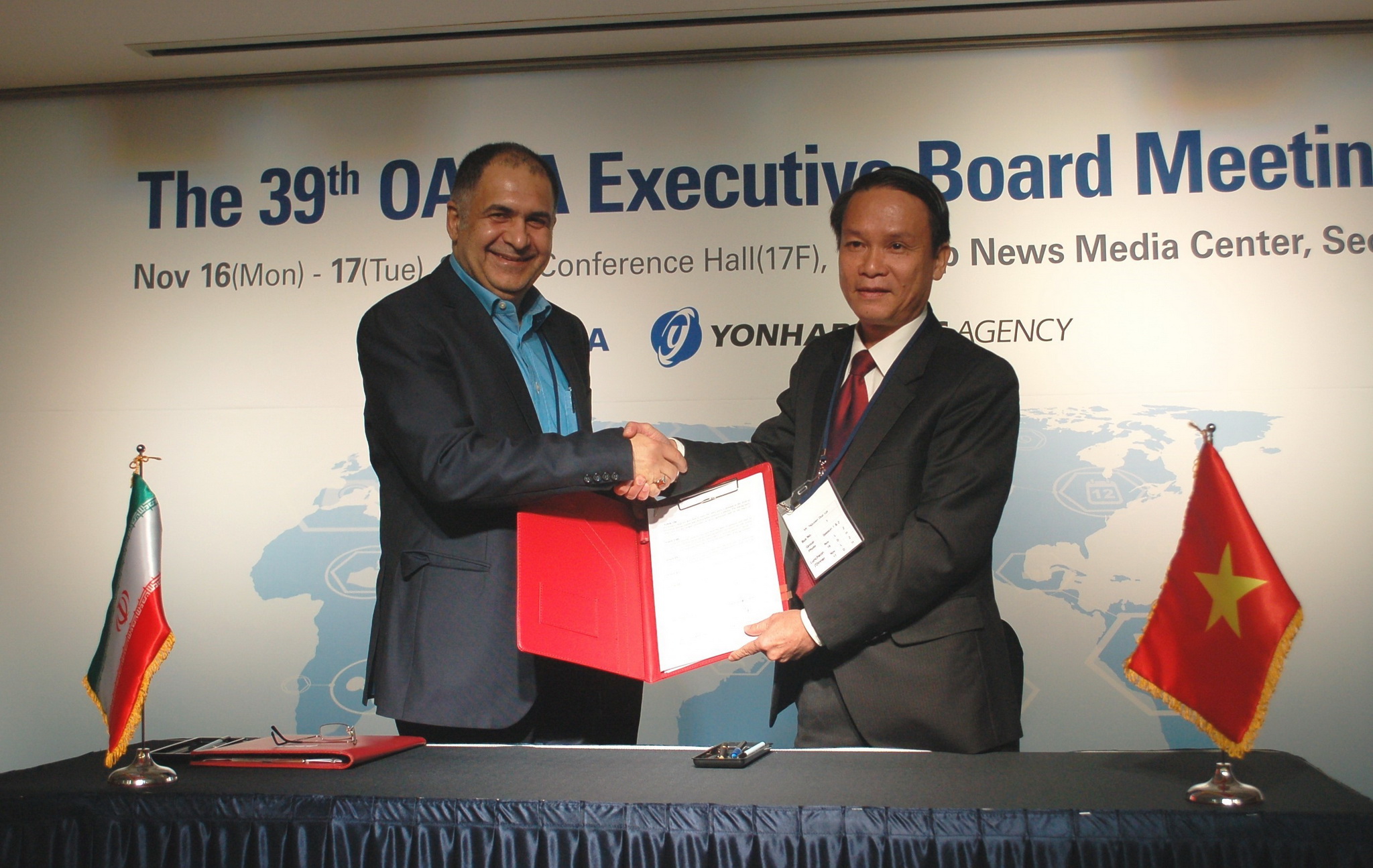
During his participation at the 39th OANA Executive Board Meeting from November 16-17, 2015 in Seoul, VNA General Director Nguyen Duc Loi (right) and Executive Director of Iran’s state news agency IRNA Mohammad Khodadi on November 16 signed an agreement on bilateral information exchange. Under the deal, the two sides will exchange visits and cooperate in journalism skills training, and provide necessary equipment. (Photo: VNA)
With its role as a “state news bank”, the VNA performs its function as the state news agency and provides official and mainstream news for news outlets at home and abroad via 15 news departments of domestic and foreign services.
Boasting a network of 63 bureaus in all the cities and provinces nationwide and 30 overseas bureaus across the five continents, the VNA has a strong contingent of reporters and editors working all over the country and in most of the key locations around the world, which creates a unique advantage for it.
VNA is currently the media agency with the highest number of products and forms of the country
With more than 60 media products by more than 1,300 reporters and editors out of its 2,500-strong staff, the VNA is now the media office with the largest number of products and formats in the country: bulletins, photos, television programmes, dailies, weeklies, monthlies, magazines, pictorials, books, TV channel, e-newspapers, and information programmes on mobile platforms and social media.
The agency also delivers news in the largest number of languages. In addition to the official Vietnamese-language news provided for domestic and foreign media outlets, stories for foreign services are written in English, Chinese, French, and Spanish; not to mention print and e-newspapers in Vietnamese, Lao, Khmer, Chinese, Japanese, Korean, Russian, English, French, and Spanish.
The VNA has bilateral and multilateral partnership with more than 40 international news agencies and press organisations around the world, and is a member of the OANA. The agency’s official news is widely published on the communication channels of its partners, contributing to improving the effectiveness of disseminating Vietnam’s external information to international friends.
Throughout the over seven decades of fighting, construction, and development closely associated with the country’s historical milestones, the VNA is the first press agency of Vietnam to be awarded the titles “Labour Hero in the renewal period” and “Hero of the People’s Armed Forces”. Additionally, it has also been honoured twice with the Gold Star Order, Ho Chi Minh Order, and first-class Independence Order, along with many other distinctions. –VNA
VNA General Director Nguyen Duc Loi (first line, sixth, left) and delegates of the 38th OANA Executive Board Meeting pose for a picture (Photo: VNA).
Hanoi (VNA) – Since its foundation in 1981, Organisation of Asia-Pacific News Agencies (OANA) has implemented cooperative activities in news exchange, training, experience sharing and building of editing standards and professional ethics, meeting the development trend of journalism.
On the occasion of the 44th OANA Executive Board Meeting hosted by the Vietnam News Agency in Hanoi from April 18-20, OANA members have shared their experience, particularly the use of up-to-date technology, in addressing challenges facing modern press.
INCREASING INTERACTION THROUGH MULTI-MEDIA SERVICES
The years 1994, 1995 and 1996 respectively marked the birth of Facebook, YouTube and Twitter, but it was not until 2010 that those social networks were able to promote the spread of information, mostly thanks to the popularisation of smart phones.
Many technology firms have developed message apps for smart phones, while the numbers of users of Facebook, YouTube and Twitter on smart phones have increased faster than those who used those apps on desktop computers.
According to the Islamic Republic News Agency (IRNA) of Iran, information products in the era of social networks are short and based on multi-media, therefore they reach recipients in a very short time. In recent years, many social networks have employed a function called “story” which allows fast sharing of concise and multi-media based information among users.
Information products in the era of social networks are short and based on multi-media.
In response to the latest trends among the audience and taking technological developments into consideration, IRNA has increased its active engagement in the web and social networks through its multimedia services.
From April 2018 to March 2019, in a period of 11 months, the agency has published 125,208 photo frames, including both photo reports and images that are attached to news articles. IRNA published 2,881 videos in the same period. The videos have been posted both on IRNA official website and on Aparat—an Iranian video sharing site like Youtube. During that period of time, IRNA also published 294 infographics and 574 audio reports. IRNA Persian page on Instagram has 155,000 followers. This number is remarkable since Associate Press and AFP have 342,000 and 439,000 followers on Instagram respectively. Furthermore, IRNA releases the latest news through Twitter and the Iranian network of Soroush. At the same time, IRNA produces long reports, essays and news bulletins for its specific audience groups. In short, IRNA tries to address the needs of different groups of society via a vast range of products.
In the framework of his attendance at the 39th OANA Executive Board Meeting from Naovember 16-17, 2015 in Seoul, the Republic of Korea, VNA General Director Nguyen Duc Loi (right) and IRNA Executive Director Mohammad Khodadi signed an agreement on bilateral information exchange, under which the two sides will exchange visits, join hands in training journalist skills and provide equipment. Photo: VNA.
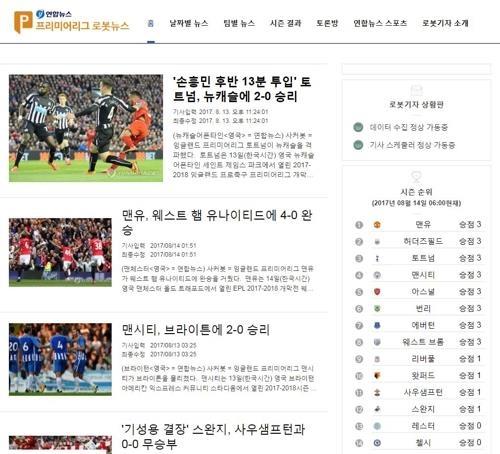
To respond to the fast changing media environment, the Yonhap news agency (the Republic of Korea) has developed and successfully put into use robot journalists using Artificial Intelligence (AI) named Soccerbot and Olympicbot.
Soccerbot was Yonhap’s first robot journalist, developed to cover the results of English Premier League (EPL) matches, which generate huge interest in the RoK.
An article written by Soccerbot published by Yonhap (Source: en.yna.co.kr)
Soccerbot has three stages: The Data Scraping Engine collects data on each match, the Text-Writing Algorithm autonomously organizes sentences from the collected data to construct a full text article, and finally the Article Template polishes the article by dividing phrases into smaller segments and adjusts them by mimicking the text patterns of human journalists. Soccerbot ran from January to May 2018, creating 169 articles on EPL games.
The Olympicbot was an AI-based robot reporter developed to cover news on the 2018 PyeongChang Winter Olympic Games. Olympicbot was able to autonomously interpret the progress of the Games and produce a number of different articles, including upcoming event schedules, match reports, medals tables and, more importantly, even cover relatively unpopular events that were not allocated to reporters for coverage due to time and manpower limits. Olympicbot automatically produced and distributed 1,190 news articles on the PyeongChang Olympics and Paralympics. Yonhap News Agency will continue to invest in developing innovative content production technology
OPTIMISING POTENTIAL OF MODERN MEDIA
It is necessary to take advantage of the potential of the modern media, especially in cyberspace, to attract a larger readership, which is the message that the IRNA brought to the 44th Meeting of the Executive Board of OANA, according to IRNA Managing Director Seyyed Zia Hashemi. He said Asia-Pacific news agencies have to adopt innovative techniques in order to compete with large news agencies in the West and in order to present a correct image of their countries to the world. If OANA members do not plan for the future, they won’t be able to keep up with the mainstream media of the world.
He shared that data-mining has been an effective technique used by IRNA in the past year, adding that it let the agency identify major news trends so they were able to cover better subjects and engage their audiences more successfully.
Interaction among the media and their audience expands the influence of media since the interaction enriches media’s understanding of the context and affects the way they explore subjects, write articles and deliver news to the people, he said.
“We have employed data-mining to explore both classical media and cyberspace at national and international levels. This way, we successfully focused on hottest issues and put emphasis on more significant and appealing topics. I recommend my colleagues in OANA to make use of data-mining techniques to improve their activities,” Seyyed Zia Hashemi said.
DEVELOPING FACEBOOK AND TWITTER PAGES
Meanwhile, the Montsame News Agency of Mongolia said to cope with the shift of new content consumption behavior, focusing on video content and YouTube platform, the agency has successfully broadcasted news content through Twitter and Facebook platforms as from September 2017. Noting that the main criterion for broadcasting information using YouTube.com platform is speed, especially in breaking news, and quality issues, the agency stressed the importance of increasing breaking news and video news. Video news are taken from the original source and there will be no chance to be fake. And it would help to solve such issues as fake news and verified news, and how to win back trust of costumers who often trust basic information, the agency said. To consolidate the position of the OANA member agencies in the global news network, the agency suggested improving the usage of the OANA’s website, increasing the supply of video news to OANA websites, and paying attention to developing Facebook and Twitter pages.
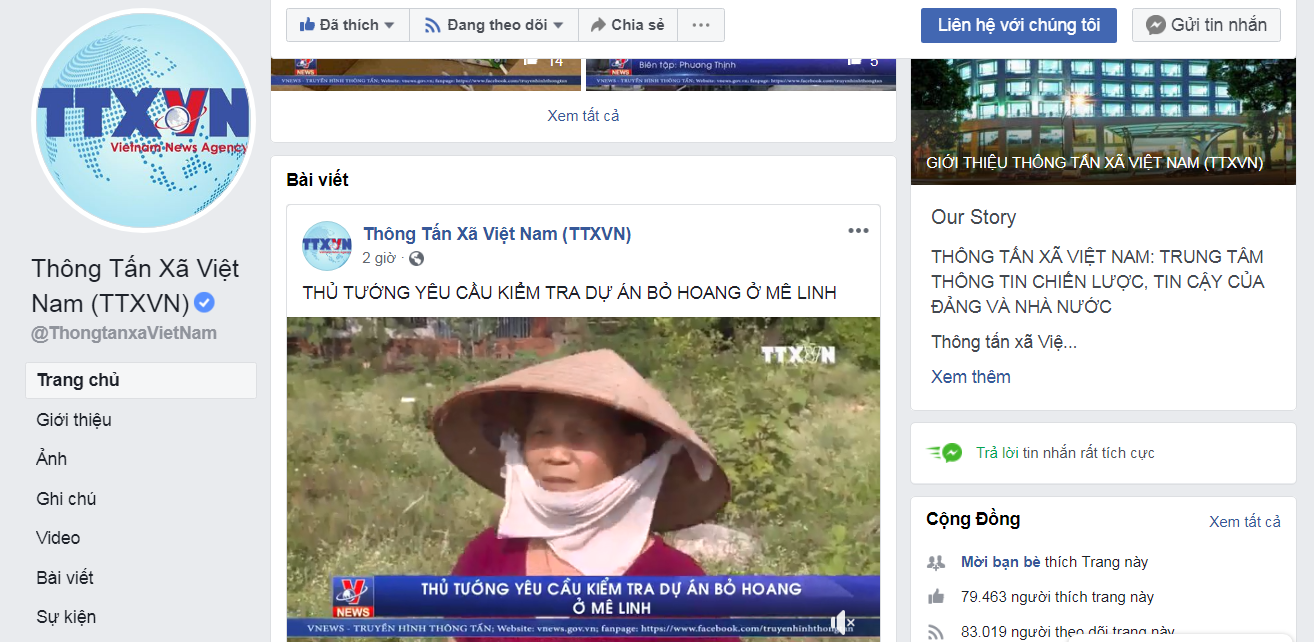
The fanpage of the Vietnam News Agency, an active member of OANA.
ACTIVELY EMPLOYING ADVANCE TECHNOLOGY
China’s Xinhua News Agency pointed out that from the world perspective, it’s getting increasingly obvious that the news audience have been moving to the internet, especially mobile internet, with the number of global internet users breaching 4 billion. Sun Yong, President of Xinhua’s Asia-Pacific Bureau, said the agency has been working hard to innovate their news products, changing from mainly serving traditional media to various types of users and their different needs. It has rolled out different services for new media and short video media, and increased mobile, visual, intelligent and digital products and so on. Currently, Xinhua produces an average of 100 short videos every day.
Xinhua has rolled out different services for new media and short video media, and increased mobile, visual, intelligent and digital products.
Sun Yong shared that the agency builds technological construction as its core competitive power, and now has a technology team of nearly 1,000 people.
It has established an all-media reporting, editing and releasing platform, combining multiple functions together including planning, news gathering, manufacturing, feed back analysis, and data statistics. The platform is now being used throughout the agency. Xinhua has also built an open news live broadcast “Cloud Platform”. Now more than 3,100 Chinese media organizations have joined the platform, and the agency conducts nearly 400 live broadcasts of various kinds every day. Sun Yong said the agency has cooperated with China’s biggest e-commerce company Alibaba and set up a new media technology company, and launched a “Media Brain” platform, the first-of-its-kind in China that brings cloud computing, the Internet of Things, Big Data and AI technology into news production. On the platform, the news gathering, production and distribution of a video are completely undertaken by machines, and the whole process only takes a few seconds, he said.-VNA
Tổng thống Mỹ Donald Trump ngày 22/6 tuyên bố áp đặt thêm các biện pháp trừng phạt Iran từ ngày 24/6, thay vì phát động một cuộc tấn công hạn chế nhằm vào quốc gia Hồi giáo, quyết định được cho là đã tạm thời tháo ngòi nguy cơ chiến tranh Mỹ-Iran trong ngắn hạn.
Lý giải cho quyết định này, Tổng thống Trump cho rằng quốc gia Hồi giáo “khôn ngoan” khi đã không bắn hạ một máy bay trinh sát P-8 có người lái của Mỹ, bởi Washington có thể chấp nhận thiệt hại về phương tiện kỹ thuật, khó có thể chấp nhận bị thiệt hại về người.
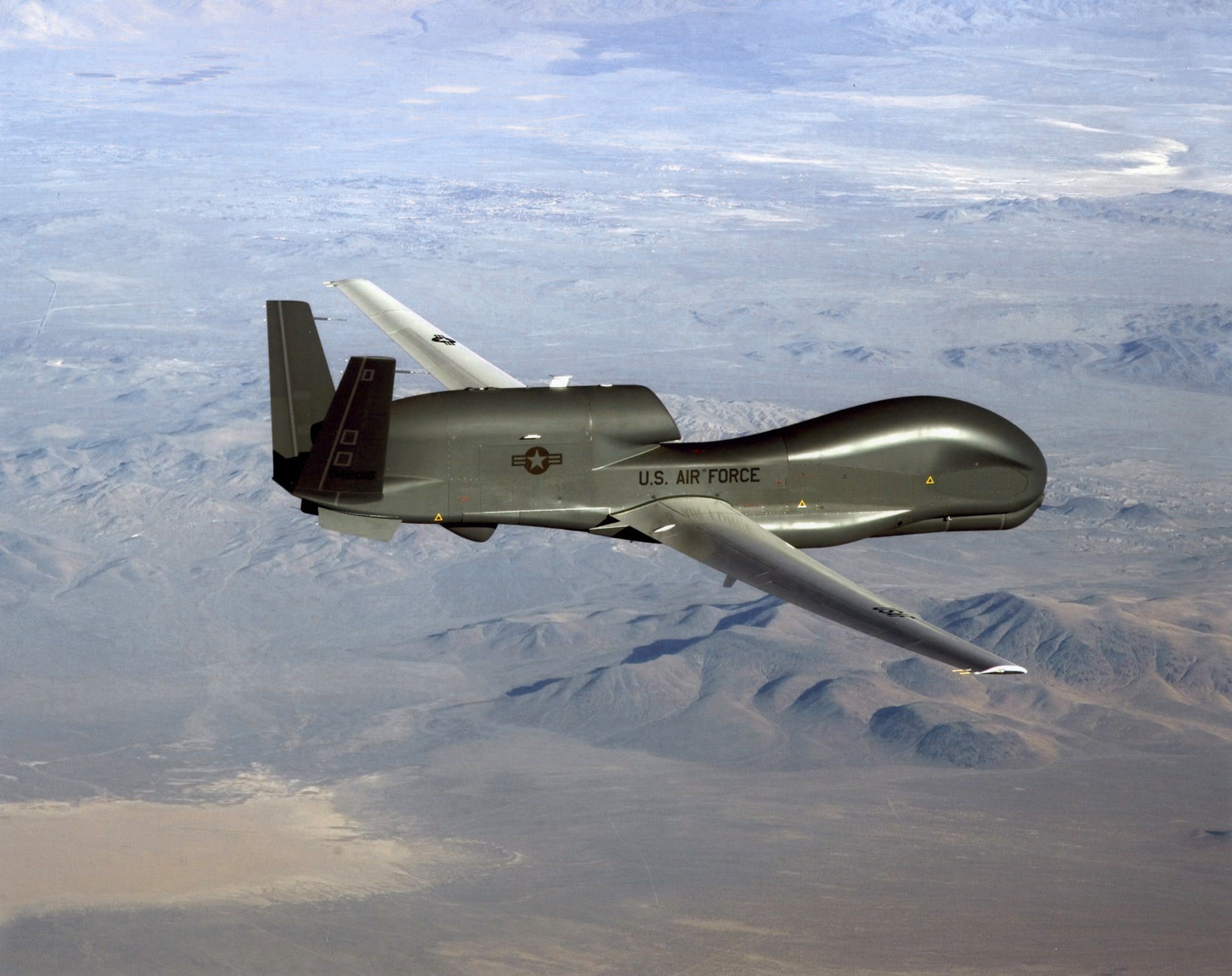
Căng thẳng Mỹ-Iran bị đẩy lên đỉnh điểm với những tranh cãi sau vụ Lực lượng Vệ binh Cách mạng Iran bắn hạ máy bay do thám chiến lược không người lái Global-Hawk BAMS-D của Mỹ.
Có thể hiểu rằng Tổng thống Mỹ muốn cảnh báo Iran không được vượt “giới hạn đỏ,” song dường như chính việc Tehran lựa chọn phương án không bắn hạ máy bay trinh sát P-8 có người lái của Mỹ cũng phần nào “mở cánh cửa” cho ông chủ Nhà Trắng, tránh có những quyết định mang tới hậu quả nguy hiểm không thể kiểm soát.
Căng thẳng Mỹ-Iran bị đẩy lên đỉnh điểm với những tranh cãi sau vụ Lực lượng Vệ binh Cách mạng Iran (IRGC) bắn hạ máy bay do thám chiến lược không người lái Global-Hawk BAMS-D của Mỹ trên vùng trời eo biển Hormuz ngày 20/6, cáo buộc máy bay Mỹ đã vi phạm không phận Iran, gây hấn và việc bắn hạ thể hiện chính sách của Tehran.
Ảnh tư liệu do Không lực Mỹ công bố: Máy bay trinh sát và do thám không người lái RQ-4 Global Hawk của Mỹ. (Nguồn: AFP/TTXVN)
Trái lại, Mỹ tuyên bố máy bay do thám bị bắn rơi khi đang hoạt động trong không phận quốc tế. Trung tướng Joseph-Guastella, Chỉ huy không quân Mỹ tại Trung Đông, lập luận máy bay của Mỹ đang hoạt động trong các hành lang không phận đã được thiết lập trước đó và chưa từng tiếp cận dưới 34km cách bờ biển Iran.
Vụ việc trên xảy ra vào thời điểm hết sức nhạy cảm, khi Mỹ công bố kế hoạch gửi thêm 1.000 quân tới Trung Đông và điều tàu khu trục USS Mason tới Vùng Vịnh ngay sau cáo buộc Iran tấn công hai tàu chở dầu nước ngoài tại vịnh Oman ngày 14/6, cáo buộc mà Tehran khẳng định là vô căn cứ và là một phần của “ngoại giao phá hoại” đang được Mỹ áp dụng đối với quốc gia Hồi giáo.
Vụ việc trên xảy ra vào thời điểm hết sức nhạy cảm, khi Mỹ công bố kế hoạch gửi thêm 1.000 quân tới Trung Đông và điều tàu khu trục USS Mason tới Vùng Vịnh.
Liên tiếp gia tăng những động thái gây căng thẳng, cả “đấu khẩu” lẫn triển khai các biện pháp liên quan tới lực lượng quân sự, có thể nói Mỹ và Iran đã cận kề chiến tranh hơn bao giờ hết, thậm chí Tổng thống Mỹ Donald Trump cho biết “đã ra lệnh tấn công 3 mục tiêu của Iran,” nhưng cũng chính người đứng đầu Nhà Trắng chỉ thị hủy kế hoạch tấn công chỉ 10 phút trước khi máy bay Mỹ tấn công các mục tiêu của Iran với lý do tránh gây thương vong cho khoảng 150 người và Washington “không vội tấn công” Tehran.
Về phần Iran, giới chức nước này tuyên bố đã lựa chọn phương án không bắn hạ máy bay trinh sát P-8 có người lái của Mỹ đang hoạt động gần với máy bay không người lái trên, chỉ buộc máy bay quân sự P-8 đổi hướng, có vẻ phần nào tránh để xung đột bị đẩy cao hơn nữa.
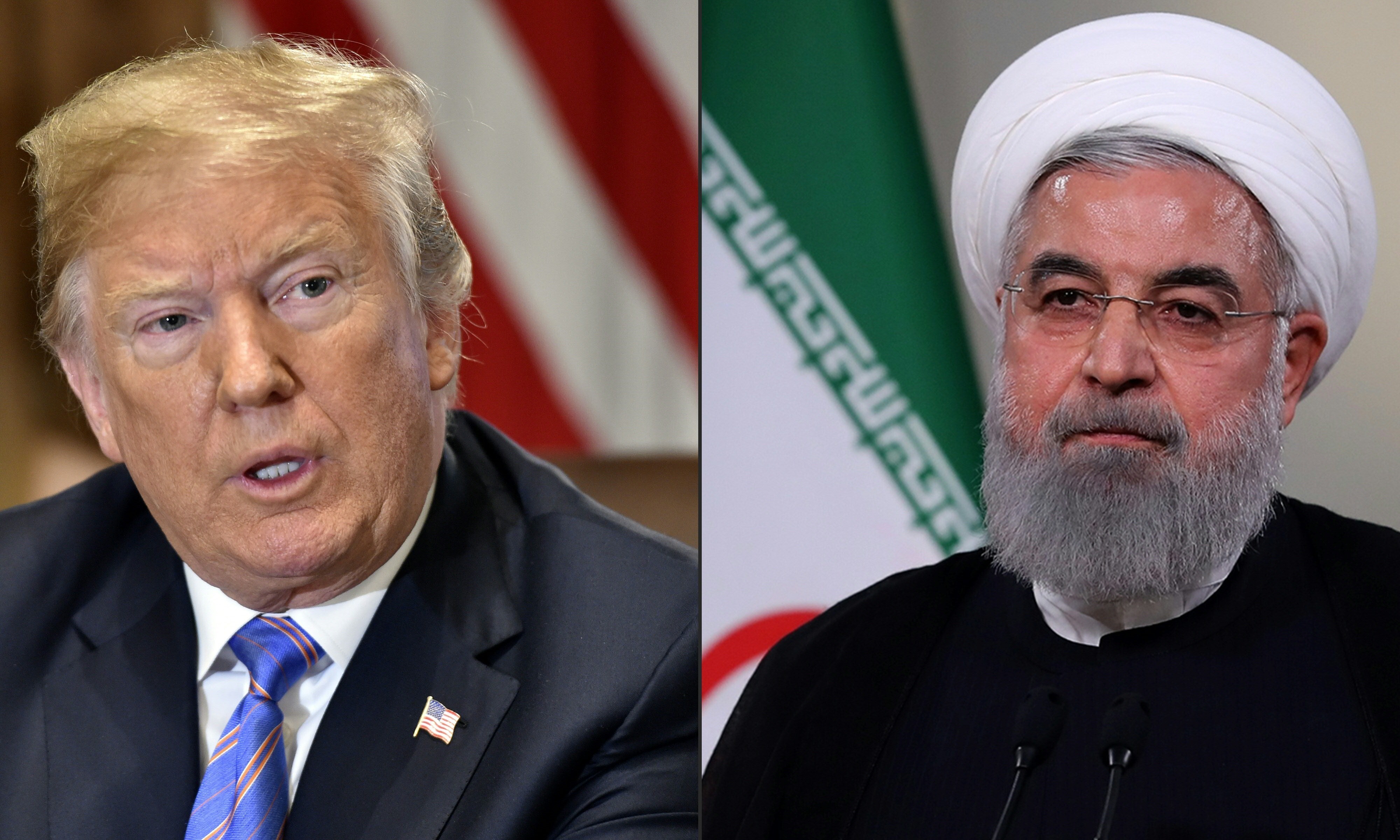
Tổng thống Mỹ Donald Trump (phải) và Tổng thống Iran Hassan Rouhani (phải). (Nguồn: AFP/TTXVN)
Giới chuyên gia cho rằng những động thái leo thang căng thẳng gần đây từ cả Mỹ và Iran tiếp tục là những “đòn cân não” để nắn gân, gây sức ép đối với đối thủ nhằm đạt được mục tiêu cuối cùng.
Tổng thống Trump phải phản ứng khi máy bay do thám của Mỹ bị IRGC bắn hạ, nhưng cách thức phản ứng cho thấy ông chủ Nhà Trắng không muốn có chiến tranh với Iran vào thời điểm chiến dịch vận động tranh cử nhiệm kỳ hai đã bắt đầu. Một cuộc tấn công quân sự hạn chế nhằm vào Iran có nguy cơ dẫn tới Tehran trả đũa, có khả năng gây ra xung đột quy mô lớn trên phạm vi khu vực.
Những động thái leo thang căng thẳng gần đây từ cả Mỹ và Iran tiếp tục là những “đòn cân não” để nắn gân, gây sức ép đối với đối thủ nhằm đạt được mục tiêu cuối cùng.
Cuộc xung đột này khó tránh kéo theo sự tham gia của các đồng minh của Mỹ và là “đối thủ” của Iran như Saudi Arabia hay Israel, cũng như các lực lượng lâu nay Washington vẫn cho rằng “có quan hệ với Iran” như Hezbollah tại Liban, Al-Houthi tại Yemen và một số nhóm dân binh Shiite tại Iraq.
Rủi ro từ cuộc chiến lan rộng ở Trung Đông khiến các lợi ích của Mỹ và đồng minh khu vực chắc chắn bị ảnh hưởng, chưa kể Washington có thể bị “sa lầy” vào một cuộc phiêu lưu quân sự mới. Trung Đông rơi vào khủng hoảng tất yếu làm gia tăng giá dầu thô toàn cầu, tác động tiêu cực đến sức khỏe của nền kinh tế thế giới, qua đó làm giảm tăng trưởng kinh tế Mỹ, vốn là yếu tố quyết định lá phiếu cử tri Mỹ trong cuộc bầu cử tổng thống 2020.
Tổng thống Mỹ Donald Trump tại cuộc họp báo ở Nhà Trắng ngày 11/6. (Nguồn: THX/TTXVN)
Việc Tổng thống Trump công khai rút lại quyết định tấn công Iran và tuyên bố về “sự thịnh vượng cho Iran nếu quốc gia Hồi giáo này chấp nhận hợp tác với Mỹ để phi hạt nhân hóa,” được đánh giá là nhằm thực hiện chiến tranh tâm lý với Tehran, cũng như truyền tải thông điệp muốn đàm phán và tạo dư luận ông đang “trao cơ hội hòa bình” cho Iran, tháo ngòi nổ chiến tranh đã rất cận kề.
Đây có thể coi là bước đi đầy tính toán vì nếu căng thẳng tiếp tục leo thang và chính sách gây sức ép tối đa không đạt hiệu quả, Tổng thống Trump có thể phải sử dụng đến một cuộc tấn công quân sự hạn chế vào Iran để giữ thể diện nước lớn và uy tín cá nhân.
Khi đó, Tổng thống Trump có thể nói với cử tri rằng Mỹ đã mở cánh cửa đàm phán nhưng Iran từ chối và buộc phải tấn công quân sự hạn chế. Bên cạnh đó, Mỹ cũng cần thời gian để gia tăng nỗ lực bảo vệ các lợi ích tại khu vực phòng trường hợp căng thẳng với Iran vượt tầm kiểm soát trở thành xung đột quân sự.
Việc Tổng thống Trump công khai rút lại quyết định tấn công Iran là nhằm thực hiện chiến tranh tâm lý với Tehran
Về phần Iran, nước này đang cho thấy không chấp nhận đàm phán một thỏa thuận hạt nhân mới theo các điều kiện Mỹ nêu ra, thậm chí, có vẻ với hành động cứng rắn bắn hạ máy bay không người lái của Mỹ, Iran tỏ ra sẵn sàng chấp nhận kịch bản một cuộc tấn công quân sự hạn chế của Mỹ nếu các lợi ích của Tehran bị đe dọa.
Iran đang rút một phần khỏi thỏa thuận hạt nhân năm 2015, còn gọi là Kế hoạch hành động chung toàn diện (JCPOA) để gây sức ép đối với Liên minh châu Âu (EU) và các nước có lợi ích tại Trung Đông gia tăng nỗ lực tác động Mỹ thay đổi chính sách cứng rắn với Tehran. Đây cũng có thể là “quân cờ mặc cả” của Iran trước khi ngồi vào bàn đàm phán, mà khi đó nhượng bộ của Tehran chính là khôi phục nguyên trạng JCPOA.
Tuy nhiên, có thể nhận thấy Iran không có lợi nếu rút hoàn toàn khỏi JCPOA vào thời điểm hiện nay, vì điều đó sẽ tổn hại tới lợi ích kinh tế, đánh mất sự ủng hộ của EU, Nga, Trung Quốc và cộng đồng quốc tế, có thể buộc Mỹ phải tiến hành một cuộc tấn công quân sự, cuộc chiến tranh chắc chắn cũng gây hậu quả tàn khốc với Iran.
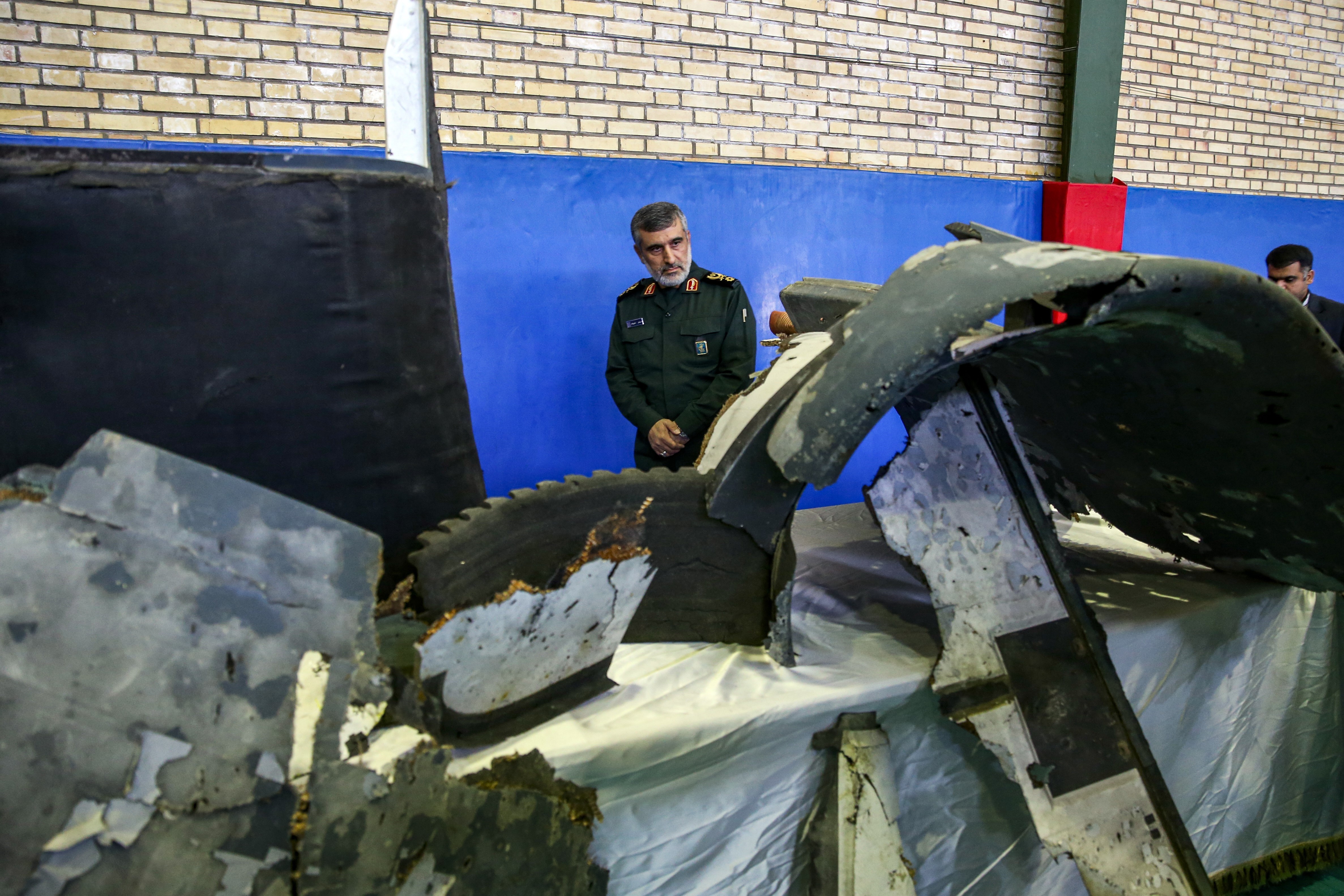
Chỉ huy đơn vị phòng không thuộc Lực lượng Vệ binh cách mạng Hồi giáo Iran (IRGC) – Chuẩn tướng Amirali Hajizadeh trong buổi họp báo công bố xác máy bay do thám không người lái của Mỹ bị phòng không Iran bắn hạ tại Tehran ngày 21/6/2019. (Nguồn: AFP/TTXVN)
Trong khi đó, các nỗ lực ngoại giao nhằm xúc tiến một cuộc đối thoại Mỹ-Iran chưa đem lại kết quả. Bởi vậy, động thái của Iran bắn hạ máy bay quân sự không người lái của Mỹ có thể hiểu như “biện pháp răn đe” nhằm gây sức ép ngược với Mỹ.
Có thể nhận thấy chính sách của Mỹ về trừng phạt và răn đe Iran khó đạt được mục đích đề ra. Mặc dù vậy, Tổng thống Trump đang trong tình thế khó có thể nhượng bộ Iran vì thể diện nước lớn và phục vụ tranh cử nhiệm kỳ hai. Thế giằng co cân não giữa Mỹ và Iran vì thế có thể còn kéo dài.
Chính sách “bên miệng hố chiến tranh” có mức độ rủi ro rất cao.
Tổng thống Trump đang lựa chọn trừng phạt thay vì tấn công Tehran, nhưng nguy cơ xung đột quân sự Mỹ-Iran rõ ràng hơn bao giờ hết. Với việc hai nước đều thực hiện các bước đi cứng rắn, chưa chấp nhận nhượng bộ, vòng tròn luẩn quẩn trả đũa lẫn nhau sẽ gia tăng, khi đó những tính toán sai lầm hoặc tai nạn sẽ đẩy hai nước vào tình trạng đối đầu quân sự trực diện vì chính sách “bên miệng hố chiến tranh” có mức độ rủi ro rất cao.
Hệ quả của chính sách này trước hết sẽ khiến Trung Đông bất ổn, tạo cơ hội cho các lực lượng khủng bố tiếp tục tồn tại và phát triển, khuyến khích chạy đua vũ trang tại khu vực. Trung Đông có ý nghĩa quan trọng đối với an ninh năng lượng toàn cầu, nhất là ổn định giá dầu thô thế giới, qua đó giúp duy trì tăng trưởng kinh tế giữa lúc cuộc chiến thương mại Mỹ-Trung Quốc chưa thể sớm kết thúc.
Trung Đông cũng đóng vai trò quan trọng đối với an ninh và ổn định của EU. Vì vậy, EU là bên có liên quan trực tiếp và có khả năng nhất trong tác động chính sách của Mỹ và Iran để giảm căng thẳng.
Trong diễn biến mới nhất, Bộ trưởng Anh phụ trách khu vực Trung Đông, ông Andrew Murrison, đến Tehran ngày 23/6 với thông điệp “trung thực và xây dựng” nhằm làm giảm căng thẳng Mỹ-Iran. Khi Trung Đông đang trong tình thế nguy hiểm do những căng thẳng giữa Mỹ và Iran, rất cần nhân tố trung gian đủ mạnh để thúc đẩy hai bên hóa giải bất đồng, tiến tới đạt được một thỏa thuận sơ bộ./.
Ảnh tư liệu: Tàu ngầm của Hải quân Iran tham gia huấn luyện tại Vịnh Oman, ngày 22/2/2019. (Nguồn: AFP/TTXVN)
Theo báo cáo của Cục Cảnh sát hình sự (Bộ Công an), trung bình mỗi năm cả nước có khoảng 1.000 trẻ em bị xâm hại tình dục, hay cứ 8 giờ trôi qua thì lại có ít nhất một đứa trẻ bị xâm hại tình dục.
Một người mẹ có con gái 5 tuổi ở Thành phố Hồ Chí Minh khi phát hiện những bất thường của con, biết được sự việc chị đã tố cáo kẻ xâm hại con mình.
Nước mắt lăn dài trên má, nỗi đau bóp chặt cổ họng, nghẹn trong tiếng nấc, tiếng kể của chị: “Chú dặn con không nói cho cô Giang, cô Hà, không nói cho ba mẹ biết. Mẹ ơi, chú làm con đau lắm…!”
Ám ảnh nhất là những dòng chữ cuối cùng của bé H.M. K., 13 tuổi, học lớp 5 ở Cà Mau trên tờ giấy ôly ngập tràn phẫn uất: “Tôi đã sấm (sắp) chết không còn ở trên trái đất này nữa, tôi chết nắm (nhắm) mắt không yên khi chuyện này không được giải quyết.”
K. – mới có 13 tuổi, là nạn nhân của vụ xâm hại tình dục gây chấn động dư luận cả nước. Em bị người hàng xóm đáng tuổi cha chú xâm hại nhiều lần và đã cùng gia đình tố cáo nhưng cảnh sát điều tra Công an tỉnh Cà Mau vẫn không khởi tố vụ án. Uất ức, K. tìm đến cái chết như một phương cách tìm lại công bằng cho mình.
Cái chết của K. như một tiếng chuông thức tỉnh lương tri của xã hội về một tệ nạn nhức nhối hiện nay. Ngày càng nhiều trẻ em bị xâm hại tình dục với diễn biến phức tạp cả về quy mô và cách thức thực hiện.
Xâm hại tình dục trẻ em đang là vấn nạn ở Việt Nam, hậu quả mà các em phải gánh chịu có thể có những tổn thất về sức khỏe thể chất và tinh thần, làm giảm khả năng học tập, hòa nhập xã hội và thậm chí có thể hủy hoại các em, ảnh hưởng đến việc trở thành con người tốt, trở thành cha mẹ tốt trong tương lai.
Phóng viên VietnamPlus đã tiếp cận vấn đề này ở nhiều góc độ khác nhau, để ngăn chặn tình trạng trẻ em bị xâm hại tình dục cần phải huy động, chung tay tham gia của toàn xã hội, để không còn những chuyện tồi tệ như vậy xảy ra với các cô bé, cậu bé và những kẻ xấu bị trừng trị, trả lại lại công bằng cho những em bé bị xâm hại tình dục.
Những đứa trẻ bị đánh cắp tuổi thơ và khuyết tật tâm hồn khi trưởng thành
“Trẻ em như búp trên cành…
Biết ăn, biết ngủ, biết học hành là ngoan…”
Khi được ai đó hỏi về tuổi thơ, đa số mọi người đều cảm thấy quãng thời gian đó thật đẹp, trong trẻo và là giai đoạn đáng nhớ nhất trong cuộc đời. Tuy nhiên, cũng có những người, tuổi thơ là đoạn ký ức chua xót mà họ luôn muốn quên đi.
Dường như, có một số “búp non trên cành” ấy đang phải đối mặt với không ít chông gai, không ít những em bé đang bị đánh cắp mất tuổi thơ do bị lạm dụng tình dục, bị ấu dâm.
Những dòng tâm sự của người mẹ, người cha hay chính những đứa trẻ ấy trong cuộc thật day dứt, xót xa…
Những lời tâm sự nhói lòng
Chị T. 32 tuổi và đã có gia đình tâm sự, mỗi khi đọc tin về việc trẻ nhỏ bị ấu dâm, xâm hại tình dục, tim chị lại nhói đau.
Khi T. 12 tuổi, đi đâu cô cũng được mọi người khen xinh. Bố mẹ T. có một chú em kết nghĩa đặc biệt yêu quý cô. Cứ mỗi lần sang chơi, thế nào chú ấy cũng phải ôm hôn T. trước mặt bố mẹ cô.
Nhà T. ở là khu tập thể của ban quản lý trồng rừng. Trước cửa nhà là cả một vườn ươm cây rộng lớn, lũ trẻ con trong xóm hay chơi trốn tìm ở đó.
“Hè năm 1998, mình vẫn chơi trốn tìm với nhóm bạn. Đến lượt phiên mình chạy đi trốn. Mình núp vào bụi vườn ươm cây như mọi lần chơi thì tự nhiên có chú em kết nghĩa đó từ đâu nhảy vào núp cùng.”
Sự sợ hãi sau lần đụng chạm ấy đi theo T. suốt tuổi thơ, là bức tường ngăn cách cô với những bạn trai cùng trang lứa.
“Mình là đứa bé 12 tuổi và đang mải trốn bạn nên thấy chú bắt đầu ôm hôn mình như mọi khi, mình đã không phản ứng lại. Chỉ đến lúc chú bắt đầu thò tay vào vê đầu ngực mới nhú của mình thì thầm hỏi: “Đây là cái gì thế?” rồi tiếp tục lột quần lót và lật váy lên để úp mặt vào người mình thì lúc ấy mình mới thấy sợ, nhảy choàng ra khỏi chỗ trốn tìm. Thấy tiếng động, một bạn chạy ra ‘xì’ mình. Thế là mình thoát. Khi mình về nhà, thấy chú ngồi đấy nói chuyện với bố mình, và vẫn như mọi khi, nhảy ra ôm hôn mình trước mặt bố, mình lại thấy sợ. Sau đó mình đã kểlại sự việc với bố nhưng bố mình không quan tâm,” T nhớ lại.
Sự sợ hãi sau lần đụng chạm ấy đi theo T. suốt tuổi thơ, là bức tường ngăn cách cô với những bạn trai cùng trang lứa.
Nghe đứa bạn gái hạnh phúc thủ thỉ về lần đầu tiên cầm tay bạn trai, sự rung cảm thiêng liêng lần đầu tiên chúng nó ôm hôn, lần đụng chạm tay đầu tiên như thế nào, T. cảm thấy ghen tỵ vì cô không thể nào có được khoảnh khắc ấy.
Các em nhỏ là nạn nhân ấu dâm sẽ mang theo vết sẹo tâm hồn trong suốt cuộc đời. (Nguồn: EW Health)
“Mình luôn nhớ lần đầu tiên của mình với sự kinh tởm trào dâng. Mình chưa bị hiếp, nhưng đã bị ấu dâm, bị dâm ô. Mình lớn lên với sự khiếm khuyết ấy. Đến bây giờ, cứ vô tình xem bộ phim có cảnh ấu dâm là mình không bình tĩnh được. Cứ đọc tin về ấu dâm mình ngồi khóc, oán hận cào xé. Mình luôn muốn vạch tội kẻ ác thú. Nhưng lại câm nín vì có hay gì, có chữa được gì đâu, có ai bảo vệ mình đâu, bố mẹ mình còn kệ nữa là. Cứ như vậy, vật vã, dằn vặt, tự nuốt căm hờn đến bây giờ,” T. tâm sự.
Rồi gương mặt đó, hành vi đó đã đi theo và ám ảnh cô trong suốt nhiều năm dài. Những tổn thương thể xác không dai dẳng và đáng sợ bằng những di chứng tâm lý. “Và tôi đã là một đứa trẻ có một tuổi thơ bị đánh cắp như thế…” Đó là những lời tâm sự nhói lòng của T. – một nạn nhân bị xâm hại tình dục.
Sang chấn tâm lý có thể đi theo suốt đời
Có không ít đứa trẻ đã bị hoảng loạn trong một thời gian dài, thậm chí những đứa trẻ ấy, đến khi lớn lên vẫn bị ám ảnh…
Nạn nhân của hành vi ấu dâm (lạm dụng tình dục trẻ em) thường phải gánh chịu những hậu quả nặng nề trong thời gian dài, thậm chí suốt đời.
Tiến sỹ Dương Minh Tâm – Trưởng phòng Điều trị các rối loạn liên quan stress, Viện Sức khỏe Tâm thần (Bệnh viện Bạch Mai) cho biết: “Quấy rối tình dục thường gây ra các sang chấn tâm lý kinh khủng đối với trẻ em. Nỗi sợ hãi ấy có thể gây ám ảnh suốt cuộc đời một đứa trẻ. Một sang chấn rất kinh khủng ở nữ giới hay gặp đó là vấn đề lạm dụng tình dục, hoặc là nam giới cũng vậy. Những trẻ từng bị quấy rối, xâm hại tình dục thường rất dễ gặp phải các rối loạn stress sau sang chấn.”
Bác sỹ Tâm cho hay, tại bệnh viện đã tiếp nhận nhiều bệnh nhân bị stress liên quan đến lạm dụng tình dục, liên quan đến ấu dâm…
Theo tiến sỹ Dương Minh Tâm, các sang chấn tâm lý thường gặp phải khi bản thân bị hành hạ hoặc bị xâm hại tình dục. Những hình ảnh đó được tiếp nhận đầy đủ trong đầu người bị lạm dụng hoặc người chứng kiến dẫn đến những trải nghiệm cảm xúc kinh sợ gắn sâu hết vào tâm trí người bị hại. Sau khi chuyện đó xảy ra, người bệnh hay xuất hiện các hồi ức, hình ảnh, cảm giác hay gặp lại, kể cả lúc bệnh nhân đang thức hay trong giấc mơ, những hình ảnh đó đều có thể xuất hiện trong đầu trở lại.
Bác sỹ Tâm phân tích: “Ngay sau khi trẻ bị quấy rối, xâm hại tình dục, trẻ luôn bị ám ảnh bởi những hình ảnh khủng khiếp. Những hình ảnh, trải nghiệm đó làm cho bệnh nhân sợ hãi, mất tập trung, người bệnh buồn phiền, xấu hổ, mất tự tin, họ thu mình, dẫn đến ức chế tư duy để phát triển. Tình trạng đó gần như cứ kéo dài suốt đời, âm thầm gây tổn hại đến sức khỏe, người bệnh luôn trong một tình trạng cảm thấy không lối thoát.”
Tiến sỹ Dương Minh Tâm – Viện Sức khỏe tâm thần, Bệnh viện Bạch Mai (Ảnh: PV/Vietnam+)
Có rất nhiều bệnh nhân đến bệnh viện điều trị sau sang chấn bị quấy rối tình dục. Họ có rất nhiều triệu chứng và than phiền với bác sỹ. Tuy nhiên, không phải ca bệnh nào cũng điều trị thành công được, bởi có khá nhiều bệnh nhân không vượt qua được mặc cảm, họ không nói thật với bác sỹ về những cú sốc mà họ gặp phải.
“Có một nữ bệnh nhân 20 tuổi, tôi điều trị rất lâu khỏi, vì bệnh nhân không nói thực tình trạng của mình, những nguyên nhân do đâu. Trải qua quá trình rất lâu, thậm chí là cả năm trời, đến khi mối quan hệ thầy thuốc và bệnh nhân, khi họ đạt đủ niềm tin, đặt đủ sự trông cậy họ mới nói ra nguyên nhân sâu xa do khi còn nhỏ bị lạm dụng tình dục. Khi bệnh nhân nói ra được nguyên nhân đó, phác đồ điều trị của chúng tôi dễ dàng hơn, với tỷ lệ thành công cao. Nếu bệnh nhân không nói nguyên nhân thì 100% việc điều trị không thành công,” bác sỹ Tâm cho hay.
“Lạm dụng tình dục ở Việt Nam còn rất cao, đây vẫn còn là tảng băng trôi, dường như chúng ta vẫn chưa khai thác được.” (Tiến sỹ Dương Minh Tâm)
Qua nhiều năm điều trị cho các bệnh nhân ở đây, bác sỹ Tâm chia sẻ: “Lạm dụng tình dục ở Việt Nam còn rất cao, đây vẫn còn là tảng băng trôi, dường như chúng ta vẫn chưa khai thác được, chưa thống kê được chính xác. Chúng tôi gặp bệnh nhân bị lạm dụng tình dục rất nhiều, đặc biệt đa phần các trường hợp bị lạm dụng tình dục hay bị bởi người thân hơn như: anh trai em gái, chú bác, người lớn trong nhà, hàng xóm…”
Hậu quả là, những em bé đó sẽ bị sang chấn rất nhiều. Điều này tạo ra gánh nặng về xã hội vì kinh tế, gánh nặng cho người bệnh, chất lượng cuộc sống…
Tổ chức Y tế Thế giới ước tính, các rối loạn ám ảnh (OCD) là một trong 20 nguyên nhân hàng đầu gây khuyết tật liên quan đến bệnh tật cho con người.
OCD có tác động đáng kể đến chất lượng cuộc sống và có thể làm giảm đáng kể mức độ hoạt động người bệnh.
Trong khi đó, tỷ lệ ám ảnh sợ xã hội có xu hướng gia tăng với tỷ lệ tăng lên khoảng 14% trong độ tuổi vị thành niên. Ám ảnh xã hội ngày càng trở nên phổ biến hơn ở phụ nữ so với nam giới trong độ tuổi vị thành niên và trưởng thành.
Điều trị cho một bệnh nhân tại Viện sức khoẻ tâm thần – Bệnh viện Bạch Mai. (Ảnh: Dương Ngọc/TTXVN)
Xâm hại tình dục trẻ em
Phần nổi của tảng băng trôi
Tại Việt Nam, Luật Trẻ em 2016 đã tạo ra hành lang pháp lý quan trọng cho công tác bảo vệ, chăm sóc và giáo dục trẻ em, góp phần rất lớn trong việc thực hiện ngày càng tốt hơn các quyền cơ bản của trẻ em.
Luật Trẻ em của Việt Nam dành hẳn một chương riêng (Chương IV) về bảo vệ trẻ em, quy định các yêu cầu bảo vệ trẻ em; cấp độ bảo vệ trẻ em và trách nhiệm thực hiện; việc thành lập và hoạt động của các cơ sở cung cấp dịch vụ bảo vệ trẻ em; chăm sóc thay thế.
Bên cạnh đó, Chính phủ cũng ban hành nhiều văn bản chỉ đạo, hướng dẫn thực hiện công tác bảo vệ, chăm sóc trẻ em, góp phần từng bước nâng cao chất lượng cuộc sống của trẻ em. Đặc biệt, Bộ luật Hình sự 2015 đã dành 5 điều luật về hành vi xâm hại tình dục trẻ em, trong đó có quy định về tội dâm ô với người dưới 16 tuổi. Mặc dù vậy, ở Việt Nam tình trạng xâm hại tình dục trẻ em chưa giảm nhiều về tính chất cũng như số lượng.
Theo báo cáo của Bộ Công an, gần đây một số loại tội phạm và vi phạm pháp luật có dấu hiệu phức tạp, trong đó có tình trạng bạo lực, xâm hại trẻ em, đặc biệt là xâm hại tình dục trẻ em.
Ngày càng có nhiều vụ việc xâm hại trẻ đau lòng, nhức nhối xảy ra. Tại Trường Tiểu học bán trú La Pán Tẩn, xã La Pán Tẩn (Mường Khương, Lào Cai) có đến 23 em bị Đỗ Văn Nam, bảo vệ nhà trường dâm ô, khiến dư luận vô cùng bức xúc.
Mới đây, tại xã Vô Tranh, huyện Lục Nam, tỉnh Bắc Giang, cháu Nguyễn Gia Đ., đứa con gái mới hơn 6 tuổi kể lại vụ việc bị xâm hại tình dục khi bố mẹ vắng nhà bởi người hàng xóm tên Tuấn. Chị gái của Đ., 8 tuổi cũng đã chứng kiến một phần hành vi xâm hại tình dục của Tuấn với em mình nhưng vì lời đe dọa của người hàng xóm và cả nỗi sợ bị bố mẹ đánh đòn nên phải 3 ngày sau, chuyện Đ. bị xâm hại mới được hé lộ.
Đa số các vụ xâm phạm tình dục đối với trẻ em lại từ những người thân thích với nạn nhân, báo động về sự suy đồi đạo đức trong xã hội.
Sự việc được trình báo với cơ quan chức năng địa phương. Quá trình điều tra được tiến hành, thêm một sự thật đau lòng khác bị phát giác khi đây không phải lần đầu tiên bé Đ. bị người hàng xóm này xâm hại.
Điều đáng quan tâm là đa số các vụ xâm phạm tình dục đối với trẻ em lại do những người thân thích với nạn nhân, báo động về sự suy đồi đạo đức như: bố dượng với con riêng của vợ; bác, chú, thậm chí có cả ông, bố đẻ và anh em ruột thịt.
Điển hình là vụ cha đẻ và ông nội hiếp dâm con và cháu nhiều năm liền khi cháu mới 10 tuổi mà mẹ của cháu biết nhưng không dám tố cáo ở Vĩnh Long. Gần đây nhất, trong những tháng đầu năm 2019 đã có hàng loạt vụ việc bố hiếp dâm con gái ruột tại Lào Cai, Bắc Giang, Gia Lai, Kon Tum… bị khởi tố.
Có lẽ, chưa bao giờ nhiều vụ xâm hại trẻ em xảy ra trong thời gian gần đây được “vạch trần” đến vậy. Ngày càng nhiều vụ xâm hại tình dục nghiêm trọng gây bức xúc trong dư luận xã hội.
Theo báo cáo của Bộ Công an, năm 2018 cả nước xảy ra 1.547 vụ xâm hại trẻ em, trong đó có tới 1.293 em bị xâm hại tình dục. Con số này cho thấy các vụ việc xâm hại trẻ em bị khởi tố chủ yếu là xâm hại tình dục. Chỉ riêng quý 1 năm 2019 đã phát hiện 253 vụ xâm hại tình dục trẻ em, khởi tố 234 vụ, 241 bị can, đang điều tra, xác minh 19 vụ, 19 đối tượng.
Đặc biệt, tội phạm xâm hại tình dục trẻ em chiếm hơn 80% tội phạm xâm hại trẻ em và những con số thống kê chỉ là “phần nổi của tảng băng trôi,” còn nhiều nguy cơ, vụ việc tiềm ẩn.
Mặc dù tỷ lệ trẻ em bị xâm hại tình dục trong các trường hợp bị phát hiện, xử lý năm 2018 giảm 3,8% so với năm 2017, tính chất vụ việc xâm hại tình dục trẻ em ngày càng nghiêm trọng, phức tạp, gây bức xúc trong dư luận xã hội.
Nếu như trước đây, tình trạng xâm hại tình dục đối với trẻ em chủ yếu xảy ra ở vùng sâu vùng xa, những khu vực dân cư thưa thớt, hẻo lánh, trình độ dân trí thấp, thì hiện nay, ngày càng nhiều vụ xâm hại tình dục trẻ em được phát hiện ở các khu đô thị, thành phố lớn. Nạn nhân chủ yếu là các bé gái từ 9-16 tuổi, cá biệt có trường hợp nạn nhân mới chỉ 3, 4 tuổi. Gần đây còn có cả tình trạng xâm hại tình dục đối với trẻ em nam.
Tình trạng xâm hại tình dục trẻ em đang có nguy cơ trở thành một vấn nạn xã hội khi thời gian gần đây số vụ việc bị phát hiện liên tục gia tăng, với hành vi gây án ngày càng táo tợn, nghiêm trọng.
Điều đáng nói, tại các môi trường tưởng chừng như an toàn nhất với trẻ như gia đình, nhà trường, những hành vi đồi bại vẫn ngang nhiên hiện diện.
Hàng loạt vụ việc xâm hại tình dục trẻ em xảy ra chính tại học đường trong thời gian qua đã khiến dư luận căm phẫn như vụ Hiệu trưởng Trường Phổ thông Dân tộc nội trú Đinh Bằng My (Phú Thọ) bị bắt vì xâm hại tình dục các nam học sinh; vụ thầy giáo ở Bắc Giang dâm ô 13 nữ sinh; thầy giáo ở Lào Cai bị tố làm nữ sinh lớp 8 mang thai; thầy giáo ở Bình Thuận dâm ô với 8 học sinh tiểu học…
Tình trạng xâm hại tình dục trẻ em đang có nguy cơ trở thành một vấn nạn xã hội khi thời gian gần đây số vụ việc bị phát hiện liên tục gia tăng, với hành vi gây án ngày càng táo tợn, nghiêm trọng.
Gần nhất, tại Thành phố Hồ Chí Minh, một bé gái 9 tuổi đang chơi trong công viên bị tên Lương Tuấn B. (28 tuổi) dụ dỗ rồi hiếp dâm ngay tại công viên. Cũng ngay trong ngày hôm đấy, tên này còn thực hiện hành vi dâm ô với một bé gái khác.
Ông Nguyễn Văn Bốn, Viện Kiểm sát nhân dân tỉnh Hà Nam nói về những vướng mắc về định nghĩa thế nào là xâm hại tình dục trẻ em trong quy định pháp luật.
Đáng báo động hơn cả, đối tượng gây án còn có cả những người có học thức, trình độ, vị trí, thậm chí là người thân quen, gây phẫn nộ trong dư luận.
Hồi đầu tháng 4, cựu Phó Viện trưởng Viện Kiển sát nhân dân thành phố Đà Nẵng đã có hành vi dâm ô bé gái ngay trong thang máy một chung cư tại quận 4, Thành phố Hồ Chí Minh.
Một vụ việc khác cũng gây rúng động dư luận, cháu Nguyễn Thị L. (sinh năm 2005) bị đối tượng Nguyễn Đức Q. (bố đẻ cháu L., một quân nhân quân đội) thực hiện hành vi hiếp dâm từ lúc cháu học lớp 4 đến lớp 8-thời điểm giáo viên chủ nhiệm phát hiện vụ việc.
Vấn đề phòng chống trẻ em bị xâm hại tình dục đang thu hút được sự quan tâm của nhiều bộ, ngành. (Ảnh: PV/Vietnam+)
Theo tổng hợp từ các ca can thiệp, hỗ trợ trẻ em bị xâm hại tình dục thông qua Tổng đài điện thoại quốc gia bảo vệ trẻ em 111 năm 2017 và 2018, hơn 86% số vụ trẻ em bị xâm hại tình dục có thủ phạm chính là những người thân quen.
Bà Nguyễn Thị Nga, Phó Cục trưởng Cục Trẻ em (Bộ Lao động-Thương binh và Xã hội) cho biết, trong số các vụ việc xâm hại tình dục trẻ em được tổng đài 111 can thiệp hỗ trợ, thủ phạm là người quen, hàng xóm chiếm 59,06%; giáo viên, nhân viên nhà trường là 6,03%; các đối tượng khác là 13,79%. Đặc biệt thủ phạm là người thân trong gia đình (bố đẻ, bố dượng, anh, em họ…) chiếm tới 21,12%.
Thừa nhận công tác bảo vệ trẻ em nói chung, phòng, chống bạo lực, xâm hại trẻ em nói riêng vẫn còn những thách thức, bà Nguyễn Thị Hà, Thứ trưởng Bộ Lao động-Thương binh và Xã hội cho biết, trung bình mỗi năm vẫn có khoảng 2.000 trẻ em bị bạo lực, bị xâm hại cần được hỗ trợ, can thiệp. Đặc biệt, tính chất của các vụ việc bạo lực, xâm hại trẻ em có chiều hướng diễn biến phức tạp, nghiêm trọng.
Chính vì tính chất các vụ việc ngày càng nghiêm trọng nên vấn đề xâm hại tình dục trẻ em liên tiếp trở thành chủ đề “nóng” trên nghị trường Quốc hội. Bộ trưởng Bộ Lao động-Thương binh và Xã hội, Viện trưởng Viện Kiểm sát, Bộ trưởng Bộ Công an, Chánh án Tòa án nhân dân tối cao đều phải giải trình trước Quốc hội về tình trạng xâm hại trẻ em ngày càng phức tạp, nhưng việc xử lý các vụ việc lại còn lúng túng, chưa kịp thời, gây bức xúc trong dư luận.
‘Khoảng trống’ trong xử lý xâm hại tình dục trẻ em
Xâm hại tình dục gây tổn thương nặng nề đến thể chất và tinh thần trẻ em, thậm chí dẫn tới trẻ em bị tử vong hoặc trẻ em tự tử. Đáng lo ngại hơn cả, đối tượng xâm hại tình dục trẻ em đa phần là những người quen, họ hàng, hàng xóm. Hàng loạt các vụ việc hiếp dâm, dâm ô trẻ em đã bộc lộ nhiều khoảng trống trong pháp luật.
Tổng hợp báo cáo của 11 bộ, ngành về kết quả thực hiện công tác phòng, chống xâm hại tình dục trẻ em đã chỉ ra hàng loạt bất cập, vướng mắc trong công tác phòng chống xâm hại tình dục trẻ em thời gian qua. Từ việc thiếu các văn bản hướng dẫn quy định của luật; khoảng trống pháp luật trong xử lý vi phạm hành chính đối với hành vi xâm hại tình dục trẻ em, thiếu quy trình tố tụng, giám định đặc biệt….
Khó định nghĩa dâm ô
Trong vụ án hiếp dâm bé gái 9 tuổi xảy ra hồi tháng 2 tại huyện Chương Mỹ (Hà Nội), ban đầu cơ quan điều tra huyện ra quyết định khởi tố tội dâm ô với bị can dù dấu hiệu tội hiếp dâm khá rõ ràng. Sau đó, nhờ dư luận vào cuộc, cơ quan chức năng thành phố Hà Nội đã ra quyết định khởi tố bị can tội hiếp dâm người dưới 16 tuổi, bắt tạm giam bị can. Phó Viện trưởng Viện Kiểm sát nhân dân huyện Chương Mỹ (Hà Nội) đã bị kỷ luật do thái độ trách nhiệm trong xử lý.
Khi vụ việc xảy ra dự luận đã vô cùng bức xúc và đặt ra câu hỏi, tình trạng không xử đúng người đúng tội là do sợ bị oan sai, viện kiểm sát quá thận trọng hay còn yếu về nghiệp vụ? Chỉ một trường hợp mà đủ thấy tính chất phức tạp, sự lúng túng của các cơ quan điều tra trong công tác ngăn chặn nạn xâm hại tình dục trẻ em ở nước ta hiện nay.
Tổng hợp báo cáo của 11 bộ, ngành về kết quả thực hiện công tác phòng, chống xâm hại tình dục trẻ em đã chỉ ra hàng loạt bất cập, vướng mắc trong công tác phòng chống xâm hại tình dục trẻ em thời gian qua.
Không thể phủ nhận các quy định về bảo vệ các em khỏi bị xâm phạm tình dục của Việt Nam tương đối đầy đủ. Nước ta tham gia Công ước quốc tế về Quyền của trẻ em rất sớm, Luật Chăm sóc và giáo dục trẻ em, Bộ luật Hình sự đều có những quy định xử lý rất nghiêm khắc đối với người có hành vi xâm hại tình dục trẻ em.
Tòa án ở các địa phương cũng đã áp dụng hình phạt nghiêm khắc đối với hành vi xâm hại tình dục trẻ em, trong đó có cả những mức án chung thân, tử hình nhưng tình trạng này vẫn không giảm, thậm chí còn ngày càng nghiêm trọng.
Vướng mắc hiện nay trong quá trình thực thi luật là khó phân định giữa ranh giới có tội hay không có tội do định nghĩa hành vi phạm tội quá tổng quát khiến cơ quan điều tra đôi khi chưa xử đúng người, đúng tội gây bức xúc trong nhân dân.
Sổ tay kiểm sát viên giải quyết vụ án xâm hại tình dục trẻ em có nêu cụ thể định nghĩa về hành vi xâm hại tình dục trẻ em.
Hiện nay, theo quy định của pháp luật Việt Nam, mọi hành vi xâm hại tình dục trẻ em sẽ bị xử lý hình sự. Tuy nhiên, quy định pháp luật vẫn còn một số “lỗ hổng,” thiếu quy định rõ ràng về hành vi dâm ô trẻ em, khiêu dâm trẻ em. Điều 146 Bộ luật Hình sự năm 2015 đã quy định khung hình phạt đối với tội “Dâm ô với người dưới 16 tuổi” nhưng không đưa ra quy định cụ thể thế nào là hành vi dâm ô.
Tương tự, nội dung này cũng chưa được làm rõ trong Luật Trẻ em. Theo đó, tại khoản 8, Điều 4 Luật Trẻ em quy định: “Xâm hại tình dục trẻ em là việc dùng vũ lực, đe dọa dùng vũ lực, ép buộc, lôi kéo, dụ dỗ trẻ em tham gia vào các hành vi liên quan đến tình dục, bao gồm hiếp dâm, cưỡng dâm, giao cấu, dâm ô với trẻ em và sử dụng trẻ em vào mục đích mại dâm, khiêu dâm dưới mọi hình thức.” Đây chính là một trong những nguyên nhân khiến nhiều đối tượng phạm tội lợi dụng để “lách luật,” vì không phải mọi trường hợp phạm tội đều có những biểu hiện kể trên.
Theo mô tả của Bộ Luật hình sự, hành vi được quy định phạm tội có tính tổng quát cao, nếu thực hiện hành vi dâm ô với trẻ em mà không vì mục đích giao cấu thì có thể bị xử lý tội dâm ô trẻ em. Vậy thì hiểu như thế nào là hành vi dâm ô trẻ em?
Khái niệm dâm ô trẻ em chưa rõ ràng nên việc khởi tố nhiều vụ dâm ô trẻ em gặp khó khăn, kéo dài thời gian xử lý khiến dư luận phẫn nộ.
Thừa nhận tính tổng quát cao trong quy định về tội dâm ô trong Bộ Luật Hình sự bà Lê Thị Hòa, cán bộ Vụ Pháp luật hành chính (Bộ Tư pháp) đã dẫn tới những cách hiểu khác nhau trong quá trình tố tụng, bà Lê Thị Hòa cho biết: “Bộ Luật Hình sự nếu muốn quy định cụ thể khái niệm dâm ô sẽ rất khó vì nó không phù hợp với kỹ thuật lập pháp hình sự lâu nay chúng ta.”
“Tòa án cũng có văn bản giải thích rõ hành vi dâm ô như mô tả sự tương tác giữa các bộ phận trên cơ thể có tính chất kích thích tình dục để thỏa mãn mục đích tạo ra các cảm giác về tình dục của mình. Đây là những hành vi được tòa án giải thích cụ thể hơn để quá trình áp dụng luật pháp chính xác, không để bỏ lọt tội phạm,” bà Lê Thị Hòa cho biết thêm.
Khái niệm dâm ô trẻ em chưa rõ ràng nên việc khởi tố nhiều vụ dâm ô trẻ em gặp khó khăn, kéo dài thời gian xử lý khiến dư luận phẫn nộ. Điển hình như vụ án ông Nguyễn Khắc Thủy có hành vi dâm ô với 4 trẻ em tại khu chung cư Lakeside (phường Nguyễn An Ninh, thành phố Vũng Tàu) phải mất tới 2 năm tòa án mới có phán quyết cuối cùng. Gần đây nhất,ông Nguyễn Hữu Linh (nguyên Phó Viện trưởng Viện Kiểm sát nhân dân thành phố Đà Nẵng) ôm, hôn bé gái 8 tuổi ở thang máy tại thang máy chung cư Galaxy 9 (quận 4, Thành phố Hồ Chí Minh) đã bị cơ quan công an khởi tố. Thế nhưng ông Linh cho rằng hành vi của bản thân chưa đủ yếu tố cấu thành tội “Dâm ô đối với người dưới 16 tuổi” theo điều 146 Bộ luật Hình sự năm 2015.
Theo bà Phạm Thị Thu Hiền, Đại biểu Quốc hội tỉnh Phú Yên, cần có sự điều chỉnh sửa đổi các điều khoản liên quan đến tội danh dâm ô với trẻ em; phải quy định cụ thể thế nào là hành vi dâm ô, hành vi tình dục khác…
“Bây giờ dâm ô thành ‘nựng,’ người hiểu luật người ta sẽ biết lách luật như thế nào và cuối cùng, việc đi tìm công lý rất khó khăn,” đại biểu Phạm Thị Thu Hiền nói.
Bà Lê Hồng Loan – Trưởng phòng Bảo Vệ Trẻ em, UNICEF Việt Nam nhận định hành lang pháp lý của Việt Nam chưa quy định đầy đủ về hành vi dâm ô. Chúng ta còn quy định quá “chặt.” Hiện nay, chỉ những hành vi xâm hại mang tính chất nghiêm trọng mới bị xử lý tội dâm ô, còn những hành vi như vỗ vào mông, ôm trẻ thì không được tính là dâm ô nên chưa bị xử lý. Do đó, dư luận bức xúc yêu cầu phải sửa đổi Bộ Luật hình sự để có chế tài thích đáng với tội danh này đồng thời phù hợp với chuẩn mực quốc tế.
Từ thực tế hàng loạt vụ việc xảy ra chưa được xử lý thỏa đáng, nhiều ý kiến cho rằng đối với hành vi có dấu hiệu phạm tội dâm ô đối với trẻ em quy định tại điều 146 Bộ luật Hình sự, cơ quan ban hành pháp luật cần phải cụ thể hóa khái niệm, phải giải thích rõ ràng, cụ thể hơn về thế nào là hành vi dâm ô trong các văn bản pháp luật hiện hành. Đây là cơ sở quan trọng để cơ quan điều tra, viện kiểm sát, tòa án, luật sư, cũng như toàn xã hội có căn cứ để xác định hành vi, đấu tranh với loại tội phạm dâm ô đối với trẻ em.
Ông Bùi Văn Xuyền, Đại biểu Quốc hội tỉnh Thái Bình nhấn mạnh, cần phải miêu tả các hành vi xâm hại tình dục trẻ em bằng văn bản, trên thực tế, việc mô tả một số hành vi xâm hại tình dục trẻ em, hội đồng thẩm phán vẫn còn đang “…” để đấy.
Ảnh minh họa. (Nguồn: humanrightskorea.org)
Khoảng trống về nhận thức pháp luật
Bên cạnh những khoảng trống trong hệ thống các quy định pháp luật, một hạn chế đáng lưu ý là nhận thức pháp luật, nghiệp vụ của các cơ quan tiến hành tố tụng đối với các vụ việc xâm hại tình dục trẻ em. Sự thiếu nhạy cảm, thiếu chuyên nghiệp trong việc xử lý các vụ việc khiến thủ phạm nhởn nhơ, không bị xử lý thích đáng chính là nguyên nhân khiến dư luận vô cùng bức xúc.
Ông Nguyễn Đình Quyền, nguyên Viện trưởng Viện Nghiên cứu lập pháp, nguyên Phó chủ nhiệm Uỷ ban Tư pháp của Quốc hội nhận định: “Việc áp dụng pháp luật có vấn đề. Mỗi cán bộ tiến hành tố tụng hãy đặt mình vào vị trí bố mẹ của đối tượng bị xâm hại thì chúng ta nghĩ gì.”
“Không thể nói không có chứng cứ nên phải phạt 200.000 đồng cho hành vi cưỡng hôn trong thang máy. Nói thế là vô cảm trước nỗi đau của người dân,” ông Nguyễn Đình Quyền nhấn mạnh.
Ông Nguyễn Đình Quyền cho rằng, rõ ràng dư luận bức xúc trong một số vụ việc vừa qua là sự bức xúc đối với sự không nghiêm minh trong thực thi pháp luật.
“Không thể nói không có chứng cứ nên phải phạt 200.000 đồng cho hành vi cưỡng hôn trong thang máy. Nói thế là vô cảm trước nỗi đau của người dân.”(Ông Nguyễn Đình Quyền)
Thời gian gần đây, tại nhiều địa phương liên tiếp xảy ra nhiều vụ án xâm hại tình dục trẻ em. Có những vụ án nghiêm trọng như như hiếp, giết trẻ em, xâm hại nhiều lần dẫn đến mang thai, xâm hại trẻ em còn quá nhỏ… Thế nhưng, nhiều vụ việc xét xử chậm, kéo dài, không thống nhất giữa các cơ quan tiến hành tố tụng.
Ông Khổng Ngọc Oanh, Đội trưởng, Cục Cảnh sát hình sự (Bộ Công an) chỉ ra rằng, xâm hại tình dục trẻ em là một loại tội phạm rất nhạy cảm, gặp nhiều khó khăn, vướng mắc và có những đặc trưng riêng, do đó lực lượng công an nói chung đặc biệt là lực lượng công an cấp cơ sở nói riêng nhận thức còn hạn chế về hậu quả tác hại lâu dài đối với nạn nhân. Họ chưa được trang bị kiến thức về pháp luật nên khó khăn, lúng túng trong công tác nhận diện tội phạm, đánh giá tội phạm và thu thập tài liệu, chứng cứ ban đầu.
“Lực lượng công an còn thiếu kỹ năng làm việc với nạn nhân, người tố giác tội phạm vì điều này đòi hỏi một phương pháp điều tra thân thiện khi làm việc với trẻ em, đảm bảo những gì tốt nhất cho nạn nhân bị xâm hại. Có thể họ làm rất đúng luật nhưng lại áp dụng một cách nguyên tắc, máy móc. Các điều tra viên cần có thêm kỹ năng làm việc, chia sẻ thông cảm với nỗi đau của nạn nhân mới không làm tái tổn thương đối với nạn nhân,” ông Khổng Ngọc Oanh nói.
Từ thực tế các vụ việc xâm hại xảy ra vừa qua cho thấy, sau khi cơ quan chức năng vào cuộc, xử lý vẫn gây bức xúc dư luận, các ý kiến cho rằng, nguyên nhân dẫn tới tình trạng này là do có “khoảng trống” trong pháp luật xử lý vi phạm hành chính đối với các hành vi xâm hại tình dục dẫn đến việc áp dụng, xử lý khiên cưỡng, thiếu chính xác, mức xử phạt chưa nghiêm.
Là một tỉnh có số dân ít nhưng trung bình mỗi năm có khoảng 10 vụ xâm hại trẻ em, nhưng chỉ riêng 6 tháng đầu năm đã xảy ra gần 10 vụ, ông Phạm Trung Trực, Phó Thủ trưởng cơ quan cảnh sát điều tra Công an tỉnh Ninh Bình cho biết, nhiều vụ có tính chất phức tạp như bố, người thân hiếp dâm con, cháu trong thời gian dài, dẫn đến có thai và bỏ thai nhiều lần. Hầu hết các vụ xảy ra tại tỉnh đều được tập trung điều tra và đưa ra xét xử nghiêm minh.
“Tuy nhiên, công tác đấu tranh với tội phạm này còn nhiều khó khăn, trước hết là do phong tục tập quán, nhận thức của nạn nhân, người nhà nạn nhân không biết thế nào là xâm hại, dâm ô; hoặc do lo ngại ảnh hưởng đến uy tín, danh dự của gia đình họ hàng nên không tố giác tội phạm. Khi phát hiện thì hậu quả xảy ra đã rất nặng nề,” ông Phạm Trung Trực cho hay.
Tội phạm thật thì như hình vành nón, còn tội phạm được đưa ra xét xử chỉ như chóp nón.” (Ông Nguyễn Văn Bốn)
Ông Nguyễn Văn Bốn, Trưởng phòng thực hành Công tố kiểm sát, Viện Kiểm sát nhân dân tỉnh Hà Nam từ thực tế tiến hành tố tụng các vụ việc xâm hại trẻ em đã chỉ ra rằng, hiện nay một số khái niệm theo quy định về hiếp dâm, cưỡng dâm, quan hệ tình dục, dâm ô với người độ tuổi 13 đến 16 tuổi chưa được giải thích rõ ràng nên trong thực tiễn có phần lúng túng.
“Chẳng hạn, như thế nào là quan hệ tình dục khác, thế nào là bộ phận nhạy cảm… để chưa có khái niệm cụ thể. Những hành vi như thế cần phải có sự hướng dẫn, giải thích chính thống của cơ quan có thẩm quyền như Hội đồng Thẩm phán, Tòa án nhân dân tối cao hoặc Ủy ban Thường vụ Quốc hội thì người thực hiện mới có thể áp dụng,” ông Nguyễn Văn Bốn nói.
Ông Khổng Ngọc Oanh, Cục Cảnh sát hình sự (Bộ Công an) nói về diễn biến các vụ việc xâm hại tình dục trẻ em trong thời gian gần đây.
Ông Nguyễn Văn Bốn khẳng định: “Gần đây, các vụ việc liên quan đến đến xâm hại tình dục của em đã được giải quyết một cách hiệu quả hơn, nhưng tội phạm phạm tình dục trẻ em vẫn như mô hình hình chóp nón, tội phạm thật thì như hình vành nón, còn tội phạm được đưa ra xét xử chỉ như chóp nón.”
Báo cáo của Bộ Công an và của Viện kiểm sát nhân dân tối cao cũng nêu rõ khó khăn khi xử lý tố giác, tin báo và giải quyết do nạn nhân và gia đình trình báo muộn nên dấu vết sinh học, dấu vết trên thân thể nạn nhân bị phân hủy hoặc không thu thập được; nhiều điều tra viên, kiểm sát viên thiếu kinh nghiệm làm việc với trẻ em nên tạo áp lực với các em…
Theo Ủy ban Tư pháp của Quốc hội, một “lỗ hổng” nữa là chưa có quy trình tố tụng đặc biệt để xử lý tố giác, tin báo và giải quyết các vụ án xâm hại tình dục trẻ em. Các báo cáo của ngành tư pháp đều nêu tính chất đặc biệt của loại án này như nạn nhân là trẻ em nên khai báo không thống nhất; xảy ra ở chỗ vắng vẻ nên thường không có người làm chứng; hành vi dâm ô ít khi để lại dấu vết; nhiều trường hợp gia đình không hợp tác do sợ ảnh hưởng đến tương lai con cái; khó khăn trong giám định…
Quy định xử lý các cơ quan, tổ chức, cá nhân không tố cáo, tố giác hành vi xâm hại trẻ em; không thực hiện hoặc thực hiện chậm trễ trách nhiệm bảo vệ trẻ em khi trẻ em bị xâm hại vẫn chưa có. Đây là những “khoảng trống” trong luật pháp về bảo vệ trẻ em.
Bên cạnh lỗ hổng về mặt luật pháp, rào cản văn hóa cũng đang là một trong những yếu tố khiến xâm hại tình dục trẻ em chưa được nhìn nhận đúng mức.
Bên cạnh lỗ hổng về mặt luật pháp, rào cản văn hóa cũng đang là một trong những yếu tố khiến xâm hại tình dục trẻ em chưa được nhìn nhận đúng mức. Vẫn còn không ít nạn nhân vì ngại ngùng, xấu hổ mà không dám lên tiếng. Vẫn còn có gia đình dù phát hiện sự việc nhưng thay vì đưa ra ánh sáng lại đã bỏ qua vì sợ điều tiếng, sợ ảnh hưởng đến tương lai của con mình. Tâm lý này đã tạo điều kiện cho nhiều kẻ phạm tội thoát khỏi sự trừng trị của pháp luật.
Thậm chí, có bậc phụ huynh còn quở trách con em mình nặng nề khiến vết thương tâm lý càng hằn sâu. Chưa kể, sự kỳ thị ác ý của những người chung quanh đối với trẻ em là nạn nhân của các vụ xâm hại tình dục cũng là áp lực không nhỏ, khiến nhiều em, nhiều gia đình chọn cách im lặng thay vì lên tiếng…
Có một số trường hợp, khi bị hiếp dâm do xấu hổ nên nạn nhân không tố cáo ngay. Sau khoảng thời gian dài, nạn nhân mới làm đơn tố cáo nên thu thập chứng cứ của cơ quan điều tra, xử lý vụ việc gặp nhiều khó khăn, phức tạp hơn.
Xử lý xâm hại tình dục trẻ em
Trách nhiệm không của riêng ai
Một vụ việc xâm hại tình dục trẻ em xảy ra cần sự vào cuộc không chỉ của cơ quan điều tra, mà là trách nhiệm của rất nhiều các cơ quan, tổ chức xã hội và quan trọng hơn cả là gia đình, những người có trách nhiệm bảo vệ trẻ em đầu tiên. Có lẽ, sẽ không có một giải pháp riêng lẻ để phòng chống, ngăn chặn xâm hại tình dục trẻ em.
Hoàn thiện quy định pháp luật
Tòa án nhân dân Tối cao đang dự thảo Nghị quyết hướng dẫn một số điều của Bộ luật Hình sự về tội hiếp dâm, cưỡng dâm. Đặc biệt, dự thảo nghị quyết hướng dẫn chi tiết việc xác định hành vi giao cấu, dâm ô trẻ em.
Dự thảo Nghị quyết hướng dẫn một số điều của Bộ luật Hình sự về tội hiếp dâm, cưỡng dâm, dâm ô đối với người dưới 16 tuổi. Các tội hiếp dâm, cưỡng dâm hiện đang được quy định tại điều 141, 142, 143, 144, 145, 146 và 147 của Bộ luật Hình sự.
Với nghị quyết mà Tòa án nhân dân Tối cao đang dự thảo, hành vi hôn vào những bộ phận, vùng nhạy cảm như bộ phận sinh dục, ngực, vùng mặt, đầu, đùi, mông… trên cơ thể người dưới 16 tuổi mà không nhằm mục đích giao cấu sẽ thuộc vào tội dâm ô.
Tòa án nhân dân Tối cao đang dự thảo Nghị quyết hướng dẫn một số điều của Bộ luật Hình sự về tội hiếp dâm, cưỡng dâm.
Trong dự thảo, Tòa án nhân dân Tối cao đã nêu rõ các trường hợp bị quy kết vào tội dâm ô đối với người dưới 16 tuổi quy định tại điều 146 Bộ luật Hình sự. Theo đó, dâm ô là một trong các hành vi nhằm thỏa mãm nhu cầu tình dục của người phạm tội, nhưng không nhằm mục đích giao cấu hoặc thực hiện các hành vi quan hệ tình dục khác với người dưới 16 tuổi.
Các hành vi dâm ô gồm: Sờ, bóp, hôn vào những bộ phận, vùng nhạy cảm như bộ phận sinh dục, ngực, vùng mặt, đầu, đùi, mông… trên cơ thể người dưới 16 tuổi. Dụ dỗ, ép buộc người dưới 16 tuổi sờ, bóp, hôn vào những vùng nhạy cảm trên cơ thể người phạm tội hoặc người khác.
Tất cả những hướng dẫn thực hiện luật đều mới chỉ là dự thảo, vậy thì trong lúc chờ đợi, việc xử lý tội phạm xâm hại tình dục trẻ em sẽ được thực hiện như thế nào?
Từ thực tế thi hành pháp luật, bà Lê Thị Hòa án bộ Vụ Pháp luật hành chính (Bộ Tư pháp) cho biết ngay cả khi chưa có văn bản quy phạm pháp luật hướng dẫn điều 146 Bộ luật Hình sự thì các cán bộ tiến hành tố tụng có trách nhiệm tiếp nhận, đánh giá hành vi khách quan cụ thể và dựa trên điều kiện hoàn cảnh nhất định để xử lý người phạm tội mà không cần thiết phải có văn bản “cầm tay chỉ việc” mới làm.
Trẻ em thảo luận về các vấn đề phòng, chống bạo lực, xâm hại trẻ em tại Diễn đàn trẻ em quốc gia lần thứ 5/2017 chủ đề “Trẻ em với vấn đề phòng, chống bạo lực, xâm hại trẻ em” (24/8/2017). (Ảnh: Anh Tuấn/TTXVN)
“Chúng ta phải có nhận thức chung trong tăng cường hiểu biết pháp luật, tăng cường tính khả thi, việc áp dụng pháp luật của người tiến hành tố tụng. Thế nhưng, trên thực tế, cán bộ áp dụng pháp luật chưa dựa nhiều vào hành vi khách quan, đánh giá một cách khách quan các hành vi để có thể xem xét xử lý tội danh dâm ô với trẻ em,” bà Lê Thị Hòa nhấn mạnh.
Mặc dù việc tương tác giữa các bộ phận không phải là bộ phận sinh dục nhưng với mục đích là tạo ra cảm hứng về tình dục thì đó hoàn toàn là hành vi dâm ô với trẻ em. Phải căn cứ vào mục đích của hành vi phạm tội, cũng như hoàn cảnh khách quan của hành vi phạm tội để đánh giá. Ví dụ bố mẹ có thể đụng chạm vào cơ thể đứa trẻ như đánh vào mông để giáo dục nhưng với người khác như người xa lạ, hàng xóm có tác động như vậy trong những hoàn cảnh nhất định có thể coi là hành vi dâm ô.
“Như vậy, cán bộ tiến hành tố tụng phải đánh giá toàn diện về cả tính chất, hành vi, mục đích của người vi phạm để có thể xem xét áp dụng các quy định xử lý cho phù hợp,” bà Lê Thị Hòa nói.
Sổ tay cho lực lượng cảnh sát
Để khắc phục việc bỏ lọt tội phạm xâm hại trẻ em, Bộ Công an đã phối hợp với ngành kiểm sát nhân dân đang tổ chức lấy ý kiến để hoàn thiện Sổ tay cho lực lượng cảnh sát về nhận thức và ứng phó với tội phạm xâm hại tình dục trẻ em và Sổ tay kiểm sát viên giải quyết vụ án xâm hại tình dục trẻ em.
Trong các cuốn sổ tay này đã cung cấp nhiều kiến thức là tiền đề, chìa khóa để mở ra giai đoạn điều tra, truy tố, xét xử được nhanh chóng và hiệu quả. Cẩm nang sổ tay điều tra quy định chặt chẽ chi tiết công tác ứng phó, quán triệt trách nhiệm của mỗi cán bộ công an; trang bị những kỹ năng và biện pháp phòng ngừa, tuyên truyền cho cán bộ công an, cộng đồng dân cư, nhà trường… hướng dẫn trẻ em ứng phó với các tình huống cụ thể; các thủ tục trình tự khi tiếp nhận tin báo, đảm bảo khởi tố nhanh chóng các vụ án xâm hại tình dục trẻ em.
Ông Lê Việt Trung, điều tra viên Phòng Hình sự, Công an thành phố Hà Nội cho biết, ngoài các nội dung hướng dẫn trong cuốn sổ tay dành cho công an và kiểm sát viên, cần bổ sung cơ chế phối hợp giữa cơ quan điều tra và Viện kiểm sát nhân dân về khám nghiệm hiện trường, kiểm tra dấu vết thân thể nạn nhân và lời khai nạn nhân. Trong thực tế, có nhiều vụ việc điều tra chậm đã gây khó khăn cho việc khởi tố tội phạm.
“Chúng ta cần có quy chế phối hợp với các cơ quan giám định trong việc trả lời kết quả giám định. Trong quá trình làm, chúng tôi trưng cầu giám định để có kết quả và quyết định giữ hay không giữ đối tượng, vì để ra các quyết định tố tụng là rất quan trọng. Thế nhưng có những trường hợp nhanh thì cũng 7 đến 9 ngày, thậm chí cả tháng cơ quan giám định mới cho kết quả. Bởi vậy, việc lưu giữ đối tượng và áp dụng các biện pháp tố tụng rất khó khăn cho cơ quan điều tra và viện kiểm sát,” ông Lê Việt Trung nói.
Cần tránh làm tổn thương thêm các em và giữ bí mật đời tư của nạn nhân tại phiên tòa. Các cơ quan ngôn luận nên hạn chế đưa tin cụ thể về những vụ án xâm hại tình dục trẻ em, nhất là việc đưa ảnh, nêu tên các em trên báo chí.
Việc điều tra, xét xử tội phạm xâm hại trẻ em cần đảm bảo thực thi Công ước của Liên hợp quốc về quyền trẻ em và Luật Bảo vệ, chăm sóc và giáo dục trẻ em, bảo vệ trẻ em bị xâm hại tình dục, đặt biệt, tránh làm tổn thương thêm các em, giữ bí mật đời tư của nạn nhân tại phiên tòa.
Các chuyên gia về bảo vệ trẻ em nhấn mạnh, cơ quan điều tra khi điều tra vụ án về hành vi xâm hại tình dục đối với trẻ em cần có biện pháp bảo vệ bí mật cho các em; Tòa án tuyệt đối không được triệu tập các em là người bị hại đến phiên tòa dù đó là phiên tòa xử kín (trừ trường hợp không thể không triệu tập). Tất cả các vụ xâm hại tình dục trẻ em đều phải được xử kín; các cơ quan ngôn luận nên hạn chế đưa tin cụ thể về những vụ án xâm hại tình dục trẻ em, nhất là việc đưa ảnh, nêu tên các em trên báo chí.
Vai trò của xã hội
Bà Lê Hồng Loan, Trưởng phòng Bảo Vệ Trẻ em, UNICEF Việt Nam cho rằng, vấn đề dâm ô trẻ em đang rất cần được các ngành quan tâm giải quyết. Dâm ô trẻ em liên quan đến nhiều yếu tố trong đó có hành lang pháp lý, nhưng nó cũng có những vấn đề liên quan đến chuẩn mực xã hội.
“Theo nghiên cứu của chúng tôi, có rất nhiều những hành vi được xã hội chấp nhận như người lớn sờ vào chim của trẻ em trai như là cách nựng trẻ em hay ôm hôn trẻ em vẫn được giải trình là ‘nựng’ trẻ. Thậm chí, các bậc cha mẹ cũng không biết đấy là các hành vi xâm hại đối với trẻ và vẫn chấp nhận những hành vi này,” bà Lê Hồng Loan nói.
Bên cạnh tăng cường hành lang pháp lý và các chế tài để xử phạt thì cần phải thay đổi cả chuẩn mực xã hội, thái độ của xã hội, kiến thức của chính cha mẹ, người chăm sóc và để cha mẹ được biết đấy là quyền của trẻ em khi trẻ cảm thấy không thoải mái, các em dám nói, dám biết đấy là hành vi các em có quyền được tố cáo.
Vai trò của gia đình là một trong những nguyên nhân làm cho nạn xâm phạm tình dục đối với trẻ em phát triển. Các vụ việc xâm hại tình dục trẻ em thường xảy ra ở các gia đình có bố mẹ lo tập trung làm ăn kinh tế, ít có sự quan tâm đến những biểu hiện không bình thường của con cái; nhiều vụ việc diễn ra trong một thời gian dài gia đình cũng không hay biết, chỉ đến khi con gái mang thai, cha mẹ mới hoảng hốt đưa con đến cơ sở y tế thì đã quá muộn.
Các đoàn thể, nhà trường và gia đình cần giáo dục cho các em hiểu biết về quyền được bảo vệ của mình; phát động tố cáo, lên án mạnh mẽ những hành vi xâm hại tình dục đối với trẻ em, đồng thời có biện pháp bảo vệ các em một cách hữu hiệu.
Không ít người đang cố tình đánh tráo khái niệm giữa hành vi xâm hại tình dục trẻ em với trêu ghẹo, đùa vui, bày tỏ sự quý mến để lạm dụng xâm hại tình dục trẻ em.
Một giải pháp đặt ra là cần đẩy mạnh việc tuyên truyền trong cộng đồng để thay đổi các hành vi ứng xử và chuẩn mực văn hóa, trong đó cần coi các biểu hiện như: vỗ mông hay đặt tay vào bộ phận nhạy cảm… của trẻ em cũng là hành vi dâm ô. Không ít người đang cố tình đánh tráo khái niệm giữa hành vi xâm hại tình dục trẻ em với trêu ghẹo, đùa vui, bày tỏ sự quý mến để lạm dụng xâm hại tình dục trẻ em.
Hoàn thiện hệ thống bảo vệ trẻ em
Xâm hại tình dục trẻ em không chỉ là hành vi vi phạm pháp luật, vô đạo đức mà còn gây ra nỗi đau về mặt thể chất cùng những tổn thương nghiêm trọng, lâu dài về cả thể xác và tinh thần cho nạn nhân, ảnh hưởng nghiêm trọng đến sự trong lành và phát triển bền vững của xã hội. Do đó, cần có một hệ thống bảo vệ trẻ em với sự tham gia của toàn xã hội.
Việc phòng ngừa, phát hiện sớm, can thiệp kịp thời để giảm thiểu hoặc loại bỏ các nguy cơ trẻ em bị xâm hại tình dục là việc phải được đặt ra như một giải pháp cấp bách trước khi để xảy ra những vụ án đau lòng. Mỗi vụ việc trẻ em bị xâm hại tình dục xảy ra đều cần sự can thiệp, hỗ trợ của rất nhiều các cơ quan, bộ ngành, tổ chức.
Bà Lê Hồng Loan chia sẻ, theo kinh nghiệm các quốc gia và của UNICEF, không có giải pháp thần kỳ nào duy nhất có thể giải quyết các vấn đề về xâm hại trẻ em, chúng ta phải đồng bộ từ tăng cường hành lang pháp lý, tăng cường xử lý, hình phạt, dịch vụ can thiệp hỗ trợ, nâng cao kỹ năng bảo vệ trẻ em. Giải quyết nhiều vấn đề từ nguồn nhân lực, tài chính mới có thể ngăn chặn được xâm hại trẻ em.
Theo bà Lê Hồng Loan, hiện nay, việc cấp bách cần phải làm trước là quy trình tiếp nhận, điều tra, truy tố liên ngành là ưu tiên bức xúc cần làm trước. Chúng ta phải quy định ngay về quy trình này từ khi báo cáo phải có đánh giá về sang chấn tâm lý, tổn hại về tinh thần, thể chất để phục vụ truy tố tốt hơn. Các dịch vụ được cung cấp dưới luật chứ không phải vấn đề từ thiện, hỗ trợ mà đây là nằm trong quy định bắt buộc của Nhà nước.
Việc cấp bách cần phải làm trước là quy trình tiếp nhận, điều tra, truy tố liên ngành là ưu tiên bức xúc cần làm trước. (Bà Lê Hồng Loan, Trưởng phòng Bảo Vệ Trẻ em, UNICEF Việt Nam)
“Việt Nam sẽ phải xây dựng một quy trình liên ngành, có sự thống nhất liên ngành về tiếp nhận, đánh giá nguy cơ, can thiệp và bảo vệ trẻ em để đảm bảo các dịch vụ được cung cấp đồng bộ. Sau khi có được quy trình can thiệp liên ngành, việc phân công trách nhiệm của các cơ quan, tổ chức cũng cần được luật hóa,” bà Lê Hồng Loan nhấn mạnh.
Bà Lê Hồng Loan, Trưởng phòng Bảo vệ trẻ em (UNICEF) nói về việc xây dựng hệ thống bảo vệ trẻ em.
Sự thờ ơ, vô cảm của người thân, xã hội, các cán bộ hành pháp, tư pháp, y tế, bảo vệ trẻ em có thể sẽ khơi thêm nỗi đau trong các em và để lại những vết thương không bao giờ xóa mờ, đánh mất tương lai thậm chí là cả sự sống của các em.
Vụ án bé K. 13 tuổi ở Cà Mau tự tử sau khi tố bị hiếp dâm đã trở thành bài học kinh nghiệm quá đắt giá, thức tỉnh hệ thống cán bộ làm công tác bảo vệ trẻ em và cán bộ hành pháp, tư pháp chuyên về xử lý tội phạm xâm hại trẻ em. Bộ Công an đã quyết định cách chức Phó Thủ trưởng Cơ quan điều tra đối với và cách chức Đội trưởng, điều tra viên trung cấp, đồng thời chuyển công tác khác ngoài cơ quan điều tra. Hai cán bộ công an bị kỷ luật, nhưng mạng sống của K. mãi mãi không bao giờ lấy lại được.
Đã đến lúc, cần phải bắt tay xây dựng một hệ thống bảo vệ trẻ trẻ em với trách nhiệm đầy đủ của tất cả các cơ quan, tổ chức; một hệ thống tư pháp thân thiện với trẻ em; một đội ngũ cán bộ bảo vệ trẻ em chuyên nghiệp, để không còn trẻ em nào bất hạnh như K./.