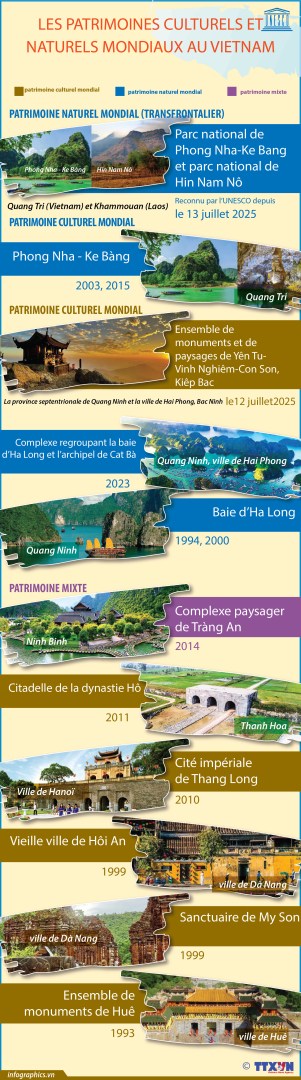
Đóng góp này cũng thể hiện cam kết, trách nhiệm của Việt Nam trong bảo vệ các Di sản thế giới không chỉ ở Việt Nam mà còn ở khu vực Đông Nam Á, gìn giữ cho hiện tại và trao truyền cho các thế hệ mai sau. Việt Nam, với tư cách là thành viên của Ủy ban Di sản Thế giới nhiệm kỳ 2023- 2027 cũng đang đóng góp tích cực hơn nữa cho việc thực thi Công ước Di sản Thế giới./.
Пагода Куиньлам, расположенная на территории исторического комплекса династии Чан (городок Донгчьеу, провинция Куангнинь), — одна из самых известных пагод Вьетнама. В прошлом она была важным буддийским центром школы дзэн-буддизма Чук Лам (Фото: ВИА)
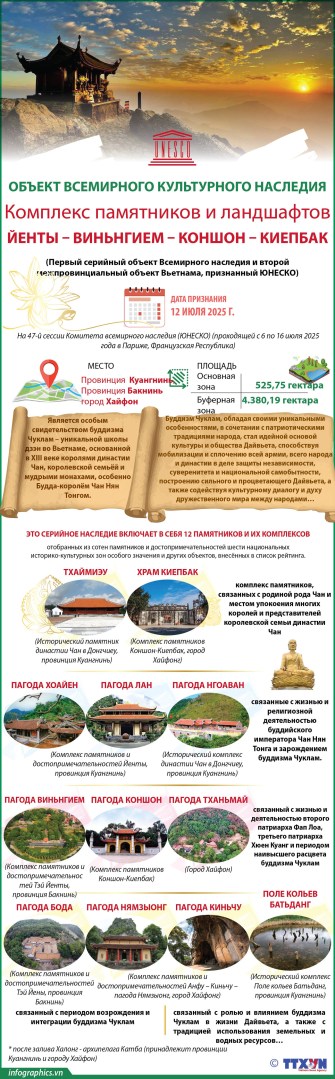
Комплекс памятников и достопримечательностей Йенты – Виньнгием, Коншон, Киепбак (расположенный на территории провинций Куангнинь, Бакнинь и города Хайфон) официально признан объектом Всемирного культурного наследия ЮНЕСКО 12 июля 2025 года.
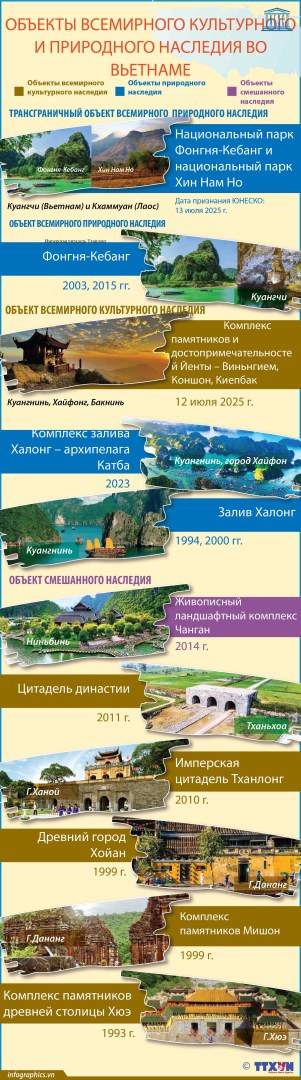
Это девятый объект Всемирного наследия во Вьетнаме, признанный ЮНЕСКО, и второй межпровинциальный объект Всемирного наследия в стране наряду с объектом “Бухта Халонг – архипелаг Катба” (на территории провинции Куангнинь и города Хайфон).
Согласно Департаменту культурного наследия, комплекс Йенты – Виньнгием, Коншон, Киепбак признан ЮНЕСКО объектом Всемирного культурного наследия по критериям (iii) и (vi), как свидетельство уникального взаимодействия государства, религии и народа в процессе формирования вьетнамской национальной самобытности; как священный ландшафт, сформированный в результате тесного и постоянного взаимодействия с природой; а также как этическая система, основанная на любви к миру, самосовершенствовании, терпимости, гуманизме и гармонии между человеком и природой.
12 июля 2025 года (по парижскому времени), на 47-й сессии Комитета всемирного наследия ЮНЕСКО, председатель сессии профессор Николай Ненов официально объявил о признании комплекса памятников и достопримечательностей Йенты, Виньнгием, Коншон, Киепбак объектом Всемирного культурного наследия (Фото: ВИА)
Критерий (iii) отражает гармоничное сочетание государства, религии и народных масс, зародившееся в горной местности Йенты, что создало уникальную культурную традицию с универсальным значением, сформировавшую национальную идентичность и способствовавшую установлению мира и безопасности в более широком регионе.
Подана заявка в ЮНЕСКО на признание комплекса памятников и ландшафтов Йенты объектом Всемирного наследия
Комплекс памятников Йенты – Виньнгием, Коншон, Киепбак является выдающимся свидетельством буддизма Чук Лам – уникального направления вьетнамского дзэн-буддизма, основанного в XIII веке династией Чан, королевской семьей и мудрыми монахами, особенно Будда-государом Чан Нян Тонгом – единственным известным азиатским правителем, который добровольно отказался от трона ради монашеской жизни и основал школу дзэн, пронизанную философией жизни и вьетнамским духом.
Интегрируя махаянский буддизм с конфуцианством, даосизмом и местными верованиями, школа Чук Лам заложила духовную основу государства Дайвьет, стала двигателем становления сильной, самостоятельной страны и способствовала культурному диалогу и укреплению мира между народами.
Комплекс памятников и достопримечательностей Йенты — Виньнгием, Коншон, Киепбак включает в себя систему пагод буддийской школы Чук Лам — уникальной вьетнамской традиции медитационного буддизма, основанной в XIII веке (Фото: ВИА)
На протяжении веков этот комплекс был важным центром практики, передачи, распространения и культурного творчества. Дух толерантности и созидания школы Чук Лам вдохновлял и нес гуманистические ценности как внутри страны, так и за её пределами.
Критерий (vi) подтверждает, что буддизм Чук Лам — это универсальное свидетельство того, как религиозное течение, возникшее из синтеза различных верований и родившееся на земле Йенты, смогло повлиять на светское общество, укрепить нацию и обеспечить региональный мир и сотрудничество.
Постоянное проведение ритуалов и праздников свидетельствует о устойчивой глобальной значимости гуманистической философии и буддийской школы Чук Лам. (Фото: Открытие весеннего фестиваля Йенты в комплексе памятников и достопримечательностей Йенты, город Уонгби, провинция Куангнинь, 7 февраля 2025 года)
Комплекс Йенты – Виньнгием, Коншон, Киепбак напрямую связан с возникновением и распространением креативных и гуманистических ценностей буддизма Чук Лам. Постоянные обряды, фестивали, проповеди и паломничества к этим святыням, как во Вьетнаме, так и в рамках международных организаций Чук Лам, являются доказательством устойчивой универсальности философии жизни, ценностей бытия, духа сообщества, гармонии с природой, любви к миру и сострадания.
Деревянные блоки с буддийскими писаниями в пагоде Виньнгием были признаны ЮНЕСКО объектом всемирного документального наследия (Фото: ВИА)
Комплекс полноценно отражает традиции буддизма Чук Лам – от его возникновения на священной горе Йенты, что подтверждается древними храмами и археологическими находками, до пагоды Виньнгием и комплекса Коншон – Киепбак; а также философские концепции, зафиксированные в надписях на камне, реликвиях и ритуальных практиках. Эти памятники обеспечивают всестороннее представление об исторических, духовных и географических аспектах дзэн-буддизма Чук Лам, демонстрируя процесс становления, развития и устойчивых связей между материальным, нематериальным и документальным наследием в историко-культурном пространстве.
Религиозный и духовно-культурный центр
Туристы посещают самый большой башенный сад во Вьетнаме в пагоде Бода, община Тьеншон, Вьетйен, Бакзянг (Фото: ВИА)
Комплекс Йенты – Виньнгием, Коншон, Киепбак включает в себя систему памятников, признанных памятниками национального значения (по решению Премьер-министра), таких как: комплекс Йенты, историческое место династии Чан в Донгчиэу, пагода Виньнгием, пагода Бода, историко-культурный комплекс Коншон – Киепбак, а также природно-исторические достопримечательности Анфу – Киньчу – Нямзыонг. Кроме того, сюда входят памятники, признанные Министерством культуры, спорта и туризма (например, пагода Тханьмай), а также реликвии, антикварные предметы, национальные сокровища, нематериальное культурное наследие и традиционные фестивали региона.
Весь ландшафт с системой гор и лесов, культурное пространство Йенты – Виньнгием, Коншон, Киепбак будет находиться под долговременной охраной, сохранением и развитием в соответствии с Законом о культурном наследии Вьетнама и Конвенцией ЮНЕСКО 1972 года об охране всемирного культурного и природного наследия.
Пагода Нгоаван — райское место для буддистов, место зарождения школы Чук Лам (Фото: ВИА)
Согласно Департаменту культурного наследия, Комплекс памятников и достопримечательностей Йенты – Виньнгием, Коншон, Киепбак, с буддизмом школы Чук Лам в качестве духовной основы, был основан в XIII веке вьетнамскими императорами династии Чан, особенно при важной роли Будда-государя Чан Нян Тонга. Буддизм Чук Лам создал множество культурных ценностей и внес значительный, устойчивый вклад в культурное и духовное наследие человечества. Возникший на священной горе Йенты, он представляет собой философскую систему и дух буддизма, основанный на терпимости и сострадании.
Идеи и культурные ценности буддизма Чук Лам полностью соответствуют основным целям ЮНЕСКО — сохранению и обогащению общечеловеческих ценностей, формированию культуры мира через просвещение; духу самодостаточности, гармоничному взаимодействию между человеком и природой, уважению к природным законам.
Комплекс памятников и достопримечательностей Йенты – Виньнгием, Коншон, Киепбак (Фото: ВИА)
Включение комплекса Йенты – Виньнгием, Коншон, Киепбак в Список всемирного наследия ЮНЕСКО является результатом последовательной реализации указаний руководства Партии и Государства, Генерального секретаря То Лама, Премьер-министра Фам Минь Тьиня, а также Вице-премьеров. Это достижение демонстрирует высокую решимость и усилия местных властей провинций Куангнинь, Хайфон, Бакнинь, особенно ведущую роль Народного комитета провинции Куангнинь, который с 2013 года начал процесс подготовки досье на включение в Предварительный список объектов всемирного наследия ЮНЕСКО, охватывающий памятники провинций Куангнинь и Бакзянг (ныне — провинция Бакнинь), а в 2020 году по решению Премьер-министра было добавлено и наследие провинции Хайзыонг (ныне — город Хайфон), чтобы обеспечить целостность объекта. Также был усилен процесс научных исследований и завершения досье для подачи на рассмотрение ЮНЕСКО.
Доцент, доктор Ле Тхи Тху Хиен — директор Департамента культурного наследия, постоянный член Национального совета по вопросам культурного наследия и руководитель группы вьетнамских экспертов в Комитете всемирного наследия
Доцент, доктор Ле Тхи Тху Хиен — директор Департамента культурного наследия, постоянный член Национального совета по культурному наследию, руководитель вьетнамской экспертной группы, участвующей в работе Комитета всемирного наследия. (Фото: ВИА)
Доцент, доктор Ле Тхи Тху Хиен — директор Департамента культурного наследия, постоянный член Национального совета по вопросам культурного наследия и руководитель группы вьетнамских экспертов в Комитете всемирного наследия — отметила: Включение комплекса Йенты – Виньнгием, Коншон, Киепбак в Список всемирного наследия ЮНЕСКО является результатом последовательной реализации указаний руководства Партии и Государства, Генерального секретаря То Лама, Премьер-министра Фам Минь Тьиня, а также Вице-премьеров.
Это достижение демонстрирует высокую решимость и усилия местных властей провинций Куангнинь, Хайфон, Бакнинь, особенно ведущую роль Народного комитета провинции Куангнинь, который с 2013 года начал процесс подготовки досье на включение в Предварительный список объектов всемирного наследия ЮНЕСКО, охватывающий памятники провинций Куангнинь и Бакзянг (ныне — провинция Бакнинь), а в 2020 году по решению Премьер-министра было добавлено и наследие провинции Хайзыонг (ныне — город Хайфон), чтобы обеспечить целостность объекта. Также был усилен процесс научных исследований и завершения досье для подачи на рассмотрение ЮНЕСКО.
Делегация послов, глав представительств и членов дипломатического корпуса, международных организаций во Вьетнаме и Бюро ЮНЕСКО в Ханое посетила особый национальный памятник Коншон-Киепбак в Хайзыонге (ныне Хайфон), 16 мая 2025 года (Фото: ВИА)
Важную роль в успехе досье сыграли Национальная комиссия ЮНЕСКО Вьетнама и Постоянное представительство Вьетнама при ЮНЕСКО в Париже, которые координировали информационную работу, оперативно взаимодействовали с профильными структурами ЮНЕСКО, ИКОМОС, Комитетом всемирного наследия и международными экспертами. Благодаря десяткам рабочих встреч и контактов с главами делегаций, послами и экспертами 20 государств — членов Комитета всемирного наследия, а также директором Центра всемирного наследия и представителями ИКОМОС, были разъяснены ключевые аспекты и глобальная ценность объекта, подтверждена приверженность Вьетнама выполнению всех рекомендаций ИКОМОС по вопросам сохранения наследия. Особый вклад был также обеспечен представительством ЮНЕСКО во Вьетнаме, международными специалистами, и ИКОМОС, оказавшими активную экспертную поддержку в доработке досье, пояснениях и реализации рекомендаций.
Заместитель министра Ха Ким Нгок, председатель Национальной комиссии Вьетнама по делам ЮНЕСКО, выступает на открытии 219-й сессии Исполнительного совета ЮНЕСКО, Париж, 18 марта 2024 года.
Заместитель министра Ха Ким Нгок, председатель Национальной комиссии Вьетнама по делам ЮНЕСКО, работал с директором Департамента по консультированию и надзору за Конвенцией всемирного наследия ИКОМОС Региной Дуригелло в кулуарах 219-й сессии Исполнительного совета ЮНЕСКО.
Заместитель министра Ха Ким Нгок, председатель Национальной комиссии Вьетнама по делам ЮНЕСКО, общается с директором Центра всемирного наследия Лазара Ассомо в рамках 219-й сессии Исполнительного совета ЮНЕСКО.
Особо стоит отметить, что Премьер-министр Вьетнама Фам Минь Тьинь направил письмо Генеральному директору ЮНЕСКО и 20 странам-членам Комитета всемирного наследия с просьбой поддержать номинационное досье комплекса Йенты – Виньнгием, Коншон, Киепбак, что стало мощным подтверждением обязательств Вьетнама по управлению и охране объектов всемирного наследия.
Это обращение было высоко оценено международным сообществом, и на основании этого сессия Комитета единогласно одобрила включение комплекса в Список всемирного наследия.
Признанные ЮНЕСКО объекты всемирного наследия во Вьетнаме вносят значительный вклад в социально-экономическое развитие местных сообществ, способствуют охране окружающей среды, устойчивому и “зелёному” росту, а также популяризируют культуру, страну и народ Вьетнама на международной арене, обогащая сокровищницу мировой культуры.
Вьетнам, являясь членом Комитета Всемирного наследия на срок 2023–2027 годов, вносит всё более активный вклад в реализацию Конвенции о Всемирном наследии. На фото: Вьетнам был избран членом Комитета Всемирного наследия на срок 2023–2027 годов, набрав 121 голос — наибольшее количество среди стран Азиатско-Тихоокеанского региона — на 24-й сессии Генеральной ассамблеи государств – участников Конвенции об охране всемирного культурного и природного наследия, проходившей в Париже 22 ноября 2023 года (Фото: ВИА)
Этот вклад также подтверждает приверженность и ответственность Вьетнама в деле охраны объектов всемирного наследия не только внутри страны, но и в регионе Юго-Восточной Азии — ради настоящего и будущих поколений. Вьетнам, как член Комитета всемирного наследия на период 2023–2027 годов, продолжает активно участвовать в реализации Конвенции о всемирном наследии./.
Пагода Нгоаван – важная реликвия, расположенная на священной земле буддизма Чук Лам Йенты (Фото: ВИА)
Le Vietnam continue de réaffirmer un engagement fort et constant en matière de conservation de la biodiversité, non seulement à l’échelle nationale, mais également en contribuant activement aux efforts collectifs de la communauté internationale.
Des cigognes s’envolent sur une rizière dorée de Ninh Binh. Photo : VNA
En tant que l’un des pays les plus riches en biodiversité au monde, le Vietnam mesure pleinement l’importance de la protection de ce patrimoine naturel précieux.
Doté d’une grande diversité d’écosystèmes – allant des forêts montagneuses aux plaines et aux zones maritimes –, le pays abrite des dizaines de milliers d’espèces, dont un grand nombre sont endémiques et rares. Ce trésor biologique ne constitue pas seulement une valeur environnementale et économique, mais aussi un socle culturel et social unique pour la nation.
De gauche à droite : la lagune de Van Long, dans la commune de Gia Vien (Ninh Binh) est la plus grande réserve naturelle de zones humides du delta du fleuve Rouge ; langur à pattes noires dans le parc national de Nui Chua, province de Ninh Thuan ; tortue imbriquée observé dans les eaux de Con Dao. Photo : VNA
Au fil des années, le gouvernement vietnamien a promulgué de nombreux textes juridiques essentiels, établissant un cadre légal solide pour la conservation de la biodiversité. On peut citer la Loi sur la Biodiversité, ainsi que diverses stratégies et plans nationaux en matière de préservation et de gestion des ressources naturelles.
Les réserves naturelles et parcs nationaux ont été créés et étendus, contribuant à la protection des écosystèmes clés et des espèces menacées. Parallèlement, des projets de restauration forestière, de protection des récifs coralliens, ainsi que des programmes de reproduction et de sauvegarde des espèces sauvages en danger sont activement mis en œuvre.
Trois pangolins de Java relâchés dans la nature au Parc national de Bu Gia Map, le 15 février 2024. Photo : VNA
Le Vietnam se classe actuellement au 16e rang mondial en termes de biodiversité, avec plus de 62 600 espèces recensées, dont des centaines sont endémiques, c’est-à-dire qu’elles ne se trouvent nulle part ailleurs sur la planète.
Le Vietnam est également un membre actif de nombreuses conventions et accords internationaux majeurs en matière de biodiversité, tels que la Convention sur la diversité biologique (CDB) ou encore la Convention CITES sur le commerce international des espèces de faune et de flore sauvages menacées d’extinction.
Le Vietnam s’efforce d’atteindre les objectifs mondiaux de conservation de la biodiversité en coopérant avec d’autres pays. Sur la photo : Séminaire « Promouvoir le développement économique de la biodiversité au Vietnam » organisé le 7 novembre 2024, à Hanoï. Photo : VNA
Son engagement dans ces instruments juridiques traduit la responsabilité assumée par le Vietnam face aux défis transfrontaliers et son volontarisme à coopérer avec d’autres pays pour atteindre les objectifs mondiaux de conservation. Sur les tribunes internationales, le Vietnam fait entendre une voix forte, partage ses expériences et appelle à une coopération accrue dans ce domaine vital. Cependant, la préservation de la biodiversité au Vietnam reste confrontée à de nombreux défis. Les pressions exercées par le développement économique, l’urbanisation rapide, la pollution, le changement climatique et le braconnage illégal continuent d’entraver les efforts de conservation.
Le Vietnam applique la science et la technologie à la conservation de la biodiversité. Sur la photo : Des pièges photographiques dans la réserve naturelle de Pu Huong servent à l’étude de la biodiversité. Photo : VNA
Conscient de cette réalité, le Vietnam déploie des approches globales, allant du renforcement de l’application des lois, de l’intégration des technologies scientifiques, à l’amélioration des capacités du personnel et au développement de campagnes d’information et d’éducation afin de sensibiliser la population.
Dans le contexte actuel, où la communauté internationale s’emploie à atteindre les objectifs mondiaux de conservation et de développement durable, l’engagement du Vietnam prend une importance cruciale.
Animaux sauvages sauvés au Parc national d’U Minh Thuong, Kien Giang. Photo : VNA
Il ne s’agit pas seulement de la responsabilité d’un pays possédant une richesse naturelle exceptionnelle, mais aussi d’une contribution concrète aux efforts communs de l’humanité pour protéger notre planète bleue au profit des générations futures.
La forêt primitive de Loi Chua, dans le village de Dong Thanh, commune de Bo Trach, abrite de nombreux arbres anciens précieux. Photo : VNA
Pourtant, cette richesse naturelle est aujourd’hui gravement menacée. La déforestation, la dégradation des habitats, le changement climatique et l’introduction d’espèces exotiques envahissantes sont autant de facteurs dévastateurs altérant profondément les écosystèmes – des forêts primaires aux récifs coralliens côtiers.
Une tortue-boîte carénée (Cuoramouhotii) observée dans la Réserve naturelle de Xuan Lien, province de Thanh Hoa. Photo: VNA
De nombreuses espèces précieuses telles que le langur à nez retroussé, le saola ou encore la tortue-boîte vietnamienne sont aujourd’hui au bord de l’extinction. Les récifs coralliens du Centre-Sud du Vietnam – surnommés les « forêts tropicales sous-marines » – ne comptent plus que 1 % de zones en bon état en raison du blanchissement massif et des effets d’un tourisme non maîtrisé, alors qu’ils étaient autrefois une fierté nationale.
Le vice-ministre de l’Agriculture et de l’Environnement, Nguyên Quôc Tri. Photo: VGP
Le vice-ministre de l’Agriculture et de l’Environnement, Nguyên Quôc Tri, a estimé qu’il est temps d’agir avec rapidité, détermination et responsabilité.
Il a lancé un appel aux ministères, autorités locales et à l’ensemble de la société pour mettre en œuvre des mesures concrètes, telles que l’élaboration de politiques intégrant la conservation à la croissance économique, le renforcement de l’application des technologies scientifiques et numériques pour la surveillance des ressources biologiques, la mobilisation de financements verts et la diversification des formes d’investissement pour la conservation, ainsi que l’intensification de la communication et de l’éducation, en particulier à destination des jeunes, sur le rôle vital de la biodiversité.
Avec plus de 6 000 variétés de riz, environ 800 espèces végétales cultivées et près de 900 races animales, le Vietnam se distingue non seulement par sa richesse quantitative, mais aussi par la diversité de ses ressources génétiques rares, qui jouent un rôle stratégique dans la sécurité biologique et agricole mondiale.
La Réserve de biosphère de Nui Chua est reconnue par l’UNESCO comme Réserve mondiale de biosphère. Photo : VNA
L’un des points forts des efforts de conservation actuels est le réseau de réserves de biosphère du Vietnam, dont 11 sites sont reconnus par l’UNESCO. Ces espaces représentent des modèles exemplaires de synergie entre préservation de la nature et développement socio-économique durable.
Espèces d’oiseaux dans la Réserve naturelle de la zone humide de Van Long, commune de Gia Vien, à Ninh Binh. Photo : VNA
Les programmes de coopération internationale, comme ceux menés avec le PNUD et la GIZ à Ninh Binh, ont déjà produit des résultats significatifs : restauration de plus de 4 000 hectares de forêts, protection de 62 000 hectares d’espaces à haute valeur écologique, et augmentation des revenus de milliers de foyers grâce à des modèles de moyens de subsistance écologiques.
Le Vietnam s’est fixé l’objectif ambitieux d’empêcher toute extinction d’espèce sauvage causée par l’activité humaine. Sur la photo: les autorités effectuent des inspections régulières et des opérations de démantèlement de pièges deux fois par semaine dans la réserve naturelle de Son Tra. Photo : VNA
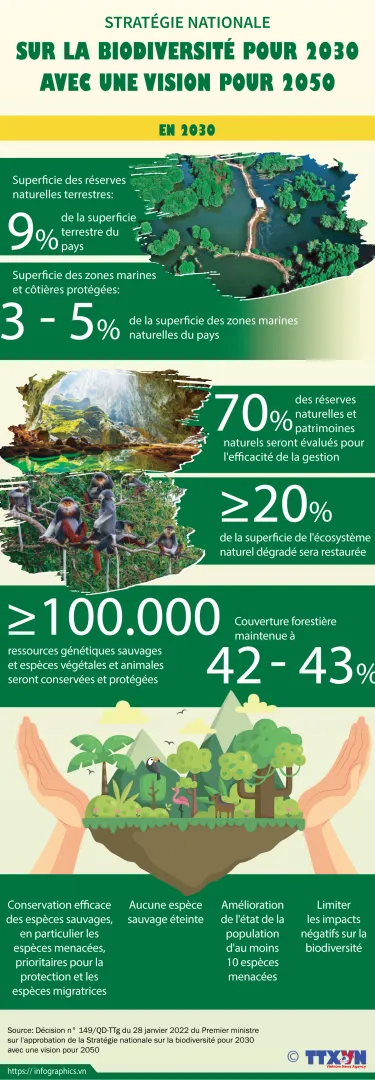
Pour concrétiser la Stratégie nationale sur la biodiversité à l’horizon 2030, avec une vision à 2050, le Vietnam s’est fixé des objectifs ambitieux : étendre les aires protégées à au moins 9 % de la superficie terrestre et 5 % de la zone maritime, restaurer au moins 20 % des écosystèmes dégradés, empêcher toute extinction d’espèce sauvage causée par l’activité humaine, et préserver et conserver au minimum 100 000 ressources génétiques animales et végétales.
Il ne s’agit pas seulement d’un engagement sur le papier, mais bien d’un devoir moral et d’une responsabilité globale.
Qu’il s’agisse de grandes politiques ou de gestes du quotidien – comme adopter une consommation durable, réduire les déchets plastiques, ne pas acheter d’animaux sauvages – chaque action compte dans la mission cruciale de protection de la planète et de transmission des valeurs de vie essentielles aux générations futures./.
Sur la photo : des gardes forestiers du Parc national de Cuc Phuong (Ninh Binh) lors d’une patrouille dans une zone sous-forestières à haut risque d’empiètement. Photo : VNA
La pagode Quynh Lâm, située dans le site historique de la dynastie Trân (province de Quang Ninh), est l’un des temples bouddhistes les plus renommés du Vietnam. Autrefois, elle fut un centre majeur du bouddhisme de la secte zen Truc Lâm. Photo : Thành Dat – VNA
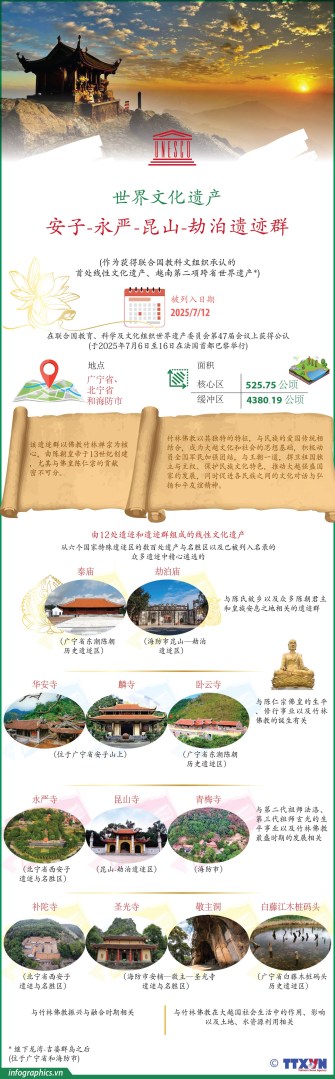
L’ensemble de monuments et de paysages de Yen Tu-Vinh Nghiem-Con Son, Kiep Bac (situé dans les provinces de Quang Ninh, Bac Ninh et la ville de Hai Phong) a officiellement été inscrit au patrimoine culturel mondial par l’UNESCO le 12 juillet 2025.
Il s’agit du neuvième site vietnamien inscrit au patrimoine mondial de l’UNESCO, et du deuxième site interprovincial du pays, après la baie d’Ha Long – l’archipel de Cat Ba (Quang Ninh et Hai Phong).
Selon le Département du patrimoine culturel, le complexe Yen Tu-Vinh Nghiem-Con Son, Kiep Bac a été reconnu au titre des critères (iii) et (vi).
Le 12 juillet 2025 (heure de Paris), lors de la 47e session du Comité du patrimoine mondial de l’Organisation des Nations unies pour l’éducation, la science et la culture (UNESCO), le Professeur bulgare Nikolay Nenov, président de la session, a frappé le marteau pour proclamer l’inscription du complexe de monuments et de sites paysagers Yên Tu – Vinh Nghiêm – Côn Son – Kiêp Bac sur la Liste du patrimoine culturel mondial.Photo : VNA
Pour le critère (iii), le complexe témoigne d’une harmonie remarquable entre l’État, les croyances religieuses et la communauté. Cette singularité a engendré une tradition culturelle d’importance universelle, qui a profondément marqué l’identité nationale et contribué à la paix et à la sécurité dans une large zone.
Soumission à l’UNESCO du dossier de l’ensemble de monuments et de paysages Yên Tu pour inscription au patrimoine mondial de l’UNESCO. Photo: VNA
Le complexe illustre de manière exemplaire le bouddhisme Truc Lam, une tradition zen typiquement vietnamienne. Fondée au XIIIe siècle par des rois Tran, la cour royale et des moines érudits, notamment le roi-bouddha Tran Nhan Tong – qui abdiqua pour devenir moine et fut le fondateur de cette école zen – elle est imprégnée d’une philosophie humaniste et de l’âme vietnamienne. En intégrant le bouddhisme Mahayana, le confucianisme, le taoïsme et les croyances populaires, le bouddhisme Truc Lam a formé le socle spirituel du Dai Viet, stimulant l’essor d’un État autonome et résilient, tout en encourageant le dialogue culturel, l’amitié et l’amour de la paix entre les peuples.En intégrant le bouddhisme Mahayana, le confucianisme, le taoïsme et les croyances populaires, le bouddhisme Truc Lam a formé le socle spirituel du Dai Viet, stimulant l’essor d’un État autonome et résilient, tout en encourageant le dialogue culturel, l’amitié et l’amour de la paix entre les peuples.
L’ensemble de monuments et de paysagers de Yên Tu – Vinh Nghiêm – Côn Sơn – Kiêp Bac regroupe des pagodes représentatives du bouddhisme Truc Lâm, une école zen originale fondée au XIIIe siècle au Vietnam. Photo : VNA
Depuis des siècles, cet ensemble de monuments et de paysages reste un centre vivant de pratique, de transmission et de création culturelles. L’esprit de tolérance et d’innovation du bouddhisme Truc Lam continue d’inspirer des valeurs humaines tant au niveau national qu’international.
Quant au critère (vi), le bouddhisme Truc Lam est un exemple d’importance mondiale de la manière dont une religion, issue de nombreuses croyances, originaire et se développant à Yen Tu, a influencé la société laïque pour promouvoir une nation puissante, la paix et la coopération régionale.
L’organisation régulière de rituels et de fêtes témoigne de la portée universelle et durable de la philosophie humaniste du zen Truc Lâm. Sur la photo : le Festival printalier de Yên Tu (à Uông Bi, province de Quang Ninh), 7 février 2025.
Le complexe est directement lié à la naissance et à la diffusion des valeurs créatives et humanistes du bouddhisme Truc Lam. La tenue régulière de cérémonies, de festivals, d’enseignements bouddhiques et de pèlerinages à des sites – tant au Vietnam que dans les communautés Truc Lam à l’étranger, témoigne de la pertinence mondiale durable de sa philosophie de vie, ses valeurs sociales, son harmonie avec la nature et son amour de la paix et de l’humanité.
Les tablettes de bois utilisées pour imprimer les sutras de la secte bouddhique Truc Lâm de la pagode de Vinh Nghiêm, reconnues par l’UNESCO en tant que patrimoine documentaire de l’humanité. Photo : VNA
Le complexe reflète pleinement les traditions du bouddhisme Truc Lam, depuis sa fondation dans les montagnes sacrées de Yen Tu, comme en témoignent les temples anciens et les vestiges archéologiques. Ces traditions s’expriment également à travers les vestiges de la pagode de Vinh Nghiem et sur le site Con Son – Kiep Bac, ainsi que par la codification de ses principes philosophiques dans les stèles, objets sacrés et rituels. Ces monuments offrent une représentation complète des dimensions historiques, spirituelles et géographiques du bouddhisme Truc Lam, mettant clairement en évidence l’évolution et l’interaction durable entre le patrimoine matériel, immatériel et documentaire au sein d’un espace historique et culturel cohérent.
Centre religieux, culturel et spirituel
Des visiteurs découvrent le plus grand jardin de stûpas du Vietnam à la pagode Bô Dà, dans la province de Bac Giang. Photo : Dông Thuy – VNA
Le complexe comprend plusieurs monuments nationaux spéciaux tels que : le site de Yen Tu, le site historique de la dynastie Tran à Dong Trieu, les pagodes Vinh Nghiem, Bo Da, le site Con Son – Kiep Bac, les sites historiques et paysagers An Phu – Kinh Chu – Nham Duong. Il englobe aussi des artefacts, trésors nationaux, patrimoines immatériels, festivals traditionnels et le paysage naturel de montagnes et forêts…
La pagode Ngoa Vân, lieu sacré d’illumination bouddhique et berceau de l’école Truc Lâm. Photo : VNA
L’ensemble sera protégé durablement conformément à la Loi vietnamienne sur le patrimoine culturel et à la Convention pour la protection du patrimoine mondial, culturel et naturel de 1972.
Centré autour de la chaîne de montagnes de Yen Tu, le complexe fut le lieu de résidence de la dynastie Tran aux XIIIe et XIVe siècles et le berceau du bouddhisme Truc Lam, une tradition zen vietnamienne qui a joué un rôle clé dans la formation du royaume de Dai Viet. Selon le Département du patrimoine culturel, le cœur de ce complexe réside dans les enseignements durables du bouddhisme Truc Lam. Les valeurs culturelles et spirituelles de Truc Lam s’alignent parfaitement avec les objectifs fondamentaux de l’UNESCO : éducation, culture de la paix, autonomie, harmonie entre l’homme et la nature, respect des lois naturelles.
L’ensemble de monuments et de paysagers de Yên Tu – Vinh Nghiêm – Côn Son – Kiêp Bac. Photo : VNA
Cette reconnaissance est le fruit des efforts des dirigeants du Parti et de l’Etat, des localités concernées, des organes compétents, ainsi que du soutien d’organisations et spécialistes étrangers.
La professeure associée et docteur Le Thi Thu Hien, directrice du Département du patrimoine culturel, membre du Conseil national du patrimoine culturel
La professeure associée et docteure Lê Thi Thu Hiên, directrice du Département du patrimoine culturel, membre permanente du Conseil national du patrimoine culturel. Photo: VNA
La professeure associée et docteur Le Thi Thu Hien, directrice du Département du patrimoine culturel, membre du Conseil national du patrimoine culturel, a souligné que cette reconnaissance est le fruit des efforts des dirigeants du Parti et de l’Etat, des localités concernées, des organes compétents, ainsi que du soutien d’organisations et spécialistes étrangers.
Elle a notamment souligné le rôle important du Comité populaire de la province de Quang Ninh depuis 2013 dans la recherche et l’inscription de sites historiques de Quang Ninh et Bac Ninh (anciennement Bac Giang) sur la Liste indicative de l’UNESCO.
Une délégation composée d’ambassadeurs, de chefs de missions diplomatiques, d’organisations internationales et du bureau de l’UNESCO à Hanoï en visite au site national exceptionnelCôn Son – Kiêp Bac, dans l’ancienne province de Hai Duong (aujourd’hui la ville de Hai Phong), le 16 mai 2025. Photo : VNA
En 2020, le Premier ministre a demandé l’ajout de sites à Hai Phong (anciennement Hai Duong) afin d’assurer l’intégrité du patrimoine. Cela témoigne de l’attention particulière et des efforts constants du gouvernement vietnamien depuis plus de dix ans pour étudier et protéger le patrimoine, menant au succès actuel.
Le vice-ministre Hà Kim Ngoc, président de la Commission nationale vietnamienne pour l’UNESCO, prend la parole lors de la session inaugurale de la 219e réunion du Conseil exécutif de l’UNESCO, Paris, 18 mars 2024. Photo : VNA
Le vice-ministre Hà Kim Ngoc s’entretient avec Regina Durighello, directrice de l’Unité de conseil et de suivi de la Convention du patrimoine mondial (ICOMOS), en marge de la 219e session du Conseil exécutif de l’UNESCO. Photo : VNA
Le vice-ministre Hà Kim Ngoc et Lazare Assomo, directeur du Centre du patrimoine mondial de l’UNESCO, en marge de la 219e session du Conseil exécutif de l’UNESCO. Photo : VNA
Ce succès résulte d’une coopération étroite entre les autorités locales, le ministère de la Culture, des Sports et du Tourisme, le ministère des Affaires étrangères, le Conseil national du patrimoine culturel et les experts du Comité du patrimoine mondial du Vietnam. Un rôle clé revient à la Commission nationale vietnamienne pour l’UNESCO et à la Délégation permanente du Vietnam auprès de l’UNESCO (Paris), qui ont efficacement coordonné avec les organes spécialisés de l’UNESCO, l’ICOMOS (organisation internationale non-gouvernementale qui œuvre pour la conservation des monuments et des sites dans le monde ), et des experts internationaux, organisant de nombreuses réunions pour clarifier la valeur du patrimoine et mettre en œuvre les recommandations de conservation.
Les patrimoines mondiaux reconnus par l’UNESCO au Vietnam contribuent activement au développement socio-économique local. Photo : VNA
Le Premier ministre Pham Minh Chinh a adressé une lettre à la Directrice générale de l’UNESCO et aux 20 États membres du Comité du patrimoine mondial pour solliciter le soutien en faveur de la candidature du complexe, affirmant l’engagement fort du Vietnam à protéger ce patrimoine. Grâce à cela, le dossier a été unanimement approuvé et inscrit sur la Liste du patrimoine mondial.
En tant que membre du Comité du patrimoine mondial pour le mandat 2023-2027, le Vietnam renforce sa participation à la mise en œuvre de la Convention du patrimoine mondial. Sur la photo : Le Vietnam est élu membre du Comité du patrimoine mondial pour le mandat 2023-2027 avec 121 voix, le score le plus élevé parmi les pays d’Asie-Pacifique, lors de la 24e Assemblée générale des États parties à la Convention du patrimoine mondial, Paris, le 22 novembre 2023. Photo : VNA
Les patrimoines mondiaux au Vietnam contribuent non seulement au développement socio-économique, à la protection de l’environnement et à une croissance durable, mais aussi à la promotion de la culture vietnamienne à l’international. En tant que membre du Comité du patrimoine mondial pour le mandat 2023-2027, le Vietnam participe activement à la mise en œuvre de la Convention du patrimoine mondial, protégeant et préservant le patrimoine pour les générations futures.-VNA
Am– pagode Ngoa Vân, un site spirituel majeur du bouddhisme Truc Lâm dans la région sacrée de Yên Tu. Photo : Tuân Anh/VNA
Quynh Lam Pagoda, part of the Tran Dynasty historical site complex in Quang Ninh province, is one of Vietnam’s famous pagodas. In the past, it was an important Buddhist centre of the Truc Lam Zen sect. (Photo: VNA)
The Yen Tu – Vinh Nghiem – Con Son – Kiep Bac Complex of Monuments and Landscapes, spanning Quang Ninh and Bac Ninh provinces and Hai Phong city, has been officially inscribed on UNESCO’s World Cultural Heritage list.
This marks Vietnam’s ninth world heritage site and its second trans-provincial world heritage site, alongside Ha Long Bay – Cat Ba Archipelago in Quang Ninh province and Hai Phong city.
The Department of Cultural Heritage under the Ministry of Culture, Sports and Tourism called the UNESCO recognition under criteria (iii) and (vi) a testament to the unique combination of state, religion, and people in shaping Vietnam’s national identity. It also includes the sacred landscape formed through close interaction with nature and an ethical system rooted in the love of peace, self-improvement, tolerance, compassion, and harmony between humanity and the natural world.
On July 12, 2025 (Paris time), at the 47th session of the UNESCO World Heritage Committee, Professor Nikolay Nenov, Chair of the session, officially struck the gavel recognising the Yen Tu – Vinh Nghiem – Con Son – Kiep Bac Complex of Monuments and Landscapes as a world cultural heritage site. (Photo: VNA)
UNESCO’s criterion (iii) recognises sites that “bear a unique or at least exceptional testimony to a cultural tradition or to a civilisation which is living or which has disappeared,” while criterion (vi) applies to those “directly or tangibly associated with events or living traditions, with ideas, or with beliefs, with artistic and literary works of outstanding universal significance.”
Under criterion (iii), the site exemplifies a harmonious integration of the state, religion, and community – rooted in the mountainous homeland of Yen Tu – that gave rise to a globally significant cultural tradition. This tradition helped define Vietnamese identity and promote peace and security in the broader region.
A statue in the Yen Tu complex of monuments and scenic landscapes
The site also stands as a distinctive testament to Truc Lam Buddhism, a unique Zen tradition of Vietnam founded in the 13th century by the Tran kings, royal family members, and enlightened monks, most notably King-Monk Tran Nhan Tong. He was the only known monarch in Asia to have renounced the throne to pursue monastic life, founding a Zen school deeply rooted in humanistic philosophy and imbued with Vietnamese character.
By integrating Mahayana Buddhism with Confucianism, Taoism, and indigenous beliefs, Truc Lam Buddhism helped shape the spiritual foundation of Dai Viet (a former name of Vietnam), fuelling the rise of a self-reliant and resilient nation, while also fostering cultural dialogue and a spirit of peace and friendship among peoples.
The Yen Tu – Vinh Nghiem – Con Son – Kiep Bac Complex of Monuments and Landscapes includes a system of pagodas belonging to the Truc Lam Buddhism, a unique Vietnamese Zen sect founded in the 13th century. (Photo: VNA)
For centuries, the Yen Tu – Vinh Nghiem – Con Son – Kiep Bac complex has played a vital role in the practice, transmission, and dissemination of cultural values. The tolerant and creative spirit of Truc Lam Buddhism has inspired humanistic values both within Vietnam and globally.
Under criterion (vi), Truc Lam Buddhism is recognised as a globally significant example of how a religion – rooted in multiple belief systems and originating from the sacred homeland of Yen Tu – has shaped secular society, contributed to the rise of a nation, and fostered regional peace and cooperation.
The continuous organisation of rituals and festivals proves the sustainable global relevance of the philosophy of life and the Truc Lam Buddhist Zen sect. (Photo: The Yen Tu Spring Festival opening ceremony at the Yen Tu relic site in Quang Ninh province on February 7, 2025)
The continuous hosting of rituals, festivals, and pilgrimages – both domestically and through international Truc Lam Buddhist organisations – demonstrates the enduring global relevance of its humanistic philosophy, communal spirit, love of peace, and respect for nature.
The Buddhist woodblocks at Vinh Nghiem Pagoda were recognised as world documentary heritage by UNESCO. (Photo: VNA)
The complex is closely associated with the origins and dissemination of the creative and humanistic values of Truc Lam Buddhism. The continuous organisation of rituals, festivals, Buddha Dharma propagation activities, and pilgrimages to the heritage sites – both within Vietnam and by international Truc Lam Buddhist communities – attests to the enduring global relevance of its humanistic philosophy, values of life, communal spirit, harmony with nature, love of peace, and compassion.
The Yen Tu – Vinh Nghiem – Con Son – Kiep Bac Complex fully embodies the Truc Lam Buddhist tradition, from its founding on the sacred Yen Tu Mountain – evidenced by ancient temples and archaeological remains – to key sites such as Vinh Nghiem Pagoda and the Con Son – Kiep Bac Relic Area. The systematisation of its philosophies is reflected in ancient inscriptions, related artefacts, and ritual practices. These heritage sites offer a comprehensive representation of the historical, spiritual, and geographical dimensions of Truc Lam Zen Buddhism, highlighting the formation, development, and enduring connection between tangible and intangible cultural values and documentary heritage in historical and cultural landscape.
A SPIRITUAL AND CULTURAL CENTRE
Tourists visit the largest stupa garden in Vietnam at Bo Da Pagoda in Bac Ninh province. (Photo: VNA)
The Yen Tu – Vinh Nghiem – Con Son – Kiep Bac Complex comprises a network of specially designated national relics – recognised by the Prime Minister – including the Yen Tu Relic and Scenic Complex, the Tran Dynasty relics in Dong Trieu, Vinh Nghiem Pagoda, Bo Da Pagoda, the Con Son – Kiep Bac relic site, and the An Phu – Kinh Chu – Nham Duong historical and scenic site.
Additionally, it includes nationally recognised sites such as Thanh Mai Pagoda, national treasures, intangible cultural heritage elements, and traditional festivals, all set within the forested mountainous terrain and cultural landscape spanning Yen Tu, Vinh Nghiem, Con Son and Kiep Bac.
These assets will be protected and promoted following Vietnam’s Cultural Heritage Law and the 1972 UNESCO World Heritage Convention.
Ngoa Van Pagoda, where the Truc Lam Zen sect originated in. (Photo: VNA)
According to the Department of Cultural Heritage, the complex – with Truc Lam Buddhism at its core, founded during the 13th century by the Tran Kings, especially King-Monk Tran Nhan Tong – represents enduring creative and spiritual contributions to the cultural heritage of humanity. Originating from the sacred terrain of Yen Tu Mountain, Truc Lam Buddhism embodies a philosophy of tolerance, aligning closely with UNESCO’s goals of promoting education, a culture of peace, and harmony between humanity and the natural world.
Illustrative photos: The Yen Tu – Vinh Nghiem – Con Son – Kiep Bac Complex of Monuments and Landscapes. (Photo: VNA)
The inscription of the Yen Tu – Vinh Nghiem – Con Son – Kiep Bac Complex on UNESCO’s World Cultural Heritage list as the result of consistent efforts and guidance from the country’s leaders, including Party General Secretary To Lam, Prime Minister Pham Minh Chinh, and Deputy Prime Ministers.
ASSOCIATE PROFESSOR DR LE THI THU HIEN, DIRECTOR OF THE DEPARTMENT OF CULTURAL HERITAGE, STANDING MEMBER OF THE NATIONAL CULTURAL HERITAGE COUNCIL AND HEAD OF THE VIETNAMESE EXPERT GROUP PARTICIPATING IN THE WORLD HERITAGE COMMITTEE
Associate Professor Dr Le Thi Thu Hien, Director of the Cultural Heritage Department, standing member of the National Cultural Heritage Council and head of the Vietnamese experts’ group participating in the World Heritage Committee (Photo: VNA)
Associate Professor Dr Le Thi Thu Hien, Director of the Department of Cultural Heritage, Standing Member of the National Cultural Heritage Council and head of the Vietnamese expert group participating in the World Heritage Committee, described the inscription of the Yen Tu – Vinh Nghiem – Con Son – Kiep Bac Complex on UNESCO’s World Cultural Heritage list as the result of consistent efforts and guidance from the country’s leaders, including Party General Secretary To Lam, Prime Minister Pham Minh Chinh, and Deputy Prime Ministers.
The nomination process, initiated in 2013 under the leadership of Quang Ninh province with support from former Bac Giang province (now Bac Ninh province), was expanded in 2020 to include former Hai Duong province (now Hai Phong city) to ensure the heritage site’s integrity. The process involved years of thorough research and careful preparation of the nomination dossier.
A delegation of ambassadors, heads of representative offices, members of diplomatic corps and international organisations in Vietnam, and the UNESCO Hanoi Office visit the special national relic site of Con Son – Kiep Bac in Hai Duong province (now Hai Phong city) on May 16, 2025. (Photo: VNA)
The successful inscription owes much to the strong support of the Vietnam National Commission for UNESCO, the Permanent Delegation of Vietnam to UNESCO in Paris, and expert input from UNESCO, the International Council on Monuments and Sites (ICOMOS), and the World Heritage Committee.
Deputy Minister of Foreign Affairs Ha Kim Ngoc, Chairman of the Vietnam National Commission for UNESCO, speaks at the opening session of the 219th meeting of the UNESCO Executive Board in Paris on March 18, 2024. (Photo: VNA)
Deputy Minister of Foreign Affairs Ha Kim Ngoc, Chairman of the Vietnam National Commission for UNESCO, meets with Regina Durighello, Director of the Advisory and Monitoring Unit for the World Heritage Convention at ICOMOS, on the sidelines of the 219th meeting of the UNESCO Executive Board. (Photo: VNA)
Deputy Minister of Foreign Affairs Ha Kim Ngoc, Chairman of the Vietnam National Commission for UNESCO, meets with Lazare Assomo, Director of the World Heritage Centre, on the sidelines of the 219th meeting of the UNESCO Executive Board. (Photo: VNA)
Prime Minister Pham Minh Chinh also sent a letter to the UNESCO Director-General and the 20 Committee member states, calling for support for the nomination and underscoring Vietnam’s strong commitment to heritage management and conservation. The application received unanimous approval from all committee members.
UNESCO-recognised World Heritage sites in Vietnam continue to play a pivotal role in supporting local socio-economic development, environmental protection, and sustainable growth. They also help to promote Vietnamese culture and national identity on the global stage, enriching the shared heritage of humanity.
The world heritage sites recognised by UNESCO have contributed considerably to the socio-economic development of localities. (Photo: VNA)
Vietnamese representatives conducted dozens of consultations with ambassadors, experts, and heads of delegation from the 20 World Heritage Committee member countries to clarify the site’s outstanding universal value and reaffirm Vietnam’s commitment to fulfilling ICOMOS recommendations for heritage preservation.
Vietnam, as a member of the World Heritage Committee for the 2023-2027 term, has been actively contributing to the implementation of the World Heritage Convention. In the photo: Vietnam elected as a member of the World Heritage Committee for 2023-2027 with 121 votes in favour, the highest in the Asia-Pacific group, at the 24th session of the General Assembly of States Parties to the World Heritage Convention in Paris on November 22, 2023. (Photo: VNA)
This success was due in no small part to the special support of the UNESCO Office in Vietnam, along with international experts and ICOMOS, who provided valuable technical assistance in completing the nomination dossier, offering clarifications, and effectively implementing ICOMOS’s recommendations.
As a member of the World Heritage Committee for the 2023–2027 term, Vietnam is making increasingly active contributions to the implementation of the World Heritage Convention – both within its borders and across Southeast Asia – to safeguard heritage for present and future generations./.
The Ngoa Van shrine – pagoda is an important relic located in the land of the Truc Lam Yen Tu Buddhism. (Photo: VNA)
Cincuenta años después del fin de la guerra y la reunificación nacional, Vietnam está emprendiendo una gran revolución – una reforma profunda que implica la fusión de provincias y la racionalización del aparato administrativo, con el objetivo de avanzar firmemente en el desarrollo nacional.
Comenzando con una audaz reforma institucional
La fusión de provincias y la racionalización del sistema administrativo no es una política nueva del Partido. Se inició hace ocho años, el 25 de octubre de 2017, cuando el Comité Central del Partido del mandato XII emitió la Resolución No. 18-NQ/TW sobre “Algunos temas para continuar la reforma y reorganización del sistema político para garantizar que sea simplificado y funcione de manera eficiente y eficaz.”
Para 2025, el Buró Político continuó implementando esta política mediante nuevas conclusiones, asignando a las agencias pertinentes el desarrollo de propuestas para la fusión provincial, la eliminación de unidades administrativas a nivel distrital y la reorganización de unidades administrativas a nivel comunal.
Vietnam entra en la era del ascenso del pueblo. (Foto: VNA)
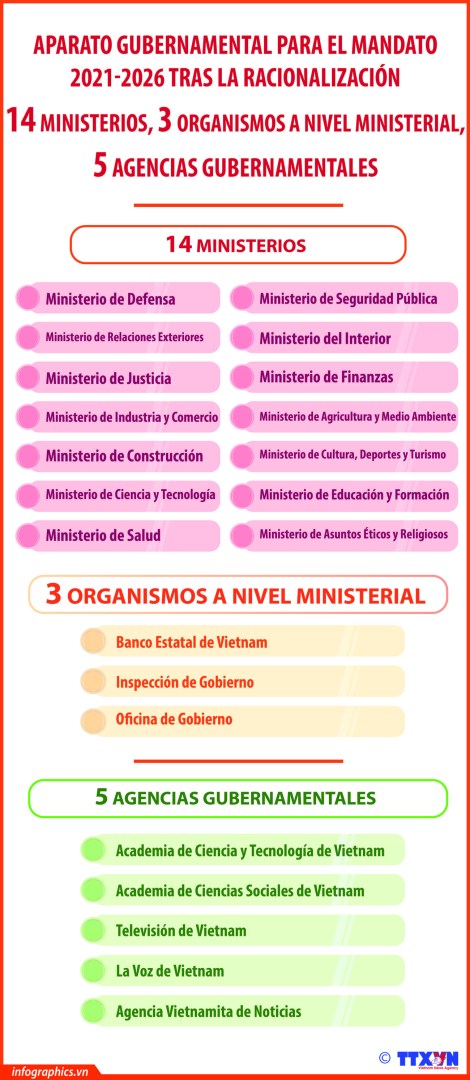
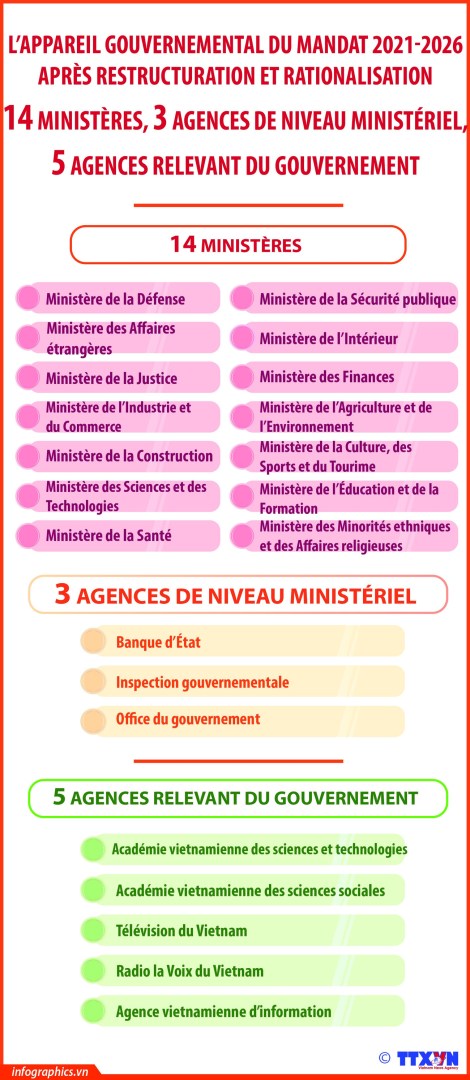
Los resultados iniciales muestran que el aparato gubernamental para el periodo 2021–2026 se ha simplificado significativamente, comprendiendo ahora 14 ministerios, tres agencias a nivel ministerial y cinco organismos afiliados al gobierno. El proceso de reestructuración ha reducido considerablemente el número de unidades y agencias administrativas para mejorar la eficiencia operativa.
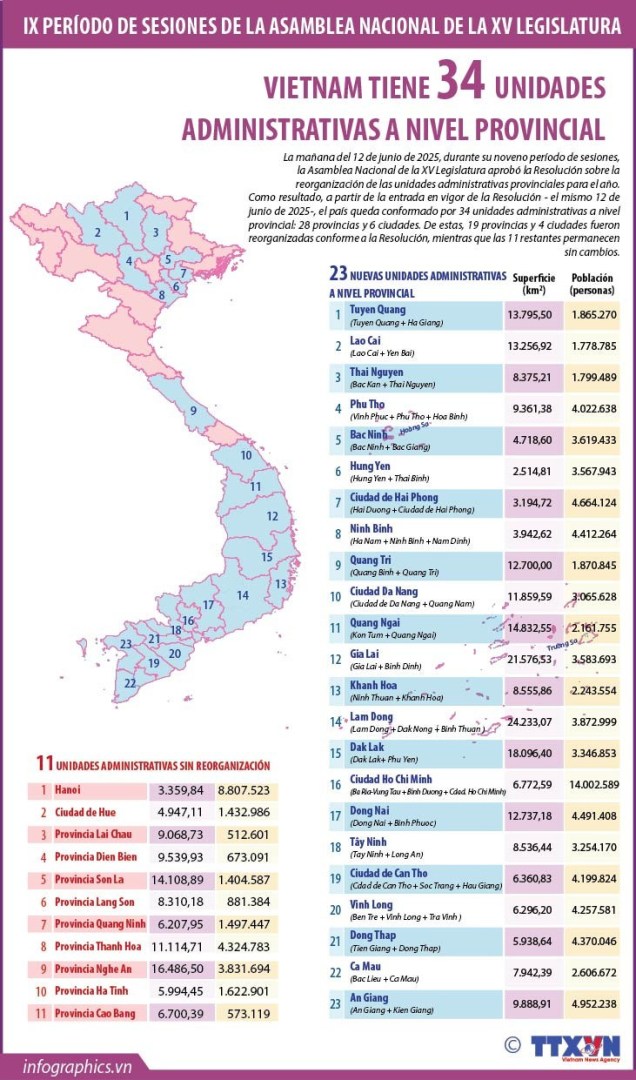
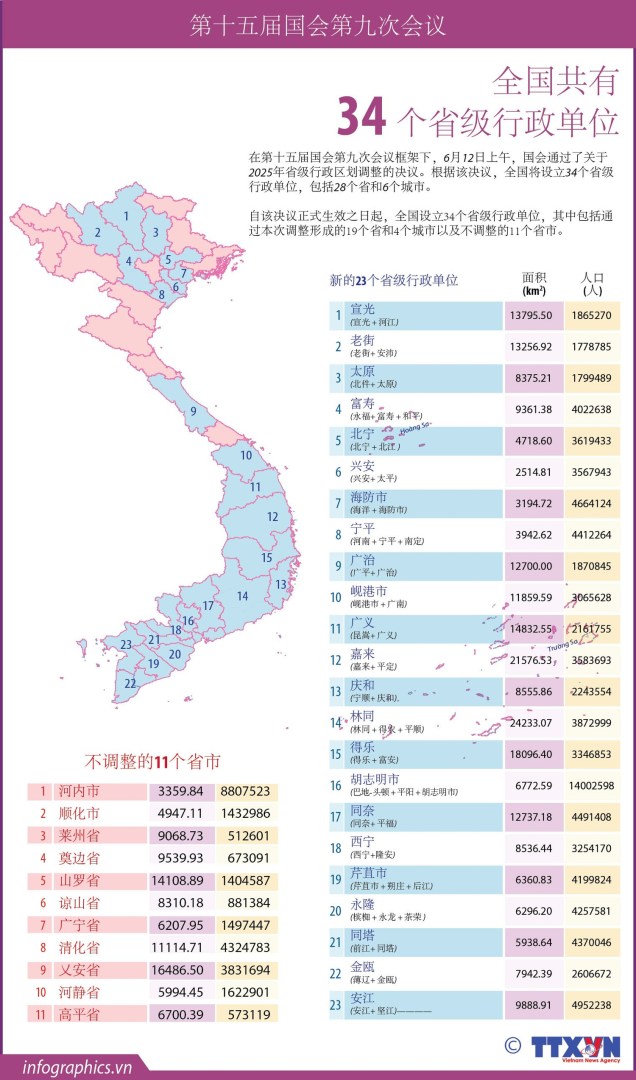
Mientras tanto, en el noveno período de sesiones de la XV Legislatura, la Asamblea Nacional (AN) aprobó la Resolución No. 202/2025/QH15 el 12 de junio de 2025, relativa a la reorganización de unidades administrativas a nivel provincial. Paralelamente, el Comité Permanente de la AN emitió 34 resoluciones sobre la reorganización de unidades administrativas comunales en 34 provincias y ciudades bajo administración central recién formadas.
Esto marca el resultado de un proceso cuidadosamente considerado y metódico a lo largo de muchos años, reflejando la fuerte determinación y visión estratégica del Partido y del Estado para racionalizar el aparato administrativo, reducir el gasto presupuestario, fortalecer la descentralización a los niveles locales y crear condiciones favorables para la formación de centros de crecimiento competitivos a escala regional e internacional.
Por primera vez en casi medio siglo, Vietnam tiene el menor número de unidades administrativas a nivel provincial en su historia. Esta decisión es más que una reorganización administrativa; representa una reforma profunda y un fuerte cambio en la mentalidad de gobernanza nacional, alineándose con las tendencias de integración global y desarrollo sostenible.
La reorganización es una “reestructuración estratégica” integral, no basada únicamente en factores geográficos, sino también incorporando criterios modernos como la conectividad regional, la eficiencia económica, el potencial de desarrollo urbano, el sistema de infraestructura, las características socioculturales y la visión de desarrollo nacional. A diferencia de fusiones a pequeña escala anteriores, este esfuerzo es sincronizado y holístico.
En el noveno período de sesiones de la AN de la XV Legislatura, el 16 de junio por la mañana, con el apoyo unánime de los 466 delegados presentes, se aprobó la Ley de Organización del Gobierno Local (modificada), que elimina oficialmente el nivel distrital y establece un modelo de gobierno local de dos niveles (provincial y comunal) en lugar de tres.
En el noveno período de sesiones de la Asamblea Nacional de la XV Legislatura, celebrada el 16 de junio de 2025, con la aprobación unánime de los 466 diputados presentes, el Parlamento aprobó la reforma de la Ley de Organización del Gobierno Local. (Foto: VNA)
Durante la conferencia nacional para revisar la implementación de la Resolución No. 18-NQ/TW del Comité Central del PCV del mandato XII sobre la reforma y la reorganización del sistema político para que sea ágil, eficaz y eficiente, celebrada el 1 de diciembre de 2024, el secretario general To Lam dijo: “¿Es este el momento correcto, la oportunidad correcta, y un momento urgente y objetivamente necesario para una racionalización revolucionaria de la estructura organizativa del sistema político para mejorar su efectividad y eficiencia? La respuesta es clara — ya no podemos permitir más demoras.”
Conferencia nacional para revisar la implementación de la Resolución n.º 18-NQ/TW, en diciembre de 2024 en Hanoi. (Foto: VNA)
Este evento tuvo una gran importancia histórica, estableciendo una base legal sólida para la organización y operación de los gobiernos locales bajo el modelo de dos niveles, aplicado por primera vez en Vietnam. Sirve como fundamento para implementar las principales políticas del Partido y del Estado en el desarrollo nacional integral, garantizar la defensa y seguridad nacional, y promover una integración internacional profunda.
La reforma, que entró en vigor el 1 de julio de 2025, ha recibido gran atención y amplio apoyo de funcionarios, miembros del Partido y el pueblo en todo el país.
La política de reorganizar y racionalizar el aparato administrativo ha permeado profundamente la mentalidad, creencia y voluntad de todo el Partido y pueblo, creando un fuerte consenso tanto en la percepción como en la acción. Ha recibido un fuerte apoyo del sistema político y la sociedad.
El proceso de reestructuración administrativa en Vietnam se ha realizado de manera metódica, científica y objetiva, siguiendo una hoja de ruta clara basada en criterios específicos y bajo el liderazgo del Partido.
Optimización del aparato: la perspectiva de expertos
Mirando globalmente, hace más de 43 años, en 1982, la República Popular China llevó a cabo una racionalización administrativa para mejorar la eficiencia operativa reduciendo el número de funcionarios y personal. Específicamente, el número de agencias bajo el Consejo de Estado se redujo de 100 a 61 y el número de ministerios de 52 a 43; además, un tercio del personal de las agencias del Consejo de Estado fue recortado.
Mientras Vietnam avanza vigorosamente en la racionalización de su aparato administrativo, Estados Unidos también realiza reformas para mejorar la eficiencia operativa y reducir costos. El presidente Donald Trump despidió a gran parte del personal y cerró agencias ineficaces. Esto muestra que la reorganización del sistema administrativo no es exclusiva de Vietnam; es una tendencia inevitable para todas las naciones en su desarrollo.
Dang Dinh Quy, exviceministro de Relaciones Exteriores, exembajador y exjefe de la delegación permanente de Vietnam ante las Naciones Unidas (ONU) en Nueva York (Fuente: VNA)
Según Dang Dinh Quy, exviceministro de Relaciones Exteriores, exembajador y exjefe de la delegación permanente de Vietnam ante las Naciones Unidas (ONU) en Nueva York, la racionalización del aparato administrativo ayuda a reducir costos para que los recursos se enfoquen en tareas más esenciales, mejorando así la efectividad general. Una estructura más ligera clarifica responsabilidades departamentales y permite flujos de trabajo más rápidos y eficientes.
Cuando el aparato administrativo se racionaliza, la transparencia y la responsabilidad individual dentro del sistema mejoran significativamente, ayudando a acortar procesos y garantizar una toma de decisiones oportuna, dijo Dang Dinh Quy.
Moisés Pérez Mok, jefe de la corresponsalía de la Agencia Informativa Latinoamericana Prensa Latina en Hanoi. (Fuente: VNA)
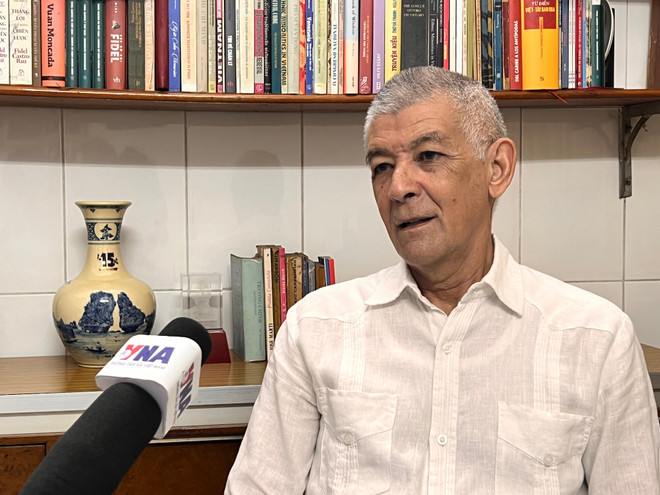
Mientras tanto, Moisés Pérez Mok, jefe de la corresponsalía de la Agencia Informativa Latinoamericana Prensa Latina en Hanoi, consideró: “Creo que tenía toda la razón el secretario general cuando dijo que es un proceso que debe acometerse de forma urgente porque es resultado de 40 años de experiencia de la aplicación del proceso de renovación que indica que ya había que pasar a una etapa superior, sobre todo atendiendo a las metas que se ha propuesto Vietnam para 2030 y para 2045, que son realmente ambiciosas.”
Las estadísticas de 2022 mostraron que el número de funcionarios públicos y empleados en Vietnam superaba los 2,2 millones, con gastos regulares que representaban hasta el 70% del presupuesto estatal, la mayoría destinado a salarios.
“Al disminuir el aparato, quedan muchos más recursos para emplear en el desarrollo, que es lo que necesita en este momento Vietnam, cuando se apresta a entrar en una nueva nueva era de prosperidad.”
Moisés Pérez Mok – jefe de la corresponsalía de la Agencia Informativa Latinoamericana Prensa Latina en HanoI
Recientemente, varios periódicos internacionales han publicado artículos señalando que el plan del Gobierno vietnamita para racionalizar el aparato estatal ha recibido un fuerte apoyo público.
The Straits Times de Singapur, así como Bangkok Post y Kaohoon International de Tailandia, describieron la aprobación por parte de la Asamblea Nacional vietnamita del plan de racionalización administrativa como un “gran cambio”, impulsado rápidamente por el liderazgo vietnamita con el objetivo de reducir el gasto del presupuesto estatal y mejorar la eficiencia del sistema. De acuerdo con los artículos, el plan cuenta con un amplio respaldo popular, ya que un aparato estatal totalmente racionalizado se considera esencial para que Vietnam persiga sus ambiciosos objetivos de crecimiento.
Según The Straits Times y Bloomberg, con sede en EE.UU., el plan del Gobierno vietnamita para racionalizar el aparato estatal también ha sido bien recibido por la comunidad inversionista. Aunque se pueden prever algunos retrasos administrativos a corto plazo, el Gobierno vietnamita ha asegurado que la reforma no afectará el proceso de aprobación de proyectos de inversión.
Racializar el aparato administrativo, mejorar la eficiencia de la gobernanza
El 30 de junio de 2025 marcó un hito histórico para la nación, ya que Vietnam comenzó oficialmente a operar un sistema de administración local de dos niveles a nivel nacional, estableciendo una nueva estructura administrativa para el país.
El secretario general del Partido Comunista, To Lam, asiste a una ceremonia para anunciar resoluciones y decisiones sobre la fusión de unidades administrativas en Ciudad Ho Chi Minh (Foto: VNA)
El presidente, Luong Cuong, asiste a una ceremonia en la que se anuncia el establecimiento del modelo de gobierno local de dos niveles en Hanoi. (Foto: VNA)
El primer ministro Pham Minh Chinh asiste a una ceremonia para anunciar el establecimiento del modelo de gobierno local de dos niveles en Hai Phong (Foto: VNA)
El presidente de la Asamblea Nacional, Tran Thanh Man, asiste a una ceremonia para anunciar el modelo de gobierno local de dos niveles en la ciudad sureña de Can Tho. (Foto: VNA)
La reforma integral del sistema político es esencial para responder a los desafíos y demandas de la nueva era que el país está entrando. El primer gran desafío es reorganizar todo el aparato estatal, no mediante recortes automáticos de personal, sino eliminando cargos y funciones innecesarias. El objetivo no es solo reducir el número de empleados, sino mejorar la eficiencia, asegurando que cada servidor público sea competente, ético y esté totalmente comprometido con servir al pueblo.
El viceministro del Interior, Truong Hai Long. (Fuente: VNA)
Según el viceministro del Interior, Truong Hai Long, para implementar esta política mayor y estratégica, Vietnam ha realizado preparativos exhaustivos, coordinados y completos en tiempos recientes, demostrando un enfoque proactivo y decidido. Esto incluyó establecer una sólida base legal y desarrollar planes de personal adecuados para la fase posterior a la reestructuración.
Se ha puesto especial énfasis en seleccionar personal capaz y calificado, con conocimientos legales y experiencia en gestión para servir a nivel comunal, el nivel de administración en contacto directo con el pueblo. Además, se ha prestado atención a mejorar las instalaciones de oficina, el equipamiento de trabajo y especialmente la infraestructura digital.
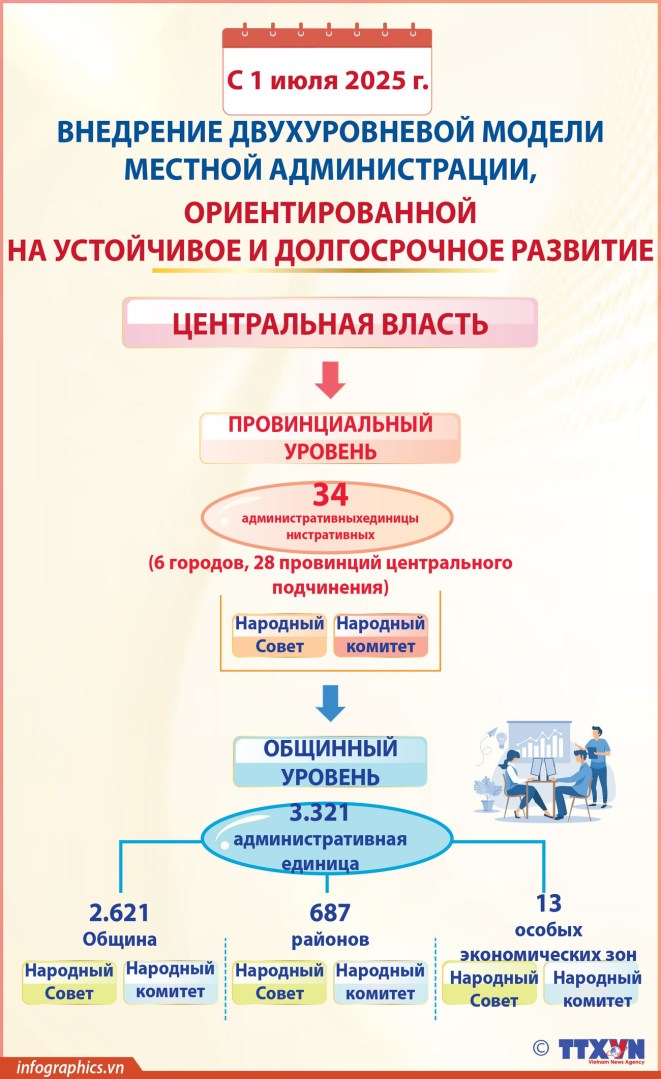
“Con estos preparativos exhaustivos, confiamos en que a partir de julio, el sistema de gobierno local de dos niveles en 34 provincias y ciudades bajo administración central, y tres mil 321 unidades administrativas comunales operará sin problemas ni interrupciones,” dijo Long.
Cuando se implemente oficialmente el modelo de gobierno local de dos niveles a partir del 1 de julio de 2025, se prevé que las localidades reduzcan 368 agencias especializadas bajo los Comités Populares provinciales. (Foto: VNA)
Reducir el número de provincias de 63 a 34, junto con la implementación del modelo de administración local de dos niveles, promoverá el potencial de desarrollo económico, fortalecerá la conectividad regional, ahorrará recursos presupuestarios y mejorará la eficiencia de la gobernanza. El modelo de administración “cercano y accesible al pueblo” mejorará la calidad de los servicios públicos para ciudadanos y empresas, además de acelerar la transformación digital y la modernización administrativa, añadió.
Paralelamente, el Ministerio de Finanzas ha ajustado sus mecanismos de gestión para simplificar los procedimientos administrativos, reducir costos y delegar significativamente la autoridad a los niveles locales. Muchos procedimientos ahora se gestionan a través de plataformas digitales, ahorrando tiempo y costos y mejorando la transparencia.
El viceprimer ministro Nguyen Hoa Binh en la sesión de interpelaciones. (Fuente: VNA)
Durante una sesión de interpelaciones en el noveno período de sesiones de la AN de la XV Legislatura, el viceprimer ministro Nguyen Hoa Binh destacó que el nuevo modelo establece un aparato gubernamental más cercano al pueblo, elimina niveles intermedios y amplía la capacidad de desarrollo económico.
El Gobierno ha desarrollado un sistema de decretos de descentralización y realizado capacitaciones para ayudar a las localidades a operar eficazmente. Para responder rápidamente a las preguntas de ciudadanos y empresas, se ha establecido una línea directa y una aplicación asistente virtual con inteligencia artificial, añadió.
Se espera que el nuevo modelo impulse el crecimiento económico, especialmente atrayendo más inversión extranjera. En los primeros cinco meses de 2025, el capital de inversión extranjera nueva y ajustada aumentó un 51% interanual, reflejando la confianza de los inversionistas en el ambiente empresarial transparente y favorable de Vietnam.
Racionalizar el aparato administrativo no es solo reducir el tamaño, sino construir un sistema más eficiente que sirva mejor al pueblo. Es esencial establecer mecanismos para recibir retroalimentación y proteger los derechos de los funcionarios afectados, fomentando un fuerte impulso reformista y asegurando un desarrollo sostenible.
El primer ministro Pham Minh Chinh describió la reestructuración de las unidades administrativas y la implementación del modelo de gobierno local de dos niveles como una “revolución” en la organización del sistema político.
“No se trata solo de un reordenamiento administrativo, sino de una transformación fundamental en la mentalidad de gestión, los métodos de gobernanza y la operación del aparato — pasando de pasivo a proactivo, de burocrático a un enfoque orientado al servicio.” – destacó el premier.
Afirmó que una vez iniciada esta reforma institucional, la unidad en el pensamiento, la coordinación, el consenso y la solidaridad en la acción son factores clave. Es esencial aprovechar todas las condiciones favorables para generar impulso e inspiración, manteniéndose firmes y resilientes para superar los desafíos y obstáculos durante la transición.
Para garantizar el éxito de esta reforma, el premier pidió a todos los niveles y sectores implementarla de manera sincronizada, integral, decidida y coherente. Durante la fase preparatoria, enfatizó la necesidad de acelerar la revisión del marco legal y eliminar barreras institucionales.
Las cuatro resoluciones clave y revolucionarias emitidas recientemente por el Buró Político constituirán los pilares institucionales fundamentales, creando una sólida motivación para impulsar al país hacia la nueva era. (Fuente: VNA)
Señaló que esta reforma organizacional es una de las soluciones clave, junto con los “cuatro pilares” para impulsar el crecimiento económico por encima del 8% este año y alcanzar dos dígitos en los próximos años, contribuyendo a lograr las dos metas centenarias del país.
Con el principio rector de “el Partido dirige, el Estado gestiona y el pueblo es dueño,” se espera que el modelo de gobierno local de dos niveles se convierta en una estructura administrativa más adecuada para el rápido, fuerte y sostenible desarrollo del país.
Esta revolución actual en la reforma organizacional no solo está diseñada para satisfacer las demandas actuales, sino también para moldear el futuro, en el que el pueblo sea mejor servido, la gobernanza sea más transparente y las funciones sociales operen con mayor eficiencia. Este es el objetivo final de la reforma administrativa: “por el pueblo, para el pueblo y al servicio del pueblo”./.
Спустя 50 лет после окончания войны и полного национального объединения, Вьетнам вступает в новую великую революцию: масштабную реформу по объединению провинций и оптимизации административного аппарата с целью уверенного продвижения нации вперёд.
Начало глубокой институциональной реформы
Объединение провинций и оптимизация аппарата управления – это не новое направление политики Партии. Оно было инициировано ещё 25 октября 2017 года, когда Центральный комитет КПВ XII созыва издал Резолюцию №18-NQ/TW «О дальнейшем обновлении и упорядочении организационной структуры политической системы, направленной на эффективность и действенность».
К 2025 году Политбюро продолжило реализацию реформы через новые заключения, поручив государственным органам разработку проектов по объединению провинций, упразднению уровня уездов и слиянию общин и кварталов.
Вьетнам вступает в эпоху национального подъёма. (Источник: ВИА)
Первичные результаты показывают: в составе правительства на период 2021–2026 годов произошло существенное сокращение – осталось 14 министерств, 3 ведомства на уровне министерства (на 5 меньше) и 5 ведомств при правительстве (на 3 меньше). Сокращение административных звеньев способствовало повышению эффективности управления.
Правительство представило, а Национальное собрание приняло Резолюцию №202/2025/QH15 от 12 июня 2025 года о реорганизации административных единиц провинциального уровня. В то же время Постоянный комитет Национального собрания утвердил 34 Резолюции о реорганизации административных единиц коммунального уровня в 34 провинциях и городах.
На 9-й сессии XV созыва Национального собрания 16 июня все 466 присутствующих депутатов единогласно приняли поправки в Закон об организации местных органов власти, официально упразднив уровень уездов и переведя местное управление на двухуровневую модель.
На 9-й сессии Национального собрания XV созыва, утром 16 июня, при полном единогласии 466 из 466 присутствующих депутатов, Национальное собрание приняло Закон о структуре местных органов власти (в новой редакции). (Источник: ВИА)
На общенациональной конференции по подведению итогов реализации Резолюции №18-NQ/TW Генеральный секретарь То Лам отметил: «Настало время, это необходимое и объективно неизбежное требование — провести революцию по оптимизации структуры политической системы, чтобы аппарат работал эффективно. Иначе уже нельзя».
Общенациональная конференция по изучению и реализации подведения итогов выполнения Резолюции №18-NQ/TW состоялась в декабре 2024 года в Ханое. (Источник: ВИА)
Это историческое событие создает прочную правовую основу для функционирования местных органов власти по новой модели, впервые реализуемой во Вьетнаме. Это позволяет эффективно выполнять стратегические задачи Партии и Государства по всестороннему развитию страны, обеспечению обороны, безопасности и глубокой международной интеграции. Реформа получила широкую поддержку среди партийных кадров, госслужащих и населения, и будет внедрена с 1 июля 2025 года.
Оптимизация аппарата: взгляд экспертов
Взглянув на международный опыт: в 1982 году Китайская Народная Республика провела сокращение аппарата, уменьшив число сотрудников для повышения эффективности. Количество органов при Госсовете сократилось со 100 до 61, количество министерств — с 52 до 43, а штат сотрудников — на треть.
В то время как Вьетнам решительно проводит реформу по сокращению и оптимизации государственного аппарата, Соединённые Штаты Америки также осуществляют реформу структуры управления с целью повышения эффективности работы и сокращения расходов. Президент Дональд Трамп уволил большое количество сотрудников и закрыл ряд организаций, деятельность которых оказалась неэффективной. Таким образом, реорганизация государственного аппарата — это не уникальное явление, характерное только для Вьетнама, а объективная тенденция, присущая всем странам мира в процессе их развития.
Данг Динь Куи — бывший заместитель министра иностранных дел, бывший посол и бывший глава Постоянного представительства Вьетнама при ООН в Нью-Йорке. (Источник: ВИА)
Данг Динь Куи — бывший заместитель министра иностранных дел, бывший посол и бывший глава Постоянного представительства Вьетнама при ООН в Нью-Йорке — отметил, что оптимизация государственного аппарата способствует снижению затрат и сосредоточению ресурсов на более приоритетных задачах, тем самым повышая эффективность его функционирования. В частности, компактная структура позволяет чётче определить ответственность каждого подразделения, ускоряет рабочие процессы и делает их более результативными.
Когда структура государственного аппарата становится компактной, улучшается прозрачность и повышается ответственность каждого сотрудника, что способствует сокращению процедур и обеспечению своевременного выполнения задач.
Мойсес Перес Мок — глава представительства латиноамериканского информационного агентства Prensa Latina в Ханое. (Источник: ВИА)
Комментируя эту тенденцию, господин Мойсес Перес Мок — глава представительства латиноамериканского информационного агентства Prensa Latina в Ханое — отметил: «Я полностью согласен с мнением Генерального секретаря о том, что данный процесс необходимо реализовать в срочном порядке. Ведь он является результатом более чем 40 лет опыта в деле обновления страны, и сейчас настал момент, когда Вьетнаму необходимо перейти на новый, более высокий этап развития — особенно в условиях, когда государство поставило перед собой амбициозные цели на 2030 год и видение до 2045 года».
Статистика за 2022 год показывает, что численность государственных служащих и работников государственного сектора во Вьетнаме превысила 2,2 миллиона человек, при этом текущие расходы составляют до 70% государственного бюджета, причем основная часть этих средств направляется на выплату заработной платы.
Оптимизация государственного аппарата создаст больший бюджетный ресурс для инвестиций в развитие — это именно то, что сейчас особенно необходимо Вьетнаму, находящемуся на пороге новой эры процветания.
Мойсес Перес Мок — глава представительства латиноамериканского информационного агентства Prensa Latina в Ханое.
В последнее время ряд международных изданий опубликовали статьи, в которых отмечается, что план оптимизации государственного аппарата, реализуемый правительством Вьетнама, получил широкую поддержку общественности.
Газета The Straits Times (Сингапур), а также Bangkok Post и Kaohoon International (Таиланд) отмечают, что одобрение Национальным собранием Вьетнама плана по оптимизации государственного аппарата стало «большим шагом вперёд». Руководство Вьетнама активно продвигает эту инициативу с целью сокращения государственных расходов и повышения эффективности системы управления. По мнению авторов статей, данная инициатива получила широкую поддержку населения, поскольку радикальное сокращение государственного аппарата поможет Вьетнаму достичь амбициозных целей роста.
Согласно The Straits Times и Bloomberg (США), план по реформированию государственного аппарата правительства Вьетнама также получил положительную оценку среди инвесторов. Хотя в ближайшее время возможны некоторые задержки в административных процедурах, правительство Вьетнама заверило, что реформы не повлияют на процесс одобрения инвестиционных проектов.
Сокращение административного аппарата — повышение эффективности управления
30 июня 2025 года стало священной и знаменательной вехой для нации — началось функционирование системы местной власти в двухуровневой модели по всей стране, что ознаменовало собой новое административное устройство Социалистической Республики Вьетнам.
Генеральный секретарь КПВ То Лам присутствует на церемонии объявления о внедрении модели местного самоуправления в два уровня в Хошимине. (Источник: ВИА)
Президент Лыонг Кыонг присутствует на церемонии объявления о внедрении модели местного самоуправления в два уровня в Ханое. (Источник: ВИА)
Премьер-министр Фам Минь Тьинь присутствует на церемонии объявления о внедрении модели местного самоуправления в два уровня в городе Хайфон (север Вьетнама). (Источник: ВИА)
Председатель Национального собрания Чан Тхань Ман присутствует на церемонии объявления о внедрении модели местного самоуправления в два уровня в городе Кан Thо (юг Вьетнама). (Источник: ВИА)
Комплексная реформа политической системы направлена на ответ современным вызовам и потребностям, с которыми сталкивается страна в новую эпоху. Первой и главной задачей стало полное переустройство государственного аппарата, устранение ненужных должностей и функций, но без автоматического сокращения. Суть реформы заключается не просто в сокращении штатов, а в повышении эффективности работы, с тем чтобы каждый государственный служащий обладал необходимой компетентностью, моральными качествами и преданностью делу служения народу.
Заместитель министра внутренних дел Чыонг Хай Лонг (Источник: ВИА)
По словам заместителя министра внутренних дел Чыонг Хай Лонга, для реализации этого масштабного и стратегически важного курса Вьетнам в последнее время провёл всестороннюю, скоординированную и тщательную подготовку, продемонстрировав активный и решительный подход в разработке правовой базы, исследовании и построении вариантов размещения кадров после реорганизации. Особое внимание уделяется отбору кадров с необходимыми компетенциями, уровнем образования, знанием законодательства и опытом управления для выполнения задач на уровне коммуны — уровне местной власти, непосредственно взаимодействующей с населением. Также приоритетом является обустройство и модернизация офисов, рабочей техники, особенно цифровой инфраструктуры.
«С такой тщательной подготовкой мы уверены, что с июля система местной власти в двухуровневой модели в 34 провинциях и городах, а также в 3.321 административной единице на уровне коммун будет работать бесперебойно и стабильно», — выразил уверенность господин Чыонг Хай Лонг.
При переходе на двухуровневую модель организации местной власти с 1 июля 2025 года, в ряде провинций планируется сократить 368 специализированных органов при народных комитетах провинциального уровня. (Источник: ВИА)
Сокращение количества провинций с 63 до 34 в сочетании с моделью двухуровневой местной власти расширит пространство для экономического развития, усилит региональную связанность, позволит сэкономить бюджетные средства и повысит эффективность управления. Двухуровневая система власти — «ближе к народу» — способствует улучшению качества обслуживания населения и бизнеса, а также стимулирует цифровую трансформацию и модернизацию административной системы.
Параллельно Министерство финансов корректирует механизмы управления с целью сократить административные процедуры, снизить расходы и усилить децентрализацию на уровне. Многие процедуры обрабатываются на электронной платформе, что экономит время, средства и повышает прозрачность.
Вице-премьер Нгуен Хоа Бинь отвечает на вопросы депутатов. (Источник: ВИА)
На сессии вопросов и ответов в рамках 9-го заседания Национального собрания заместитель премьер-министра Нгуен Хоа Бинь подчеркнул, что новая модель создает систему управления, приближенную к народу, сокращает промежуточные звенья и расширяет масштаб экономического роста. Правительство разработало систему постановлений о децентрализации и организовало обучение для поддержки эффективной работы местных органов. Одновременно была создана горячая линия и внедрено приложение виртуального помощника с ИИ для оперативного ответа на вопросы граждан и предприятий.
Ожидается, что новая модель будет стимулировать экономику, особенно за счёт привлечения иностранных инвестиций. За первые пять месяцев 2025 года общий объем зарегистрированных и скорректированных иностранных инвестиций увеличился на 51% по сравнению с аналогичным периодом прошлого года, что отражает доверие инвесторов к благоприятной и прозрачной деловой среде.
Премьер-министр Фам Минь Тьинь отметил, что процесс реорганизации административных единиц и внедрение двухуровневой модели местного самоуправления является настоящей «революцией» в структуре государственного аппарата.
«Это не просто административная перестановка, а переход в мышлении, методах управления, способах функционирования аппарата — от пассивности к проактивности, от администрирования к служению», — подчеркнул Премьер-министр.
Для достижения успеха Премьер-министр потребовал от всех уровней и ведомств действовать синхронно, всесторонне, решительно и последовательно. На подготовительном этапе следует активно пересматривать законодательную систему и устранять институциональные барьеры. Он также отметил, что данная организационная реформа — одно из ключевых решений наряду с «четырьмя стратегическими опорами», направленное на достижение экономического роста выше 8% в этом году и двузначных показателей в последующие годы, а также на выполнение двух 100-летних целей, поставленных страной.
Четыре ключевых и прорывных постановления Политбюро, изданные в последнее время, станут институциональными опорами, создающими мощный стимул для продвижения нашей страны вперёд в новую эпоху. (Источник: ВИА)
В духе «Партия руководит, Государство управляет, Народ является хозяином» модель двухуровневой местной власти станет более подходящей административной структурой для условий быстрого, мощного и устойчивого развития страны.
Текущая революция по реорганизации государственного аппарата направлена не только на удовлетворение актуальных потребностей, но и на формирование будущего – будущего, в котором народ обслуживается лучше, власть работает прозрачно, а общество функционирует эффективно. Это и есть конечная цель административной реформы — «ради народа, по воле народа и на службе у народа»./.
Fifty years after the end of the war and national reunification, Vietnam is embarking on a new great revolution — a sweeping reform involving the merger of provinces and streamlining of the administrative apparatus, aimed at advancing the nation firmly forward.
Beginning with bold institutional reform
The merger of provinces and streamlining of the administrative system is not a new policy of the Party. It was initiated eight years ago, on October 25, 2017, when the 12th Central Party Committee issued Resolution No. 18-NQ/TW on “Some issues on continuing reform and reorganising the political system to ensure that it is streamlined and operates efficiently and effectively.
By 2025, the Politburo continued to implement this policy through new conclusions, assigning relevant agencies to develop proposals for provincial mergers, the elimination of district-level administrative units, and the reorganisation of commune-level administrative units.
Vietnam enters the era of the nation’s rise (Photo: VNA)
Initial outcomes show that the government apparatus for the 2021–2026 term has been significantly streamlined, now comprising 14 ministries and three ministry-level agencies, five government-affiliated bodies. The restructuring process has significantly reduced the number of administrative units and agencies to improve operational efficiency.
The Government submitted, and the National Assembly passed Resolution No. 202/2025/QH15 on June 12, 2025, regarding the reorganisation of provincial-level administrative units. At the same time, the National Assembly Standing Committee issued 34 resolutions on the reorganisation of commune-level administrative units in 34 newly-formed provinces and centrally-run cities.
This marks the result of a carefully considered and methodical process over many years, reflecting the Party’s and State’s strong determination and strategic vision to streamline the administrative apparatus, reduce budget expenditures, enhance decentralisation to localities, and create favourable conditions for the formation of large-scale and competitive growth hubs at both regional and international levels.
For the first time in nearly half a century, Vietnam has the fewest number of provincial-level administrative units in its history. This decision is more than just an administrative reorganisation; it represents a profound reform and a strong shift in national governance mindset, aligning with global integration and sustainable development trends.
The reorganisation is a comprehensive “strategic restructuring,” not merely based on geographical factors but also incorporating modern criteria such as regional connectivity, economic efficiency, urban development potential, infrastructure system, socio-cultural characteristics, and national development vision. Unlike previous small-scale mergers, this restructuring effort is synchronised and holistic.
At the 9th session of the 15th National Assembly on June 16 morning, with unanimous approval from all 466 deputies present, the NA passed the amended Law on Organisation of Local Governments, officially abolishing the district level and launching the two-tier local administration model.
At the 9th session of the 15th National Assembly on June 16 morning, with unanimous approval from all 466 deputies present, the NA passed the amended Law on Organisation of Local Governments. (Photo: VNA)
At a national conference to review and implement Resolution No. 18-NQ/TW, Party General Secretary To Lam said, “Is this the right time, the right opportunity, and an urgent, objectively necessary moment for a revolutionary streamlining of the political system’s organisational structure to enhance its effectiveness and efficiency? The answer is clear — we can no longer afford any delay.”
The national conference to review the implementation of Resolution No. 18-NQ/TW, in December 2024 in Hanoi. (Photo: VNA)
This event held great historical significance, establishing a solid legal foundation for the organisation and operation of local governments under the two-tier model, which is applied for the first time in Vietnam. It serves as the basis for implementing the Party’s and State’s major policies on comprehensive national development, ensuring national defence and security, and promoting deep international integration.
The reform, effective on July 1, 2025, has garnered strong attention and broad support from officials, Party members, and people across the country.
The policy of reorganising and streamlining the administrative apparatus has deeply permeated the mindset, belief, and will of the entire Party and people, creating a strong consensus in both perception and action. It has received strong support from the political system and society.
The process of administrative restructuring in Vietnam has been carried out methodically, scientifically, and objectively, following a clear roadmap based on specific criteria and under the leadership of the Party.
Perspective from experts
Looking back globally, more than 43 years ago, in 1982, the People’s Republic of China undertook an administrative streamlining to improve the efficiency of its operations by reducing the number of officials and staff. Specifically, the number of agencies under the State Council was reduced from 100 to 61 and the number of ministries from 52 to 43; and one-third of the personnel in State Council agencies were cut.
While Vietnam is vigorously pushing forward with streamlining its administrative apparatus, the US is also undertaking reforms to improve operational efficiency and reduce costs. US President Donald Trump dismissed a large number of staff and shut down ineffective agencies. This shows that the reorganisation of the administrative system is not unique to Vietnam; it is an inevitable trend for all nations worldwide in the course of development.
former Deputy Minister of Foreign Affairs, former Ambassador, and former head of Vietnam’s Permanent Mission to the UN in New York Dang Dinh Quy. (Photo: VNA)
According to former Deputy Minister of Foreign Affairs, former Ambassador, and former head of Vietnam’s Permanent Mission to the UN in New York Dang Dinh Quy, streamlining the administrative apparatus helps reduce costs for resources to be focused on more essential tasks, thereby improving overall effectiveness. A leaner structure clarifies departmental responsibilities and enables faster, more efficient workflows.
When the administrative apparatus is streamlined, transparency and individual accountability within the system are significantly improved, helping to shorten processes and ensure timely decision-making, Quy said.
Moises Perez Mok, head of the Prensa Latina bureau in Hanoi (Photo: VNA)
Commenting on this trend, Moises Perez Mok, head of the Prensa Latina bureau in Hanoi, said, “I completely agree with the Party General Secretary To Lam’s view that this is a process that must be carried out urgently. It is the culmination of over 40 years of experience in the country’s “Doi moi” (renewal) process, and now is the time for Vietnam to transition into a higher stage of development, especially as the nation has set ambitious goals for 2030 and a long-term vision to 2045.”
Statistics from 2022 showed that the number of public officials and employees in Vietnam exceeded 2.2 million, with regular expenditures accounting for up to 70% of the State budget, the majority of which goes toward salary payments.
“Mok stressed that streamlining the administrative apparatus will create greater fiscal room for development investment — the thing Vietnam urgently needs at this critical juncture, as it stands on the threshold of a new era of prosperity.”
Moisés Pérez Mok – HEAD OF THE PRENSA LATINA BUREAU IN HANOI
Recently, several international newspapers have published articles noting that the Vietnamese Government’s plan to streamline the state apparatus has received strong public support.
The Straits Times of Singapore, as well as the Bangkok Post and Kaohoon International of Thailand, described the Vietnamese NA’s approval of the administrative streamlining plan as a “major shift,” driven forward rapidly by Vietnam’s leadership with the goals of reducing state budget spending and improving system efficiency. According to the articles published on the newspapers, the plan enjoys widespread public backing, as a thoroughly streamlined state apparatus is seen as essential for Vietnam to pursue its ambitious growth targets.
According to The Straits Times and US-based Bloomberg, the Vietnamese Government’s plan to streamline the State apparatus has also been well received by the investment community. While some short-term administrative delays may be predicted, the Vietnamese Government has affirmed that the reform will not affect the approval process for investment projects.
June 30, 2025 marked a historic milestone for the nation, as Vietnam officially began operating a two-tier local administration system nationwide, establishing a new administrative structure for the country.
Party General Secretary To Lam attends a ceremony to announce resolutions and decisions on merging administrative units in Ho Chi Minh City (Photo: VNA)
State President Luong Cuong attends a ceremony announcing the establishment of the two-tier local government model in Hanoi. (Photo: VNA)
Prime Minister Pham Minh Chinh attends a ceremony to announce the establishment of the two-tier local government model in Hai Phong (Photo: VNA)
National Assembly Chairman Tran Thanh Man attends a ceremony for announcing the two-tier local government model in the southern city of Can Tho. (Photo: VNA)
Comprehensive reform of the political system is essential to respond to the challenges and demands of a new era that the country is entering. The first major challenge is to reorganise the entire state apparatus, not through automatic staff cuts, but by eliminating unnecessary positions and functions. The goal is not merely to reduce headcount, but to enhance efficiency, ensuring that every public servant is competent, ethical, and wholeheartedly committed to serving the people.
Deputy Minister of Home Affairs Truong Hai Long speaks at a meeting (Photo: VNA)
According to Deputy Minister of Home Affairs Truong Hai Long, to implement this major and strategic policy, Vietnam has undertaken thorough, coordinated, and comprehensive preparations in recent times, demonstrating a proactive and determined approach. This included establishing a strong legal foundation and developing personnel plans suitable for the post-restructuring phase.
Particular emphasis has been placed on selecting capable and qualified personnel with legal knowledge and management experience to serve at the commune level—the tier of administration in direct contact with the people. In addition, attention has been given to upgrading office facilities, working equipment, and especially digital infrastructure.
“With these thorough preparations, we are confident that from July, the two-tier local government system in 34 provinces and centrally-run cities, and 3,321 commune-level administrative units will operate smoothly and without disruption,” Long said.
When the two-tier local government model is officially implemented from July 1, 2025, localities are expected to reduce 368 specialised agencies under the provincial People’s Committees. (Photo: VNA)
Reducing the number of provinces from 63 to 34, along with implementing the two-tier local administration model, will promote economic development potential, strengthen regional connectivity, save budget resources, and improve governance efficiency. The “close to and accessible to the people” administration model will enhance the quality of public services for citizens and businesses, while also accelerating digital transformation and administrative modernisation, he added.
In parallel, the Ministry of Finance has adjusted its management mechanisms to streamline administrative procedures, reduce costs, and significantly delegate authority to grassroots levels. Many procedures are now handled through digital platforms, saving time and costs while improving transparency.
Deputy Prime Minister Nguyen Hoa Binh speaks at a Q&A session (Photo: VNA)
During a Q&A session at the 9th session of the 15th NA, Deputy Prime Minister Nguyen Hoa Binh stressed that the new model establishes a government apparatus that is closer to the people, eliminates intermediate levels, and expands economic development capacity.
The Government has developed a system of decentralisation decrees and conducted training sessions to help localities operate effectively. To promptly address questions from citizens and businesses, a hotline and AI-powered virtual assistant application have been set up, he added.
The new model is expected to drive economic growth, particularly by attracting more foreign investment. In the first five months of 2025, total newly registered and adjusted foreign investment capital increased by 51% year-on-year, reflecting investors’ confidence in Vietnam’s transparent and favourable business environment.
Streamlining the administrative apparatus is not merely about downsizing, but about building a more efficient system that better serves the people. It is essential to establish mechanisms for receiving feedback and protecting the rights of affected officials, thus fostering strong reform momentum and ensuring sustainable development.
Prime Minister Pham Minh Chinh described the restructuring of administrative units and the implementation of the two-tier local government model as a “revolution” in the organisation of the political system. He said that this is not merely an administrative rearrangement, but a fundamental transformation in management mindset, governance methods, and the operation of the apparatus — shifting from passive to proactive, from bureaucracy to service-oriented approach.
He affirmed that once this institutional reform is underway, unity in thought, coordination, consensus, and solidarity in action are the key factors. It is essential to leverage all favourable conditions to generate momentum and inspiration while remaining steadfast and resilient in overcoming the challenges and obstacles that arise during the transition.
“This is not merely an administrative rearrangement, but a fundamental transformation in management mindset, governance methods, and the operation of the apparatus — shifting from passive to proactive, from bureaucracy to service-oriented approach,” Prime Minister Pham Minh Chinh said.
To ensure the success of this reform, the PM called on all levels and sectors to implement it in a synchronised, comprehensive, determined, and consistent manner. During the preparatory phase, he emphasised the need to accelerate the review of the legal framework and remove institutional barriers.
The four key and breakthrough resolutions recently issued by the Politburo will be the fundamental institutional pillars, creating a strong motivation to move the nation forward in the new era. (Source: VNA)
He noted that this organisational reform is one of the key solutions, alongside the “four pillars” to drive economic growth to over 8% this year and reach double digits in the coming years, contributing to the achievement of the country’s two centennial goals.
With the guiding principle of “the Party leads, the State manages, and the people are the owners,” the two-tier local government model is expected to become an administrative structure better suited to the country’s rapid, strong, and sustainable development.
This current revolution in organisational reform is not only designed to meet present-day demands, but also to shape the future, in which the people are better served, governance is more transparent, and society functions are more efficiently. This is the ultimate goal of administrative reform: “by the people, for the people, and in service of the people.”/.
Cinquante ans après la fin de la guerre et la réunification nationale, le Vietnam est entré dans une nouvelle grande révolution, celle de la fusion des provinces et de la rationnalisation de l’appareil administratif, avec pour objectif de faire progresser la nation à pas ferme.
Début d’une profonde réforme institutionnelle
La fusion des provinces et la rationalisation de l’appareil ne sont pas une politique nouvelle du Parti communiste du Vietnam. Elles ont été initiées il y a huit ans, plus précisément le 25 octobre 2017, lorsque le 12e Comité central du Parti a publié la résolution n°18-NQ/TW sur “Certaines questions sur la poursuite de la rénovation, de la restructuration de l’appareil du système politique pour le rendre rationnalisé, efficace et efficient”.
D’ici 2025, le Politburo continuera de piloter la mise en œuvre par le biais de nouvelles conclusions, en confiant des missions aux agences chargées d’élaborer des projets de fusion de provinces, de suppression du niveau de district et de fusion de communes et de quartiers.
Le Vietnam entre dans une nouvelle ère. Photo : VNA
Les premiers résultats montrent que l’appareil du gouvernement pour le mandat 2021-2026 a été considérablement rationalisé, composé de 14 ministères, 3 agences de niveau ministériel (réduction de 5 ministères et branches) et 5 agences gouvernementales (réduction de 3 agences). La restructuration a considérablement réduit le nombre de points focaux et d’agences, contribuant ainsi à améliorer l’efficacité opérationnelle.
L’Assemblée nationale a promulgué le 12 juin 2025 la résolution n°202/2025/QH15 sur la réorganisation des unités administratives provinciales ; et parallèlement, le son Comité permanent a publié 34 résolutions sur la réorganisation des unités administratives communales dans 34 provinces et villes.
Ces textes sont l’aboutissement d’une réflexion minutieuse et méthodique menée au fil de nombreuses années, témoignant de la volonté de rénovation révolutionnaire et de la vision stratégique du Parti et de l’État pour rationaliser l’appareil, économiser le budget, décentraliser davantage les pouvoirs vers les localités et créer les conditions permettant de créer de nouveaux pôles de croissance à grande échelle, compétitifs aux niveaux régional et international.
Le 16 juin, l’Assemblée nationale (15e législature) a adopté, lors de sa 9e session, à l’unanimité des 466 députés présents, la Loi sur l’organisation des administrations locales (modifiée). Photo: VNA
Pour la première fois depuis près d’un demi-siècle, le Vietnam compte le plus petit nombre d’unités administratives provinciales. Cette décision est bien plus qu’un simple changement d’organisation administrative mais elle marque une profonde réforme, une forte mutation de la gouvernance nationale en phase avec la tendance à l’intégration et au développement durable.
Cette réorganisation représente une “restructuration stratégique”, intégrant des critères modernes majeurs comme la connectivité régionale, l’efficacité économique, le potentiel urbain, les infrastructures ou les dimensions socioculturelles et, surtout, elle est porteuse d’une vision de développement national et menée de manière synchrone et globale.
Conférence nationale sur la résolution n° 18-NQ/TW, décembre 2024 à Hanoï. Photo : VNA
La 15e Assemblée nationale a adopté lors de sa 9e session, le 16 juin, à l’unanimité des 466 députés présents la Loi sur l’organisation des collectivités locales (modifiée), abolissant officiellement le niveau de district et actant le passage du modèle d’organisation des collectivités locales de trois à deux niveaux.
Cet événement revêt une importance historique majeure, car il pose les bases juridiques solides de l’organisation et du fonctionnement des collectivités locales selon le modèle à deux niveaux, appliqué pour la première fois au Vietnam. Il constitue le fondement de la mise en œuvre des grandes politiques du Parti et de l’État en matière de développement national global, de défense et de sécurité nationales, ainsi que d’intégration internationale approfondie. Plébiscité et soutenu par les cadres, membres du Parti et les habitants, ce modèle est officiellement mis en place à l’échelle nationale depuis le 1er juillet 2025.
Rationnalisation de l’appareil : points de vue d’experts
Lors d’une conférence nationale visant à vulgariser la révision de la mise en œuvre de la Résolution n°18-NQ/TW, le secrétaire général Tô Lâm a déclaré que la question était désormais de savoir si le moment était opportun, s’il s’agissait d’une urgence et d’une exigence objective pour la révolution visant à rationaliser la structure organisationnelle du système politique afin de garantir un fonctionnement efficace et efficient. La réponse est que la nation ne peut plus se permettre de retarder le processus, car il s’agit d’une question urgente qui doit être traitée sans délai. Plus tôt ce travail sera accompli, plus grands seront les bénéfices pour le peuple et la nation.
La restructuration de l’appareil organisationnel n’est pas un phénomène propre au Vietnam, mais est une tendance inévitable de chaque pays du monde dans le processus de développement. En 1982, la Chine a rationalisé son appareil, réduit l’effectif du secteur public afin d’améliorer la qualité de ses opérations. Le nombre d’agences relevant du Conseil des affaires de l’État de la République populaire de Chine est passé de 100 à 6; celui des ministères de 52 à 43 ; et les effectifs ont été réduits d’un tiers. Les États-Unis réforment également leur appareil administratif afin d’en améliorer l’efficacité opérationnelle et de réduire les coûts.
Dang Dinh Quy, ancien vice-ministre des Affaires étrangères, ancien ambassadeur et ancien chef de la Mission permanente du Vietnam auprès des Nations Unies. Photo: VNA
Dang Dinh Quy, ancien vice-ministre des Affaires étrangères, ancien ambassadeur et ancien représentant permanent du Vietnam auprès des Nations Unies, a expliqué que la rationalisation de l’appareil permet de réduire les coûts et de concentrer les ressources sur des tâches plus importantes, améliorant ainsi son efficacité.
Plus précisément, une rationalisation de l’appareil permet de clarifier les responsabilités des départements et d’optimiser leurs opérations, a-t-il insisté.
Moisés Pérez Mok, représentant en chef de l’agence de presse latino-américaine Prensa Latina à Hanoï. Photo: VNA
Commentant cette tendance, Moisés Pérez Mok, représentant en chef de l’agence de presse latino-américaine Prensa Latina à Hanoi, a déclaré : “Je partage pleinement l’avis du secrétaire général selon lequel il s’agit d’un processus qui doit être mis en œuvre de toute urgence. Il s’agit en effet de la concrétisation de plus de 40 ans d’expérience en matière de rénovation, et il est temps pour le Vietnam de franchir une nouvelle étape de développement, notamment dans le contexte où le pays s’est fixé des objectifs ambitieux pour 2030 et une vision pour 2045.”
Les statistiques de 2022 montrent que le nombre de fonctionnaires et d’employés du secteur public a dépassé les 2,2 millions de personnes, les dépenses courantes représentant jusqu’à 70% du budget de l’État, dont la majeure partie est consacrée aux salaires.
“Le raccourcissement de l’appareil créera plus d’espace budgétaire pour les investissements de développement – quelque chose dont le Vietnam a particulièrement besoin à l’heure actuelle, alors qu’il se trouve au seuil d’une nouvelle ère de prospérité.”
Moisés Pérez Mok, représentant en chef de l’agence de presse latino-américaine Prensa Latina à Hanoi
Récemment, plusieurs journaux internationaux ont publié des articles affirmant que le plan du gouvernement vietnamien visant à rationaliser l’appareil d’État bénéficiait d’un large soutien public, car il aidera le Vietnam à atteindre des objectifs de croissance ambitieux.
Le Straits Times de Singapour, ainsi que le Bangkok Post et le Kaohoon International de Thaïlande, ont commenté que l’adoption par l’Assemblée nationale du Vietnam du plan de rationalisation de l’appareil d’État constituait une “transformation majeure” rapidement promue par les dirigeants vietnamiens afin de réduire les dépenses du budget de l’État et de promouvoir l’efficacité du système.
Selon le journal singapourien Straits Times et l’américain Bloomber, le projet du gouvernement vietnamien de rationaliser l’appareil d’État a également été largement salué par les investisseurs. Des retards dans les procédures administratives sont attendus prochainement, mais le gouvernement vietnamien a affirmé que la réforme n’affecterait pas le travail d’approbation des projets.
Réduction de l’appareil administratif et amélioration de l’efficacité de la gestion
Le 30 juin 2025 a marqué la mise en place d’un appareil d’administration locale à deux niveaux à l’échelle nationale.
Le secrétaire général du PCV Tô Lâm assiste à la cérémonie d’annonce de la mise en place du modèle d’administration locale à deux niveaux à Hô Chi Minh-Ville. Photo: VNA
Le président Luong Cuong assiste à la cérémonie d’annonce de la mise en place du modèle d’administration locale à deux niveaux à Hanoi. Photo: VNA
Le Premier ministre Pham Minh Chinh assiste à la cérémonie d’annonce de la mise en place du modèle d’administration locale à deux niveaux à Hai Phong (Nord). Photo: VNA
Le président de l’Assemblée nationale Trân Thanh Mân assiste à la cérémonie d’annonce de la mise en place du modèle d’administration locale à deux niveaux dans la ville de Cân Tho (Sud). Photo: VNA
Une réforme complète du système politique est en cours pour répondre aux défis et aux besoins d’une nouvelle ère. Le premier défi majeur consiste à réorganiser en profondeur l’appareil d’État, en supprimant les postes et fonctions inutiles sans suppressions automatiques. Il s’agit non seulement de réduire les effectifs, mais aussi d’améliorer l’efficacité, en veillant à ce que chaque cadre possède les compétences, l’éthique et le dévouement nécessaires pour servir le peuple.
Le vice-ministre de l’Intérieur Truong Hai Long. Photo: VNA
Selon le vice-ministre de l’Intérieur Truong Hai Long, le Vietnam a mené des préparatifs rigoureux et complets, faisant preuve d’un esprit proactif et déterminé dans l’élaboration des bases juridiques, la recherche et le développement des ressources humaines appropriées après la réorganisation. L’accent a été mis sur la sélection d’un contingent de cadres capables et qualifiés pour assumer les tâches inhérentes aux communes.
Le Vietnam met en place officiellement le modèle d’administration locale à deux niveaux à l’échelle nationale à partir du 1er juillet. Photo: VNA
La réduction du nombre de provinces de 63 à 34, avec 3.321 unités administratives au niveau communal fonctionnant suivant le modèle d’administration locale à deux niveaux élargiront l’espace de développement économique, amélioreront la connectivité régionale, permettront de réaliser des économies budgétaires et d’améliorer l’efficacité de la gestion, la qualité des services aux citoyens et aux entreprises, tout promouvant la modernisation du système administratif.
Le nouveau modèle crée un appareil gouvernemental plus proche du peuple, réduit les niveaux intermédiaires et élargit l’échelle du développement économique, a affirmé le vice-Premier ministre Nguyên Hoa Binh lors de la séance de questions-réponses à l’Assemblée nationale.
Le vice-Premier ministre Nguyên Hoa Binh lors d’une séance de questions-réponses à l’Assemblée nationale. Photo: VNA
Le gouvernement a mis en place un système de décrets relatifs à la décentralisation, organisé des formations pour soutenir les localités dans leur fonctionnement efficace, et lancé une ligne d’assistance téléphonique répondre rapidement aux questions des citoyens et des entreprises.
Ce nouveau modèle devrait stimuler l’économie, notamment en attirant les investissements étrangers. Au cours des cinq premiers mois de 2025, le total des investissements étrangers nouvellement enregistrés et ajustés a augmenté de 51%, témoignant de la confiance des investisseurs dans un environnement des affaires favorable et transparent.
Le Premier ministre Pham Minh Chinh a estimé que le processus de réorganisation des unités administratives et la mise en œuvre du modèle d’administration locale à deux niveaux constituaient une “révolution” dans l’organisation de l’appareil politique.
“Il ne s’agit pas d’un simple aménagement administratif, c’est un changement des mentalités et des méthodes de gouvernance, et du fonctionnement de l’appareil passant d’une approche passive à une approche proactive, d’une approche administrative à une approche de service” – a-t-il souligné.
Pour mener à bien ce processus, le chef du gouvernement a appelé tous les échelons et secteurs à une mise en œuvre synchrone, globale, résolue et ferme. Il a également a déclaré que cette révolution organisationnelle est également l’une des solutions clés, avec les “quatre piliers”, c’est-à-dire quatre résolutions stratégiques pour propulser le Vietnam dans une nouvelle ère, pour atteindre une croissance économique de plus de 8% cette année et à deux chiffres dans les années à venir, et achever les objectifs des deux centenaires fixés pour 2030 et 2045.
La révolution organisationnelle actuelle vise non seulement à répondre aux besoins actuels, mais aussi à construire l’avenir : un pays où la population est mieux servie, où l’administration fonctionne de manière transparente et où la société fonctionne efficacement. Photo: VNA
Dans l’esprit “le Parti dirige, l’État gère, le peuple est maître”, le modèle d’administration locale à deux niveaux deviendra une structure organisationnelle administrative plus adaptée au développement rapide, robuste et durable du pays.
La révolution organisationnelle actuelle vise non seulement à répondre aux besoins actuels, mais aussi à construire l’avenir : un pays où la population est mieux servie, où l’administration fonctionne de manière transparente et où la société fonctionne efficacement. Tel est l’objectif de la réforme administrative “pour le peuple, par le peuple et au service du peuple”./.