
A slew of policies are being revised to increase birth rates, yet public concern remains over whether the proposed incentives in the draft Population Law will effectively address the declining number of births, said insiders.
The Politburo has requested removing discipline against Party members who have up to three children, and waiving and reducing tuition fees for their children.
Recently, the Ministry of Health proposed allowing couples and individuals to decide the number of children and birth spacing, extending maternity leave from six to seven months for female workers, and providing support for renting or purchasing social housing.
Extending maternity leave, providing housing support
According to the National Statistics Office, Vietnam’s population in 2024 was estimated at 101.3 million people. Its fertility rate dropped to 1.91, falling below the replacement level of 2.1, and this declining trend is expected to continue. Without timely intervention, Vietnam could officially enter an aging population phase in the next decade and face labour shortage in the future.

Births particularly remain low in large cities and industrial zones, where high child-rearing costs and work pressure force many couples to delay or forgo having more children. In response, the Ministry of Health has proposed various policies to encourage families to have at least two children.
The MoH’s Department of Population has advised the ministry to submit a proposal to the Government for drafting the Population Law, focusing on three key policy groups – maintaining the replacement rate, addressing the gender imbalance at birth, and improving population quality.

To maintain the replacement rate, the bill suggests that couples and individuals should have the equal right to decide on the number of children and birth spacing, based on their age, health, education, work conditions, income, and child-rearing capacity.
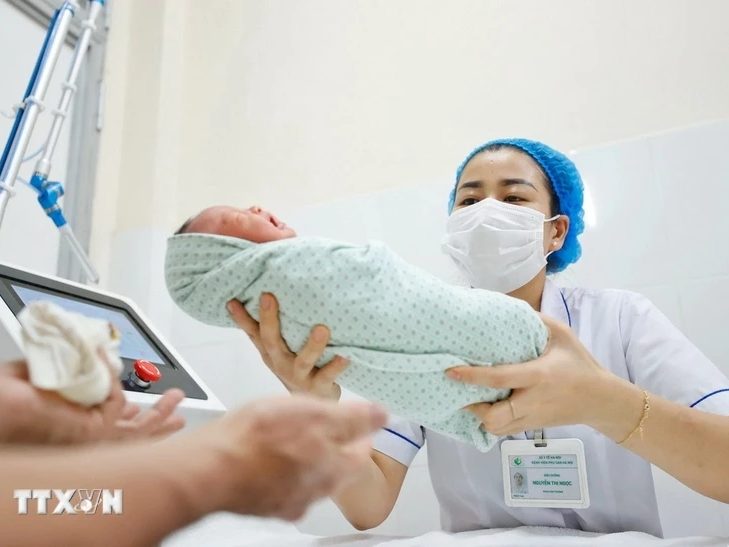
Additionally, the document proposes extending maternity leave to seven months from the current six months for female laborers who have a second child, and providing housing support for female workers having at least two children and working at industrial and export processing zones, and in provinces or cities with low birth rates.


The extension of maternity leave is seen as a solution to maintain the replacement rate and improve population quality.

| Nguyen Thi Lan, a worker at Sai Dong B Industrial Park, Gia Lam, Hanoi, said: This policy benefits both mother and child by allowing more time for early-stage care. However, she is concerned about income, as an additional month of leave without adequate financial support could create economic difficulties for families. |
| Pham Thanh Thuy, another worker at the industrial park expressed her concerns that upon returning to work, she might be assigned less demanding tasks, have fewer opportunities for promotion, or face dismissal if she is on a short-term contract. |
| Nguyen Hoai Nam from TMN Trading JSC said: As a business owner with many female employees, he supports extending maternity leave to give mothers more time to care for their children. However, he noted that this policy also puts significant pressure on businesses to maintain production. Without temporary hiring support or reasonable staffing adjustments, companies may struggle. He hoped that the policy would be accompanied by measures that can support businesses and ensure benefits of female employees. |
To make the pro-birth policies spring to life, comprehensive adjustments are needed to balance the interests of workers, businesses, and the State, experts said, adding that maternity leave extension and financial and housing support are crucial solutions, but they must ensure job security, stable income, and a family-friendly work environment.



Additionally, policies should be tailored to specific regions, especially big cities and industrial zones where birth rates are declining. The Government should introduce mechanisms to help businesses maintain operations when female employees take maternity leave while also encouraging companies to develop supportive policies that allow women to have children without fearing career setbacks.
Free education helps remove barriers to having children


The Politburo has approved a policy to remove disciplinary measures against Party members with up to three children and to waive tuition fees for students from kindergarten to high school in the nationwide public school system.
Experts said that these policies align with reality and help spur the replacement rate, as financial pressure—especially in big cities with high child-rearing costs—remains a key barrier to having more children.

Many women worry about the impact of having children on their career, income, and professional growth. Therefore, to maintain the replacement rate and address population aging, comprehensive support policies are needed to help them balance their work and family responsibilities.
According to Prof. Nguyen Dinh Cu, former Director of the Institute of Population and Social Issues at the National Economics University in Hanoi, the removal of disciplinary measures against Party members with up to three children marks a significant turning point, contributing to controlling the declining births while laying a foundation for revising and perfecting related regulations.

Raising children should not be the responsibility of families but a shared effort of the society and the State. While providing free tuition is a positive step, it is not enough, as child-rearing involves many other expenses. The State should promptly adjust policies to offer greater support for women and families, and learn from other countries’ experiences to raise birth rates.
Specifically, amending the 2008 Population Ordinance and moving toward building a Population Law will help harmonise population policies to better align with the current situation. Moreover, it is important to acknowledge that a child’s birth not only brings joy and responsibility to the family but also contributes to the society’s development in the long run.
Therefore, raising children should not be the responsibility of families but a shared effort of the society and the State. While providing free tuition is a positive step, it is not enough, as child-rearing involves many other expenses. The State should promptly adjust policies to offer greater support for women and families, and learn from other countries’ experiences to raise birth rates.

Children play together at a walking street in Hanoi during the National Day holiday. (Photo: VNA)

Experts said it is necessary to have a comprehensive approach, along with financial support, social welfare, and improved workplace conditions to promote the birth rate.
Extending maternity leave to seven months also gives women more time to care for their children, but it must go with measures to ensure income and employment benefits to avoid negative impacts on their careers, they added.
For long-term success, these policies must be rolled out in a concerted manner with close cooperation between the State, businesses, and society. Beyond financial support, creating a family-friendly work environment—such as flexible working time and on-site childcare—will help women balance their careers and family responsibilities, laying a solid foundation for population and economic growth./.
