YEARS OF VIETNAM-CHINA TIES: PEOPLE-TO-PEOPLE EXCHANGE LAYS FOUNDATION FOR SUSTAINABLE FUTURE
People-to-people exchange has long served as a vital bridge between Vietnam and China, forming a strong social foundation for building trust, fostering cooperation, and maintaining peace. In celebration of the 75th anniversary of diplomatic ties in 2025, the two Parties and Governments have jointly designated the year as the “Year of Vietnam-China Humanistic Exchange,” reflecting a shared strategic vision to promote sustainable bilateral relations rooted in public engagement.
On January 18, 1950, China became the first country to establish diplomatic relations with the Democratic Republic of Vietnam.
Despite historical ups and downs, the special friendship as both comrades and brothers between the two nations has grown stronger and more comprehensive. Among various aspects of bilateral ties, people-to-people exchange has become an increasingly important pillar, with activities in culture, education, academia, and youth cooperation enhancing mutual understanding and trust.
People-to-people exchange: A firm pillar of Vietnam–China relations
As early as the 1950s, tens of thousands of Vietnamese students, youth, and officials received training in China. Regular exchanges of artists, engineers, and doctors made meaningful contributions to Vietnam’s resistance and post-war reconstruction.
On June 23, 1955, President Ho Chi Minh makes his first official visit to China. Chairman Mao Zedong, Chairman of the Standing Committee of the National People’s Congress Liu Shaoqi, Vice Chairman of the Communist Party of China Zhu De, and Premier Zhou Enlai are at the airport to welcome him. Photo: VNA
Since 1991, people-to-people exchange has entered a new phase, becoming more diverse and in-depth. Numerous programmes, such as the Vietnam–China Youth Friendship Meeting, scholarly exchange, locality-to-locality partnerships, media collaboration, cultural and sports events, have been held with growing frequency and effectiveness.
In 2025, the Year of Vietnam-China Humanistic Exchange, a wide range of activities from cultural festivals, exhibitions, and arts events to experiential and historical education programmes like the “Red Study Tour” have been launched. These initiatives create meaningful connections and emotional resonance, especially among younger generations in both countries.
Youth – Culture – Media: Enduring bridges
A highlight of the year is the “Red Study Tour”, an initiative introduced by General Secretary of the Communist Party of China and Chinese President Xi Jinping during his visit to Vietnam in April.
Leaders of the Parties and States of Vietnam and China jointly launch the “Red Study Tour” Programme on April 15, 2025. Photo: VNA
This three-year programme invites Vietnamese youth to visit “red sites” in China—locations associated with the revolutionary activities of President Ho Chi Minh and early Vietnamese leaders.
“Historic sites, such as the Vietnamese Revolutionary Youth League in Guangzhou and the “Viet Minh” Liaison Office in Jingxi, Guangxi, are living testaments to the revolutionary friendship between China and Vietnam,”stated General Secretary of the Communist Party of China and Chinese President Xi Jinping.
The first leg of the journey themed “Following in Uncle Ho’s footsteps” took place on May 18 in Guangxi. The Vietnamese youth delegation visited the Nan Xishan field hospital, a wartime medical base, Viet Minh historical sites, the Vietnamese School Memorial in Guilin, and the Huangpu military school. These visits helped younger generations better understand the shared revolutionary history and fostered a sense of idealism and gratitude.
Nguyen Thi Phuong Hoa, former Deputy Director of the Institute for Chinese Studies and Deputy Editor-in-Chief of the China Studies Journal, commented that the Red Study Tour is a vivid demonstration of a new chapter in youth cooperation, blending historical memory with a forward-looking orientation.
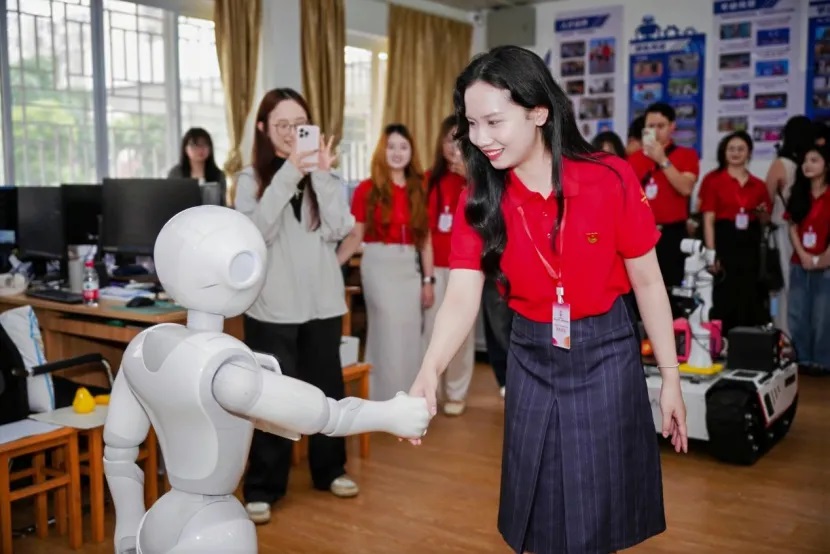
The programme also integrated experiences in cutting-edge technology, including tours of artificial intelligence laboratories, high-speed railway systems, and digital ecosystems. These visits showcased China’s scientific and technological advancements while opening up opportunities for innovation and cooperation between young people from both countries.
Activities like these allow Vietnamese and Chinese youth to share not only a common historical memory but also a joint vision for the future, grounded in understanding, mutual respect, and collaboration, according to Nguyen Tuan Thang, a youth delegate from Vietnam.
In Vietnam, the 24th Vietnam–China Youth Friendship Meeting, held from April 12–18, was another major highlight of the Year of Vietnam-China Humanistic Exchange.
The Chinese youth delegation engaged in activities in Quang Ninh, Ninh Binh, and Hanoi, including student interactions, visits to historical sites, and immersion in local cultural practices.
In 2025, cultural and media collaboration also took centre stage. One notable example is the two-part documentary film “The Road to Development”, jointly produced by Guangxi Television and Vietnam Television. The film revisits key moments of friendship between generations of leaders and vividly depicts the close bonds between the two countries’ people.
Educational exchanges have also expanded. Seminars, academic exchanges, and student mobility programmes between universities in both countries have grown. Bilingual curricula, Chinese language teacher training, and the establishment of Vietnam–China research centres form a robust foundation for long-term scholarly cooperation.
Education and research are the strongest, most enduring bridges between our two countries, according to Dam Vinh Hoa, Director of the Confucius Institute at Hanoi University.
People-to-people exchange is now recognised as one of the six key areas of cooperation that Vietnam and China are actively promoting as they enter a new phase of development.
“The people and younger generations of both countries must shoulder the responsibility of carrying forward and continuously developing the deep and enduring Vietnam-China relationship, both comrades and brothers, an invaluable legacy built by President Ho Chi Minh, Chairman Mao Zedong, and leaders of previous generations of the two nations,” Party General Secretary To Lam stated.
According to Hoa, in order to deepen these exchanges, the first step is to expand their scope to new fields such as economic cooperation, science and technology, environmental protection, and agriculture.
In order to deepen these exchanges, the first step is to expand their scope to new fields such as economic cooperation, science and technology, environmental protection, and agriculture.
Secondly, she highlighted the importance of leveraging the influence of scholars, artists, entrepreneurs, and public figures to communicate effectively with broader audiences, especially farmers, workers, and labourers, through accessible and engaging multi-platform media.
Thirdly, both countries should consider easing or waiving visa fees to promote more frequent people-to-people travel.
Finally, existing mechanisms such as the Vietnam–China People’s Forum, friendship gatherings, and professional exchange conferences should be fully utilised to maximise their effectiveness.
Over the past 75 years, people-to-people exchange has been a resilient and enduring current in the Vietnam–China relationship. The 2025 Year of Humanistic Exchange is more than a symbolic gesture; it is the beginning of a strategic vision in which the people of both nations are placed at the centre. With the concerted efforts of the political systems, social organisations, and individuals on both sides, people-to-people exchange will continue to grow in depth, breadth, and vitality, serving as a sustainable force for driving forward Vietnam–China relations in the new era./.

 YEARS OF VIETNAM-CHINA TIES: PEOPLE-TO-PEOPLE EXCHANGE LAYS FOUNDATION FOR SUSTAINABLE FUTURE