
For hundreds of years, Nhi Khe village in Hanoi’s Thuong Tin district has been home to the fine craft of wood turning.
Located about 20 kilometers south of Hanoi, the village is well-known for hand-turned wooden objects for use in religious activities and other wooden, horn, bone, stone and clamshell items for decoration and daily use.
Nhi Khe also boasts a rich culture, academics, and is the hometown of great figures such as Nguyen Trai (1380 – 1442) – a prominent Vietnamese poet, scholar, and statesman during the early 15th century, and his father Nguyen Phi Khanh. Also hailing from the village is Luong Van Can (1854 – 1927) – a Vietnamese mandarin, school administrator, independence activist and writer, as does Luong Ngoc Quyen (1885 – 1917) – a patriot who took part in many movements against French colonialists.
Nhi Khe village is famous nationwide for sophisticated wood products. The craft has brought a prosperous life to local people and shaped the fame of this place. Turning is not limited to wood but also other materials like horn, bone, and stone. From this village, many high-quality jewelry and other handicraft items are exported to many countries in Europe and Asia.


In the history
Legend has it that during the reign of the Le Kings and Trinh Lords, a talented woodturner named Doan Tai designed many unique products, including an 18-hole bamboo pipe for 18 young men to smoke at the same time.
Originally, he went to Khanh Van village, Khanh Ha commune on the other side of the To Lich River (also in Thuong Tin district), to teach carpentry. He was frustrated as it was difficult to teach the craft there. He went to the river bank and saw children swimming. He asked if they wanted to learn about how to make wooden things. The children agreed, so he waded across the river to Nhi Khe village to teach the craft.
Over the years, the people in Nhi Khe village mastered the job. The great trainer Tai left suddenly and never returned to the village, leaving only the wood craft in his wake. To show their gratitude and respect to the founder of the craft, Nhi Khe villagers built a small shrine to worship him and chose the day he left the village, the 25th of the 10th lunar month, as the day to pay tribute to their craft village’s founder.
The craft village developed prosperously. In the 18th-19th century, locals brought the craft to various places such as Nam Dinh and Thai Nguyen to make a living. In Hanoi, their shops concentrated on To Tich street in Hang Gai ward today.


New vitality
In the past, with very simple tools and foot-powered lathe, Nhi Khe woodturners were able to make sophisticated products.
They use two main materials for turning – wood and horns. There are various kinds of wood that can be used while artisans use horns of buffalo, cow, deer, and elk. Ivory was also turned to make precious items for the royal court and noble families.
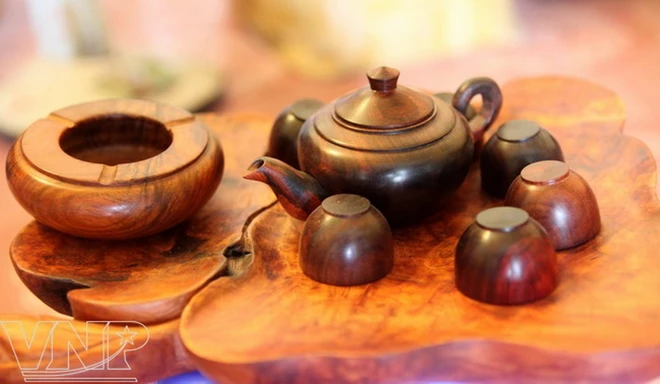
Previously, villagers focused on producing religious objects and household utensils such as incense tubes, vases, display trays, candle holders, baskets for holding teapots, pipe bowls, or spinning tops.
Nowadays, Nhi Khe craftsmen have managed to diversify their products. Apart from traditional objects, the list of the craft village’s products now includes jewelry items made from wood, buffalo horn and bone, clamshell and stone, wooden chessmen, wooden-bead mats and curtains, chopsticks, toothpick containers, which serve not only domestic demands but also export markets. In addition, Nhi Khe village’s products, such as trays, candle holders, vases and teapots, are also used by lacquer makers in the neighboring village of Ha Thai in Duyen Thai commune to produce lacquer-coated items of high economic value.
In recent years, taking advantage of wood scraps, they have made round beads to string into blinds or pillows. This new profession creates jobs and income for hundreds of local workers of different ages. New products have also been created to meet consumers’ demand such as Buddha statues and animal statues.
Moreover, local craftsmen also skillfully combine carpentry with lacquer, sculpture, and pearl shell inlay production techniques to invent exquisite products, especially high-class decorative and handicraft items.
Today, turning technology has developed a lot. Households purchased lathes and other types of machinery and equipment for production. Each household is usually specialised in a certain product.
Products in Nhi Khe are increasingly diverse, meeting the tastes of domestic and foreign consumers. Many are even exported, contributing to the development of the craft village.
The woodturning craft has created jobs not only for villagers but also people from other localities. Thanks to that, people’s lives have been improved, and the locality gained a facelift.
Attractive tourist destination
Nhi Khe village is also an attractive tourist destination in Thuong Tin district.
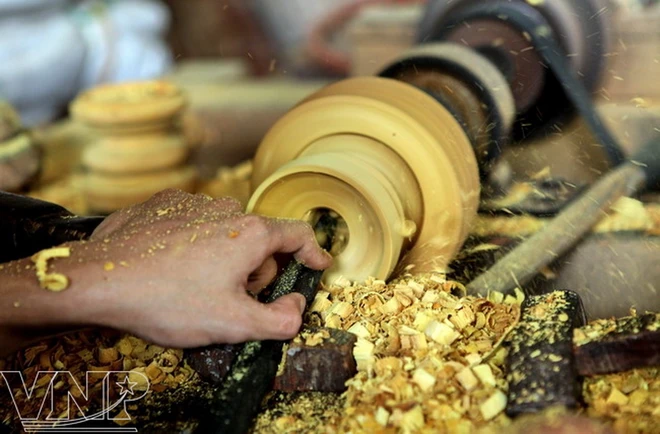
Coming to the village, visitors can witness the process of creating wooden products and souvenirs. They can also learn about and visit relics along with tangible and intangible cultural heritages such as the village communal house, the Truc Shrine, the temple dedicated to the craft founder, Nguyen Trai’s Temple, the Dragon stop, the Phoenix stop, Van Bridge, the Ba Cha communal house, or Thong Pagoda. Nguyen Trai (1380 – 1442) was an illustrious Vietnamese Confucian scholar, a noted poet, a skilled politician and a master strategist. He was credited with writing the important political statements of Le Loi and inspiring the Vietnamese populace to support open rebellion against the Ming dynasty rulers. He was also the author of ‘Great Proclamation upon the Pacification of the Wu’.
Marking his 600th birth anniversary in 1980, Nguyen Trai was recognised by the United Nations Educational, Scientific and Cultural Organization (UNESCO) as a World Cultural Celebrity.
At the eastern end of Van Bridge that spans the To Lich River, there is a Confucian worship site and stele records which show the names and positions of the local people who passed the imperial examinations during the Tran and Le dynasties. The oldest stele was erected in 1690.


Coming to the village, visitors can witness the process of creating wooden products and souvenirs. (Photo: VNA)
Nhi Khe is also home to many halls of worship dedicated to those who contributed to the village and the country. These include the halls of the Duong, Nguyen Trung, and Luong clans, worshiping their ancestors and renowned figures such as Duong Cong Do, Duong Ba Cung, Nguyen Trung Mach, Nguyen Trung Luong, and Luong Van Can.
The school built by Luong Van Can in 1924 is now used as classrooms for first graders in the village. It was listed as a municipal-level relic site in 2005.
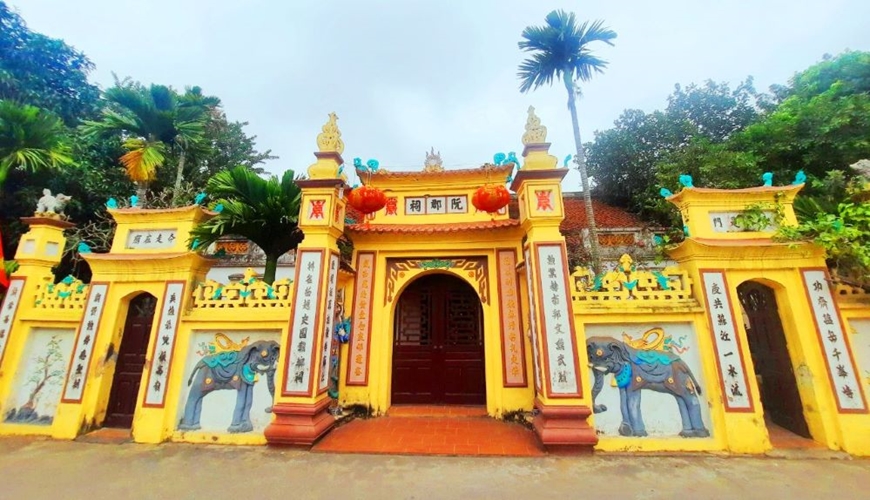
Meanwhile, the Ba Cha communal house used to be the oldest of its kind in Nhi Khe village but it was destroyed by the French colonialists to build an outpost in 1948. The only relic of the communal house is the stone statues of two generals that the villagers brought to the Thuong Dinh communal house to preserve.
The Thong Pagoda, built 300 years ago, was also ruined by the French army. A statue that used to be placed at the pagoda are now at Duyen Thai Pagoda./.
