
Eighty years since the historic autumn of 1945, the Vietnamese nation has overcome countless challenges to gain its independence and gradually develop thanks to the revolutionary path that is both resolute and flexible under the leadership of the Party. This is a profound inheritance and creative application of President Ho Chi Minh’s thought on “employing the invariables to cope with the variables” — a deep and guiding principle that has forged the mettle, intellect, and resilience of the Vietnamese people.


The grand parade marking the 50th anniversary of the Liberation of the South and National Reunification in Ho Chi Minh City on April 30, 2025. (Photo: VNA)
On May 31 1946, before setting off on an official visit to France as a distinguished guest, President Ho Chi Minh told the Acting President Huynh Thuc Khang: “For the national mission entrusted to me, I must be away for a while. Many difficulties remain at home, and I rely on you and others to resolve them. I hope you maintain immutability while responding to uncertainty.”
In saying this, President Ho Chi Minh underscored the need for flexibility, proactivity, creativity, and adaptability in executing the revolutionary mission, while remaining anchored in immutable principles. It means not sacrificing the greater, fundamental goals for minor or trivial issues. It also means standing firm on the immutable principles while observing, reconciling, and adjusting oneself and all things in accordance with the objective laws of movement.


In Ho Chi Minh’s thought, “maintaining immutability” means holding fast to principles and supreme objectives that are non-negotiable. From his revolutionary practice, these “immutable” values include national independence, territorial integrity, the Party’s leadership, and the people’s sovereign rights. These are the common denominators throughout all circumstances. As President Ho Chi Minh once affirmed, “nothing is more precious than independence and freedom.” This thought is the lodestar through all struggles and the foundation for defining national interests in every period.
Alongside “maintaining immutability,” Ho Chi Minh’s thought emphasises responding to uncertainty with flexibility and the intelligent application of context-specific solutions. “Coping with the variables” is not about altering the objective, but about innovating implementation methods and strategies, depending on specific opportunities and conditions.
Maintaining immutability
Coping with the variables
| ✅Holding fast to principles and supreme objectives | ✅Flexibility in action methods |
| ✅Core interest are non-negotiable | ✅ Leveraging intelligence to navigate and adapt effectively to a dynamic reality |
| ✅ Immutable values: – National independence – Territorial integrity – The Party’s leadership – The people’s sovereign rights | ✅ Not altering the objective, but innovating implementation methods and strategies, depending on specific opportunities and conditions |


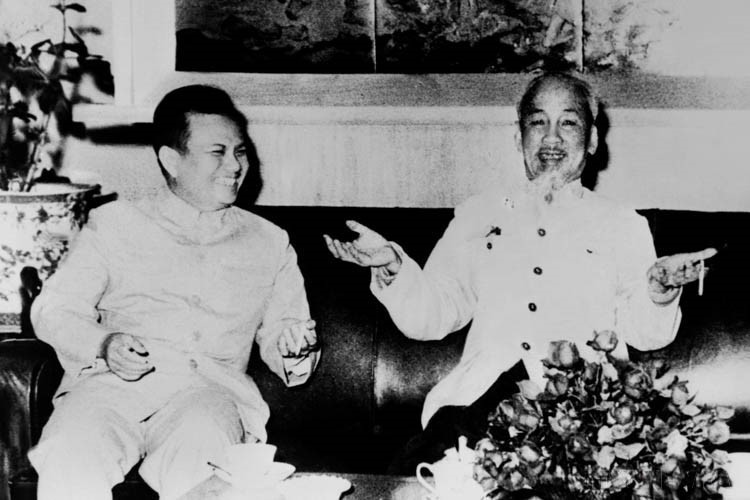


“Long ago, the Hung Kings founded our nation, today, we must defend the nation together.”
president ho chi minh

“Nothing is more precious than independence and freedom”
president ho chi minh
Key to success in every revolutionary stage
After the 1945 August Revolution, the country was in a precarious situation, threatened simultaneously by famine, illiteracy, and foreign invasion. In that context, rather than confront the enemy head-on, the Party and President Ho Chi Minh applied a flexible strategy – signing the Preliminary Agreement on March 6, 1946, with France, accepting tactical and temporary concessions in exchange for valuable time to consolidate the young revolutionary government and prepare the people for resistance.
History has proven that thanks to the principle of “staying firm in policy, yet flexible in its execution,” just one year later, the nation entered a nationwide war of resistance against French colonialism, with strength, morale, and public support significantly reinforced. This is a typical example of skilfully combining resolute principles with flexible strategy — a vivid expression of the thought “employing the invariables to cope with the variables”.


In the legacy of Vietnamese military thought, “fighting with sure victory” is immutable; choosing the appropriate method of combat is the art of “coping with the variables”.

Throughout the two resistance wars against French colonialists and American imperialists, the Party continued to “maintain immutability and address uncertainty with flexibility”. The goal at this time was “willing to sacrifice everything, never accept losing the country, never accept slavery,” “Vietnam is one, the Vietnamese people are one,” “all for the victory against the American invaders.” With that spirit, the Party resolutely pursued a comprehensive, long-term people’s war, relying primarily on its strength.
Throughout the implementation, strategies remained flexible and adaptable, from seeking international aid and building broad national unity fronts, to the strategy of “fighting and negotiating” in the Geneva Agreement (1954) and Paris Peace Accords (1973). All of these demonstrate the Party’s resilience in “addressing uncertainties with flexibility” to lead the nation to gradually complete the cause of national liberation, reunification, and socialist transition.


In the context of the rapid development of the Fourth Industrial Revolution worldwide, the “four pillars” are expected to help Vietnam take off in the new era — one of the nation’s rise.


After reunification, Vietnam faced enormous challenges as it entered a new development phase, including economic and social crises triggered by harsh international embargoes. In this context, the Party once again demonstrated the spirit of “maintaining immutability, addressing uncertainties with flexibility” by initiating the Doi Moi (Renewal) policy at the 6th National Congress in 1986.
The “immutable” principle was upheld – steadfast independence and socialism, for the goal of wealthy people, strong country, democracy, justice, and civilisation. But in strategy, Vietnam actively innovated economic thinking, embraced international integration, and diversified international relations. Thanks to this correct line, Vietnam gradually overcame the crisis, joined ASEAN (1995), the WTO (2007), engaged in many new-generation Free Trade Agreements, and gained great, comprehensive achievements in all fields of economy, culture, social affairs, education, and health care.


Today, in the context of globalisation, increasingly complex competition among world powers, and rapid development of the Fourth Industrial Revolution, Ho Chi Minh’s thought “employing the invariables to cope with the variables” remains highly relevant. That is holding fast to the principle, “national and people’s interests first,” while responding flexibly in all relationships, from comprehensive strategic partnerships with major powers to regional cooperation; and from adapting to climate change to addressing non-traditional security issues.


A lodestar in foreign affairs
The principle in national governance, “staying firm in policy, yet flexible in its execution” has become a distinctive hallmark in Vietnam’s diplomacy.
Over the decades, the Party has applied Ho Chi Minh’s thought on “employing the invariables to cope with the variables” in guiding important foreign policy matters, correctly handling relationships, and accurately assessing and forecasting situations.


Vietnam’s consistent and comprehensive foreign policy is independence, self-reliance, multilateralisation, diversification of relations, being a trusted friend and partner, a responsible member of the international community, and proactively and deeply integrating into the world.
Vietnam’s foreign policy principle and motto are to safeguard the highest national and people’s interests based on the UN Charter and international law; and resolutely and persistently defend independence, sovereignty, unity, and territorial integrity.
To date, Vietnam has established diplomatic relations with 194 countries, built a network of strategic and comprehensive partnerships with 37 nations, including all major powers and all five permanent members of the UN Security Council, and actively participated in over 70 international and regional organisations. The Party has also maintained relations with 259 political parties in 119 countries.


Vietnam’s position, prestige, and influence have been established in numerous significant multilateral forums and mechanisms, including ASEAN, the United Nations, the Mekong Sub-region, APEC, AIPA, and IPU. In addition to taking on important international responsibilities, Vietnam has proposed various initiatives to enhance cooperation and contribute effectively to global challenges, including disease control, disaster response, climate change, food security, water security, and peacekeeping.
Eighty years on, Ho Chi Minh’s thought on “employing the invariables to cope with the variables” has always been the lodestar of the nation’s development path. In all circumstances, the Party always firmly maintains core values while steering the revolutionary ship through all challenges to victory. This thought continues to light the path as Vietnam strides confidently into a new era – that of the nation’s rise./.

helping the nation confidently step into the era of nation’s rise. (Illustrative photo: VNA)