
Although e-commerce is rapidly developing in Vietnam, this sector is facing a severe manpower shortage. With the current explosive growth, the demand for e-commerce human resources is rising quickly and will continue to accelerate.
Therefore, to address the manpower shortage, the Ministry of Industry and Trade will promote efforts to improve the training quality to achieve the goal of developing human resources for e-commerce as set out in the National E-Commerce Development Master Plan for 2026–2030.


According to experts, in 2024, the e-commerce market size surpassed 25 billion USD, up 20% from 2023, accounting for 9% of total national retail sales of goods and consumer service revenue. Notably, Vietnam remains among the top 10 countries globally in e-commerce and ranks fifth worldwide in this sector’s growth rate.
E-commerce is creating millions of jobs, pushing businesses toward digital transformation, and becoming a pillar of the digital economy. However, while e-commerce is growing at lightning speed, the labour market is not expanding in tandem, and workforce training has not received adequate attention.

Le Hoang Oanh, Director of the E-Commerce and Digital Economy Agency (iDEA) under the Ministry of Industry and Trade, stated that for many years, the shortage of e-commerce manpower, especially high-quality personnel, has been a major obstacle to the sector’s development in Vietnam.
This field requires broad knowledge across economics, IT, management, and foreign languages, demanding long-term training. Short-term courses and vocational training can only temporarily meet the labour shortfall. Therefore, formal and long-term training at higher education institutions is a fundamental solution for developing high-quality e-commerce human resources in the future.
A survey by the agency shows that only 30% of employees at e-commerce solution providers have been formally trained. The remaining 70% come from other fields such as business, IT, and marketing, and must self-train to adapt to their roles. This highlights society and businesses’ significant demand for e-commerce human resources.
At educational institutions, e-commerce is a trending discipline offering broad and diverse job opportunities with attractive salaries and a dynamic work environment.
Le Hoang Oanh, Director of the E-Commerce and Digital Economy Agency (iDEA) under the Ministry of Industry and Trade


According to the Vietnam E-Commerce Association, there are over 500 universities and colleges in the country, but only 36 institutions offer specialised e-commerce training, and just over 50 schools include e-commerce modules in their curricula. This is still too limited to meet market demand. Furthermore, universities face challenges in the training, including a lack of qualified lecturers, educational materials, relevant curricula, cooperation among institutions, and alignment with industry practices.
A representative from Lazada noted that not only do e-commerce platforms require manpower, but retail businesses transitioning to e-commerce also need specialised personnel. This is why the demand for high-quality manpower in e-commerce continues to surge.
Although e-commerce workforce training in universities has increased by nearly 30%, it still falls short of industry development needs. This calls for the schools to strive harder to enhance training quality and align curricula with the practical needs of society and businesses.


Do Huu Hung, CEO of Accesstrade Interspace Vietnam Co., Ltd, pointed out that Vietnam currently trains only about 10,000–15,000 e-commerce students annually. Yet Shopee, a large e-marketplace, alone operates over 600,000 storefronts that need personnel.
If each business needs just one person to run, it will take 30 years to satisfy this manpower demand. Moreover, e-commerce training remains unstandardised and lacks formal frameworks, despite the sector generating millions of jobs and opening up cross-border export opportunities.


E-commerce is generating millions of jobs. (Source: Grab, Xanh SM, Be)
To assist local government agencies in staying updated with e-commerce policies and to support businesses in overcoming production and business challenges, the Vietnam E-Commerce Development Centre (EcomViet) under iDEA has coordinated with provincial departments and cross-border e-commerce platforms like Amazon and Alibaba to launch numerous e-commerce connection and training programmes nationwide.



iDEA has also signed an agreement with Amazon Global Selling to implement the initiative “Cross-border E-Commerce: The Breakthrough Era” to support the development of cross-border e-commerce human resources for Vietnamese enterprises during 2022–2026. The goal is to enhance capacity and create export opportunities for local businesses.
For instance, EcomViet frequently collaborates with provincial departments of industry and trade and major e-marketplaces like Amazon and Alibaba to carry out various local e-commerce training and connection programmes. These training sessions attract a wide range of participants, including businesses, cooperatives, government officials, and universities.


A survey of 238 universities by the Vietnam E-Commerce Association shows that 47% have introduced e-commerce modules, with 40 institutions offering it as a formal major. Additionally, many localities have issued their own e-commerce development plans, prioritising human resource training as central to local e-commerce development.
Bui Trung Kien, Vice Chairman of the Vietnam E-Commerce Association, said that improving training quality requires close coordination among educational institutions, businesses, and regulatory bodies. Notably, strengthening the connection between universities and companies is key.
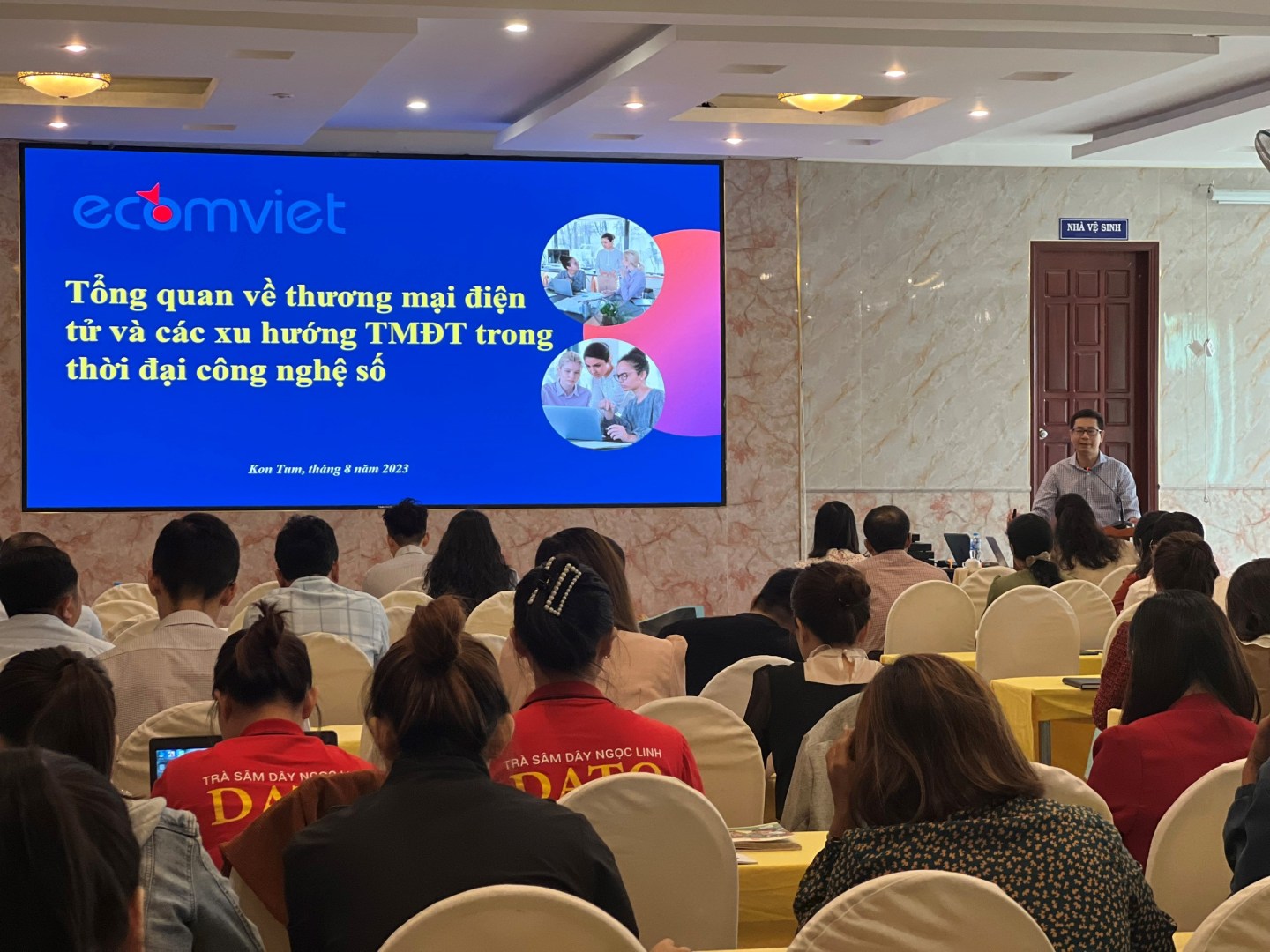



He proposed developing vocational training programmes that feature coordination between universities, colleges, and businesses to give students real-world experience along with access to the latest technologies and online business processes. Schools should also be encouraged to offer practical modules such as e-commerce website building, advertising campaign management, and livestream selling.


As part of its human resources development initiative, consumer finance company Happy Money recently organised a training course titled “Professionalism in Every Interaction – The Standard Happy Money Communication Style” led by a corporate skills training expert for nearly 200 employees in customer-facing departments.
The training programme was intensively designed to standardise the communication style, develop professional behaviour, and shape personnel images suited to the financial sector. Beyond theory, the course included practical interactive exercises to help staff apply the skills to real-life situations and improve service quality, especially in transaction offices where customer interaction takes place frequently.



According to Le Hoang Oanh, to promote human resources development, iDEA will push ahead with implementing the e-commerce development plan in localities, focusing on training and improving workforce quality.
Additionally, the agency will regularly cooperate with local authorities and global e-commerce platforms like Amazon and Alibaba to roll out a range of training and connection programmes across various provinces and cities.
Moreover, iDEA will assist schools in updating and revising training programmes, lecture content, learning materials, internships, and practicums for both lecturers and students. It will help them stay informed about the latest policies and trends in digital business and technology in this field. Through these efforts, Vietnam aims to quench its thirst for e-commerce manpower, building a professional, confident, and standardised workforce that fosters customer trust and drives sustainable development in the digital era./.
