
The role of the private sector is affirmed in Resolution No. 68-NQ/TW issued on May 4, 2025 by the Politburo, in which, for the first time, it is identified as one of the most important driving forces of the national economy.
Vietnam’s private sector is now placed on an equal footing with the state and collective economic sectors, playing a key role in building an independent, self-reliant, and deeply integrated economy.

Resolution 68 marks a major shift in the perception of the private sector, recognising it as the most important driving force of the national economy. This fosters excitement and confidence among the business community. Confidence is essential for the sector to make a leap forward and achieve real growth.
Inspirational goals
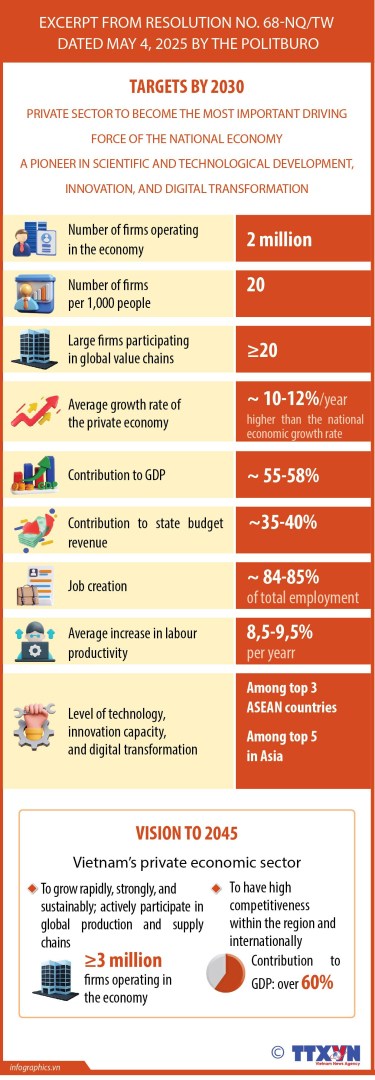
The resolution sets out both concrete goals and a long-term vision extending to 2030 and 2045. One standout target is to double the number of registered enterprises to 2 million by 2030. By then, the private sector is expected to contribute 58% of GDP, generate 40% of state budget revenue, and create jobs for 85% of the national workforce, demonstrating a clear, strong political commitment.


Of particular note is the goal of having at least 20 large firms participate in global value chains by 2030, and increasing the total number of businesses to 3 million by 2045. These targets reflect an ambition to transform Vietnam’s private sector into a global competitor that deeply integrates into the international economy.


But these are more than just numbers. They are a call to national pride, entrepreneurial spirit, innovation, and the legitimate pursuit of wealth by entrepreneurs, businesses, and all Vietnamese citizens.
Addressing institutional bottlenecks
Resolution 68 goes beyond rhetoric, targeting deep institutional reforms, long recognised as major obstacles to private sector development. Key measures include administrative simplification, reduction of red tape, full digitalisation of procedures, protection of property rights, and ensuring fair competition and contract enforcement.
A paradigm shift is underway: from pre-approval to post-audit regulation, from a “give-and-take” mindset to a service-oriented government. The resolution affirms the right of businesses to operate in all industries not prohibited by law, with any restrictions clearly defined. If fully and properly implemented, these reforms could transform Vietnam’s business environment.


Beyond regulatory reform, the resolution provides support policies for access to land, capital, and high-quality human resources, while also promoting digital transformation, innovation, sustainable development, and global value chain integration. Special mechanisms are designed to assist small- and medium-sized enterprises (SMEs) and household businesses, including tax exemptions, free digital tools, and legal support.
These are critical steps toward unlocking long-standing institutional constraints that have hindered private-sector development.

Rebuilding trust and confidence
The most important highlight of Resolution 68 is its focus on building trust—an intangible but indispensable asset. It emphasises the state’s responsibility to foster a transparent, stable, predictable, and globally-aligned business environment. Such conditions are vital for businesses to confidently invest in the long term, innovate, and expand their operations.


Prime Minister Pham Minh Chinh chairs a meeting in Hanoi on February 10 between permanent Government members and leaders of businesses to discuss solutions for private enterprises’ acceleration and breakthrough, thus contributing to fueling the nation’s rapid and sustainable growth in the new era (Photo: VNA)


For the first time, a Politburo resolution explicitly enshrines the protection of property rights, business freedom, fair competition, and contract enforcement—not merely as ideals, but as enforceable legal principles. Eliminating legal barriers will help unlock social capital, drive innovation, and boost national competitiveness.
Resolution 68 doesn’t just provide strategic orientation for private sector development but serves as a solid stepping stone for building trust for people and businesses so that they believe starting a business is legitimate, wealth creation is encouraged, innovation is a catalyst of development, and the law is a reliable safeguard for every contribution.
Unlocking resources for growth

The resolution also outlines targeted policies to ensure equitable access to growth resources. On land, it promotes transparency, digital transactions, and faster processing. Regarding finance, it encourages the expansion of green credit, stock markets, investment funds, and crowdfunding. On human capital, it calls for practical training, executive education, and stronger digital and language skills aligned with the demands of digital transformation.


Innovative enterprises are offered incentives through tax breaks, R&D deductions, technology development funds, and regulatory sandboxes. These tools aim to help private businesses evolve from passive market participants to technology leaders and business model pioneers.
Resolution 68 also encourages stronger linkages between private, state-owned, and foreign-invested enterprises to build resilient domestic supply chains. The “Go Global” initiative reflects a clear vision: empowering Vietnamese businesses to expand internationally and become integral players in global value chains.

Importantly, the resolution pays special attention to small, micro and household businesses, which make up the largest share of Vietnam’s economy. Measures such as abolishing lump-sum taxation, providing free accounting software, simplifying financial management, and offering business training aim to help them transition into more formal and transparent operations. Inclusive financial policies will also empower women, youth, and ethnic minorities.


If fully implemented, Resolution 68 could become a powerful catalyst for a new era of development in Vietnam—one driven by innovation, integration, and inclusive prosperity. At its core lies a vibrant, confident, and empowered private sector, poised to lead the way forward./.
