Recognising the crucial role of the private sector, the Party and State have implemented robust policies to drive its development, aiming for rapid and sustainable economic growth. The establishment of the steering committee for building a private economic development project, along with the determined leadership of Party General Secretary To Lam, demonstrates the high political commitment to eliminating barriers, unlocking resources, and fostering the private sector, making it a key pillar of the economy.



The private sector has consistently maintained a fairly strong growth rate and continues to be the largest contributor to the economy. Illustrative photo. Source: VNA
Currently, the private sector comprises over 6.1 million business establishments, including approximately 940,000 active enterprises and more than 5.2 million business households. The private sector continues to maintain a steady growth rate, remaining the largest contributor to the economy, accounting for about 50% of GDP and over 56% of total social investment.


The private sector contributes more than 30% of Vietnam’s total export turnover. Photo: VNA
The private sector contributes more than 30% of Vietnam’s total export turnover. The sector’s active involvement in export activities has helped Vietnam expand its market reach, diversify export products, effectively leverage free trade agreements, increase added value, and elevate the status of Vietnamese products on the international stage.


Workers in the private sector currently account for around 82% of the national workforce. (Photo: VNA)
In terms of employment, the private sector accounts for approximately 82% of the total workforce in the country, generating millions of new jobs each year. The development of private enterprises not only helps reduce unemployment but also improves income and living standards for workers. Notably, these businesses have played a significant role in shifting the workforce from agriculture to industry and services, driving the urbanisation and modernisation of rural areas.


Many private enterprises have taken the lead in adopting new technologies and investing in research and development (R&D), contributing to improved productivity and product quality. Photo: VNA
In the field of innovation, many private enterprises have been pioneers in adopting new technologies, investing in research and development (R&D), and contributing to enhanced productivity and product quality. The private sector’s flexibility and responsiveness have led to the creation of numerous new products and services that meet the growing demands of both domestic and international markets. This not only strengthens the economy’s competitiveness but also contributes to building a national brand globally.
The private sector has also made a crucial contribution to improving labour productivity, with an average annual growth rate of 6-8%. The ongoing competition and innovation within the sector has driven skill enhancement, process improvements, and the adoption of new technologies, fostering sustainable economic growth and increasing workers’ income. Thanks to this competition, consumers now have more options and better access to products with competitive prices and higher quality.
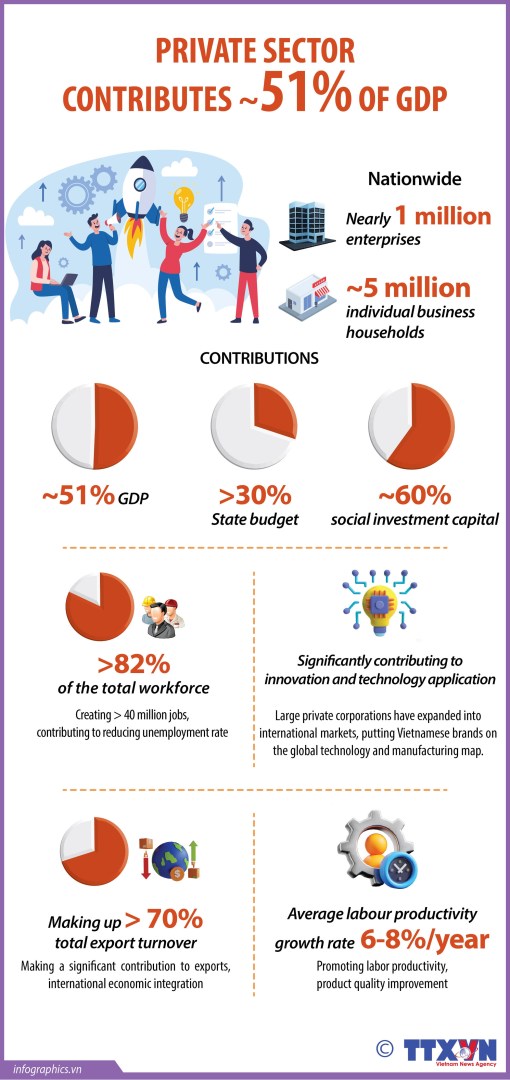
The private sector has been playing an indispensable role in the socio-economic development of Vietnam. Photographics by VNA
Overall, the private sector has affirmed its indispensable role in Vietnam’s socio-economic development, significantly contributing to the country’s strategic goals. At a meeting on March 7, 2025 with the Party Central Committee’s Commission for Policies and Strategies on the development of the private sector, General Secretary To Lam emphasised that the private sector is the most important driver of economic growth.
Barriers remain
Although the private sector has made significant contributions to the national economy, it still faces numerous challenges that hinder its sustainable development. During the March 7 working session, the Party chief highlighted several limitations, such as constraints in scale, capacity, and competitiveness, especially in international competition.
One of the major difficulties facing the private sector is an unfriendly business environment.
Dr. To Hoai Nam, Permanent Vice Chairman and General Secretary of the Vietnam Association of Small- and Medium-Sized Enterprises (VINASME)

Dr. To Hoai Nam, Permanent Vice Chairman and General Secretary of the Vietnam Association of Small- and Medium-Sized Enterprises (VINASME), identified some of the major difficulties facing the private sector, including an unfriendly business environment. Private enterprises often find it hard to access capital, land, and other necessary resources due to complex administrative procedures and informal costs. While Vietnam has recently implemented several reforms to improve the business environment, many barriers still remain that need to be addressed to better facilitate private enterprise development.


The majority of private enterprises are small- and medium-sized. Photo: VNA
Furthermore, the competitiveness of Vietnamese private enterprises remains limited. Most of them are small and medium-sized, lacking resources for research and development, which diminishes their innovation ability. This reduces their competitiveness in international markets, especially in the context of deeper economic integration.
In addition, compliance with laws and corporate governance practices is not always sufficiently rigorous. Many private enterprises fail to build transparent administration systems, leading to tax evasion and legal violations. This not only damages the reputation of businesses but also undermines trust from partners and customers.
Moreover, the linkage between private enterprises and other sectors of the economy remains weak. The lack of cooperation and information-sharing between businesses leads to unhealthy competition, which reduces economic efficiency.


Although the proportion of trained workers is increasing, their skills and qualifications have still not met the needs of businesses. Illustrative photo. Source: VNA
Another critical issue is workforce quality in the private sector, which has yet to fully meet the demands of the market. Although the number of trained workers is increasing, their skills and qualifications still fall short, particularly in high-tech industries. The shortage of skilled labour significantly affects the competitiveness and development of private enterprises.
Removing bottlenecks

Prime Minister Pham Minh Chinh chairs the second meeting of the steering committee for building a private economic development project on April 2, 2025. Photo: VNA
To ensure that the private sector becomes the most crucial driver of the economy, on March 6, 2025, Prime Minister Pham Minh Chinh issued Decision No. 526/QD-TTg to establish the steering committee for building a private economic development project, led by the Prime Minister, with Deputy Prime Minister Nguyen Chi Dung as the Permanent Deputy Chairman and Minister of Finance Nguyen Van Thang as the Deputy Chairman. The establishment of this steering committee reflects the Government’s responsiveness in implementing the Party’s policy on developing the private sector.

Party General Secretary To Lam works with the Parry Central Committee’s Commission for Policy and Strategy on March 7, 2025. Photo: VNA
Also at the March 7 working session, Party General Secretary Lam emphasised the need for a clear development strategy for the private sector, aligned with the current level of economic development and the new geo-economic and geopolitical context of the country.
He stressed the importance of eliminating any negative perceptions, biases, or prejudices against the private sector, encouraging the development of an industrial mindset and a culture of business and entrepreneurship throughout society. The General Secretary also called for the removal of institutional bottlenecks, improvements in the investment and business environment, and the elimination of barriers to enterprise development.
On March 15, 2025, the steering committee held its first meeting to outline the framework, tasks, objectives, and main directions for the proposal to the Politburo.
Deputy PM Dung emphasised the need to develop project with strong, breakthrough policies that are highly feasible and meet the requirements of the new era. He stressed the importance of having clear, concise content, with a focus on key solutions to address the main bottlenecks hindering private sector growth.

Deputy Prime Minister Nguyen Chi Dung chairs the first meeting of the steering committee for building a private economic development project on March 15, 2025. Photo: VNA
The goal is to have 2 million private enterprises and 1,000 large enterprises playing a leading and pioneering role in various sectors by 2030.
With the strategic orientation of the Party and the active involvement of the Government and ministries, Vietnam’s private sector is on the brink of a promising future. It will play core role in economic growth, while serving as a foundation helping Vietnam become a developed, modern nation with high international competitiveness./.
