
The Central Highlands province of Kon Tum has issued a directive aimed at strengthening the preservation and promotion of the cultural heritage of local ethnic minorities, particularly the space of gong culture, traditional festivals, and folk songs, dances, and music.
The provincial People’s Committee has instructed relevant departments to review, document, and collect the heritage from the seven long-established ethnic groups in Kon Tum. They are Gia Rai, Ba Na, Xo Dang, Gie -Trieng, Brau, Ro Mam, and Hre.
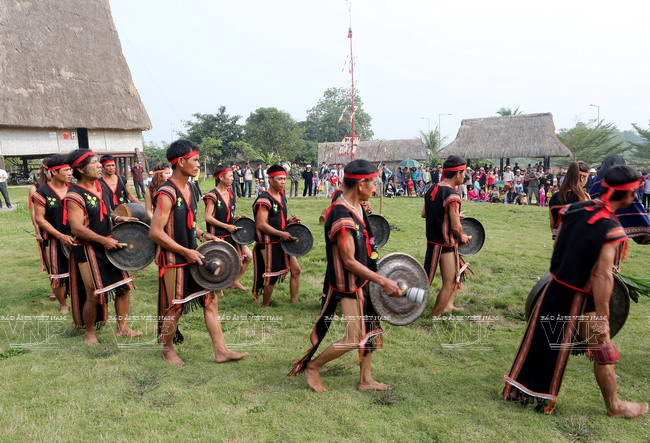
The Ba Na ethnic group’s peace-praying festival in Kon Tum is vividly and authentically recreated at the Vietnam National Village for Ethnic Culture and Tourism in Dong Mo, Son Tay, Hanoi. (Photo: VNA)
Accordingly, guidance should also be provided to localities to preserve and restore their communal houses in a way that maintains the cultural identity of these communities and leverages locally available materials.
It is necessary to develop traditional crafts tied to the gong culture, festivals, folk music, and local economic and social development.
Also in need are the proposal and implementation of protection measures targeting traditional village names to preserve cultural spaces, as well as the prohibition of actions that may dilute or alter ethnic minority cultures.


Preservation efforts have helped establish a sustainable cultural system across Kon Tum (Photo: VNA)
Annually, based on current budget allocations and legal external sources, funds are set to be prioritised to support the preservation of the cultural heritage.
In 2022, the provincial Party Committee issued a resolution focusing on the preservation of traditional crafts through 2025, with a vision for 2030, the results of a project on sustaining traditional village culture for the 2020 – 2025 period.
To date, such efforts have helped establish a sustainable cultural system across the province.
Out of 622 ethnic minority villages in Kon Tum, 409 now have Rong (communal) houses. The establishment is considered as the most sacred place where the souls of the heaven and earth join together to protect the village and its people. It is the administrative headquarters of ethnic villages and also the place where community activities, such as religious festivals, the delivery of a new baby and wedding ceremony, take place. It has for long been praised as a great work of sculpture, painting and decoration. Each village keeps their own valuable traditional objects such as gong, drum, weapon and heads of immolated animals in its Rong house.
These traditional structures contribute to the richness of the province’s cultural identity and attract both tourists and researchers. Renovating and preserving traditional Rong houses are crucial in the modern context, as they are the core of the culture of ethnic groups in the Central Highlands, together with the famous gong space.


Effective preservation and restoration of traditional Rong houses will create conditions for heritages and cultural values associated with them to be preserved and promoted. (Photo: VNA)
Kon Tum has also implemented an open-air museum project, showcasing the traditional cultural space of ethnic minority groups. This approach has proven effective and widely influential.
In terms of intangible heritage, the province has successfully restored several traditional cultural practices, including the Ro Mam Wedding Ceremony, Brau New Rice Festival and Xo Dang Water Source Ceremony. The new rice celebration is usually held around October (lunar calendar) when the rice is ripe and the ethnic community begins harvesting them.


The new rice celebration is usually held by the Xo Dang people in Kon Tum around October (lunar calendar) when the rice is ripe and the ethnic community begins harvesting them. (Photo: VNA)
In addition, Kon Tum has conducted surveys and collected cultural highlights from the Brau and Xo Dang ethnic groups.
According to the provincial ethnic affairs committee, Xo Dang people are among the indigenous groups that have long resided in the Truong Son mountain range, the Central Highlands region, and nearby mountainous areas of Quang Nam and Quang Ngai provinces. Today, they predominantly live in Kon Tum province as well as Tra My and Phuoc Son districts of Quang Nam and Tay Son district of Quang Ngai. Believers in supernatural forces, the Xo Dang integrate numerous rituals into their daily lives and farming practices, focusing on prayers for bountiful harvests, safety, and protection from misfortune for both individuals and their communities. The ethnic minority group are known for their numerous musical instruments and dances, with specific dance performances for men, women, or mixed-gender groups. Additionally, their folklore is rich and vibrant, featuring an array of captivating tales passed down through generations.
The Brau people, meanwhile, migrated to Vietnam around a century ago and now primarily reside in Dac Me village, Bo Y commune, Ngoc Hoi district, Kon Tum. They live in high-roofed stilt houses and rely on upland farming to cultivate rice, corn, and cassava as their primary livelihood. Within their villages, traditional blacksmith workshops repair farming tools, while skilled men craft woven items. At the heart of the community is the communal house, which also serves as a training ground where village elders teach the youth vocational skills, cultural traditions, and the importance of safeguarding their community’s security and heritage. Brau folklore includes enchanting melodies, wedding songs, lullabies, and myths such as the story of Pa Xay – the creator god, and the legend of Un Cha Dap Lep. Their musical heritage is equally distinctive, featuring instruments like the klong put and sets of bronze gongs.
These two groups exemplify the cultural diversity of Kon Tum, offering a wealth of traditions, stories, and arts that contribute significantly to the province’s vibrant heritage.
Notably, in Kom Tum, gong culture is now integral to the lives of local ethnic minorities, closely linked to communal ceremonies and often held in their communal houses, stilt houses, or cemeteries.
Since a project to preserve gong culture for the 2016 – 2020 period was launched, 502 out of 622 local ethnic minority villages now have gongs. Over 200 workshops have been held, teaching over 5,000 participants gong playing, traditional dances, weaving, basketry, and musical instrument crafting, among others.
Gongs dated back to the Dong Son culture, some 3,500-4,000 years ago. Nowadays, the cultural space of gongs covers five Central Highlands provinces, namely Dak Lak, Dak Nong, Lam Dong, Kon Tum and Gia Lai, with 17 ethnic minority groups. As a communication form among people, with Gods and the supernatural world, they become the most sacred and valuable asset in every ethnic family. Most of ethnic minority villages in the Central Highlands have a gongs team to play at their groups’ traditional rituals and festivals, such as wedding, new house welcoming, baby delivery, crop harvest, new year, and funeral. The space of the gong culture in the Central Highlands was recognised as a masterpiece of the oral and intangible cultural heritage of humanity on November 25, 2005.


To preserve and promote the cultural values of indigenous peoples, the Education Department of Kon Tum city has introduced gong and xoang dance into extracurricular teaching hours. (Photo: VNA)
Additionally, the Ba Na-Ro Ngao ethnic group’s Epic has been recognised as a national intangible cultural heritage, contributing to further safeguarding these unique traditions.

Blessed with a cool climate, diverse ecosystems, and natural beauty, including forests, rivers, and waterfalls, Kon Tum is well-suited for eco-tourism, adventure and resort tourism.
The province also boasts several scenic spots, such as the Mang Den Ecotourism Resort and Chuu Mom Ray National Park.
With a rich history and diverse cultural heritage, it is home to over 30 ethnic groups, each with distinct customs and traditions. These include customary laws, housing styles, festivals, gong music, folk art, traditional clothing, ethnic languages, and crafts like weaving and carving.
By 2025, Kon Tum aims to develop diverse tourism products, focusing on ecotourism, community-based, and cultural-historical tourism. The province will also invest in key sites such as Mang Den and Chu Mom Ray to fully develop its ethnic tourism potential. It plans to complete five main tourism offerings, including eco-tourism, cultural-historical tourism, resort tourism, community-based tourism, and specialised thematic tourism.
Kon Tum currently boasts 13 tourist destinations and one provincially-recognised tourism area. In the first half of this year, it welcomed an estimated 1.565 million visitors, generating approximately 427 billion VND (16.7 million USD) in revenue.
According to Bach Thi Man, Deputy Director of the provincial Department of Culture, Sports, and Tourism, the province aims to attract 1.7 million tourist arrivals in 2024, representing an annual increase of nearly 30%. The projected total revenue is expected to reach 605 billion VND, up 12% year-on-year.
Looking ahead, Kon Tum is setting its sights on welcoming 2.5 million visitors by 2025./.
