
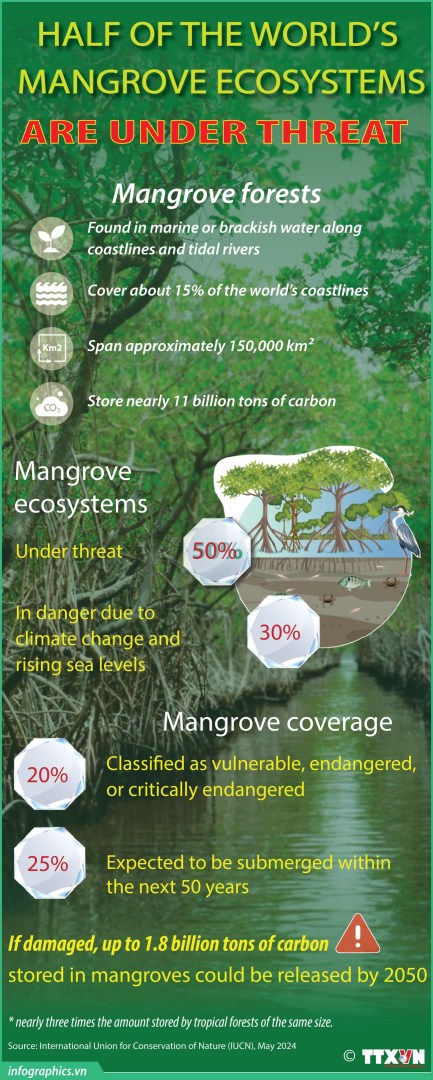
Despite covering just about 200,000 hectares or 1.5% of the national forest area, mangrove forests are highly valued for their socio-economic and biodiversity conservation benefits. The United Nations Development Programme (UNDP) has recognised them as a significant carbon sink, contributing substantially to reducing greenhouse gas emissions.
A Source of Blue Carbon
According to the Ministry of Agriculture and Rural Development (MARD), mangrove forests are distributed across 28 coastal provinces and cities. Notably, the southern region, the northeast region and the Red River Delta account for 97% of the country’s mangrove coverage.
Supported by the Climate Promise project in the Asia-Pacific, the UNDP has partnered with the MARD’s Department of Forestry to develop methods for measuring and calculating carbon stored in these forests. This project has piloted calculations in areas such as Hai Phong, Quang Ninh, Thua Thien-Hue, Binh Dinh, Ho Chi Minh City, and Ca Mau, representing six ecological regions of the Northeast, Red River Delta, North Central, South Central, Southeast, and Southwest.


The Vam Sat ecotourism area, located within the Can Gio Mangrove Biosphere Reserve, in Can Gio district, Ho Chi Minh City, has been recognised by the World Tourism Organisation as one of the two sustainable ecotourism destinations in Vietnam. (Photo: VNA)
Results indicate that they hold about 245 tonnes of carbon per hectare, with 71% of this carbon stored in the soil beneath the mangroves (up to 30 cm deep) and only 29% in the biomass of living plants (both above-ground and root systems). Carbon stock assessments in six representative localities show significant storage amounts, including over 3 million tonnes in Quang Ninh, 15.7 million tonnes in Ho Chi Minh City, and 12.7 million tonnes in Ca Mau.
Evaluating the carbon absorption and storage capacity of mangrove forests provides a scientific basis for state management on greenhouse gas emissions reduction and the conservation and development of mangroves. It also supplies information for international negotiations on greenhouse gas reduction programmes. Revenue from carbon sales can support forest management, protection, development efforts, and improve the livelihoods of people in mangrove areas.
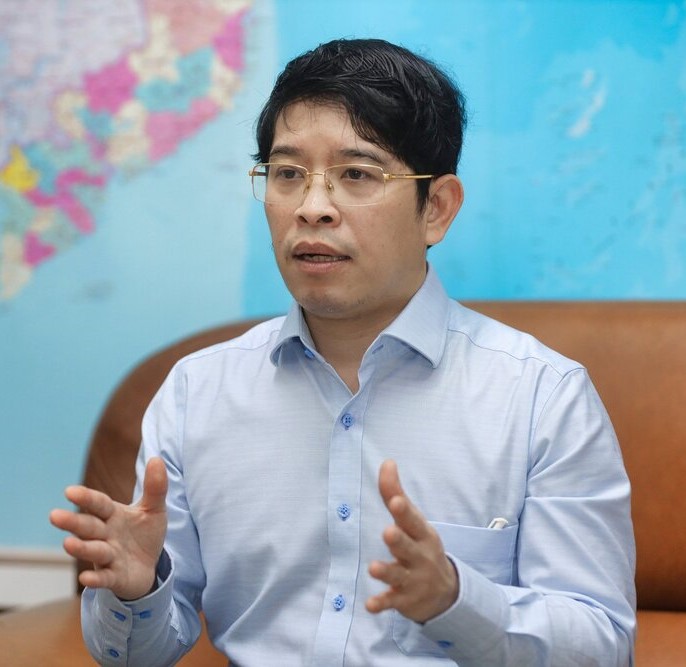
Nguyen Dinh Tho, Director of the Ministry of Natural Resources and Environment’s Institute of Strategy and Policy on Natural Resources and the Environment (ISPONRE)
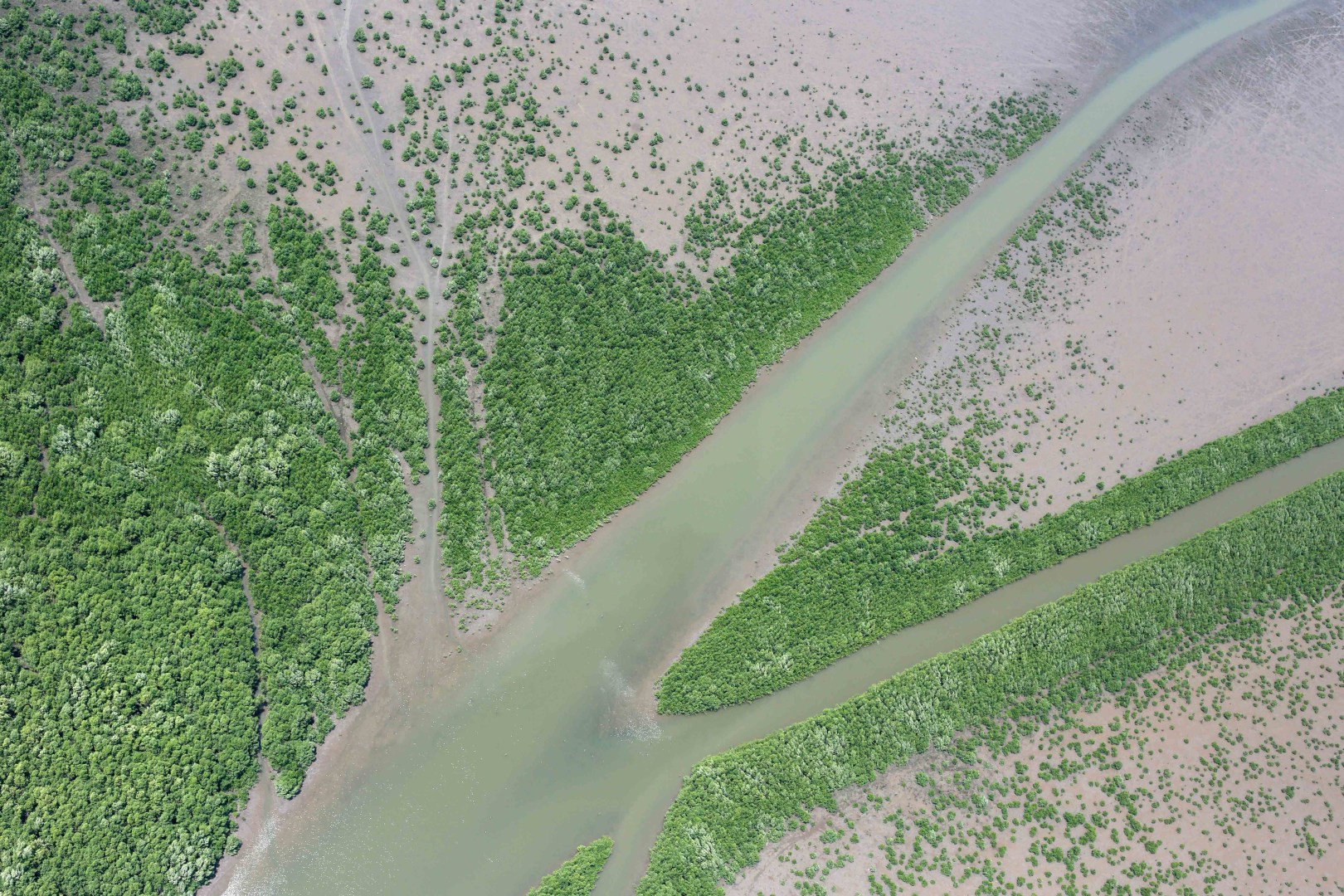
Ca Mau, located at the southernmost tip of Vietnam, has a unique geographical position with three sides bordering the sea. Covering a total area of nearly 50,500 hectares, the local mangrove forests are among the largest in the world, featuring a rich and diverse ecosystem of flora and fauna. ISPONRE, in collaboration with the Dragon Capital Vietfund Management (DCVFM), conducted a study on the valuation of the mangrove ecosystem. It reveals that the ecosystem provides substantial contributions, ranging from direct use values (such as food supply, timber, fuel wood, and tourism) to indirect use values such as carbon storage and sequestration, and landscape beauty. It also holds conservation value by reducing encroachment by ocean waters.
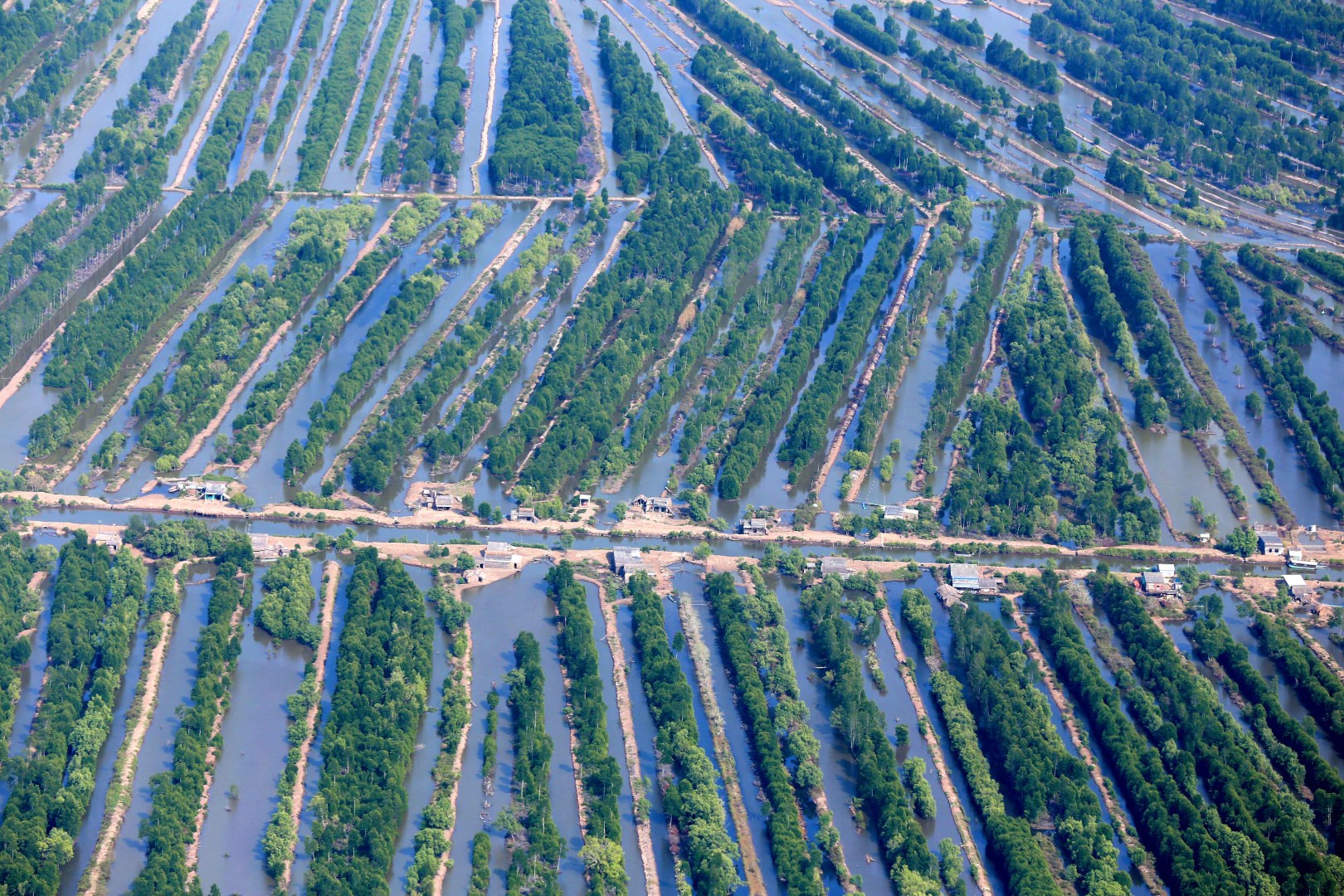

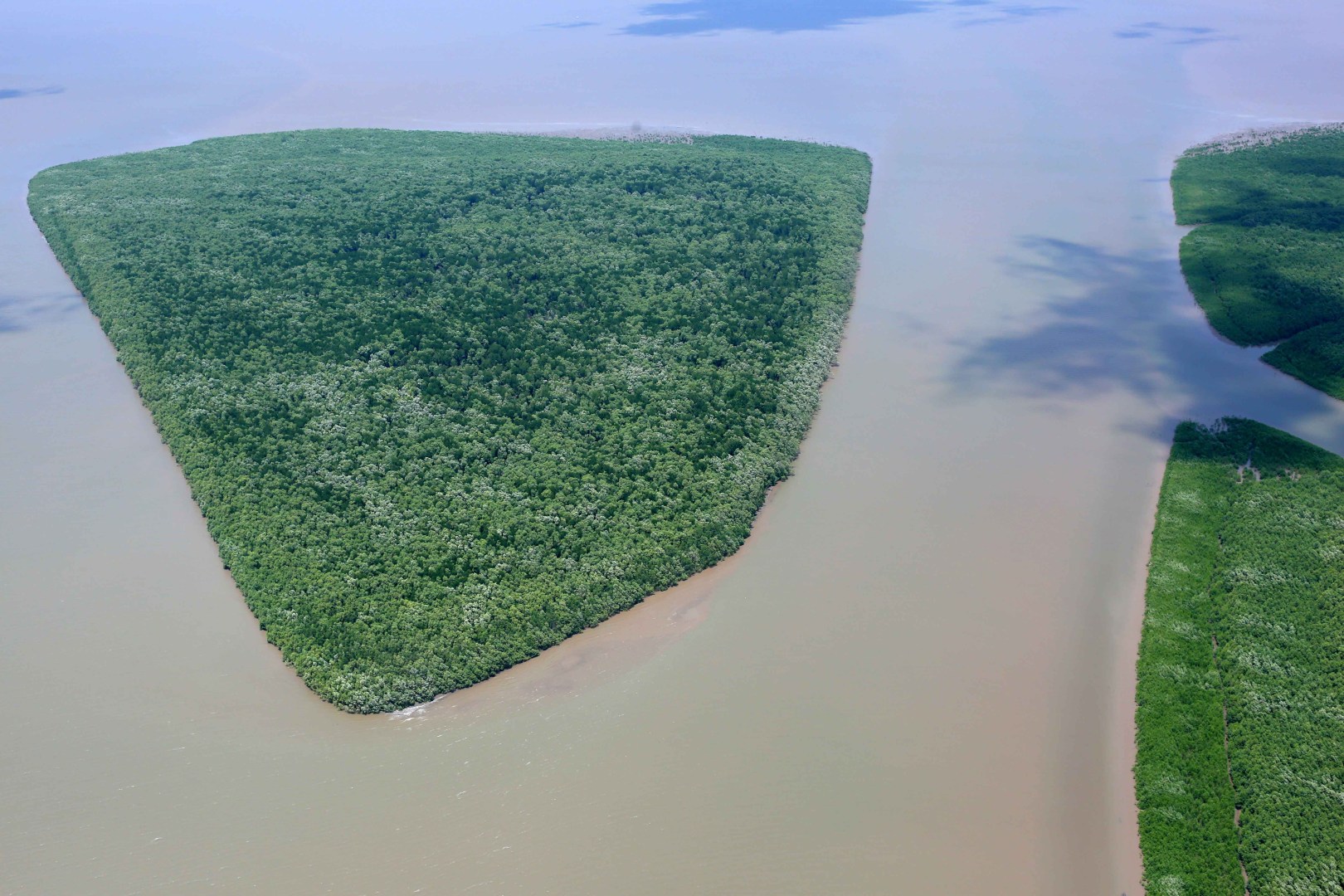
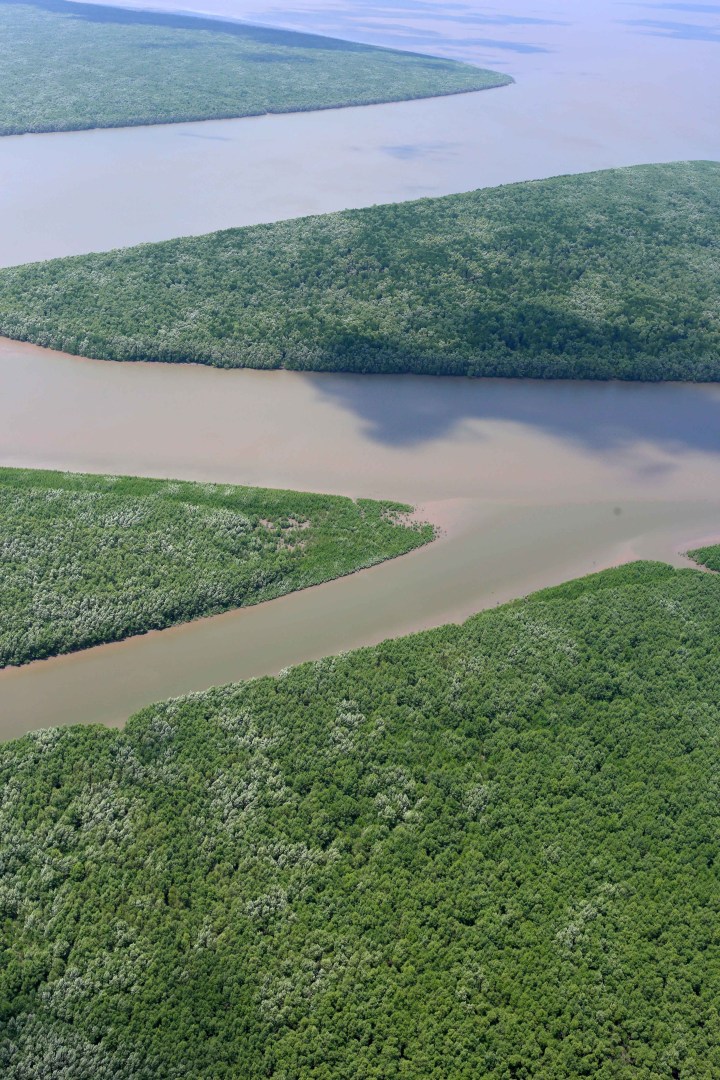
Mangrove trees are gradually encroaching into the sea, expanding the area of the U Minh Ramsar site. (Photo: VNA)
Their total economic value is estimated at over 1.74 trillion VND (70.83 million USD) per year. Of this, direct use values exceed 1.08 trillion VND per year, while indirect use values contribute 656.1 billion VND per year. This proportion is expected to change as the national policy on payment for forest environmental services is implemented. According to this policy, large emitters will be required to pay for the carbon storage and sequestration services provided by forests. Consequently, the value of carbon storage and sequestration by mangrove forests will be reclassified as a direct use value.
Protecting a valuable resource
Recognising mangrove forests as a valuable national resource, Vietnam continually emphasises their importance and has strengthened related management policies.
In October 2021, the Prime Minister approved a plan to protect and develop coastal forests in response to climate change and promote green growth for the 2021-2030 period. The plan aims to sustainably manage, protect, and utilise existing coastal forests and newly created forest areas, with a target to plant about 20,000 hectares of new forests and rehabilitate and enrich 15,000 hectares by 2030.


Local authorities, the forest management board, and youth union members of Ho Chi Minh City are working together to protect and plant trees in the Can Gio biosphere reserve. (Photo: VNA)
Efforts to protect and enhance the economic value of coastal mangrove forests in Vietnam have been actively supported by localities, communities, businesses, and international organisations.
For example, an initiative entitled “Canh rung Net Zero (Net Zero Forest) by Vinamilk and the Gaia nature conservation centre aims to regenerate 25 hectares of mangroves within the Ca Mau Cape National Park. The project, lasting six years from August 2023, plans to plant 100,000 – 250,000 of Avicennia trees, with an investment of 4 billion VND from Vinamilk.
The project also includes activities to support the natural regeneration of mangrove forests, along with awareness-raising programmes for local communities living in and around the Ca Mau Cape National Park. With an estimated 25 hectares of mangrove forest under normal growth conditions, it is expected to create a carbon sink capable of absorbing between 17,000 and 20,000 tonnes of carbon, or between 62,000 and 73,000 tonnes of carbon dioxide equivalent (CO2e).


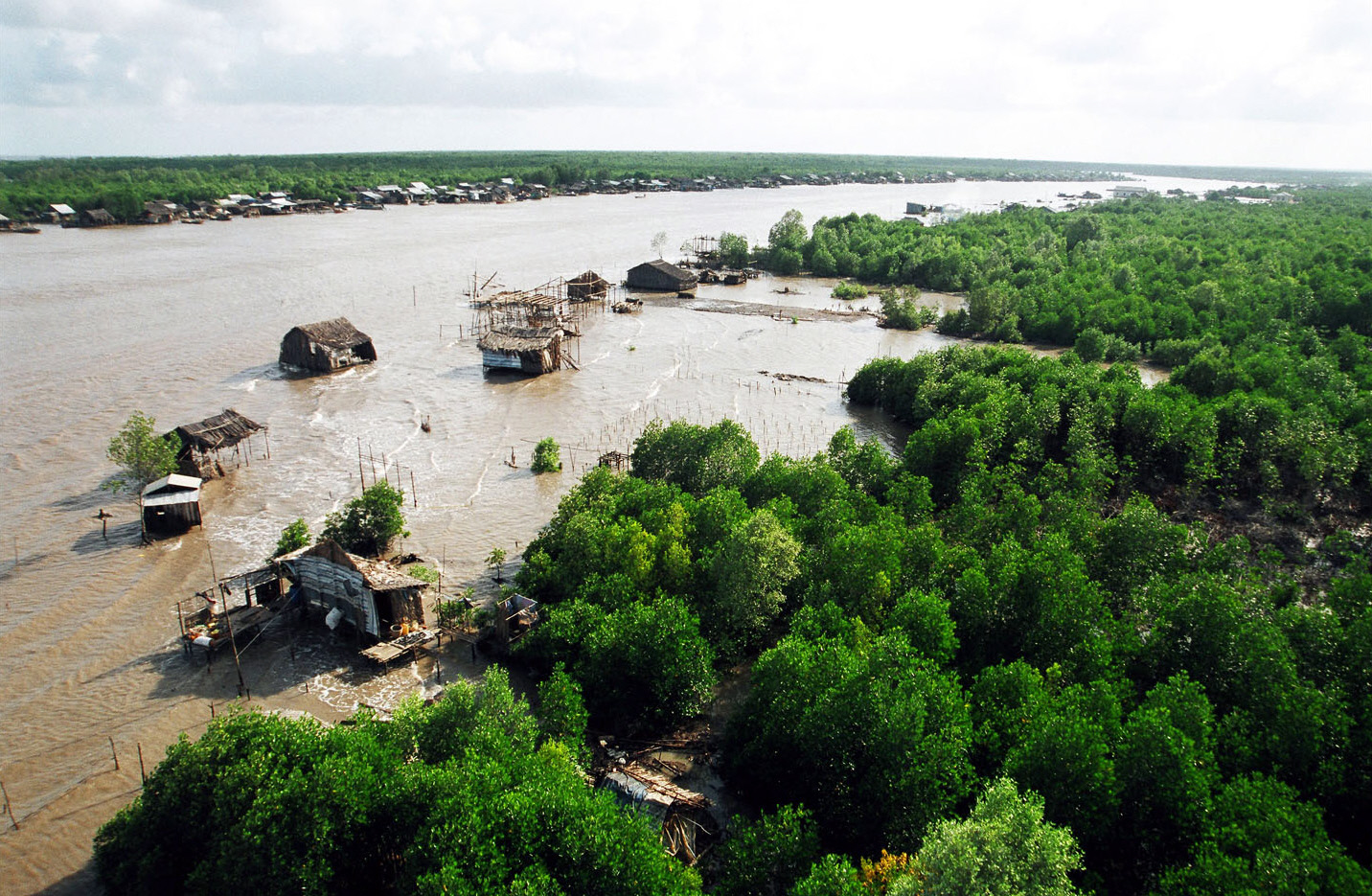
The mangrove forest at Ca Mau Cape plays a crucial role in coastal protection, windbreaks, the prevention of erosion, and the improvement of climatic factors. (Photo: VNA)
In the six coastal provinces of Nam Dinh, Thanh Hoa, Thua Thien-Hue, Quang Nam, Quang Ngai, and Ca Mau, 4,260 hectares of mangroves have been supplemented, restored, and newly planted as part of the GCF project on enhancing resilience of coastal communities to climate change impacts in Vietnam.


The Xuan Thuy National Park (Nam Dinh province) is home to nearly 20 species adapted to wetland conditions, forming a vast mangrove forest ecosystem spanning thousands of hectares. (Photo: VNA)
Implemented since 2018, this project, co-financed by the Green Climate Fund, UNDP, and the Vietnamese Government, has seen many forests flourish, forming a “green wall” that shields coastal defences, reduces wave impact, protects sea dikes, improves livelihoods, and enhances biodiversity. Recent measurements up to June 2024 indicate that the project’s mangrove forests had reduced emissions by more than 1.1 million tonnes of CO2, surpassing the goal of over 565,000 tonnes. This methodology serves as a foundation for the Department of Forestry to refine its mangrove carbon measurement and calculation methods and to create a temporary technical manual for determining biomass and carbon stocks in coastal mangroves.
On August 12, Tien Phong Newspaper, in collaboration with the People’s Committee of Hai Phong City, launched an initiative to protect mangrove forests, with the newspaper donating to the coastal city 2,600 mangrove trees native to the area and are well-suited to the local soil and climate conditions. These trees are set to be planted in tidal flats in Vinh Quang commune, Tien Lang district.
Mangrove regeneration is a vital strategy to achieve both greenhouse gas reduction and climate change adaptation goals, aligned with Vietnam’s international commitments on climate change./.
