
Along with economic development and improved living conditions in Vietnam, attitudes toward nursing homes have gradually changed to a more plausible possibility. As a result, the demand for nursing homes is increasing in both quantity and quality.
This is not only a story in other countries. In Vietnam, real estate for nursing homes has begun, bringing many new opportunities, and attracting large developers.
According to experts, the demand for healthcare services of the elderly is increasing in quality and quantity in the context of the rapidly aging population.
Two major property developers in the Vietnamese market – Vingroup and Sun Group – have been stepping into the retirement housing market to capitalise on the opportunities.
In March 2024, Vingroup signed a cooperation agreement with Japan’s Well Group to develop a world-class healthcare model for the elderly that offers daily care and long-term care, also known as retirement homes. The model has been developed in Vinhomes Ocean Park 2 urban area in Hung Yen province.

Perspective of Vinhomes Ocean Park nursing home (Photo: Vingroup)
Meanwhile, the Sun Group is the second company that has developed retirement homes that provide comprehensive healthcare services for the elderly. In early August, the Sun Group started the construction of the Sun Urban City project in the northern province of Ha Nam, which also aims to develop products for the elderly where they can enjoy comprehensive healthcare services with a nursing home area and a specialised hospital.
However, experts said that these facilities only serve a very small number of elderly people in urban areas because the costs in private facilities are still high compared to the average income in Vietnam, especially the income of the elderly.
In Vietnam, the number of facilities that provide care services for the elderly in general, and the number of private facilities in particular, is still limited compared to the potential. According to a survey and statistics by Bao Viet Insurance Company (BVI), retirement homes are available in only 32 out of 63 provinces and centrally-run cities across the country while the rate of elderly people living alone is increasing.


Elderly people take part in activities at nursing homes. (Photos: VNA)
A survey by the Vietnam Association of Real Estate Brokers (VARS) shows that there are about 400 nursing homes in Vietnam, with about half of them being charity centres or being invested by the State. VARS also cited data from the United Nations Population Fund (UNFPA) as saying that Vietnam is one of the countries with the fastest-aging population in the world.
Accordingly, people aged 60 and over accounted for 11.9% of the total population in 2019 and this number will increase to more than 25% by 2050. Vietnam will enter the aged population period by 2036, shifting from an aging society to an aged society. This demographic change is not only due to a decrease in mortality rates and an increase in life expectancy, but largely due to a sharp decrease in the birth rate. The decline in the birth rate over the past decades has had a huge impact on Vietnam’s population structure, accelerating the aging rate.

It is expected that Vietnam’s aging population will continue to be accelerated as it is difficult to increase its birth rate. Specifically, the birth rate has halved over the past 30 years, from 3.8 children in 1989 to less than 2 children in 2023.
VARS analysed that while developed countries have hundreds of years or more than half a century to gradually change policies and respond to the gradual aging population, Vietnam only has at most 12 more years to take advantage of the golden population period and prepare to face the impact of population aging.
There are significant opportunities to develop retirement real estate in Vietnam to meet the demand for nursing care and health care to improve the quality of life of the elderly. This will become pressing according to VAR forecasts, especially when the family structure in Vietnam is changing so dramatically, with the proportion of elderly people living with their children decreasing in both urban and rural areas.
People will look for more options in the coming time, including daytime care, boarding, home-based care nursing, or community-based care. Seniors who have a sizeable income before their retirement will be particularly interested in elderly care services.
To ensure sufficient facilities and quality of care for the elderly, experts said that the State needs to develop policies to encourage businesses to participate in the sector, particularly in developing care models.
Retirement homes, as a special type of housing, require special attention. Like social housing, the State needs to study and provide preferential loans with low or zero interest rates for private enterprises that develop retirement home projects. VARS also proposed the Government establish a fund to provide grants or credit guarantees for retirement home development projects.
Vietnam Association of Real Estate Brokers

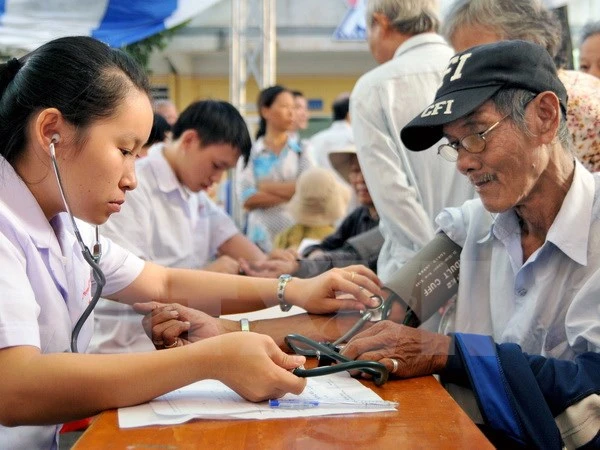
Illustrative photo (Photo: VNA)
In addition, policies are needed to encourage and attract foreign investors to the elderly care sector in Vietnam through offering incentives relating to land leases, taxes, and fees, and speeding up administrative procedure reform.
Troy Griffiths, Deputy Managing Director of Savills Vietnam, said that the Vietnamese market had multiple advantages for the development of retirement homes, with insurance packages that come with an investment value becoming particularly popular.
The Vietnamese market has multiple advantages for the development of retirement homes
Troy Griffiths, Deputy Managing Director of Savills Vietnam

In the future, there should be a shift of investment opportunities from traditional family houses to nursing centres, he added./.
