
Hanoi (VNA) – With a millennium-old history, the art of “Cheo” – a traditional theatrical art genre – has long been part of Vietnamese people’s culture and society and also a popular practice in their spiritual life.

“Cheo” is associated with the daily life and festive activities of Vietnamese people. It is traditionally performed in festivals to express gratitude to gods for bumper crops and well-being and as pure entertainment for the people.
Recently, Deputy Prime Minister Tran Hong Ha agreed on the submission of a dossier to UNESCO to seek the inscription of the art on the representative list of the intangible cultural heritage of humanity. The move not only affirms the significant cultural value of this art in the spiritual life of each Vietnamese but is also a source of pride for the people of Thai Binh province, which is renowned for its ancient and famous melodies of the Red River Delta.

Unique practice in the hub of rice farming
Nguyen Anh Tuan, Deputy Director of the Thai Binh provincial Department of Culture, Sports and Tourism, said “Cheo” is a form of folk theatrical art of Vietnamese people. It is strongly attached to the Red River Delta, along with nearby areas in the northern midland and mountainous region and the north-central region.


Scenes of a play titled “The king turns tiger” by artists of the “Cheo” troupe of Hai Phong city at the opening ceremony of the 2013 National “Cheo” Festival. (Photo: VNA)

Artists from the “Cheo” Theatre of Hai Duong province perform on the Sat River in May 2022. (Photo: VNA0
In each area, people have different performing techniques as the art style varies according to local folk songs and dances. The eastern “Cheo” zone covers Hai Duong province, Hai Phong city, Quang Ninh province, and the north of Hung Yen province. The western zone consists of western areas of Hanoi and the provinces of Phu Tho, Vinh Phuc, and Tuyen Quang. The southern zone spans the south of Hanoi, the south of Hung Yen, along with the provinces of Thai Binh, Nam Dinh, Ninh Binh, and Thanh Hoa. Meanwhile, the northern zone comprises the north of Hanoi and the provinces of Bac Giang, Bac Ninh, and Thai Nguyen.

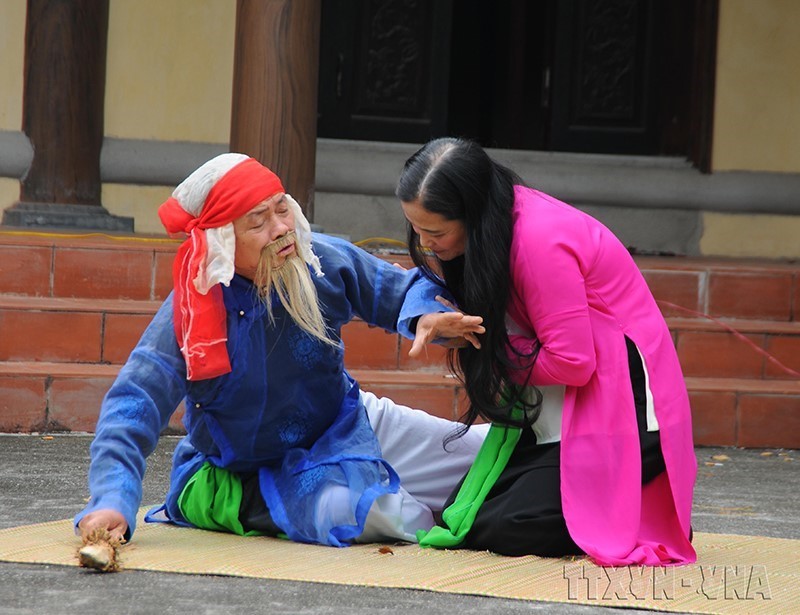
A practice session of a “Cheo” preservation club in Thai Binh province. (Photo: VNA)
Boasting many typical characteristics of the Red River Delta’s wet-rice culture, Thai Binh is where traditional folk cultural values, notably the art of “Cheo”, concentrate and are brought into play. Braving countless ups and downs in history, this province still preserves the soul of many unique melodies.
The provincial Department of Culture, Sports and Tourism said there are no documents that specify the time “Cheo” was first performed in Thai Binh. However, there were about 50 units called by different names such as “Ganh”, “Phuong”, and “Hoi” here in the last half of the 19th century. They had three core zones – “Cheo Khuoc” in Phong Chau commune of Dong Hung district, “Cheo Ha Xa” in Tan Le commune of Hung Ha district, and “Cheo Sao Den” in Song An commune of Vu Thu district.


The “Cheo” club of Khuoc Bac hamlet in Phong Chau commune, Thai Binh’s Dong Hung district, maintains routine activities at the local temple dedicated to the founder of “Cheo”. (Photo: VNA)
Making reference to Thai Binh, “Cheo Khuoc” is the first to be mentioned. Seeing the ups and downs throughout its long history, the distinctive features of “Cheo Khuoc” are still maintained nowadays. This village also serves as a training place supplying several actors/actresses and instrumentalists for many theatres and professional troupes in Thai Binh and other localities.

In Khuoc Village, “Cheo” is an indispensable part of the spiritual life of locals, from the elderly to youngsters. Some families even have two or three generations of performers of the art, which is passed down as a treasure to the young.
The tradition is facing the risk of disintegration as a wide range of new entertainment forms have emerged in modern society. To preserve this folk art, Thai Binh has boosted the performance of “Cheo” in the community.
The Thai Binh version of the performance was recognised as part of the national intangible cultural heritage by the Ministry of Culture, Sports, and Tourism on February 14, 2023.
Efforts made to keep “Cheo” melodies going
Thai Binh identified the preservation of the traditional performance as an important task. In 2022, the provincial People’s Committee approved a plan to develop this art for the 2022 – 2025 period, with an orientation towards 2030. The goal is to turn “Cheo” into a cultural product, a tourism product, and also a source of strength contributing to local socioeconomic development.


Nearly 300 “Cheo” clubs have been established across Thai Binh, gathering over 8,000 members. (Illustrative photo: VNA)
Tuan said to uphold the art, the provincial administration has ordered district-level centers of sports and culture to open “Cheo” classes. So far, nearly 300 clubs with over 8,000 members have been established across Thai Binh.
Thai Binh is among the few localities taking the lead in teaching the “Cheo” performances at schools. In 2022, its People’s Committee also adopted a plan to develop the art in preschool, high school, vocational training, and continuing education establishments to 2030. After more than one year of implementation, this plan has proved effective in inspiring the young’s love for folk art which is now at risk of falling into oblivion.


The art of “Cheo” is included in the curriculum of the Binh Dinh Primary School in Kien Xuong district, Thai Binh province. It is taught in music and literature lessons, and also practiced on playground every Tuesday and Thursday morning. (Photo: VNA)


Kindergarten children in Thai Binh province learn to perform traditional “Cheo” melodies. (Illustrative photo: VNA)
Tran Thi Bich Van, Deputy Director of the provincial Department of Education and Training, said 100% of local schools have included “Cheo” in their curricula, teaching the art via diverse forms. Many have also set up “Cheo” clubs for students, and some even created their own compositions.
To help affirm the value of “Cheo” in the millennia-long history of Vietnamese people, the Department of Culture, Sports and Tourism of Thai Binh and 13 other localities in the northern delta and midland region coordinated to complete a dossier to be submitted to UNESCO to seek the recognition of this art as part of the representative list of the intangible cultural heritage of humanity.
Thanks to efforts by the local community and administration, the art is still being preserved and passed down from generation to generation in Thai Binh. Both traditional and modern forms have created intrinsic cultural strength and become a characteristic of this province./.
