The Lang Son Geopark has been recognised as a UNESCO Global Geopark. (Photo: VNA)
Hanoi (VNA) – The recent recognition of the Lang Son Geopark as a UNESCO Global Geopark is expected to help the northern province gain momentum and mobilise resources for enhancing the management, preservation, and promotion of the geopark, along with its biodiversity, historical and cultural values, and scenic landscapes.
Earlier, three geoparks in Vietnam had earned the recognition, namely the Dong Van Karst Plateau in the northernmost province of Ha Giang, Non Nuoc Cao Bang Geopark in the northern province of Cao Bang, and Dak Nong Geopark in the Central Highlands province of Dak Nong.
The recognition was made at a meeting held in the northern province of Cao Bang on September 8 within the framework of the 8th Asia Pacific Geoparks Network Symposium.
The Lang Son Geopark is scheduled to receive the UNESCO Global Geopark certificate in Chile next year.
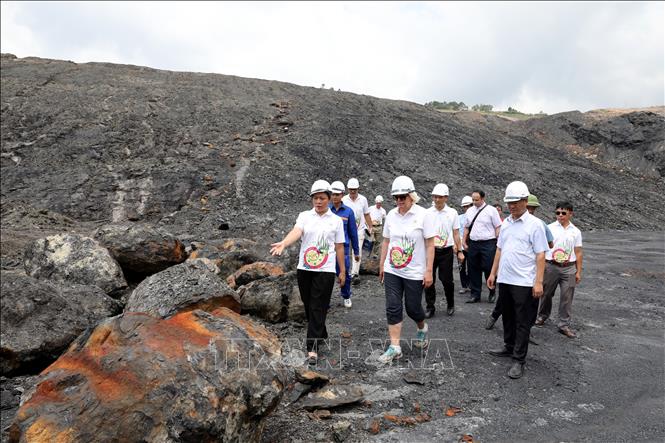
The management board of the Lang Son Geopark and experts during a trip to assess and verify the dossier of the Lang Son Geopark. (Photo: VNA)
New development direction for Lang Son tourism
Established in 2021, the Lang Son Geopark stretches across Bac Son, Chi Lang, Huu Lung, Loc Binh, and Van Quan districts and Lang Son city, along with part of Binh Gia and Cao Loc districts, which cover 4,842.58 sq.km. This area is home to nearly 627,000 people, equivalent to about 58% of the province’s area and 78% of the local population.
Covering a total area of 4,842.58 sq.km, the Lang Son Geopark is one of the largest of its kind in Vietnam. (Photo: VNA)
As one of the largest of its kind in Vietnam, the Lang Son Geopark features many distinctive features, including geological and geomorphological values. It also boasts a rich system of paleontological fossils showing hundreds-of-millions-of-years history of life, as far back as 500 million years. Some fossils indicate that this area used to be under the sea.
Đoàn chuyên gia UNESCO thẩm định hồ sơ Công viên địa chất Lạng Sơn
The Lang Son Geopark boasts a rich system of paleontological fossils showing hundreds-of-millions-of-years history of life. (Photo: VNA)
The geopark is also famous for such scenic landscapes as the low rock mountains surrounding valleys and villages in Yen Thinh commune (Huu Lung district), and caves that used to be shelters of prehistoric humans like Tham Khuyen Cave in Binh Gia district.
The Lang Son Geopark is home to many scenic landscapes attracting visitors all year round. (Photo: VNA)
In terms of culture, it accommodates many temples dedicated to the worship of the Mother Goddesses of the Three Realms, including Bac Le Temple, as well as villages where traditional customs of Tay and Nung ethnic groups are still maintained.
With the global status recognition for its geopark, Lang Son is planning to open this site to the public to tap into the potential of sustainable tourism development and turn the place into a magnet for domestic and foreign travellers, investors, tourism companies, and researchers.
The culture and daily life of residents in the Lang Son Geopark are also a magnet for tourists. (Photo: VNA)
Capitalising on the diversity of landscapes and cultural and belief-related relics, the province has selected 38 sites to arrange into four key tourism routes within the geopark.
Those sites and routes are being developed in a way that connects the places typical for the continuous evolution of life with outstanding cultural heritages and natural landscapes of Lang Son province.
Local communities crucial to geopark preservation
At the 8th Asia Pacific Geoparks Network Symposium, the UNESCO Global Geoparks Council re-verified 228 geoparks of 49 countries, comprising 213 already granted the global status and 15 new ones.
The 8th Asia Pacific Geoparks Network Symposium held in Cao Bang province in September 2024 (Photo: VNA)
In his opening remarks, Deputy Prime Minister and Minister of Foreign Affairs Bui Thanh Son asked the conference to devise a general approach to ensure consistency of awareness and action in preserving and bringing into play geoparks’ values for sustainable development.
It is necessary to integrate the principles of sustainable development into the policies on conserving biodiversity, ecosystem, the environment, and the culture of communities.
This requires the harmonious settlement of the relationship between preservation and development, between economic benefits and environmental protection, between traditional and modern values, along with between domestic development and international cooperation.
Deputy Prime Minister and Minister of Foreign Affairs Bui Thanh Son (Photo: VNA)
Themed “Local/Indigenous People and Sustainable Development in Geoparks”, the symposium issued a statement which says UNESCO Global Geoparks actively involve local and indigenous peoples, draft and implement co-management plans to meet socioeconomic demand, protect landscapes, and preserve local cultural identities.
UNESCO Global Geoparks recognise the importance of local/indigenous communities to the determination, protection, and preservation of geopark territories. Local people are relevant stakeholders and hold rights during the determination, nomination, and management of UNESCO Global Geoparks, as well as the introduction of heritage.
To enhance local communities’ right to mastery and attract tourists, the UNESCO Global Geoparks Network protects and optimises the use of tangible heritage to tell stories about geological, historical, and cultural processes, along with rituals and beliefs of locals.
The relevant sides also stressed the demand for preserving and promoting all local/indigenous languages, along with related knowledge systems within geoparks’ territories.
Participants in the 8th Asia Pacific Geoparks Network Symposium, held in Cao Bang province on September 8 – 9 (Photo: VNA)
The statement also notes that UNESCO Global Geoparks have a crucial role to play in promoting and contributing to the 17 Sustainable Development Goals in the UN’s 2030 Agenda, especially the ones on poverty reduction, quality education, partnerships for the goals, climate action, reduced inequalities, and gender equality./.
The brilliant beauty of the ripe rice season in Bac Son Valley of Lang Song province.